
Sometimes you need to see something to believe it.
We can write here repeatedly that smaller companies are a diversifying part of a portfolio – and have historically beaten large caps over different stages of the stock market cycle.
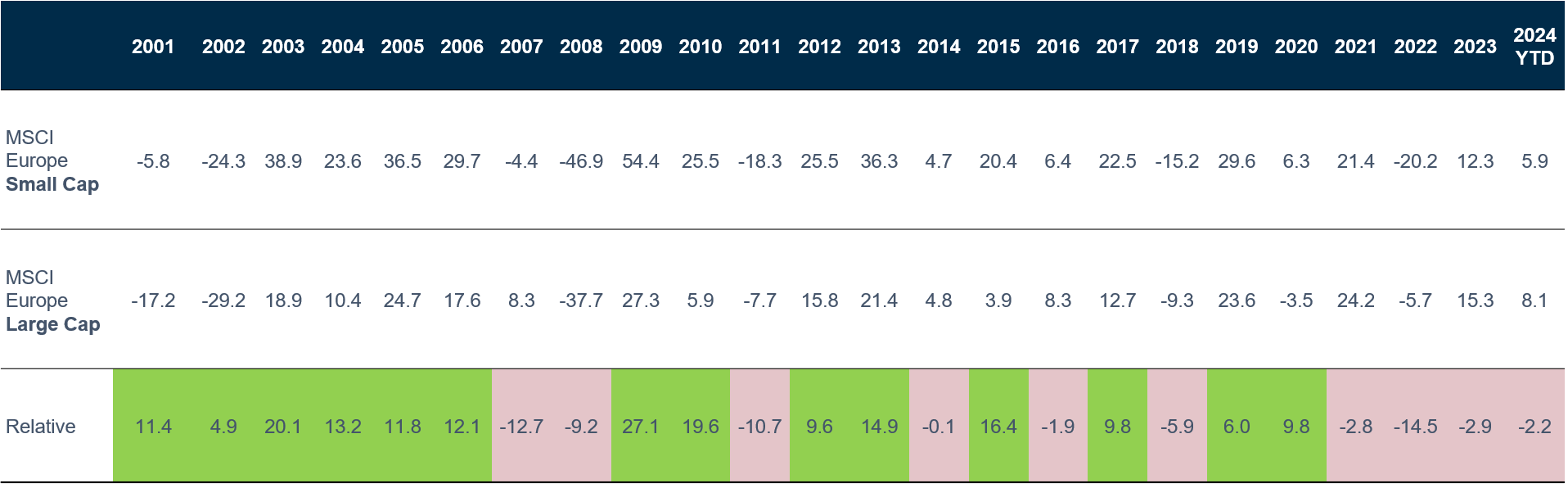
But, the chart below may convey this message more clearly.
European small caps have outperformed large caps in 14 of the last 23 years
Source: Refinitiv DataStream, Janus Henderson Investors Analysis, in Local currency, as at 11 November 2024. Note: Indices used: European Small Caps = MSCI Europe Small Cap Index, European Large Caps = MSCI Europe Large Cap Index, US Equities = S&P 500 Index. Rebased to 100. Past performance does not predict future returns.
The green years are those when European smaller companies outperformed their larger peers. The red are those when they have not.
The first, and most obvious, question this chart throws up is: why have smaller companies done so much worse in the last half decade than they did in the rest of this period?
An extended stretch of ultra-low interest rates were immediately succeeded in 2021 by a period of significant economic uncertainty, a distinctly unfavourable environment for smaller companies. As markets fall and economic growth falters, smaller companies are often the first to suffer. However, historically smaller companies have also been the first to rebound as both markets and economies recover – food for thought.
Investing in European smaller companies
When it comes to investing in smaller companies, for us the chart above sends an even clearer message. That is, that the investing context of the next 2, 5 or 10 years is hard – or impossible – to predict. Rather than attempt to do this, we opt instead to look at individual companies, what they do and how they do it.
We consistently invest in a broad spread of smaller businesses, having examined their finances, operations and management in detail. Our emphasis is on businesses that generate cash: i.e. they sell things or services and actively make money from them. We also look for cases where that profile is underappreciated by the market. These can be in their first years of existence or long-established companies experiencing a turnaround – or indeed anywhere in between.
Most importantly, these companies often operate in niches untouched by their larger peers, making them a unique investment.
Click here to find out more about The European Smaller Companies Trust
Diversification
A way of spreading risk by mixing different types of assets/asset classes in a portfolio, on the assumption that these assets will behave differently in any given scenario. Assets with low correlation should provide the most diversification.
Large caps
Well-established companies with a valuation (market capitalisation) above a certain size, eg. $10 billion in the US. It can also be used as a relative term. Large-cap indices, such as the UK’s FTSE 100 or the S&P 500 in the US, track the performance of the largest publicly traded companies, rather than all stocks above a certain size.
Small caps
Companies with a valuation (market capitalisation) within a certain scale, eg. $300 million to $2 billion in the US, although these measures are generally an estimate. Small cap stocks tend to offer the potential for faster growth than their larger peers, but with greater volatility.
Portfolio
A grouping of financial assets such as equities, bonds, commodities, properties or cash. Also often called a ‘fund’.