Key takeaways:
- Rapid growth in margin debt relative to mortgage and credit card debt is signaling increased speculation and potential risk within financial markets.
- Deglobalization is contributing to renewed inflation pressure as core import prices rise faster than core U.S. consumer prices.
- Opportunities are broadening beyond recent market leaders, with compelling growth across global equities and non-U.S. stocks outperforming venture capital over roughly the past five years.
This summer has seen the return of blockbuster movies. We have also witnessed some “blockbuster” returns, both positive and negative, for investors.
But a Siren Song of quick, riskless, and sizable returns seems to be luring portfolios toward the rocks. Investors may need to put wax in their ears to block out the noise (note the Odyssey reference!).
Here are five no-noise charts to peruse under an umbrella on the beach before napping. Enjoy the remainder of the summer, everyone!
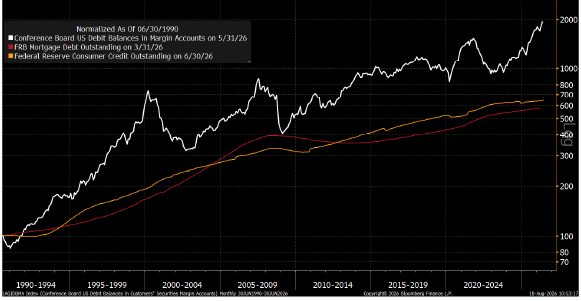
1) Margin debt is growing faster than mortgage or credit card debt!
Monetarist theory suggests that abnormal credit creation precedes abnormal price appreciation. We tend to think of that rule within the context of bank lending, the real economy, and price inflation. However, abnormal credit creation can also lead to abnormal financial markets. Might we have that situation today?
Margin debt, as it has during other speculative periods, is growing considerably faster than either credit card debt or mortgage debt.
Maybe the Federal Reserve (Fed) should consider hiking margin requirements instead of the fed funds rate?
Exhibit 1: Margin debt growth vs. mortgage and credit card debt(June 1990 – June 2026)
Source RBA/JHI, Bloomberg Finance L.P.
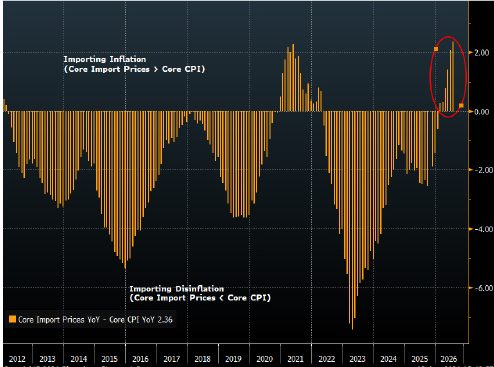
2) The U.S. is importing inflation!
Our long-standing deglobalization theme continues to manifest in the global economy and is now contributing to U.S. inflation.
Globalization was perhaps the primary cause of secular disinflation, because globalization opens markets and increases competition. Basic economics states that increasing competition results in lower prices, and roughly 30 years of increasing globalization accordingly led to secular disinflation.
Deglobalization now seems well underway, which means markets are being closed, competition is decreasing, and less competition is resulting in higher prices.
During globalization, economists suggested the U.S. was “importing disinflation” because Core Import Prices were rising more slowly than was the Core U.S. Consumer Price Index (CPI). Today, the reverse is true, and the U.S. is now importing inflation. Core import prices are rising faster than the Core CPI.
Exhibit 2: Core Import Prices YoY – Core CPI YoY (December 2011 – August 18, 2026)
Source RBA/JHI, Bloomberg Finance L.P.
3) You can only find growth in the U.S. WRONG!!!
The favorable story for non-U.S. stocks has long been that they are cheaper than U.S. stocks, but there was not a compelling growth story to accompany that undervaluation. Today, there is one.
There are presently about two hundred companies around the world that have projected long-term earnings growth rates of 25% or more. Interestingly, only one of the Magnificent 7 companies passes that screen, and analysts are now forecasting strong secular profits growth for companies in the broader U.S. market, in developed markets, and in emerging markets.
Investors’ continued significant underweight to non-U.S. stocks suggests a meaningful investment opportunity.
Exhibit 3: ACWI long-term consensus EPS growth estimates >25%