Key takeaways:
- As advisor teams work to meet clients’ expectations while facing increasing administrative pressure, many find themselves struggling to do more with less.
- Artificial intelligence can amplify a team’s intelligence and efficiency, but it’s important to understand that not all AI works the same way. Knowing when to use which form of AI is key to unlocking performance.
- AI isn’t about replacing advisors; it’s about amplifying their intelligence, efficiency, and ability so they can focus their time where it leads to the strongest results – namely, connecting with clients in meaningful conversations. The advisory teams that thrive in the next decade will be those that adopt AI not as a novelty but as an operational, relational, and strategic asset.
Wealth advisory teams face an escalating challenge: Clients expect highly personalized, responsive, sophisticated guidance, yet teams operate under growing administrative, compliance, and operational pressure.
At the same time, the traditional playbook of “doing more with more people” is being rewritten. Today, high-performing advisory teams must do more with less, which means seeking ways to be more efficient and consistent in how they deliver service and address clients’ financial planning needs.
One potential solution to this conundrum is the ubiquitous force that has been taking industries and businesses around the world by storm recently: Artificial intelligence (AI).
Embracing change: View AI as a teammate, not a threat
Change is never easy, but avoiding it comes at a cost. The future belongs to advisory teams that approach AI as a teammate, not a threat. The next era of advisory teams will be defined not by technology alone, but by leaders who use AI to think more strategically, adapt more quickly, and connect more meaningfully. In contrast, the teams that hesitate will watch others gain speed while they fall behind.
Partnering with AI now ensures your team stays competitive, relevant, and ready for the expectations of tomorrow’s clients. The key is to start small, stay curious, and build confidence, one workflow at a time.
Two types of AI: Configured agents vs. adaptive AI
Implementing AI can amplify your team’s intelligence, consistency, and efficiency. But it’s important to understand that not all AI works the same way.
Configured agents are built to lock in consistency and scale your team’s best practices. Adaptive AI can help you think faster, explore ideas, and solve problems in real time. They’re both powerful, but for completely different reasons.
Knowing when to use which form of AI is key to unlocking performance. To help you make that determination, here are some of the main uses of both configured agents and adaptive AI.
Configured agents (e.g., Copilot Studio)
Agents are reusable digital teammates trained on your team’s documents, standards, workflows, guardrails, and voice. Use them when the team needs:
- Consistency
- Reliability
- Compliance-safe outputs
- Standardized best practices
- Clear workflows
- Repeatable client experience
- Teamwide alignment
Adaptive AI (e.g., Copilot for M365 / ChatGPT)
Adaptive AI is free-form, conversational, and creative. Use it when the team needs:
- Brainstorming
- Drafting emails
- Summarizing documents
- Rewriting for tone
- Creative prompts
- Exploratory thinking
Configured agents vs. adaptive AI
Adaptive AI helps you explore and create, while configured agents help you standardize and scale.
| Category | Configured Copilot Agent | Adaptive AI |
| Purpose | Standardize workflows | Respond flexibly to prompts |
| Setup required | Yes, configure with documents | None, just start prompting |
| Ties to team content | Yes, curated knowledge base | Only when manually added |
| Consistency | Very high | Variable |
| Compliance safety | Strong guardrails | Dependent on prompt |
| Best for | Meeting prep, SOPs, sponsor insights | Drafting, rewriting, brainstorming |
| Team alignment | Excellent | Limited by user |
| Rule of thumb | Build for consistency | Prompt for creativity |
Human + AI partnership model
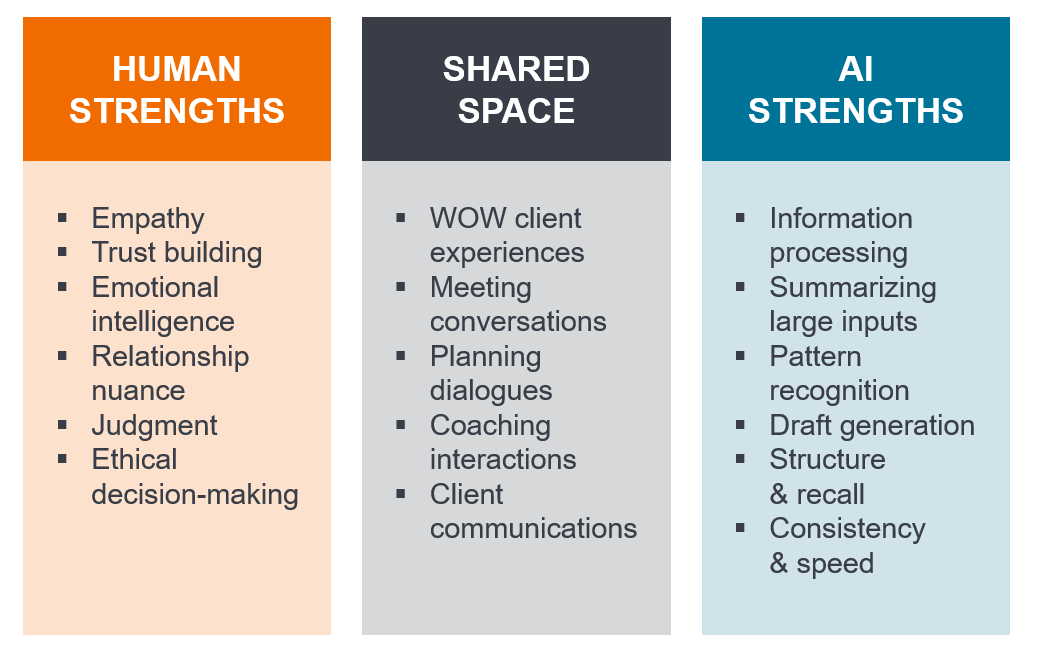
The human + AI partnership graphic below illustrates a simple reality: Teams that try to push through complexity on their own risk falling behind those that use AI to create clarity.
AI handles the structure, speed, and information load so advisors and their teams can stay focused on what matters: Understanding clients’ needs and goals and creating a real connection. When both sides of the partnership come together, teams can have clearer conversations, make better decisions, and deliver a client experience that consistently stands out.
Compliance, governance, and firm alignment
AI can accelerate your team’s performance, but it must operate within your firm’s compliance framework. Before publishing or broadly sharing any Copilot agent, teams should confirm that the agent’s instructions, outputs, and connected documents align with firm policies and regulatory expectations. AI doesn’t remove compliance risk; it simply changes where the risk shows up.
Always partner with your firm’s Compliance Officer, Supervisory Principal, or designated governance leader early in the process. Share your agent’s system instructions, guardrails, sample outputs, and knowledge sources so they can provide guidance on required language, restricted topics, or documentation standards. This step not only protects the team; it also builds confidence that your AI tools are safe, aligned, and ready for client-facing work.
Finally, treat compliance as a continuing partnership and not a one-time check. Policies evolve, new documents replace older ones, and workflows change. Regular reviews, either quarterly or at least twice a year, will ensure your agents remain accurate, current, and compliant. When AI, advisory teams, and compliance work together, the result is a more consistent, confident, and future-ready client experience.
Getting started with agents
Every team operates differently, and you can build agents around any repeatable process where clarity, consistency, or efficiency matters. Start with the agents that make the biggest difference in your day-to-day work, then expand as your team’s confidence and creativity grow.
Some examples of where agents can streamline processes include:
- Client meeting prep and debriefing (annual reviews, volatility, onboarding)
- Client experience (milestones, life transitions)
- Operations and workflow (onboarding, transfers)
- Talent development and coaching (reviews, development, succession planning)
Beyond these examples, teams often create agents for compliance review prep, marketing content outlines, internal huddle agendas, prospect qualification, and new-hire onboarding.
Step by step: How to build a Copilot agent
Building a Copilot agent isn’t complicated; it’s a practical, repeatable process that any team can learn. By following the steps below, you can convert your best workflows into digital teammates that bring clarity, consistency, and speed to your day-to-day work. Start here to build agents that support your team within minutes.
STEP 1 — Prepare
- Pick ONE job
- Assign an AI Champion
- Gather 1–3 core documents
STEP 2 — Access Copilot Studio
Open → Create → Blank agent
STEP 3 — Name the Agent
Choose clear, functional names:
- “Meeting Prep Copilot”
- “Sponsor Intel Copilot”
STEP 4 — Write System Instructions
Include:
- Role definition
- Tone
- Guardrails
- Formatting expectations
STEP 5 — Connect Knowledge Sources
Upload files → connect SharePoint → confirm access
The future-ready advisory team
AI isn’t about replacing advisors; it’s about amplifying their intelligence, efficiency, and ability so they can focus their time where it leads to the strongest results – namely, connecting with clients in meaningful conversations. The advisory teams that thrive in the next decade will be those that adopt AI not as a novelty but as an operational, relational, and strategic asset.
AI-enabled advisory teams:
- Enter every client meeting prepared, calm, and focused
- Communicate with warmth, clarity, and precision
- Deliver personalized WOW experiences effortlessly
- Operate with fewer errors and greater internal trust
- Use time intentionally on planning, coaching, and client depth
- Turn tribal knowledge into scalable team systems
- Build stronger plan sponsor and COI partnerships
- Move faster, think deeper, lead better
AI raises the floor so advisors and their teams can raise the ceiling. Your culture, your empathy, and your leadership remain the differentiator. AI simply makes them scalable.
Artificial intelligence (“AI”) focused companies, including those that develop or utilize AI technologies, may face rapid product obsolescence, intense competition, and increased regulatory scrutiny. These companies often rely heavily on intellectual property, invest significantly in research and development, and depend on maintaining and growing consumer demand. Their securities may be more volatile than those of companies offering more established technologies and may be affected by risks tied to the use of AI in business operations, including legal liability or reputational harm.