

Key takeaways:
- The healthcare sector entered the 2026 J.P. Morgan Healthcare Conference on solid footing, with sentiment buoyed by fading policy concerns, a steady regulatory backdrop, and solid share price performance across the sector in the back half of 2025.
- Despite the lack of blockbuster deals announced during JPM week, M&A remained a defining theme, with sustained strategic interest across biopharma and medtech reinforcing the scarcity value of high‑quality growth assets.
- After several years of policy- and macro‑related disruptions, the tone at JPM26 reflected a more normalized operating environment, with companies refocusing on innovation, pipelines, and execution – all of which supports our constructive view of the opportunities ahead in 2026.
For over 25 years, members of the Healthcare Team have attended the annual J.P. Morgan Healthcare Conference, a week-long event that takes place every January and helps set the tone for the sector for the coming year. Our calendars were once again booked from morning to night, attending company presentations and meeting with roughly 300 executives and industry leaders. Here, we share some highlights and takeaways from the week.
Overview
Improved sentiment matched by increasingly constructive sector backdrop
Andy Acker and Dan Lyons
JPM week arrived with clear and sunny skies in San Francisco for a second straight year, a welcome departure from the rainy conferences of the prior two years. This time, the gorgeous weather was matched by a notably more upbeat mood on the ground. Whereas last year’s conference came on the heels of a sharp sector selloff, healthcare – and biotech in particular – enjoyed a sustained rally in the back half of 2025, recovering from a weak start to the year and outperforming all other sectors in the fourth quarter.
As we discussed in our 2026 outlook, several factors contributed to that strength. As the year progressed, investors gained clarity on drug pricing reform and now see a path around onerous pharmaceutical tariffs. The Food and Drug Administration (FDA) proved its support for a strong U.S. biopharma industry, largely meeting review deadlines in 2025 and introducing new programs to accelerate drug approvals. This, combined with falling interest rates, helped reignite mergers and acquisitions (M&A), setting the stage for a more constructive backdrop heading into JPM26.
With policy headwinds fading, M&A and innovation take center stage
Given the deal momentum into year end, the notable lack of blockbuster biopharma M&A announcements at this year’s conference received some attention. We view this more as a function of timing rather than any harbinger for the year ahead. More likely, the flurry of large‑scale deals at the end of 2025 left fewer ready‑to‑sign transactions queued up for early January. We continue to expect 2026 will be an active year for strategic M&A across the sector – a view reinforced by comments from big pharma executives who signaled strong appetite for strategic acquisitions. The final day of the conference also brought Boston Scientific’s $14.5 billion bid for Penumbra, underscoring the scarcity and value of high‑quality growth assets in medtech.
In some ways, this year’s conference felt like a return to more normal times for the sector. Following years of disruption from COVID, inflation, tariffs, and policy volatility, the improved environment shifted the focus back squarely on innovation. Companies delivered a steady stream of pipeline updates and pre-announcements, with more attention on clinical progress, upcoming data readouts, and launch execution than on macro headwinds. While leadership changes at the FDA still bear watching, the regulatory backdrop has proven more stable than many feared, and several biotechs highlighted strengthened alignment with the agency on pivotal trial designs and approval pathways.
Coupled with improved sentiment heading into the conference and the constructive meetings held by each member of our team, this renewed focus on innovation left us incrementally more excited about the prospects for new treatments and the sector’s trajectory in 2026.
Pharmaceuticals
Renewed willingness to spend; potential treatment paradigm changes on the horizon
Having emerged from the heightened uncertainty that dominated early 2025, management teams arrived at this year’s conference with greater clarity on the policy front and an industry on much stronger footing. With improved confidence in the rules governing the sector, big pharma companies are signaling renewed willingness to spend, with conversations once again centered on pipelines and strategic investments.
Following the massive success of injectable GLP-1 therapies, 2026 is shaping up to be the “year of the pill”, with several companies advancing next‑generation oral formulations designed to broaden access and capture the next leg of category growth. Beyond obesity, we also see multiple therapeutic areas where innovation is poised to reshape treatment paradigms over the coming years.
In immunology, Phase II data from inflammatory bowel disease (IBD) combination readouts from Johnson & Johnson and AbbVie this year could have important implications for companies developing next‑generation therapies. In oncology, important data are expected on new regimens aimed at moving beyond the long‑standing checkpoint‑inhibitor‑plus‑chemotherapy standard, with implications for AstraZeneca, Merck, and others. And neuroscience is emerging as the next frontier, with new therapies targeting Alzheimer’s prevention, Alzheimer’s‑related psychosis, and depression among the more notable areas to watch this year and into 2027.
For investors, we would focus on companies with improving earnings visibility supported by maturing pipelines and high‑probability readouts. As always, near‑term catalysts require careful assessment of expectations, but the overall setup for pharmaceuticals in 2026 is increasingly constructive.
Biotechnology
Steady deal appetite and a full slate of 2026 clinical milestones
While biotech M&A headlines were on the quieter side this year, the tone from industry leaders at JPM26 gave no indication that the strong deal momentum exiting 2025 is abating. Bankers remain active, year‑end financing was robust, and big pharma executives signaled they have both the means and the appetite to pursue strategic acquisitions. At the conference, Merck’s CEO reiterated the company’s willingness to pursue transactions “in the multi‑tens‑of‑billions of dollars,” while Bristol Myers Squibb’s CEO pledged to “cast a broad net,” emphasizing that business development remains a top priority.
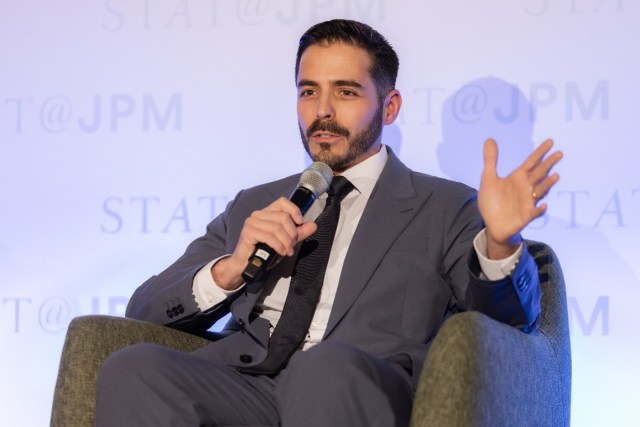
Agustin Mohedas participating in a panel hosted by STAT News at the 2026 J.P. Morgan Healthcare Conference. Photo by Sarah Gonzalez
What stood out more for us was the quality of conversations we had with management teams. Many companies enter 2026 with cleaner balance sheets and clearer paths to late‑stage readouts, setting the stage for a catalyst‑rich year. On the regulatory front, the FDA’s 2025 approval activity remained broadly consistent with historical averages, helping support planning across the sector. While there has been no meaningful deterioration to date, a handful of FDA review deadlines have recently been extended – something we will continue to monitor.
In CNS (central nervous system) disorders, several programs are approaching important data, including late‑stage readouts in essential tremor and regulatory‑stage activity across other epilepsy and mood‑disorder indications. Companies also highlighted meaningful progress in next‑generation oral immunology programs, where emerging psoriasis and IBD agents are moving toward broader Phase II and Phase III readouts in a space that could support multiple large commercial opportunities over time.
Rare disease and respiratory programs are another focal point, with key programs in pulmonary hypertension, idiopathic pulmonary fibrosis (IPF), and transthyretin (ATTR) amyloidosis moving toward important updates. Vaccine and infectious‑disease platforms are also progressing, particularly efforts aimed at broader‑coverage pneumococcal vaccines with adult and pediatric data expected to build through 2026.
Taken together, the depth of upcoming data, strong funding backdrop, and sustained strategic interest from large pharma leave us upbeat on biotech’s prospects for 2026.
Medtech, life science tools, and managed care
Medtech: Innovation and demographic tailwinds support a constructive outlook
Medtech companies came to this year’s conference with an industry on solid footing. Innovation remains robust, and numerous products and markets are early in their life cycle, paving the way for significant growth potential. Among key watchpoints, companies are contending with potential coverage‑related headwinds tied to the expiration of Affordable Care Act exchange subsidies and Medicaid work requirements. However, given the importance of healthcare to voters ahead of midterm elections, it’s possible these impacts could be dampened.
It is worth noting that third-party data released during JPM week pointed to softer utilization trends at the end of 2025, which raised some questions about the strength of the operating environment. However, subsequent large‑cap earnings have suggested procedure volumes remained resilient, helping ease concerns around underlying demand. We believe demographics are creating a multi-year tailwind for procedural volumes, driven by the growing number of baby boomers reaching age 75, a point at which healthcare consumption typically doubles compared to age 65.
In our view, the backdrop remains supportive, with plenty of opportunities for investors to be selective across the medtech landscape, especially with valuations below historical averages.
Life science tools: Improving end markets, coupled with normalized valuations, support a balanced view
In life science tools, end markets have improved meaningfully over the past six months. Biopharma and biotech spending is recovering, academic and government demand is stabilizing, and reshoring efforts offer an incremental tailwind. Bioprocessing remains a bright spot, with consumables strengthening and early signs of a turnaround in equipment. That said, following recently strong share price performance, valuations have risen, arguing for a measured approach to investing across the group.
Managed care: Rate surprise resets the path to margin recovery, yet depressed multiples create select opportunities
Heading into the conference, managed care leaders had grounds to be cautiously optimistic toward the year ahead, with signs of stabilization across Medicare Advantage and the potential green shoots in Managed Medicaid. Conversations we had during the conference supported this view. Industry margins in both government end markets (Medicare Advantage & Managed Medicaid) remain negative – a rare occurrence and one we view as unsustainable.
Against this backdrop, management teams noted that benefit cuts implemented for 2026, alongside utilization‑management initiatives, should help margins begin to rebuild from historically low levels. This, along with signs of cost trend normalization and depressed multiples across the group, gave reason for optimism for an out-of-favor subsector.
However, the landscape shifted meaningfully with the preliminary 2027 Medicare Advantage rate notice released on January 26, which came in essentially flat and well below expectations, weighing on managed care stocks. Time will tell if this reflects the administration’s willingness to use healthcare as a “pay for” to offset fiscal pressures or whether it represents an opening bid to draw managed care companies to the bargaining table, similar to the approach with big pharma in 2025.
In the near term, a lower‑than‑expected rate reduces the margin for error and delays the potential margin normalization for the sector. Plans will likely need to rely more heavily on benefit reductions, tighter utilization management, and coding practices heading into 2027 to offset the shortfall. But there are limits to how much each of these levers can be pulled, which means profit margins could come under pressure in 2027.
Importantly, CMS (Centers for Medicare & Medicaid Services) rates typically improve between the initial and final announcements, and there remains a possibility of a meaningful upward revision in the spring.
Still, with healthcare comprising 18% of U.S. GDP and bipartisan support for improving affordability, policy-driven risk remains across the entire healthcare ecosystem – not just for managed care. That said, given depressed valuations and the opportunity for significant margin recovery in 2026, we believe selective opportunities remain in a challenging subsector.
IMPORTANT INFORMATION
Diversification neither assures a profit nor eliminates the risk of experiencing investment losses.
Equity securities are subject to risks including market risk. Returns will fluctuate in response to issuer, political and economic developments.
Health care industries are subject to government regulation and reimbursement rates, as well as government approval of products and services, which could have a significant effect on price and availability, and can be significantly affected by rapid obsolescence and patent expirations.