
Key takeaways:
- A wide and unusual gap between single-stock and index volatility is making options on individual stocks pay more than options on the S&P 500 right now.
- That gap gives investors room to be selective by writing against fewer positions to potentially preserve upside and letting dividend yield flex with changing market conditions.
- Writing options stock by stock, not at the index level, enables investors to adapt to shifting valuations and volatility rather than applying the same overlay regardless of conditions.
Look at the broad market this year, and volatility seems unremarkable. Look underneath it, however, and a different picture emerges: Individual stocks are swinging sharply.
That gap reshapes how much income an options overlay can generate, particularly for active enhanced-income strategies with the flexibility to write calls at the stock level. We believe it’s one of the more important, and underappreciated, features of the current market.
A widening volatility divide
Stocks have been increasingly trading on their own stories rather than moving in lockstep. Some of the largest companies in the market have moved 10%, 15%, even 20% in a single day, often with no earnings news to explain it. For well-established companies to move that sharply outside of earnings season is rare by historical standards.
The result is that writing calls on individual stocks presently pays more than writing against the S&P 500® Index. The implied volatility priced into broad index options (black line, Exhibit 1) versus single-stock options (orange line) reflects an unusually wide spread, and the implied correlation between individual stocks — the degree to which the market expects them to move together — sits near historic lows (Exhibit 2).
Exhibit 1: S&P Top 50 vs. S&P 500 Index implied volatility
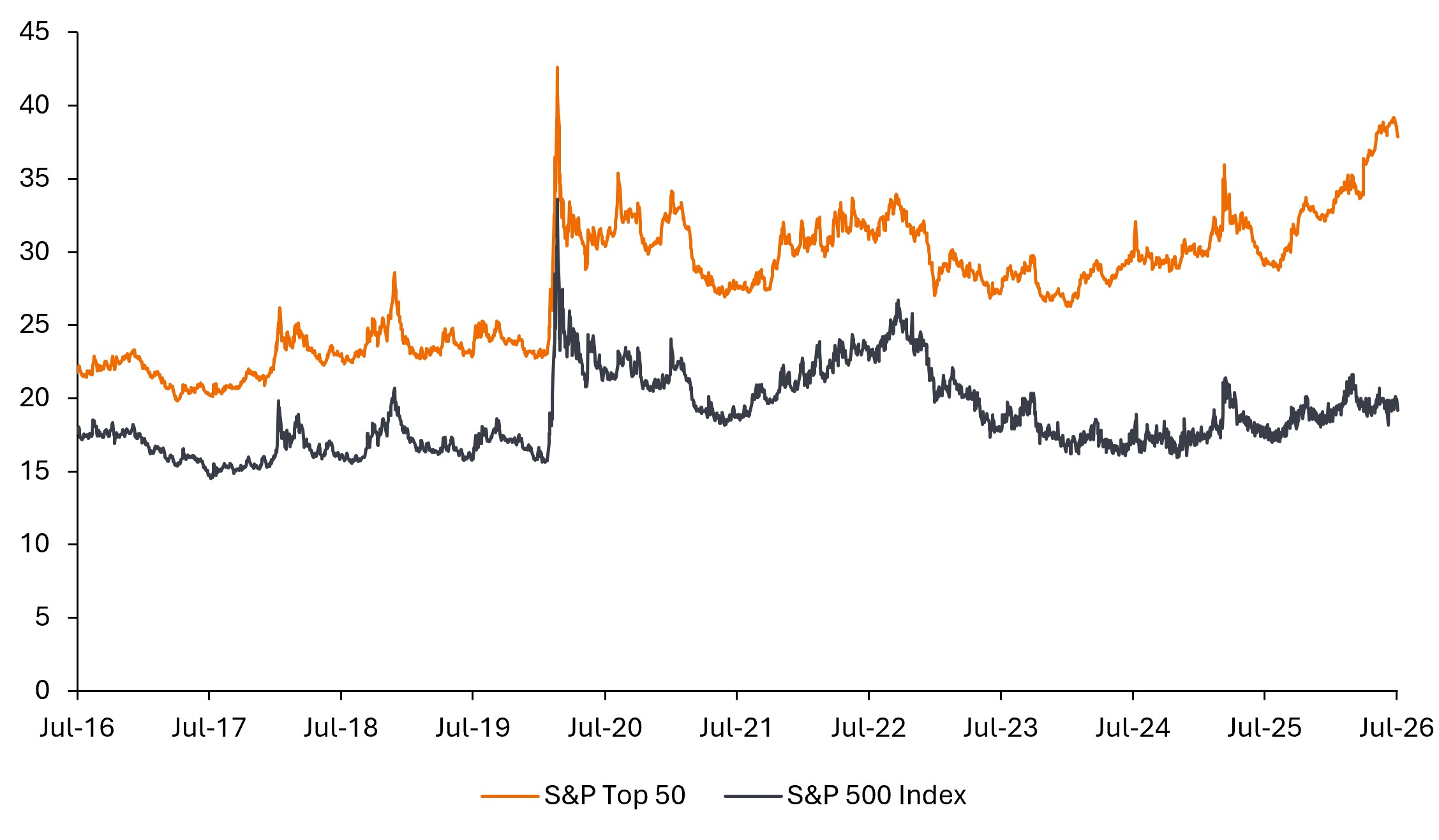
Source: Janus Henderson Investors, Bloomberg. Daily values from 29 July 2016 to 31 July 2026. S&P Top 50 takes the cross-sectional weighted average volatilities of the top 50 S&P 500 Index constituents. Implied volatilities are 2-year at-the-money.
Exhibit 2: Implied correlation
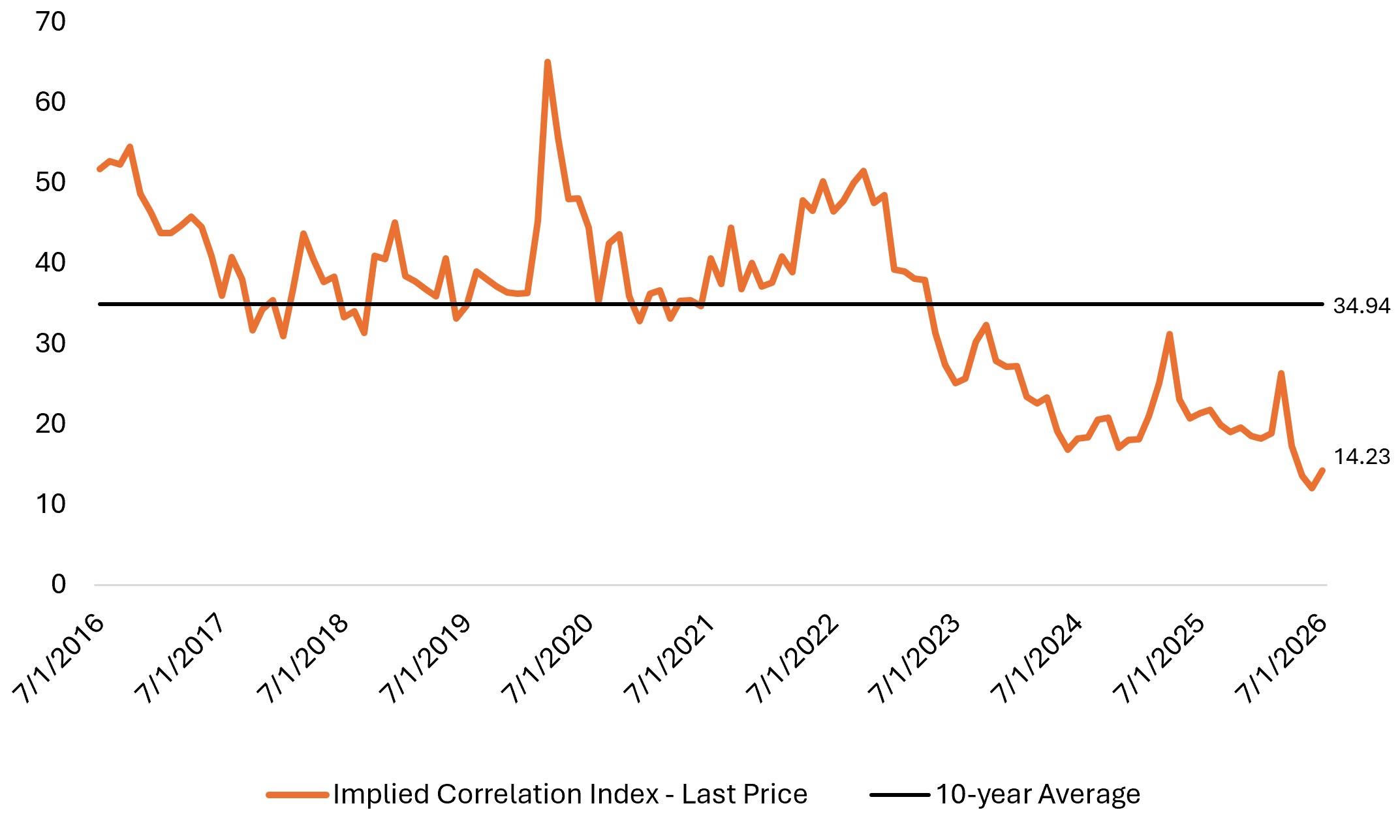
Source: Bloomberg. Monthly values from 29 July 2016 to 31 July 2026. The Implied Correlation Index measures estimates of expected correlation using implied volatilities of SPX index and top 50 component options.
A couple of forces appear to be driving this. The rise of thematic trading — money moving in and out of single-stock ETFs, semiconductor baskets, and other narrow vehicles — is fueling outsized moves in individual names. At the same time, the rapid growth of covered-call and options-income strategies, most of which are built around S&P 500 Index writing, has placed persistent selling pressure on index volatility, compressing it further relative to what’s happening underneath.
That gap matters for how we think about actively managing income generation and portfolio construction.
Richer premiums let us fine-tune the option overlay
For us, fundamentals come first: The decision to own a company comes before the decision to write an option against it. That means starting with high-quality businesses that are selected for their ability to sustain dividends and deliver capital appreciation over time.
From there, how much to write shifts with valuation. Stocks trading well below fair value tend to see less option overlay, which could help preserve upside. As a stock approaches fair value, writing more against it can make sense, since less appreciation is likely being left on the table.
Richer premiums give active managers room to be selective by writing against a smaller share of holdings to generate the same income while preserving upside potential elsewhere. That same selectivity also extends to the terms. Unlike systematic strategies that apply a uniform overlay regardless of conditions, an active strategy manages strike prices, expiration dates, and the percentage of each position overwritten.
This flexibility has been valuable recently. As AI-infrastructure stocks surged earlier this year, active managers could reduce overwriting there to participate in the rebound. As defensive sectors like consumer staples and regulated utilities rallied closer to fair value, they became better candidates for harvesting higher premiums through selective call writing.
The same flexibility extends to dividend yield
Similar to the options overlay, dividend yield may be treated as an adjustable input, not a fixed target. Because elevated single-stock volatility has meant richer option premiums, options income has done more of the work toward yield targets, without leaning as heavily on dividend payers to get there.
That flexibility works both ways. Earlier this year, adding higher-beta names after a period of market weakness made sense: Valuations were more attractive in late March, and those stocks carried rich option premiums. But concentrating too heavily in those names, even for the income benefit, can leave a portfolio more exposed to a pullback.
As markets recovered in the second quarter from the earlier weakness, adding to dividend-paying names helped investors manage that risk. The larger point is that yield can lean lower when the environment favors capital appreciation and higher when income needs to carry more weight.
Turn off autopilot
Income generation today is less about a fixed formula and more about responding to where volatility and valuation actually sit. In our view, single-stock volatility, not the index, is the signal that matters most for option income right now, and a uniform, index-based approach risks leaving that opportunity on the table.
Beta measures the volatility of a security or portfolio relative to an index. Less than one means lower volatility than the index; more than one means greater volatility.
Correlation measures the degree to which two variables move in relation to each other. A value of 1.0 implies movement in parallel, -1.0 implies movement in opposite directions, and 0.0 implies no relationship.
Implied Correlation Index is a financial benchmark that measures expected correlation using implied volatilities of SPX index and top 50 component options. The index is calculated using Cboe Hanweck 1Y 50 Delta constant maturity delta relative implied volatilities.
Premium/Discount indicates whether a security is currently trading above (at a premium to) or below (at a discount to) its net asset value.
S&P 500® Index reflects U.S. large-cap equity performance and represents broad U.S. equity market performance.
Strike prices are the specified prices at which the holder of an options contract can buy (call) or sell (put) the underlying asset.
Volatility measures risk using the dispersion of returns for a given investment.
Yield: The level of income on a security over a set period, typically expressed as a percentage rate. For equities, a common measure is the dividend yield, which divides recent dividend payments for each share by the share price. For a bond, this is calculated as the coupon payment divided by the current bond price.
IMPORTANT INFORMATION
Actively managed portfolios may fail to produce the intended results.
Any yield management process discussed includes an effort to monitor and manage yield which should not be confused with and does not imply the ability to control yield.
Derivatives can be more volatile and sensitive to economic or market changes than other investments, which could result in losses exceeding the original investment and magnified by leverage.
Covered call strategies can limit the ability to benefit from increases in the market value of the underlying securities because upside potential is capped by the option’s strike price. While option premiums can help offset declines, they may not fully protect against losses, and option exercises can result in selling securities at times that may not be advantageous.
Dividend-oriented stocks that have paid regular dividends to shareholders may decrease or eliminate dividend payments in the future. A decrease in dividend payments by an issuer may result in a decrease in the value of the security.
Equity securities are subject to risks including market risk. Returns will fluctuate in response to issuer, political and economic developments.
Options may be difficult to trade under certain market conditions, and imperfect correlation between an option and its underlying securities can reduce the effectiveness of an options strategy.