
Alternatively, watch a video of the recording:
Key takeaways:
- AI‑driven electricity demand is transforming the utilities and energy landscape, with expected multi‑gigawatt data‑center expansion creating structural tailwinds for select operators.
- Financials are beginning to capture real productivity gains from AI, improving software development, client service, and operational efficiency across global franchises.
- Rate shifts and policy developments are influencing sector outlooks, highlighting the value of bottom‑up research in identifying companies best positioned for 2026 and beyond.
IMPORTANT INFORMATION
Actively managed portfolios may fail to produce the intended results. No investment strategy can ensure a profit or eliminate the risk of loss.
Artificial intelligence (“AI”) focused companies, including those that develop or utilize AI technologies, may face rapid product obsolescence, intense competition, and increased regulatory scrutiny. These companies often rely heavily on intellectual property, invest significantly in research and development, and depend on maintaining and growing consumer demand. Their securities may be more volatile than those of companies offering more established technologies and may be affected by risks tied to the use of AI in business operations, including legal liability or reputational harm.
Energy industries can be significantly affected by fluctuations in energy prices and supply and demand of fuels, conservation, the success of exploration projects, and tax and other government regulations.
Financials industries can be significantly affected by extensive government regulation, subject to relatively rapid change due to increasingly blurred distinctions between service segments, and significantly affected by availability and cost of capital funds, changes in interest rates, the rate of corporate and consumer debt defaults, and price competition.
Definitions
10-Year Treasury Yield is the interest rate on U.S. Treasury bonds that will mature 10 years from the date of purchase.
Duration measures a bond price’s sensitivity to changes in interest rates. The longer a bond’s duration, the higher its sensitivity to changes in interest rates and vice versa.
View transcript
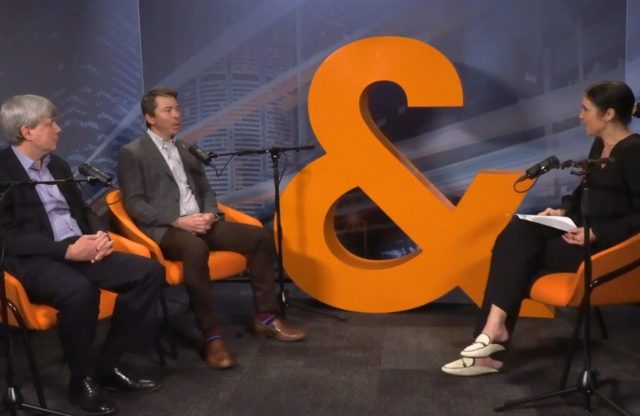
Lara Castleton: Hello, and thank you for joining this episode of Global Perspectives, a Janus Henderson podcast created to share insights from our investment professionals and the implications that they have for investors. I’m your host for the day, Laura Castleton.
For years, equity market leadership was narrow, with just seven stocks dominating returns. But 2025 may have marked the moment where equity broadening finally moved from theory to reality. As we record this just one month into 2026, two of the sectors driving headlines today are financials and energy. At Janus Henderson, we turn to our long-standing Research franchise to cut through the noise and understand what’s really moving markets today. So I am thrilled to be joined by John Jordan, Portfolio Manager and Financial Sectors Lead, And Noah Barrett, Energy and Utility Sectors Lead. Gentlemen, thank you both for being here.
Noah Barrett: Thanks for having us.
Castleton: So, I want to get an overall outlook from both of you in terms of where you did see sector broadening and winning within your respective spaces from 2025 and maybe where you see the start of 2026 shaping up. Noah, let’s just start with you.
Barrett: Yeah, so 2025, the energy sector materially underperformed the broader market. It was still up in absolute terms, so it was a win, but relative to the market indexes, it was a relative loser. Utilities did a little bit better but still lagged the broader market. If we look into 2026, flipping that calendar, things have changed remarkably for the energy sector. It’s one of the best performing sectors in the market, materially outperforming the broader index. And utilities are hanging in there, doing about, you know, in line with the market index.
Castleton: So, we’re going to talk a lot more about what’s going on within your sectors, but any notable shifts that you have seen since, you know, last year to this year being such a dynamic change?
Barrett: Yeah, so even though energy was an underperformer last year, there were pockets of relative outperformance by sub-sector. So, refiners did really, really well in 2025. This year, the leadership has been taken up by other sub-sectors. Oil services, historically, an area of stocks that have a lot of leverage to higher crude prices have done really, really well. In utilities, similar dynamics. Some of the winners in 2025, the independent power producers have gotten off to a slow start to begin this year, and the regulated utilities are doing a little bit better.
Castleton: Okay, very interesting. And John, if we shift to you, what about financials? 2025, how did they do broadly relative to the market, and where are you seeing leadership in 2026?
John Jordan: Yeah, financials had a good year, particularly in a global context in terms of stock performance. I’d call out, outside the U.S., European banks, which had a stellar year from both a financial perspective and from a stock return perspective. In the U.S., I’d call out banks as well, as capital markets players that benefited from improved regulation, more capital return, and a robust capital markets environment.
Castleton: Great. So, I’m excited to go into some of the fundamental opportunities that you both are seeing. But before that, there is a clear theme that we’re always discussing, which is the Fed and interest rate policy going forward. So, we’re in an easing cycle. There are questions on how many rate cuts we’ll have in 2026, but at the moment, no material pricing of hikes. So how does interest rate cuts factor into both of your respective areas? Maybe again, start with you, Noah.
Barrett: Yeah, so the interest rate environment matters a lot more for utilities. Historically, it’s a more interest rate-sensitive sector. Falling rates are generally good for utilities; that’s for a couple reasons. First, these companies rely on a lot of debt financing. So lower rates means, you know, their cost to fund their CapEx programs is a lot lower. And they’re also income vehicles, so with lower rates, the dividend yields, the cash return that utilities provide may be more appealing for an income investor. So, if we’re set up for an environment of falling rates, that historically is an environment where utilities do well.
Castleton: And can you dissect … because we’ll get to this more with you, John, but it’s rates, we always talk about falling rates. It doesn’t mean across the yield curve. Does that matter for utilities, whether we’re talking short end, long end, how does that…?
Barrett: They issue data kind of across the spectrum. So, I would say generally just a lower-rate environment. It doesn’t really matter so much for, you know, very short-term debt versus longer dated debt.
Castleton: Great. So how does interest rates … they’re more directly tied, obviously, to financials, but maybe you can walk through the impact that you’re seeing within your respective spaces in the outlook?
Jordan: Absolutely. So maybe start with the short end of the curve and whether, and to what extent, we see more cuts. I think to the extent that we see more cuts, that’s generally constructive for significant areas of financials. That tends to bring a lower cost of capital, which is constructive for asset valuations and capital markets activity. I think we’ve talked some in the past about the importance of deposit-taking franchises, things like banks. And so, if we cut rates all the way to zero, that would be quite negative for those. It would decrease the value and the earnings that come from raising low-cost deposits. But if we’re just talking about a few rate cuts, you know, and we’re talking about interest rates that might be plus or minus 3%, I think that’s still a very constructive environment for banks and deposit franchises.
If we shift to the long end of the curve, you know, that does matter, in part for asset deployment by banks and other financials, but also, again, back to cost of capital and risk appetite. So, to the extent that 10-year yields, for example, come down, that could be a tailwind for mortgage refinancing, which is constructive for the consumer and for overall housing activity, [and] obviously a tailwind for the economy. I think we are watching if long-term rates were to respond differently and not come down at short-term rates and potentially rise. Obviously, there are significant fiscal deficits in the U.S. and in many countries globally. And so that’s something to watch. And if we saw 10-year rates rise significantly, that could be a concern for markets.
Castleton: That’s the big question for 2026, is hopefully we do see one or two more rate cuts on the short end, but we know since the Fed did start cutting that long end has gone up from there. So, we’ll see where the path of interest rates goes. That is very difficult to predict, hence why we are bottom-up fundamental investors.
So, if we can focus on what we can control, one of the biggest narratives, again, we’re benchmarking against from 2025 and before, is AI in general, which has, you know, in a lot of our conversations been associated with technology, but that’s not the case. So, I want to dig into … Noah, we’ll start with you. I want to hear a little bit about how you’re thinking of AI as obviously it pertains to energy and utility demand. How are you seeing opportunities in that space?
Barrett: Yeah, I mean, I could talk about this for hours. I think a couple of things may be important to frame, like the magnitude of what we’re talking about. So, we hear a cutting-edge AI data center or a data center campus; we’re talking now in the gigawatt-size range, not the megawatt-size range. And to put that in perspective, when we say, what does it mean to have one gigawatt of power? That’s enough power to supply 750,000 homes with electricity. So, if the next phase of the AI data center is a one- to two-gigawatt campus, we’re talking up to maybe one and a half million homes worth of power, you know, effectively a decent-sized city. So, this is a little bit uncharted territory.
And so, I think the question then naturally flips to, how are we going to supply all this power? Where does it come from? So, if you think about the U.S. grid, the generation capacity in the U.S., it’s about 1,300 gigawatts. But that number comes from peak load. So that generation is there to serve … periods where we have winter storms, everyone’s turning on their furnaces, drawing a lot of electricity, or in the summer, a heat wave when everyone’s turning on their air conditioning units. Generally, we run at much less than that than peak load. But there is a lot of latent capacity on the grid. And one of the questions that we’re trying to solve is, well, can data centers take advantage of that latent capacity and not influence peak power periods?
Where it gets really complicated is, most data centers like to run 24/7. So, if you connect a data center to the grid, it’s potentially adding to peak load. It’s not just using that latent capacity on the grid. So, there are a lot of clever solutions. One possible solution is demand response. And so, if you are a data center, maybe you run, you know, high 90% uptime, but when a winter storm hits or a heat wave hits, and we need electricity to power hospitals, schools, you know, more essential infrastructure, data centers will be asked to flex down. And it’s just unclear if that trade-off, if that works for a data center, or maybe they have to implement some type of backup power solution on site, whether that’s battery storage, small diesel engines, or turbines to provide power for those periods where the grid needs to divert electricity to more important sources.
Castleton: So, clearly a lot to be ironed out, but some interesting solutions underneath the hood that may be able to be deployed. Are there any numbers being floated around right now in terms of how much data center capacity is needed to be built?
Barrett: So again, a moving target. I think one thing that’s generally well recognized is that some of the headline numbers we see, the amount of projects that are in the queue, they call the interconnect queue, is wildly overstated. And so, there’s a lot of double counting, triple counting. People just want to get a project in there but maybe don’t really have that much hope of actually getting it developed. But even if we haircut that to what we think are realistic assumptions, it’s still … we’re talking in the 50 to 60 gigawatts of incremental power through the end of the decade. So again, putting that in…
Castleton: 1,300.
Barrett: Yeah. So, putting that into perspective, a large natural gas CCGT delivers about one gigawatt of power. So, to meet just AI demand, we’d have to build 60 of those in the next five years. That becomes a challenge for an industry that hasn’t had to deal with demand growth for effectively the last 20 years. It’s something that they’re grappling with.
Castleton: So, does that … how does that affect the investment process? Or just, that’s a huge tailwind in terms of the mismatch of demand and supply. Does that mean utilities all together, or are you doing work on it? You have to find the right ones.
Barrett: Yes, so I think we find the deregulated power markets really interesting. So, there’s a group of … I referred to them before, the IPPs, independent power producers. And these companies, because they’re unregulated, they could take advantage of some of the really strong demand signals that we’re seeing. Regulated utilities will participate, but as the name would imply, they’re regulated. And so we see the opportunity there. It’s really a duration game. So, they have a pretty formulaic EPS [earnings per share] growth rate formula plus a dividend, maybe gets you to a high single-digit, call it maybe even 10%, total return. And we think the development of AI, the buildout, the need for all this power, it just extends the duration of that EPS growth algorithm, which should argue for a higher multiple. So regulated utilities can win, but we see more opportunity in deregulated markets.
Castleton: Okay, very interesting. And in general, when talking with clients, there’s not much utilities represented in the broad passive indices anyway. So having this fundamental expertise where you can go in and pick the winners really helps our firm as a whole, being part of our research franchise.
So let me shift then to you, John, to talk about financials. So, completely different. Maybe intuitively, people don’t necessarily think exactly of the tie to AI as you would maybe utilities, but how are you seeing AI affect your sector broadly?
Jordan: Yeah, so I’d start with AI investment by financial companies, AI use by financial companies, and what we’re seeing in terms of how that impacts their operations and their earnings and financials. So, I think financials have been significant investors in AI for their own use. I think we’re still relatively early in use cases, but some of the use cases where we’re already seeing significant benefit are on the programming side. So, software programming, significant improvement in efficiency for internal software engineers, so more code, better code, faster code.
The second would be in customer service, where financial companies are utilizing AI to let AI do more of that and have less human intervention. A third area we’re seeing is really in the back office and operations, where AI is being used to streamline and automate more work processes and, you know, allow humans to focus on other higher value-added tasks.
And then the last thing I’d highlight is on the front office side. So, example here might be someone that’s calling on a series of clients using AI to make them better prepared for meetings, help them identify the most important clients to see on a particular day, and improve their overall efficiency and effectiveness.
Castleton: So, this is, I mean, it was 2022, I think, when ChatGPT came out. So we are now almost four years removed from that. So, it sounds like you are actually finally seeing the productivity gains coming through in meaningful ways within these financial companies. And is that a global story? Or, I’m assuming it’s also just, there are winners and losers in that space, right?
Jordan: Yeah. No, I think it is a global story. You know, I think certainly, for example, European banks are also talking about the ways in which they are using AI today to improve their efficiency and the effectiveness of their employees. So I do still think we’re in relatively early stages. Like, there are a lot of use cases that are still being tried out, but I think it’s generally a tailwind in terms of financial returns for the sector. We think that many different types of companies from different sub-sectors can benefit from AI. I’m talking within financials here, but certainly some of the biggest companies with the most modern tech stacks have been at the forefront of leveraging AI today.
Castleton: Right. So outside of AI, there are other things happening within both of your sectors. So, it would be great to get a sense of maybe one or two other secular themes that are happening within your spaces. Noah, with energy and utilities, what are you seeing?
Barrett: Yeah, so starting with utilities, I think just the overall continued electrification of the economy. So, AI data centers get a lot of headlines, but if we think about all the other parts of the economy, whether that’s kind of the regular boring data centers, electric vehicles, which we still think penetration will continue, the electrification of heavy industry. There are a lot of things where AI data centers and the demand from that, the power demand from that is still a tailwind, but it’s just one part of this really nice secular theme of electrification throughout the economy. So, we think utilities win on that.
I think also, sticking with utilities, there’s a lot of headlines around power generation, which we talked about, but the grid also needs investment as well, so, transmission and distribution. So, we think there are a lot of interesting opportunities there for companies that do the nuts and bolts, you know, actually supply and deliver the electricity to the end customer. Some of this is outside my sector, too. So, you know, it’s industrial companies that build the equipment, build that necessary infrastructure. And so, you know, I work really closely with the industrials team to help them think about, well, how could this impact some of the companies in your sector?
And then switching to energy, I think maybe a secular theme is the resilience of global oil demand. So, it wasn’t a crazy thought coming out of the pandemic that global oil demand maybe had peaked and was going to decline at a pretty rapid pace. And by 2030, we were somehow going to be off of fossil fuels or at least oil. And I think that that’s been proven false. And while we’re still, as a planet, looking for ways to reduce our reliance on fossil fuels, there’s just certain applications where it’s almost physically impossible to replace the energy density of hydrocarbons. And so, we see a continued path for increased demand in both oil and natural gas, and we think, for the companies that I look at, resource life and cost of supply are going to be really important themes over the next 5, 10, 15 years. And so, we’re looking for companies that check those boxes, responsible operators and producers of hydrocarbons, but ones that have enough resource at depth to continue to supply the planet for decades to come.
Castleton: I think that was something you’d been saying for a long time was the 2030 cutoff is maybe not super realistic.
Barrett: Yeah, a little optimistic.
Castleton: Yes, exactly. And so that’s very clearly obviously a global story. So, boots on the ground looking at these companies globally and where to find and the best opportunities is key to that process.
Barrett: Yeah.
Castleton: John, financials: What other secular themes outside of AI are you really focusing on?
Jordan: Yeah, one secular theme that we’re focused on is the improving M&A and capital markets environment. So, we’ve seen increased merger and acquisition activity really around the globe and across sectors. Financials participate in that in part because firms advise on those mergers and acquisitions. Sometimes alternative asset managers own some of those companies that are involved, and then they provide financing for those deals or help facilitate financing for those deals. So that’s benefiting quite a number of players across that ecosystem.
We’re also seeing rising consolidation within financial services. A significant part of that has been within banks, but we’re also seeing activity in insurance and other sub-sectors. And generally, consolidation leads to a more rational, competitive environment, or it can lead to … I wouldn’t say it generally leads to, but in some circumstances, it can lead to a more rational, competitive environment. And then certainly, it offers opportunities for cost savings and other synergies.
Castleton: Great. So, I might wrap this up and keep with you, John, because we do need to address just policy and the uncertainty around policy ahead. Like I mentioned at the intro, both of your sectors are at the heart of some of the biggest headlines we’ve seen to start 2026. So, John, do you mind just walking through and addressing some of the headlines that are out there today and how you see policy impacting financials going forward?
Jordan: Yeah. So maybe start with the backdrop, which is that I think regulation in the U.S. and Europe in other jurisdictions, particularly on the banking side, has become more balanced over the last, let’s call it year, but in the relatively recent time period. And I think that’s a tailwind that has been helping and will continue to help going forward.
I think if we turn to some of the recent headlines, for example, there has been talk of a potential one-year cap of 10% on credit card interest rates. That, in my personal opinion, would be damaging for credit availability and for consumer spending and therefore the overall economy. I think the initial indications are that it has limited support in Congress, so it would require an act of Congress. So, we’ll see how that develops, but I think initial cause for optimism that it won’t be taken all the way to the finish line.
I think we’re seeing other policy announcements, potential changes or modifications related to the housing market that could be helpful in a tailwind there. But a lot of these are still in the planning stages, so we’ll just continue to monitor them.
Castleton: The agenda is heavily on affordability, so that does affect your sector very much. So, it’s important to be mindful. Are there any things that you … so, mortgages, anything else that you see actually coming to fruition?
Jordan: Well, I mean, I think the other thing that I would highlight, which was actually baked in the cake last year, are some of the tax withholding for U.S. consumers. So that will flow through initially as higher-than-normal refunds for many Americans. So that should be a tailwind for consumer balance sheets and consumer spending. And then during this year, the consumers will also get the benefit of that lower withholding related to the fiscal bill, the so-called One Big Beautiful Bill that passed last year.
Castleton: Yeah, great. Okay, and there’s a lot going on, happening, geopolitically as well. So, Noah, maybe take us home with policy impacts.
Barrett: Yeah. So, maybe starting with Venezuela and on the energy side, I think there’s a lot of things that need to happen before we see, you know, a return to Venezuela. So, I think, you know, first you need political stability in the country, but also safety. So, I don’t think any Western oil companies are going to put boots on the ground until they feel that it’s an environment where their employees are safe. And then you need fiscal stability in Venezuela and some type of hydrocarbon law. So, if a large major is going to invest in upstream, I think they need to have the confidence that they’ll be able to earn an acceptable return on that investment and also extract cash back to shareholders out of Venezuela. And that is just, again, we’re only a month into the year, so there’s still a lot of uncertainty. But I think companies really are going to be a little bit more cautious before they commit to a return. On the policy or stability on the political side, that applies to the U.S. as well.
And so, I think some of these companies, if there was an implicit backstop by the U.S. government where they would guarantee some type of return, that may make them a little bit more interested in going back. But as of now, we haven’t seen that yet. And so, we may have gotten a little bit ahead of ourselves in terms of some of the excitement about how much incremental oil can be produced out of Venezuela. But there’s a huge resource there. And I think it’s conventional oil; the oil companies know how to extract it. And it is valuable. It’s a certain type of crude that is valuable to both global refiners, but it also makes certain products that are in high demand. And so, time will tell, but I would maybe slow play some of the return to Venezuela talk.
Castleton: Great. Well, thank you both for being here. This is what I love so much about our Research franchise is that we don’t … in our strategies globally and both in the U.S., we don’t necessarily take bets on which sector is going to be the best one, but we take bets on the right companies within each. So, thank you for representing both of your relative sectors today as leads and as investors.
Hopefully you enjoyed the conversation and consider as the market broadens out, maybe looking to active fundamental managers to pick the winners and losers amidst this backdrop can help find the best opportunities for 2026 and beyond. We hope you enjoyed the conversation.
For more insights from Janus Henderson, you can download other episodes of Global Perspectives wherever you get your podcasts, or visit Janushenderson.com. I’ve been your host for the day, Laura Castleton. Thanks. See you next time.
Related insights


These are the views of the author at the time of publication and may differ from the views of other individuals/teams at Janus Henderson Investors. References made to individual securities do not constitute a recommendation to buy, sell or hold any security, investment strategy or market sector, and should not be assumed to be profitable. Janus Henderson Investors, its affiliated advisor, or its employees, may have a position in the securities mentioned.
Past performance does not predict future returns. The value of an investment and the income from it can fall as well as rise and you may not get back the amount originally invested.
The information in this article does not qualify as an investment recommendation.
There is no guarantee that past trends will continue, or forecasts will be realised.
Marketing Communication.