
Key takeaways:
- A target is only a starting point. Ambition is now widespread, but credibility depends on whether committed capital, a realistic pathway, and clear accountability sit behind the headline year.
- Follow the money, not the pledge. Capital spending, research and development, and executive pay can tell investors more than a sustainability report.
- Credible progress looks different in every business. Emissions may sit in a company’s own operations, its value chain, or the products it sells, so a consistent framework needs to be paired with a clear understanding of each business model.
The investment challenge
Investment in the energy transition reached a record $2.3 trillion in 2025,1 and most large companies now have some form of decarbonisation target. But targets are far more common than credible plans to meet them, and for investors the distinction matters. A company that has promised more than it can deliver may carry transition risk that is not reflected in its valuation. One that is quietly executing ahead of its peers may be undervalued.
Telling the two apart is difficult. There is no single standard for a credible transition plan, and ratings providers can reach very different conclusions about the same company because they measure different things. Disclosure is often incomplete, particularly for Scope 3 emissions. Pathways are also rarely linear. Building new capacity, whether renewable generation, electric fleets, or more efficient buildings, can increase emissions in the short term, so a rising line is not necessarily a sign of failure. What matters is whether capital spending supports long-term decarbonisation.
How we – and Berkeley – think about it
Assessing a transition plan starts with the business itself, not the target. Understanding where a company plans to grow, and where its emissions will arise as it does, raises the central question: can growth be decoupled from emissions, and is there a funded plan to do so? Common warning signs include targets that exclude Scope 3, long-term goals without near-term milestones, and growth strategies that contradict stated decarbonisation ambitions.
Too many corporate pledges look like a New Year’s resolution without an exercise plan. That is not enough. Ambition has to translate into action.
– Dara O’Rourke, Associate Professor, Department of Environmental Science, Policy and Management at UC Berkeley
To bring structure to this assessment, we developed our proprietary Climate Transition Assessment (CTA). It asks four questions. Ambitions: are targets comprehensive, well designed, and independently verified? Actions: is the company investing to deliver them? Accountability: are executives incentivised, and is the board equipped to hold them to account? Achievements: are emissions actually falling? More than 70 indicators feed a single score, placing each company on a spectrum from ‘Not Aligned’ to ‘Achieving’ net zero.
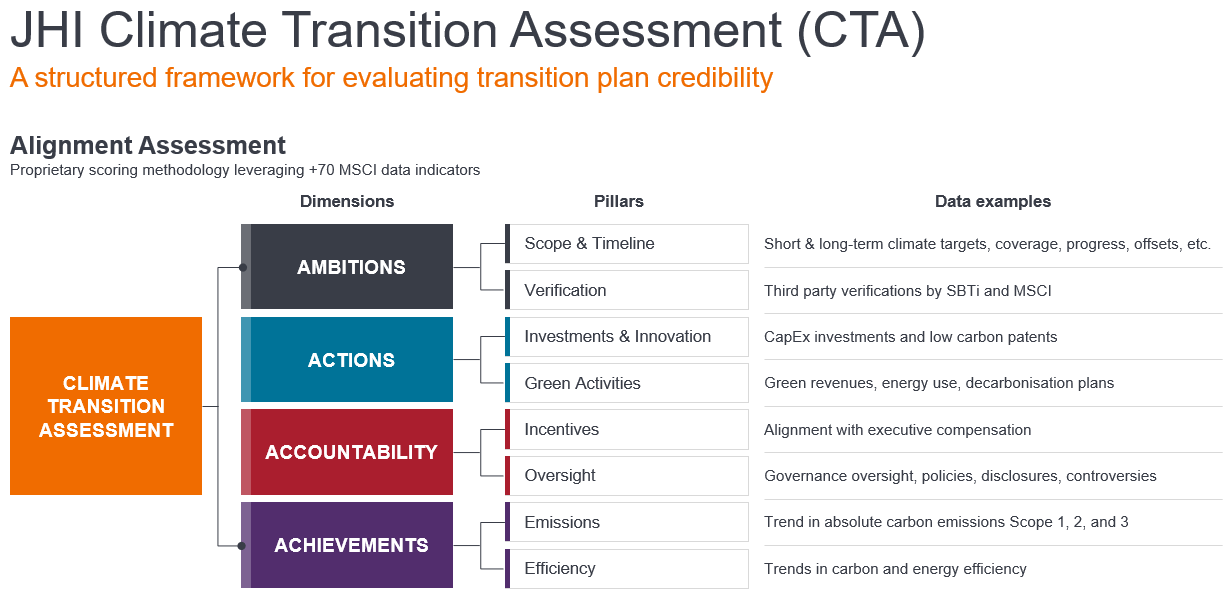
A structured view of transition credibility. The CTA assesses companies across four dimensions, from the targets they set to the results they deliver.
Source: Janus Henderson Investors and UC Berkeley Executive Education
Each dimension can reveal something a headline target conceals. Ambition can quietly erode: TotalEnergies, the first European oil major to set a net zero target, excluded the assets it does not operate and has since abandoned its goal for Scope 3 emissions altogether. Capital allocation can be the clearest signal of intent, as with utilities that direct most of their capital spending into renewables and grids. Executive remuneration is equally revealing, because the boldest climate commitments do not always come with the strongest incentives to deliver them. At one oil major, for example, a pay metric labelled ‘low-carbon’ included growth in liquefied natural gas.
In practice
The real test is whether ambition, investment, and incentives translate into lower emissions, and Microsoft illustrates why assessing progress requires context. Since it set a goal in 2020 to become carbon negative by 2030, its carbon intensity has fallen by 28%, largely because revenue has grown so quickly. Over the same period, absolute emissions have risen by 62% as its cloud and AI business has expanded. While that reflects the challenges associated with rapid infrastructure build-out, it also highlights why investors need to look beyond headline commitments and assess whether growth, investment decisions and long-term decarbonisation plans remain aligned. That kind of paradox, where improving intensity coincides with rising absolute emissions, is exactly what a credibility assessment is designed to surface.
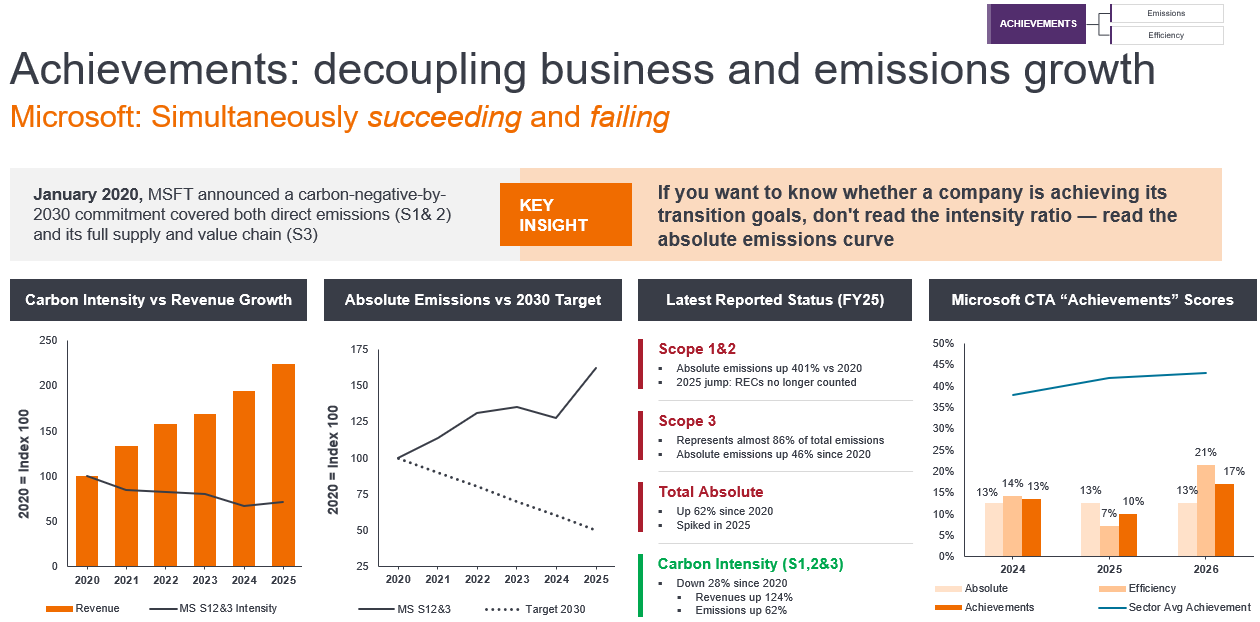
Efficiency is not the same as decarbonisation. Microsoft’s carbon intensity has improved, but absolute emissions have risen as the business has grown.
Source: Janus Henderson Investors and UC Berkeley Executive Education
Reported figures also need context. Microsoft’s recent move to more credible, long-term clean power contracts has, in the short term, made its emissions look worse, a reminder that a better strategy can sometimes produce worse headline numbers. The same scrutiny applies to carbon offsets. The question is no longer whether companies use them, but when, how, and of what quality. Avoidance, reduction, and removal credits differ significantly, price is not a reliable guide to quality, and emerging standards increasingly expect deep decarbonisation first, with offsets reserved for residual emissions.
The Magnificent Seven, the largest US technology companies show why frameworks must be paired with company-level understanding. Each faces a different decarbonisation challenge. For hardware and chip companies, emissions sit mainly in the value chain, while for cloud providers they sit in the power behind their data centres. AI adds further complexity. Rapid data-centre expansion is increasing emissions in the short term, and in some cases pushing companies towards gas-fired power. At the same time, ongoing efficiency gains make long-term energy demand hard to predict, and AI may help reduce emissions in other sectors. With so much uncertainty, a useful question for investors is which companies are making infrastructure decisions that balance speed, cost, resilience and environmental impact while supporting long-term value creation.
This is where research and engagement matter most. Within our investment process, the CTA is embedded in ESG Explore, our proprietary ESG data and research platform. It is not a buy or sell signal, but it helps our teams identify where ambition outruns delivery, prioritise engagement, and inform position sizing and risk management.
We’re in a resource-constrained world, and resource-efficient leaders will win: not just today’s leaders, but the companies thinking long term and treating sustainability as a capital allocation decision.
– Kimberley Pavier, Sustainability Analyst on the Global Technology Leaders Team
What’s next
Judging whether a transition plan is credible is an important step, but it only adds value if it changes investment decisions. In the next article in this series, we consider how climate and biodiversity factors can be built into each stage of the investment process, and why they work best as part of fundamental analysis rather than as a separate overlay.
IMPORTANT INFORMATION
For additional disclosure on Climate Transition Assessment please refer to janushenderson.com
1BloombergNEF, Energy Transition Investment Trends 2026.
Capital expenditure (CapEx): Money invested to acquire or upgrade fixed assets such as buildings, machinery, equipment or vehicles to maintain or improve operations and support future growth.
Decarbonisation: The process of reducing the amount of carbon, mainly carbon dioxide (CO₂), released into the atmosphere to combat global warming and climate change.
Environmental, Social and Governance (ESG): Factors relating to the quality and functioning of the natural environment, the rights, wellbeing and interests of people and communities, and the governance of companies and their stakeholders.
ESG integration: The consideration of financially material ESG risks and opportunities throughout the investment process.
Fundamental analysis: The analysis of information that contributes to the valuation of a security, such as a company’s earnings, its management team and wider economic factors.
Magnificent Seven (Mag 7): The seven major technology stocks: Apple, Microsoft, Nvidia, Amazon, Tesla, Alphabet and Meta.
Net zero: A state in which greenhouse gases, such as carbon dioxide (CO₂), released into the atmosphere are balanced by their removal from the atmosphere.
Scope 1 carbon emissions: Direct greenhouse gas emissions from owned or controlled sources.
Scope 2 carbon emissions: Indirect greenhouse gas emissions, such as those created through the generation of purchased energy, including electricity.
Scope 3 carbon emissions: Greenhouse gas emissions associated with the entire value chain of a business for which it is indirectly responsible, from products purchased from suppliers to the use of its products by consumers.
Scope 1–2 carbon emissions (measurement): Tonnes of carbon dioxide equivalent per million US dollars of total revenue on a Scope 1 and 2 basis. For companies that do not report figures, emissions are based on proprietary estimation models.
Secular themes and trends: Long-term investment themes with strong growth potential, such as climate change, artificial intelligence, clean energy or changing demographics.
Security: A broad term referring to shares, bonds or any other financial instrument.
These are the views of the author at the time of publication and may differ from the views of other individuals/teams at Janus Henderson Investors. References made to individual securities do not constitute a recommendation to buy, sell or hold any security, investment strategy or market sector, and should not be assumed to be profitable. Janus Henderson Investors, its affiliated advisor, or its employees, may have a position in the securities mentioned.
Past performance does not predict future returns. The value of an investment and the income from it can fall as well as rise and you may not get back the amount originally invested.
The information in this article does not qualify as an investment recommendation.
There is no guarantee that past trends will continue, or forecasts will be realised.
Marketing Communication.