
Key takeaways:
- Headline technology exposure may overstate the true AI disruption risk in collateralized loan obligations (CLOs), as only a smaller subset of software-related loans is directly exposed.
- Loan-level analysis and active CLO manager selection are critical in assessing this risk, given wide dispersion in stressed technology exposure across deals and managers.
- Higher-rated CLO tranches may offer stronger structural protection, making AAA, AA, and A rated exposure a preferred way to navigate AI-related uncertainty, in our view.
The most common misunderstanding of disruptive innovations is to overestimate their impact in the short term and underestimate it in the long term.
– Geoffrey Moore
While the proliferation of artificial intelligence (AI) solutions is expected to eventually impact most major industries, investor concern is presently hyper focused on the threat posed to software companies.
Autonomous agents are becoming more capable of executing tasks directly within business applications, which could undermine the traditional per-seat subscription model of many software providers. At the same time, AI is lowering barriers to entry by reducing the cost and complexity of software development, making it easier for new competitors – or even corporate customers themselves – to build customized tools.
Where does the risk reside?
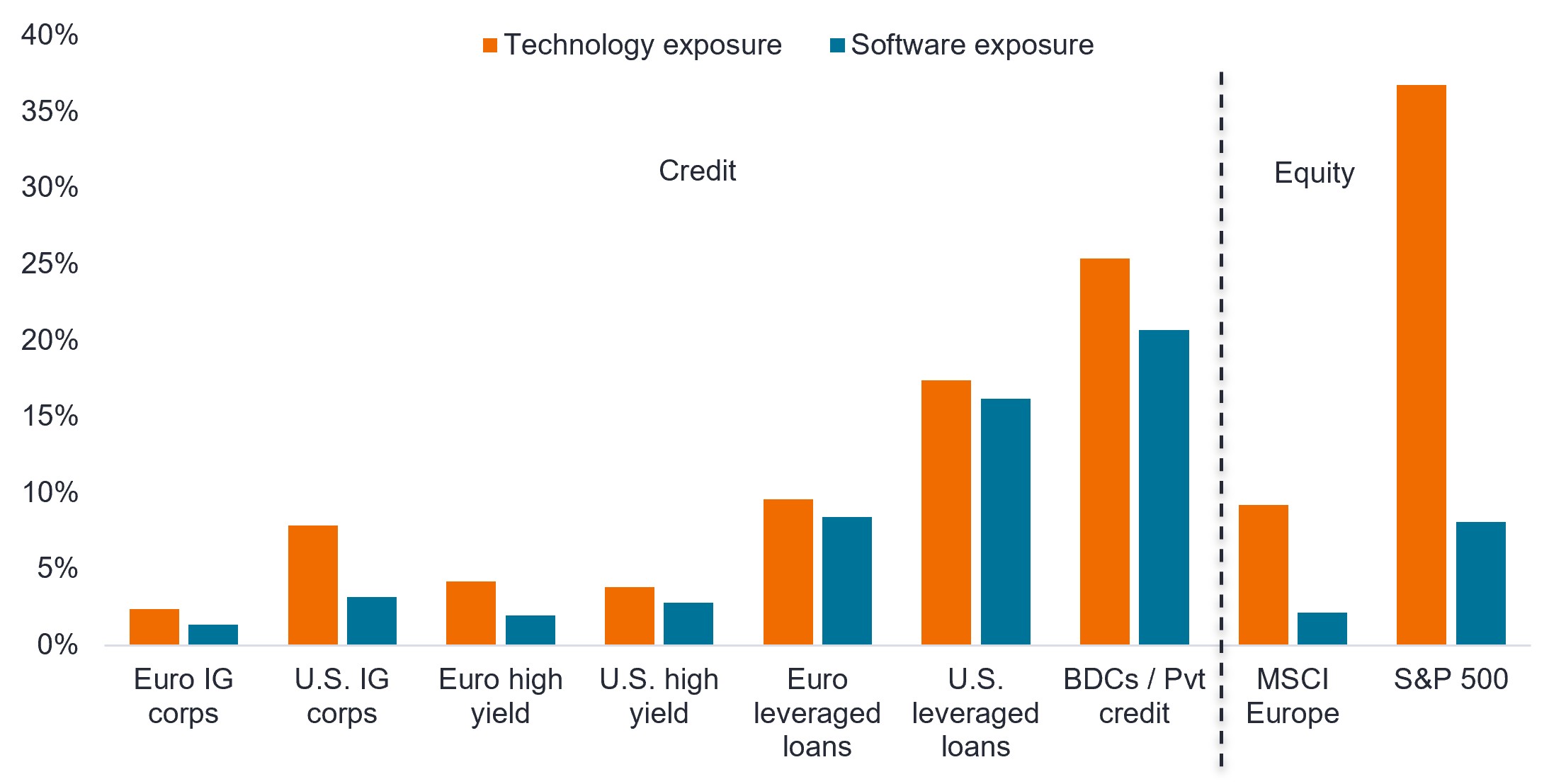
Software companies have leaned more heavily on leveraged loans and private credit for financing than on corporate markets. Business Development Companies (BDCs) have been drawn to software businesses for leveraged buyouts because their recurring subscription revenues, strong margins, and asset-light operating models have been well suited to supporting higher debt loads.
Exhibit 1: Technology and software exposure in U.S. and European markets
Leveraged loans and BDCs / private credit have higher exposure to software and technology.
Source: Bloomberg, Barclays Research, as of 31 July 2026.
Given the higher technology and software exposure of leveraged loans or collateralized loan obligations (CLOs), investors may be tempted to eschew these asset classes altogether. But we think the issue requires a more measured approach and warrants a closer look at loan-level metrics.
As outlined below, our method involves isolating and quantifying the risk, seeking to mitigate risk through active management, and selecting the investment vehicles that we believe may offer structural protections against defaults.
1. Isolate and quantify the risk
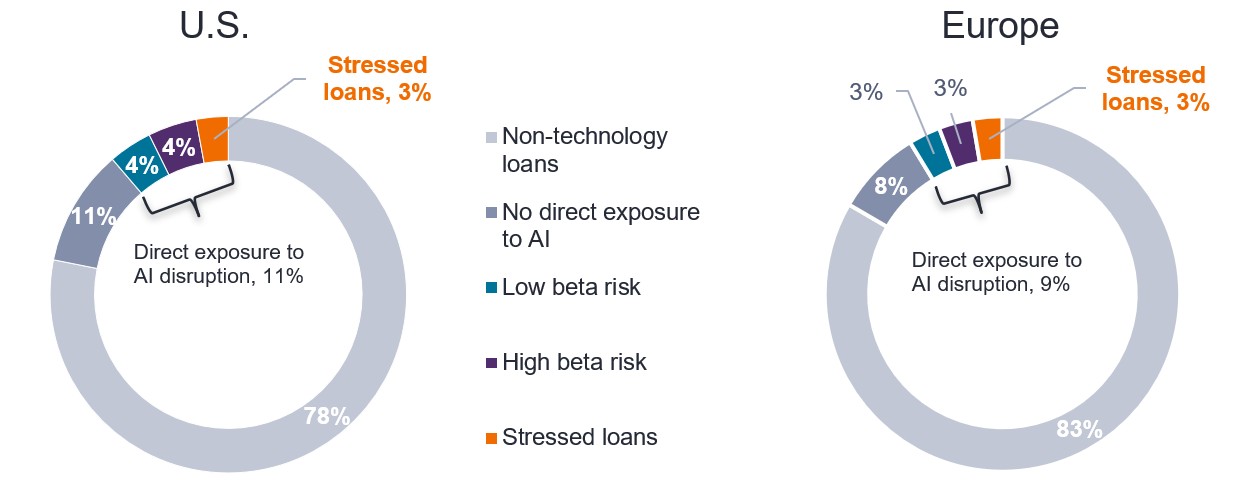
Technology and technology-adjacent1 loans represent around 22% of the U.S. CLO loan universe and 17% of the European CLO loan universe. However, in our opinion, sector classification alone overstates the risk because not all issuers are directly exposed to AI disruption.
Drawing on our strong corporate credit research capabilities, we assess each loan individually and have determined that only 11% of U.S. CLO loans and 9% of European CLO loans are directly exposed to AI disruption – roughly half the headline technology exposure.
We go a step further and separate the loans with direct AI exposure into three risk buckets using real-time pricing data – which we consider to be a highly efficient information aggregator – to determine whether the market perceives the loan to be lower risk, higher risk, or stressed.
Exhibit 2: Weighted average price (WAP) of technology loans directly exposed to AI disruption
Stressed technology loans represent just 3% of all loans.
| Risk bucket | U.S. Market weight | U.S. WAP | EU Market weight | EU WAP |
|---|---|---|---|---|
| Low beta | 4% | 99.2 | 3% | 99.4 |
| High beta | 4% | 94.0 | 3% | 96.5 |
| Stressed | 3% | 70.4 | 3% | 79.7 |
| Total | 11% | 89.7 | 9% | 92.2 |
Low-beta loans in the U.S. and Europe are pricing very close to par (100) at 99.2 and 99.4, respectively, indicating the market sees no credit concern in those loans. The high-beta risk cohort, priced at 94.0 and 96.5, reflects some uncertainty but is still priced well above distressed levels.
The stressed portion, at just 3% of the index, is where real credit risk resides. Nonetheless, the stressed cohort is much smaller than headline exposure might suggest.
Technology loans directly exposed to AI disruption are a far smaller percentage of the index than headline weights suggest.
Source: Janus Henderson Investors, as of 30 June 2026.
2. Seek to mitigate risk through active management.
Once we have appropriately isolated and quantified the risk, we seek to mitigate the risk through active management. The two salient points here are to a) assess the maturity profile of the stressed loans to quantify imminent refinancing risk, and b) identify variations in direct AI exposure by individual CLO deal.
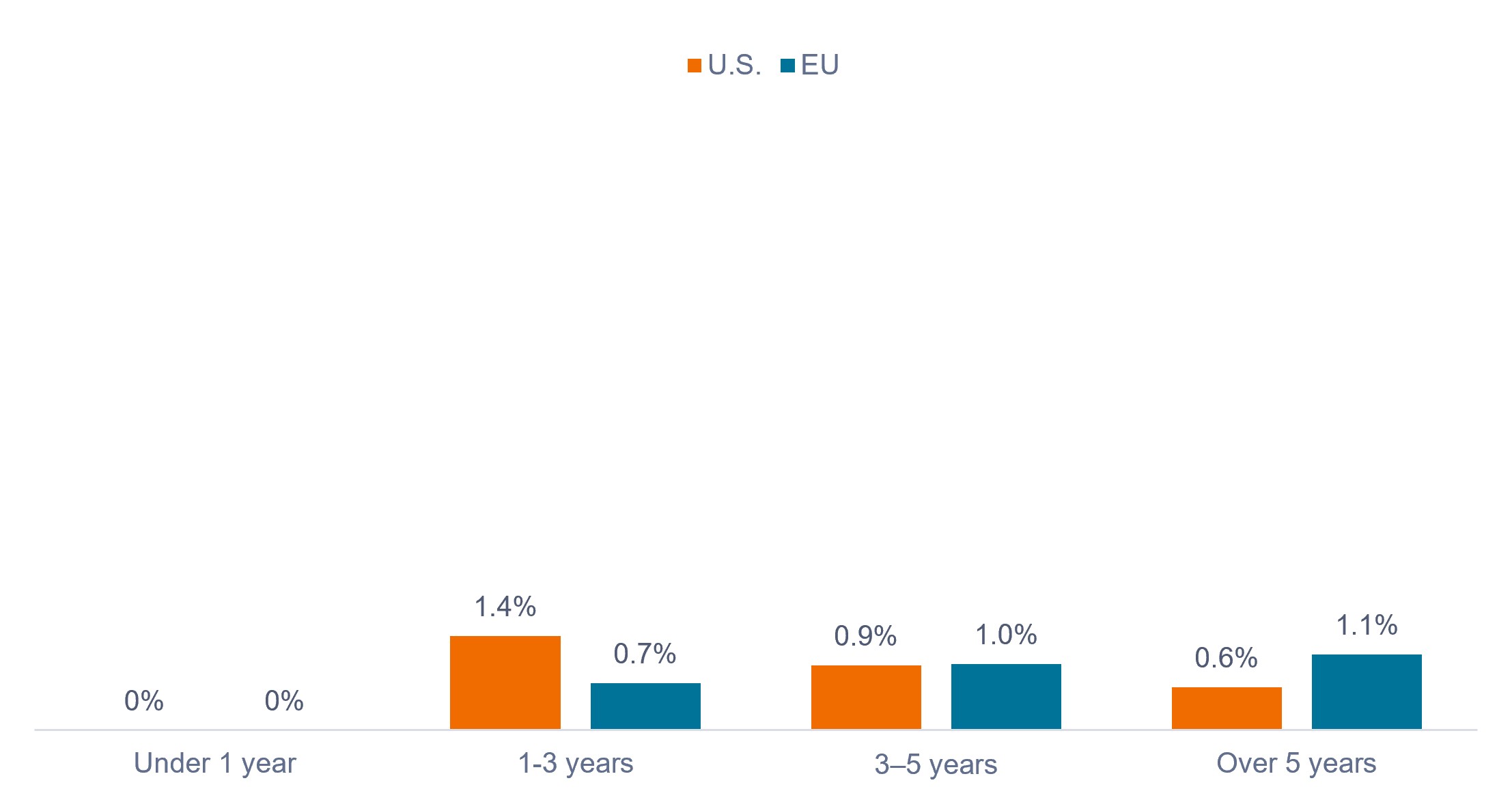
As it relates to a), a potential concern with AI-disrupted borrowers is refinancing risk. If a loan matures too soon for a borrower facing structural revenue uncertainty, it maybe forced to refinance at materially wider spreads or fail to refinance altogether.
In the U.S., stressed technology loans maturing within three years represent just 1.4% of the loan universe, while in Europe that number is 0.7%. No stressed technology loans mature within one year.
This healthy maturity profile provides time for credit situations to develop or resolve before refinancing pressure builds, and therefore no imminent maturity wall exists to force crystallization of losses.
A very small percentage of the loan universe is stressed and faces refinancing within three years.
Source: Janus Henderson Investors, as of 30 June 2026.
Regarding point b), the figures above describe the universe as a single portfolio, yet individual CLO deals are very different.
After analyzing over 2,750 CLO transactions across U.S. and European markets, we found that exposure to stressed technology loans varied significantly by deal and by CLO manager. In our analysis, we identified and measured each CLO’s exposure to stressed technology loans and then ranked the deals from lowest to highest exposure and grouped them into quartiles.
The data points in Exhibit 6 represent the average exposure across all deals within each respective quartile. Exposure to stressed technology loans in the most-exposed quartile was ~300% higher in the U.S. and ~600% higher in Europe compared to the least-exposed quartile.
Exhibit 5: Individual CLOs ranked and grouped by level of exposure to stressed technology loans
Active manager and CLO selection is critical, as deal-level dispersion is presently wide.
| Quartile | U.S. average stressed exposure | EU average stressed exposure |
|---|---|---|
| 1st – least exposed | 1.5% | 0.8% |
| 2nd | 2.6% | 2.0% |
| 3rd | 3.1% | 3.0% |
| 4th – most exposed | 4.6% | 4.9% |
With over 170 CLO managers operating across both markets and individual managers running deals of varying composition and vintage, the exposure is ultimately determined by credit selection at the deal level.
3. Select the investment vehicles we believe may offer structural protection
In our view, investors seeking floating-rate exposure should consider CLOs over leveraged loans due to the structural protections and higher credit quality within CLOs, as well as the ability to select one’s desired level of credit risk.
Whereas CLOs employ a waterfall2 structure to provide credit enhancement, leveraged loans participate in default-related losses from the first dollar, as there is no tranche hierarchy inherent in direct loan exposure.
This credit enhancement feature within CLOs has proven resilient over time, particularly for higher-rated tranches. That’s because losses from underlying loans hit the equity tranche first, moving upward through B and BB tiers before touching the BBB, A, AA, and AAA tranches.
Exhibit 6: Impact of leveraged loan defaults on U.S. CLO tranches (1998-2026)
Higher-rated CLO tranches have historically been extremely bankrupt remote.
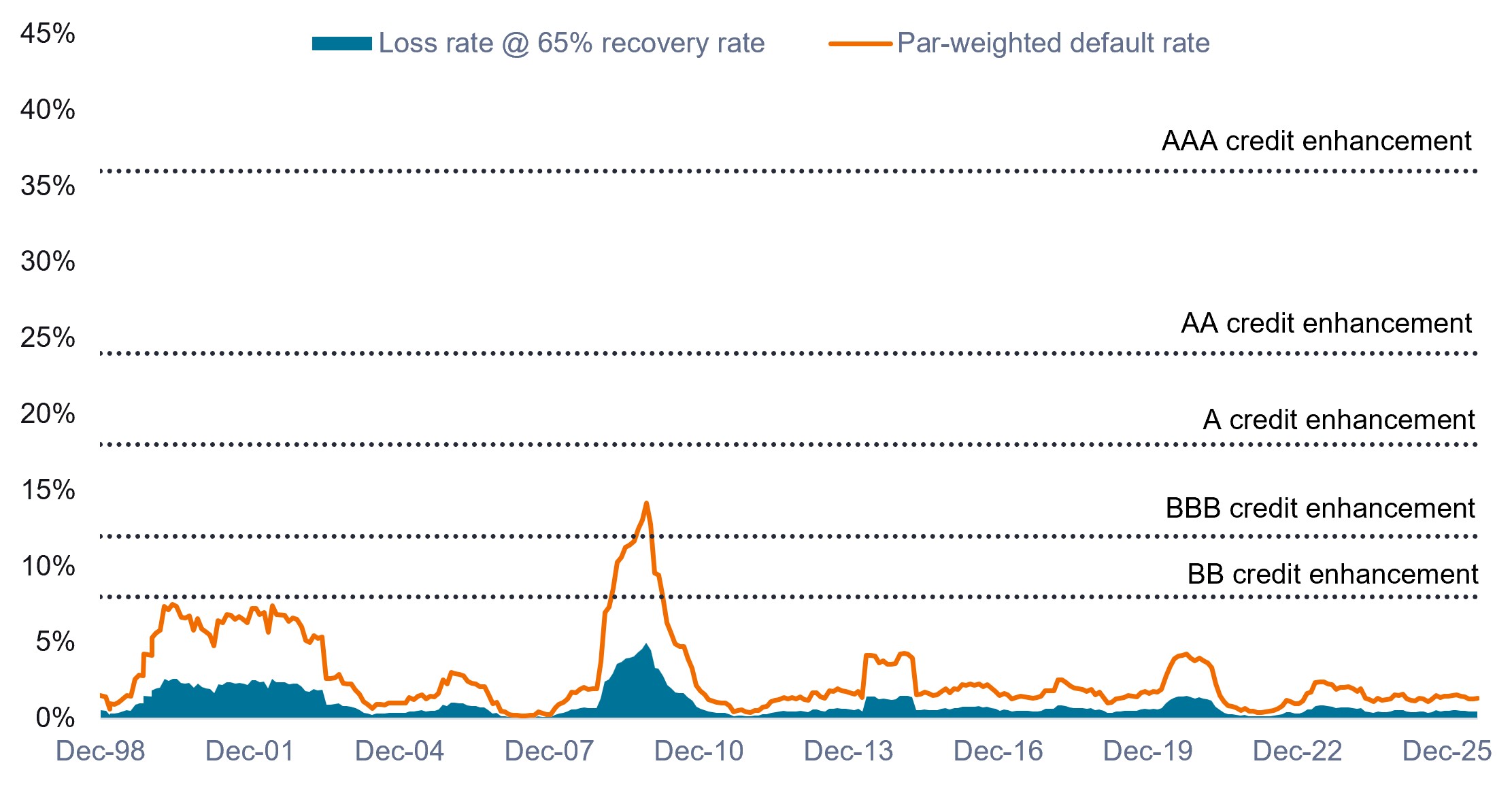
Source: JP Morgan, LSTA, Janus Henderson Investors, as of 31 July 2026. Credit enhancement is the ratio of the principal value of the assets to the outstanding debt tranches that comprise the capital structure. It represents the level of losses a tranche can withstand. Loss rate assumes a 65% recovery rate consistent with historical trends. Past performance does not predict future results.
Due to the heightened level of uncertainty within the technology sector, we prefer exposure to the highest-rated (AAA) tranches of CLOs where structural protections are at their maximum. AA and A rated CLOs remain a compelling option as well, as they exhibit a very high degree of credit enhancement while offering some additional credit spread over the AAA tranche.
For investors in BB and B CLO tranches, the risks are more direct. A negative turn in AI-exposed credits could drive tranche rating downgrades and spread repricing further down the capital stack and we do not believe the BB and B tranches are adequately compensating investors for this risk. Therefore, we believe investors should consider moving up in quality to the BBB tranche, or potentially into the A, AA, and AAA tranches.
In summary
Returning to Moore’s quote from our introduction – and in light of the data presented – we believe the headline hype around software loans is overblown in the short term, while longer-term impacts remain to be seen.
Floating-rate bond exposure remains an essential component of a diversified fixed income allocation, with CLOs being the preferred investment vehicle due to their strong credit ratings, structural protections, and historical resilience.
A combination of deep loan-level analysis, active selection, and a bias toward higher-rated CLO tranches remains our preferred approach to navigating the risk of AI disruption within software loans. Selecting deals with disciplined credit exposure and avoiding those with concentrated risk in AI-sensitive sectors is where we see the clearest opportunity to add value for investors.
1 Technology-adjacent loans typically have exposure to technology despite their inclusion in non-technology sectors, such as services, media and telecom, finance, or real estate.
2 CLOs are structured so that the AAA tranche is first to receive payments from the underlying loans. Once payments to the AAA securities have been fulfilled, the AA tranche receives its payments, and so on. This is sometimes referred to as a waterfall structure. The structure fulfills payments all the way down to the equity tranche unless there are defaults to the underlying loans. In the event of defaults, CLOs provide additional credit enhancement. If at any point there is insufficient collateral in the CLO, the cash flows originally intended for the lower-rated tranches are diverted to the higher-rated tranches, starting with the AAA tranche and working down. Therefore, in a time of market stress, the credit quality of the higher-rated tranches generally improves.
Basis point (bp) equals 1/100 of a percentage point. 1 bp = 0.01%, 100 bps = 1%.
A BDC (Business Development Company) is a specialized type of closed-end investment vehicle created to help fund small and middle-market private businesses.
Credit quality ratings are measured on a scale that generally ranges from AAA (highest) to D (lowest).
Credit Spread is the difference in yield between securities with similar maturity but different credit quality. Widening spreads generally indicate deteriorating creditworthiness of corporate borrowers, and narrowing indicate improving.
A leveraged loan is a type of commercial loan extended to companies or individuals that already have a significant amount of debt or a low credit rating.
Refinancing risk is the danger that a borrower cannot replace an expiring loan with a new loan under reasonable terms.
IMPORTANT INFORMATION
Actively managed portfolios may fail to produce the intended results. No investment strategy can ensure a profit or eliminate the risk of loss.
Artificial Intelligence (“AI”) focused companies, including those that develop or utilize AI technologies, may face rapid product obsolescence, intense competition, and increased regulatory scrutiny. These companies often rely heavily on intellectual property, invest significantly in research and development, and depend on maintaining and growing consumer demand. Their securities may be more volatile than those of companies offering more established technologies and may be affected by risks tied to the use of AI in business operations, including legal liability or reputational harm.
Collateralized Loan Obligations (CLOs) are debt securities issued in different tranches, with varying degrees of risk, and backed by an underlying portfolio consisting primarily of below investment grade corporate loans. The return of principal is not guaranteed, and prices may decline if payments are not made timely or credit strength weakens. CLOs are subject to liquidity risk, interest rate risk, credit risk, call risk and the risk of default of the underlying assets.
Concentrated investments in a single sector, industry or region will be more susceptible to factors affecting that group and may be more volatile than less concentrated investments or the market as a whole.
Credit spread risk is the potential for a financial loss on a debt security due to a widening of the spread (difference in yield) between that security and a risk-free benchmark, such as a U.S. Treasury bond. It represents changes in market value caused by increased market perception of credit risk, distinct from the actual risk of borrower default.
Diversification neither assures a profit nor eliminates the risk of experiencing investment losses.
Fixed income securities are subject to interest rate, inflation, credit and default risk. The bond market is volatile. As interest rates rise, bond prices usually fall, and vice versa. The return of principal is not guaranteed, and prices may decline if an issuer fails to make timely payments or its credit strength weakens.
Index performance does not reflect the expenses of managing a portfolio as an index is unmanaged and not available for direct investment.
Securitized products, such as mortgage-backed securities and asset-backed securities, are more sensitive to interest rate changes, have extension and prepayment risk, and are subject to more credit, valuation and liquidity risk than other fixed-income securities.
Technology industries can be significantly affected by obsolescence of existing technology, short product cycles, falling prices and profits, competition from new market entrants, and general economic conditions. A concentrated investment in a single industry could be more volatile than the performance of less concentrated investments and the market as a whole.
These are the views of the author at the time of publication and may differ from the views of other individuals/teams at Janus Henderson Investors. References made to individual securities do not constitute a recommendation to buy, sell or hold any security, investment strategy or market sector, and should not be assumed to be profitable. Janus Henderson Investors, its affiliated advisor, or its employees, may have a position in the securities mentioned.
Past performance does not predict future returns. The value of an investment and the income from it can fall as well as rise and you may not get back the amount originally invested.
The information in this article does not qualify as an investment recommendation.
There is no guarantee that past trends will continue, or forecasts will be realised.
Marketing Communication.