
Key takeaways:
- Climate and nature can be financially material. Their effects can show up in revenues, costs, capital expenditure, asset values, and the cost of capital, so they belong inside financial analysis rather than alongside it.
- Look beyond ESG ratings and headline targets. These can obscure important underlying factors, including carbon exposure and the credibility of transition plans. Company-level research helps determine what matters to the investment case.
- Insight should inform investment decisions. A material risk does not automatically mean avoiding a company. Deeper analysis can influence valuation, engagement, conviction and position sizing, while portfolio analysis can reveal concentrations across holdings.
The investment challenge
All investment analysis ends in a simple choice: own or don’t own. Owning then leads to more nuanced decisions about target price, position size, and whether to engage. The key question is whether financially material climate and nature factors change that choice, and whether the market is pricing them correctly. Rather than treating ESG analysis as a separate input, analysts can consider these factors alongside revenue, margins, capital expenditure, asset lives, multiples, terminal value, and the cost of capital.
There is already evidence across sectors that these factors are financially relevant. TSMC, the semiconductor company, trucked in water during a Taiwanese drought, illustrating how water availability can affect production, costs, and capital requirements. The wildfire liabilities of PG&E, the utility, contributed to its bankruptcy, demonstrating the potential financial significance of physical and liability risks. The sustainability-linked bonds of Enel, the energy group, tie its coupon to emissions performance, directly linking environmental performance to financing costs. In each case, climate and nature factors reached the financials through a different channel.
Exhibit 1: It’s already in the numbers: Climate and nature risks show up where analysts actually look – the financials
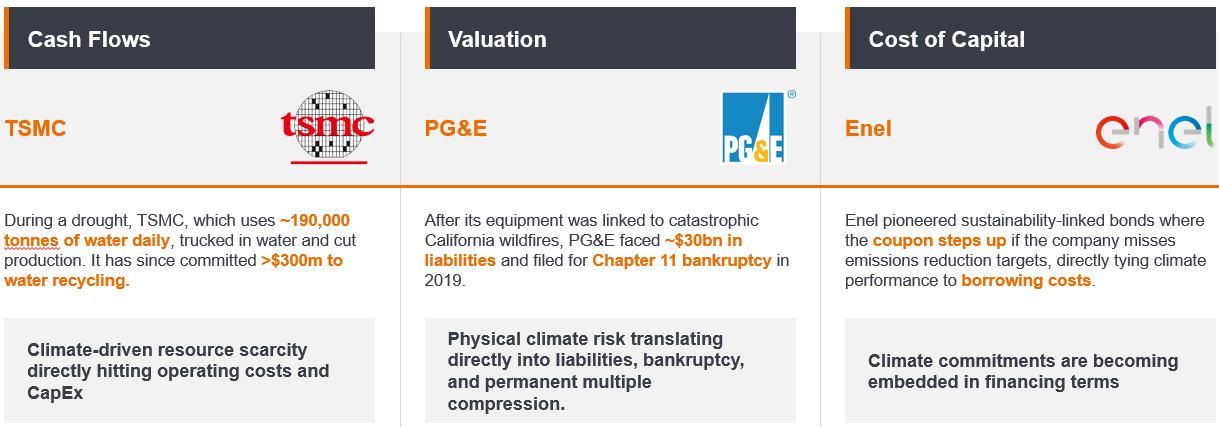
Water scarcity, wildfire liabilities and sustainability-linked financing show how climate and nature factors can affect operating costs, valuation and the cost of capital.
Source: Company filings, Janus Henderson Investors. For illustrative purposes only. Not a recommendation to buy or sell any security. Use of third party names, marks or logos is purely for illustrative purposes and does not imply any association between any third party and Janus Henderson Investors, nor any endorsement or recommendation by or of any third party. Unless stated otherwise, trademarks are the exclusive property of their respective owners.
Not all of these risks are equally visible. Carbon has explicit prices in some regions, through taxes and emissions trading schemes, which makes it relatively easy to model. Nature has no equivalent price signal. Water and biodiversity risks are local and hard to measure, and supply chains can look resilient until they are not. Risks that are hard to see are the ones most likely to be mispriced, and that is where careful analysis can add the most value.
How we – and Berkeley – think about it
ESG ratings can provide a useful starting point, but headline scores may obscure important underlying factors. Sasol, the South African energy and chemicals company we examined in the session, holds an MSCI AA rating despite very high absolute emissions. Strong governance and social scores can lift an overall rating even where one area carries material risk, and ratings tend to look backwards, while investors are focusing on the future. Emissions targets can be similarly misleading: a target that has not changed can look like a sign of commitment, even if the plan for meeting it has been substantially revised. Company-level research allows investors to look beneath these headline signals and understand which factors are financially material to the business and investment case.
Crucially, climate and nature are new inputs, not a new investment framework. Analysts still assess revenues, costs, capital expenditure, asset lives and valuation, but financially material climate and nature information can change the assumptions behind them. The key is understanding whether the information changes the investment case, warrants further research or engagement, or should be monitored over time.
This is about how climate and biodiversity actually change an investment decision. Not in theory, not as a separate overlay, but in the real world of research, valuation, engagement, portfolio construction, and stewardship.
– Robert Strand, Executive Director of the Center for Responsible Business at UC Berkeley’s Haas School of Business
In practice
Sasol brings these points together. At the holding level, analysts identify financially material climate and nature factors, assess their potential financial significance, and consider whether they affect earnings, cash flows, capital requirements or valuation. On headline multiples, Sasol’s shares looked inexpensive. But South Africa’s carbon tax is set to rise sharply, and on our estimates Sasol’s carbon costs could reach almost 14% of EBITDA by 2030, a cost most sell-side forecasts do not fully reflect. Once those costs are included, the shares look considerably less cheap. The transition plan also needed a closer look. Sasol’s 2030 emissions target was unchanged between 2021 and 2025, but the capital spending behind it had fallen and offsets had become part of the plan. Much of the 13.5% reduction since 2017 came from carbon credits and lower production, rather than changes to the underlying business.
Exhibit 2: Research – Sasol: Carbon intensity will continue to impact Sasol, but how much is priced in?
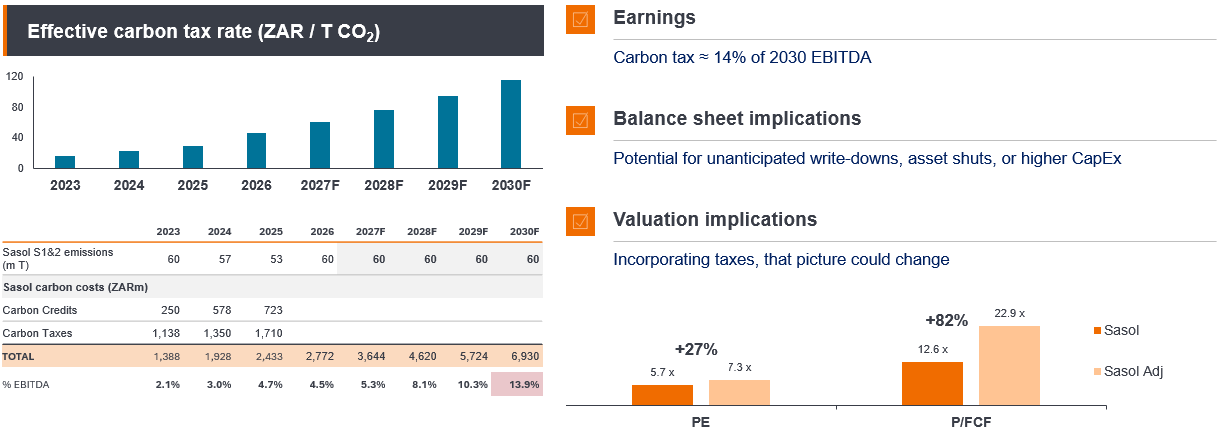
On our estimates, Sasol’s carbon costs could approach 14% of EBITDA by 2030, materially raising its valuation multiples once included.
Source: Company filings, Bloomberg, Janus Henderson Investors. As at 30 September 2026. For illustrative purposes only. Not a recommendation to buy or sell any security. There is no guarantee that past trends will continue, or forecasts will be realised.
Engagement can provide additional insight as part of the research process. Discussions with company management can help investors understand how financially material issues are being managed, with that insight feeding back into ongoing research and monitoring. Engagement can also push for outcomes that may protect long-term value, such as clearer milestones or incentives linked to real emissions reductions. Where progress stalls, investors can escalate to the board and through proxy voting.
Research gained from company engagements can then inform the investment decision. A financially material climate or nature risk does not automatically mean avoiding a company. Investment teams can consider the significance of the risk, how it is being managed and whether it is reflected in the company’s price. This may inform valuation, position sizing, further engagement or, in some cases, a decision to reduce, exit, or not invest at all.
Integration does not automatically mean don’t buy if there’s a risk. It means buy smarter. Understand the risk, the opportunity, what the market’s pricing, and make a better investment decision.
– Michelle Dunstan, Chief Responsibility Officer, Janus Henderson Investors
Portfolio-level analysis provides an additional perspective alongside company-level research. A strategy can look well diversified while a handful of holdings drive most of its climate exposure. Tools such as ESG Explore, our proprietary ESG data and research platform, can show where that exposure is concentrated and where engagement would make the most difference. The process then continues after an investment is made through ongoing research, monitoring, and, where relevant, engagement and stewardship.
What’s next
Understanding how climate and nature factors affect risk and valuation is one part of the picture. The same structural changes are also creating investment opportunities. In our final article, we consider how geopolitics, artificial intelligence (AI) driven power demand, and industrial economics are reshaping the energy transition and where the most compelling opportunities may emerge.
Bond: A debt security issued by a company or government to raise money. Investors effectively lend money to the issuer in return for periodic payments, known as a coupon, and repayment of the original amount at maturity.
Capital expenditure: Money invested to acquire or upgrade fixed assets such as buildings, machinery, equipment or vehicles to maintain or improve operations and support future growth.
Cash flow: The net balance of cash moving in and out of a company. Positive cash flow means more money is coming in than going out, while negative cash flow means more money is going out than coming in.
Coupon: A regular interest payment on a bond, described as a percentage of the face value of the investment.
Earnings before interest, tax, depreciation and amortisation (EBITDA): A metric used to measure a company’s profitability net of expenses and associated costs, taxes or debts.
Environmental, Social and Governance (ESG): Factors relating to the quality and functioning of the natural environment, the rights, well-being and interests of people and communities, and the governance of companies and their stakeholders.
ESG integration: The consideration of financially material ESG risks and opportunities throughout the investment process.
ESG rating: Third parties provide ratings that score companies according to their commitment to ESG factors.
Exposure: The amount invested in an asset or market that could potentially be lost should an investment fail. It is another way of describing financial risk.
Fundamental analysis: The analysis of information that contributes to the valuation of a security, such as a company’s earnings, its management team and wider economic factors.
An MSCI AA rating means a company is a “Leader” in managing its financially relevant environmental, social, and governance (ESG) risks and opportunities compared to its global industry peers.
Portfolio: A grouping of financial assets such as equities, bonds, commodities, properties or cash. Also often called a fund.
Position: An investment in a single financial instrument or group of financial instruments, such as shares or bonds.
Security: A broad term referring to shares, bonds or any other financial instrument.
Weighted average cost of capital (WACC): A measure of the average cost to a company to finance its assets, used to assess whether new projects will add or destroy value. WACC can assist with investment decisions, valuing a business or assessing its overall financial risk.
These are the views of the author at the time of publication and may differ from the views of other individuals/teams at Janus Henderson Investors. References made to individual securities do not constitute a recommendation to buy, sell or hold any security, investment strategy or market sector, and should not be assumed to be profitable. Janus Henderson Investors, its affiliated advisor, or its employees, may have a position in the securities mentioned.
Past performance does not predict future returns. The value of an investment and the income from it can fall as well as rise and you may not get back the amount originally invested.
The information in this article does not qualify as an investment recommendation.
There is no guarantee that past trends will continue, or forecasts will be realised.
Marketing Communication.