

Key takeaways:
- Despite geopolitical uncertainty, rate volatility and sector‑specific stress, the spreads on securitised investments have remained orderly, supported by diversification, short duration and structural protections.
- Securitised credit typically benefits from broad underlying loan diversification and floating‑rate structures, helping to limit performance drawdowns and reduce sensitivity to rate moves, compared with other areas of credit.
- While fundamentals remain broadly sound, dispersion across sectors and structures highlights the importance of bottom‑up analysis, active risk management and disciplined underwriting.
Looking through geopolitical noise
Securitised credit markets have navigated a volatile start to the year with resilience. Against a backdrop of heightened geopolitical uncertainty, shifting interest rate expectations and idiosyncratic stress, repricing in securitised spreads has remained orderly, underpinned by strong investor demand and supportive technicals.
Amid such volatility, the defining benefits of securitised investments, namely diversification, structural protection and active risk management, come to the fore. Securitised investments tend to be driven less by geopolitical shocks and more by underlying consumer and collateral performance. That distinction has recently helped limit drawdowns and dampen volatility in securitised credit, in contrast to the larger gyrations experienced by broader risk markets.
Software exposure: Manageable, not systemic
This breadth of exposure has helped insulate portfolios from sharp drawdowns in individual sectors, including recent weakness seen in parts of the software market. Across Europe, we estimate approximately 10% of the investable collateralised loan obligation (CLO) universe has some form of software exposure. Crucially, only around 4% sits within the sub-sectors that have generated the most concern.1
This differentiation matters. CLO managers – who actively manage the loan pool – are not indiscriminately exposed to a single theme; rather, exposures vary meaningfully by strategy and mandate. Active engagement with managers has highlighted clear frameworks around what they own, why they own it, and how they seek to manage downside risk. In aggregate, software exposure has proven manageable.
Data centres: Structural demand from AI supercycle, defensive cashflows
In terms of opportunity from AI, data centres are emerging as a distinctive and increasingly relevant exposure within securitised markets. Demand is rising, underpinned by long‑term structural drivers, including cloud adoption, AI workloads and enterprise digitisation, rather than short‑cycle economic growth. For securitised investors, these assets are characterised by long 10–15-year contractual lease terms, high tenant quality and well-defined cashflow visibility, often extending beyond the shorter tenor of the bonds themselves.
Risk profiles also differ meaningfully from traditional real estate. Operating risk is typically limited, with tenants bearing the non-operational risk of energy, equipment and fit‑out costs, while lease structures embed strong protections, in terms of break optionality. In Europe, issuance remains relatively scarce and skewed towards higher‑quality sponsors and assets. Data centres offer attractive relative value and potential income stability, with the defensive high-quality bias that characterises securitised investments.
Orderly repricing underpinned by strong technicals
Market technicals entered 2026 on a solid footing, which was evident in February, at the time of the Structured Finance Association’s (SFA) conference in Las Vegas. While spreads widened, the moves were modest and orderly. Since then, issuance has slowed, allowing supply and demand to rebalance, with spreads largely reverting to pre-SFA levels, underscoring the market’s ability to absorb volatility without disruption.
Importantly, the adjustment since late January has been measured rather than disruptive, and materially smaller than the volatility spike seen following Liberation Day. This repricing reflects both technical factors and a reassessment of risk, rather than a deterioration in underlying fundamentals. One illustration is the mortgages market, where demand was supported by policy direction for Fannie Mae and Freddie Mac to purchase up to US$200 billion of Agency Mortgage‑Backed Securities (MBS). This also lifted US non-qualifying mortgage spreads through 2026 given their correlation with agency MBS, while it is perceived this activity would lower mortgage rates and boost housing affordability. It also highlights the resilience of securitised collateral pools, which we tackle next.
Figure 1: Securitised spreads adjust in an orderly fashion despite renewed volatility
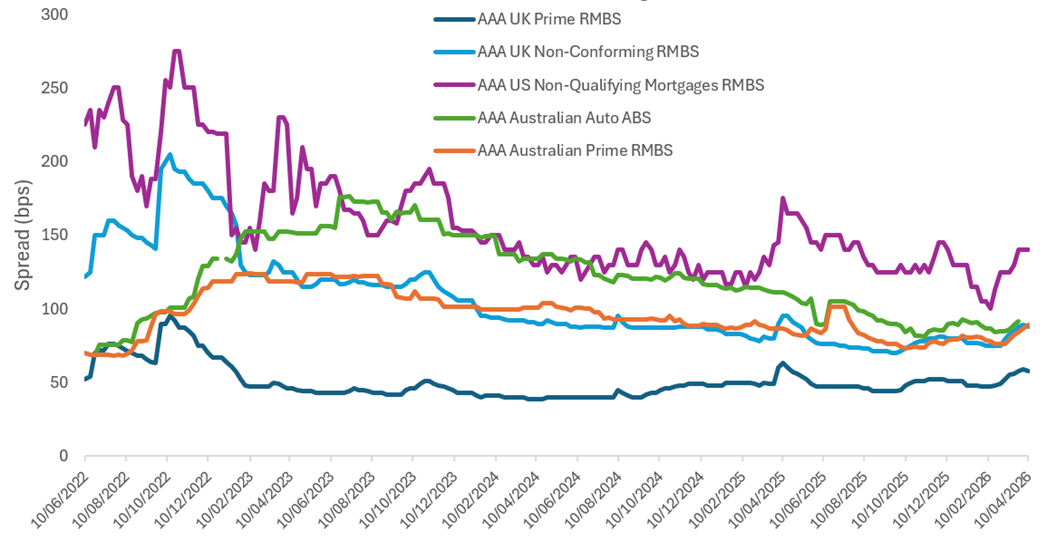
Source: JP Morgan, Pricing Direct Inc, Westpac, as at 10 April 2026. CMBS: Commercial Mortgage-backed Securities. RMBS: Residential Mortgage-backed Securities. US Non-Qualifying Mortgages: JP Morgan NQM A1 index data. The rest of the sectors are from JP Morgan analysis, where spreads do not reflect a particular bond or basket of bonds, but rather indicate observations of general secondary market movements on a week-to-week basis from JP Morgan’s European ABS secondary trading desk.
Resilient collateral pools
On the consumer side, much of the rates-related stress in 2022-2023 (as shown in Figure 1) has now washed through. Higher rates, inflation and house price adjustments prompted originators to tighten underwriting standards and rein in riskier lending. That discipline has transpired in the quality and performance of collateral pools, particularly in more recently originated transactions. Recent events in the Middle East raise concerns about a resurgence of inflation, however consumer lending is now in a relatively stronger position than the previous cycle.
While some segments, such as UK buy‑to‑let mortgages, show slightly higher arrears, performance remains within expectations, even at subordinate levels. In CLOs, rising CCC buckets over the past two to three years reflect pressure from higher floating rate costs, but absolute levels remain in low to mid‑single digits.in percentage terms. Structural protections continue to provide meaningful buffers across the capital stack. Around 65% of a typical securitised deal is rated AAA,2 offering high-quality debt that is also short dated.
Floating rate structures and duration protection
Another meaningful advantage then is that much of securitised universe is issued at the short-end, with spread durations – the sensitivity of an investment to the movement of spreads – of three to five years. Coupled with floating rate characteristics, this may help securitised portfolios avoid the duration‑driven losses seen elsewhere in some areas of the fixed income market.
With heightened selling activity earlier in 2026 now normalising, market conditions have stabilised. In the current environment, where the path of future rates is uncertain and inflation remains a risk, exacerbated by geopolitics, floating‑rate exposure offers a resilient income profile and reduced duration risk, reinforcing the role of the asset class within diversified portfolios.
Securitised investments also continue to benefit from attractive carry, driven by their floating‑rate structure and the steady pass‑through of higher reference rates. While moves in base interest rates are not an immediate driver of returns, the impact builds through daily compounding, supporting income over time. Price performance is therefore more closely linked to spread dynamics than interest rate volatility.
Volatility that is easier to stomach
A key distinction between securitised credit and the leveraged loan market (the building blocks of CLOs) has been the nature of volatility. Sudden price moves of several points in individual loans can be difficult for investors to digest as it can materially impact performance. However, diversified CLO portfolios can absorb those idiosyncratic loan price movements without materially impacting the overall credit quality, particularly for investment-grade-rated tranches. This means that the resulting price impact on those CLO tranches can be far less.
This relative stability has reinforced the reality that securitised investments exhibit less volatility than sometimes assumed. As an example of this, the stability of CLO spreads can be seen through the recent market volatility (Figure 2). Crucially, this stability is not solely due to the structure of securitisations. Active management plays an important role in smoothing performance across different market environments.
Figure 2: Stability in CLO spreads through the recent market volatility
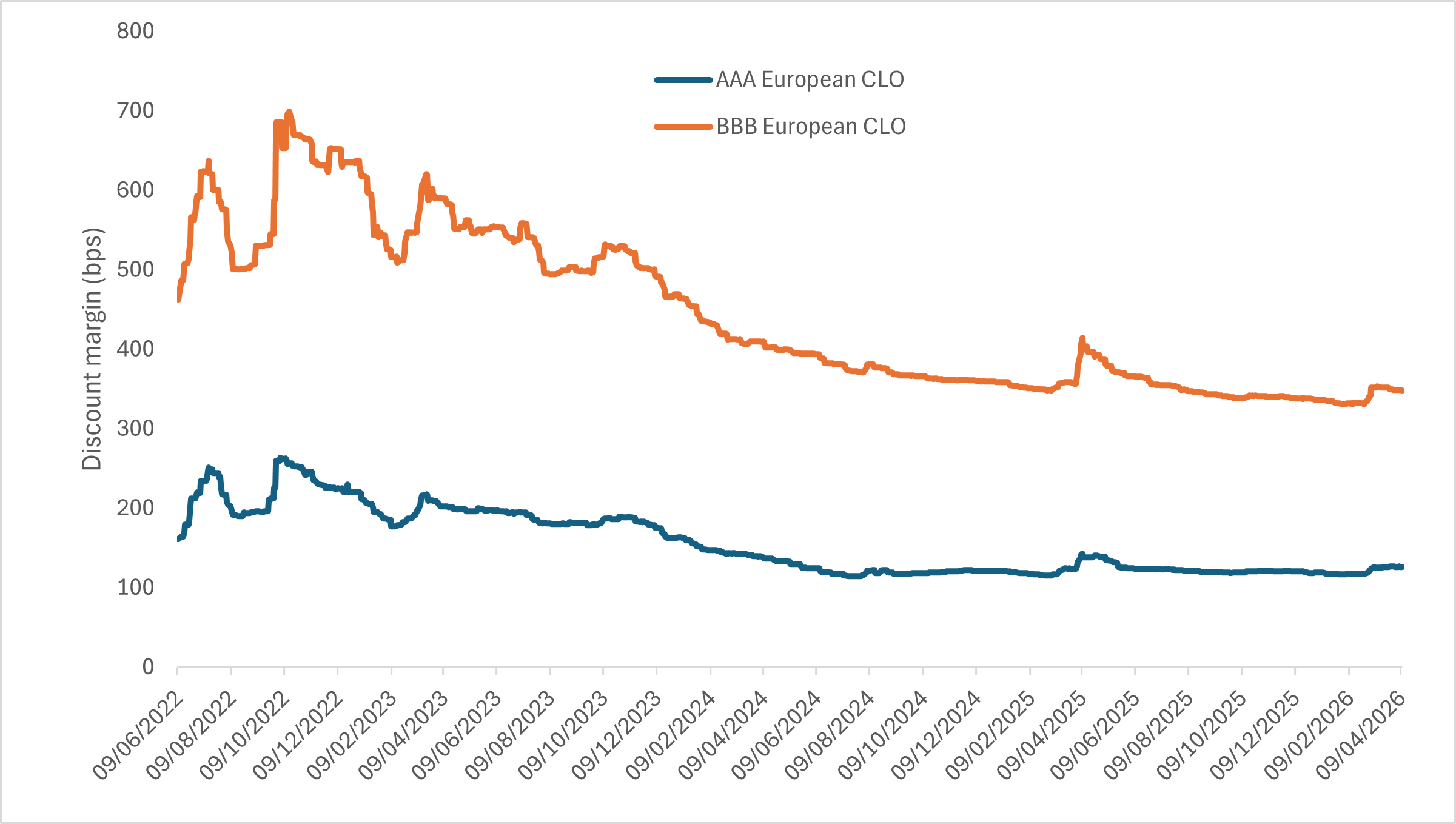
Source: JP Morgan, as at 10 April 2026. J.P. Morgan European Collateralized Loan Obligation BBB Index; J.P. Morgan European Collateralized Loan Obligation AAA Index. Past performance does not predict future returns.
Through disciplined credit selection, ongoing surveillance of underlying collateral and proactive trading, CLO managers can address emerging risks early, rebalance exposures and potentially preserve downside protection.
Solvency II reforms are unlocking insurer demand for securitised credit
Recent reforms to Europe’s Solvency II framework are materially lowering capital charges for selected securitised investments, making areas such as CLOs, commercial and parts of residential mortgage-backed securities far more accessible to European insurers.
This shift is already translating into growing interest from the insurance sector, broadening the institutional buyer base and supporting market depth. Over time, these regulatory changes could play a meaningful role in sustaining and strengthening European securitised credit markets as insurers reassess how and where they allocate capital.
Securitised credit: A resilient role within portfolios
Taken together, recent market dynamics reinforce the case for securitised credit as a resilient and adaptable allocation in uncertain times, with an increasingly globalised opportunity set emerging. Orderly repricing, robust collateral performance and strong technicals highlight an asset class driven less by headline risk and more by fundamentals.
In an environment where uncertainty around growth, inflation and policy remains elevated, securitised credit continues to offer a combination of stability, income and risk control that is increasingly difficult to replicate elsewhere. For investors seeking income, diversification and defensiveness within fixed income portfolios, we believe that securitised credit continues to stand out as a compelling allocation.
IMPORTANT INFORMATION
Actively managed portfolios may fail to produce the intended results. No investment strategy can ensure a profit or eliminate the risk of loss.
Artificial intelligence (“AI”) focused companies, including those that develop or utilize AI technologies, may face rapid product obsolescence, intense competition, and increased regulatory scrutiny. These companies often rely heavily on intellectual property, invest significantly in research and development, and depend on maintaining and growing consumer demand. Their securities may be more volatile than those of companies offering more established technologies and may be affected by risks tied to the use of AI in business operations, including legal liability or reputational harm.
Bank loans often involve borrowers with low credit ratings whose financial conditions are troubled or uncertain, including companies that are highly leveraged or in bankruptcy proceedings.
Collateralized Loan Obligations (CLOs) are debt securities issued in different tranches, with varying degrees of risk, and backed by an underlying portfolio consisting primarily of below investment grade corporate loans. The return of principal is not guaranteed, and prices may decline if payments are not made timely or credit strength weakens. CLOs are subject to liquidity risk, interest rate risk, credit risk, call risk and the risk of default of the underlying assets.
Diversification neither assures a profit nor eliminates the risk of experiencing investment losses.
Fixed income securities are subject to interest rate, inflation, credit and default risk. As interest rates rise, bond prices usually fall, and vice versa. High-yield bonds, or “junk” bonds, involve a greater risk of default and price volatility. Foreign securities, including sovereign debt, are subject to currency fluctuations, political and economic uncertainty and increased volatility and lower liquidity, all of which are magnified in emerging markets.
Securitized products, such as mortgage- and asset-backed securities, are more sensitive to interest rate changes, have extension and prepayment risk, and are subject to more credit, valuation and liquidity risk than other fixed-income securities.
1Source: Janus Henderson Investor estimates, as at 10 April 2026.
2Source: Janus Henderson observations, as at 10 April 2026.
Agency Mortgage-Backed Securities (Agency MBS): A type of asset-backed security that is specifically secured by a collection of mortgages. These securities are issued by one of the three government-sponsored enterprises (GSEs): Fannie Mae (Federal National Mortgage Association), Freddie Mac (Federal Home Loan Mortgage Corporation), or Ginnie Mae (Government National Mortgage Association). They buy mortgages and either hold them to maturity or repackage them into Agency MBS, which helps provide liquidity to the mortgage market.
Asset-backed Securities (ABS): These are financial instruments that are backed by a pool of assets—typically those that generate a cash flow from debt, such as loans, leases, credit card balances, or receivables.
Bond issuance: when an issuer (e.g. a company, bank, or government) sells new bonds to raise capital.
Bottom-up (investing): Bottom-up fund managers build portfolios by focusing on the analysis of individual securities rather than broader macroeconomic or market factors in order to identify the best opportunities in an industry, country, or region; the opposite of top-down investing.
Capital charges: In reference to insurers, this specifies the amount of capital an insurer must hold to withstand extreme market events to ensure they can continue to operate and meet claims with a high degree of confidence.
Capital stack: The hierarchy of funding sources in a company, asset, or transaction, ranked by seniority of claims on cash flows and assets.
Capital structure: Refers to the amount of debt and/or equity used by a company to fund its operations and finance its assets. The optimal capital structure is the proportion of debt and equity that results in the lowest weighted average cost of capital (WACC), i.e. the blended cost of all sources of capital, including common shares, preferred shares, and debt.
Carry: Return earned from a security assuming its price remains unchanged. For a bond, carry is essentially the income generated by the bond less the cost of financing.
Collateral: In a securitisation, collateral refers to the pool of financial assets that are bundled together to form the basis of a security.
CLO manager: The specialist investment manager responsible for selecting, monitoring and actively managing the underlying loan portfolio within a CLO, including decisions on credit risk, diversification and trading.
Commercial Mortgage-Backed Securities: A type of mortgage-backed security that is secured by the loan on commercial real estate properties rather than residential real estate.
Credit rating: An independent assessment of the creditworthiness of a borrower by a recognised agency such as Standard & Poors, Moody’s, or Fitch. Standardised scores such as ‘AAA’ (a high credit rating) or ‘CCC’ (a very low credit rating) are used, although other agencies may present their ratings in different formats. Ratings refer to credit quality. Subordinate levels in credit quality refer to portions of a capital structure or security hierarchy that are lower in priority for repayment and loss absorption, and therefore carry higher credit risk than more senior levels.
Dispersion: The extent to which returns across securities vary. Higher dispersion means returns are spread out rather than clustered together, creating bigger opportunities for both gains and losses.
Diversification: A way of spreading risk by mixing different types of assets or asset classes in a portfolio on the assumption that these assets will behave differently in any given scenario. Assets with low correlation should provide the most diversification.
Drawdown: A measure of historic risk that looks at the difference between the highest and lowest price of a portfolio or security during a specific period. It is used to evaluate the possible risk and reward of an investment.
Duration can measure how long it takes (in years) for an investor to be repaid a bond’s price by the bond’s total cash flows. Duration can also measure the sensitivity of a bond’s or fixed-income portfolio’s price to changes in interest rates. The longer a bond’s duration, the higher its sensitivity to changes in interest rates, and vice versa. ‘Going short duration’ refers to reducing the average duration of a portfolio, while ‘going long duration’ refers to extending a portfolio’s average duration.
Floating-rate asset: A debt security where the interest payments are not fixed over the life of the instrument but vary in response to a reference rate, such as the overnight lending rate or the rate of inflation.
Headline risk: This refers to the risk of short‑term market volatility or price movements driven by news headlines, rather than changes in underlying fundamentals.
Inflation: The rate at which the prices of goods and services are rising in an economy. The consumer price index (CPI) and retail price index (RPI) are two common measures; the opposite of deflation.
Interest rates: The amount charged for borrowing money, shown as a percentage of the amount owed. Base interest rates (the Bank Rate) are generally set by central banks, such as the Federal Reserve in the US or Bank of England in the UK, and influence the interest rates that lenders charge to access their own lending or saving.
Investment grade bond: A bond typically issued by governments of companies perceived to have a low risk of defaulting on their payments, reflected in the higher rating given to them by credit ratings agencies.
Idiosyncratic risk: Factors that are specific to a particular company and have little or no correlation with market risk.
Liberation Day: On 2 April 2025, Trump announced what he termed ‘Liberation Day’, when he announced a series of tariffs to be applied on the import of foreign goods, in an effort aimed at trying to address a perceived trade ‘imbalance’.
Leveraged loan: Privately-issued debt from non-investment grade (lower quality) companies that is secured against company assets, and that ranks first in priority of payment in the event of default. These types of loans generally offer a higher interest rate to offset the perception of higher risk.
Market technicals: This refers to supply‑and‑demand dynamics and trading mechanics that influence asset prices independently of underlying fundamentals such as credit quality, earnings, or macroeconomic outlook.
Operating risk: The risk of loss resulting from failures in internal processes, people, systems, or from external events, rather than from market movements or credit defaults. Break optionality in a tenancy lease refers to a contractual right that allows either the tenant, the landlord, or both to terminate the lease early, subject to specific conditions.
Option-adjusted spread (OAS): The yield spread (difference in yields between two bonds or securities) after accounting for the value of any other extra rights embedded in each bonds’ structure. It represents the compensation that investors might expect for credit or liquidity risk (i.e. risk that the borrower might not repay, or any difficulties associated with buying or selling).
Originated transactions: Securitised investments that are created directly from newly underwritten (or recently underwritten) assets, rather than bought as existing securities in the secondary market.
Non-conforming mortgages (UK) and Non-Qualified Mortgages (Non-QM, US): home loans designed for borrowers who may not meet all the standard criteria for traditional mortgages. This can include people with complex income sources (such as the self-employed), those with limited credit history, or individuals whose financial profiles don’t fit conventional requirements. These loans offer greater flexibility in underwriting, helping a wider range of borrowers’ access home financing.
Residential Mortgage-backed Securities: Collections of residential mortgages with similar characteristics that are packaged together. The cashflows (principal and interest payments) from the underlying mortgage loans are passed through to service investor debt tranches.
Repricing: A market adjustment in the price or spread of securities in response to changing fundamentals, technicals or risk sentiment.
Risk markets: Segments of financial markets where asset prices are highly sensitive to economic growth, liquidity conditions, and investor risk appetite. Performance in these markets tends to improve when investors are confident and deteriorate when uncertainty rises.
Spreads: The difference in yield between securities with similar maturity but different credit quality, often used to describe the difference in yield between corporate bonds and government bonds. Widening spreads generally indicate a deteriorating creditworthiness of corporate borrowers, while narrowing indicates improving.
Tenor: The length of time remaining until the bond matures, measured from the present date to its final repayment date.
Volatility: The rate and extent at which the price of a portfolio, security, or index, moves up and down. If the price swings up and down with large movements, it has high volatility. If the price moves more slowly and to a lesser extent, it has lower volatility. The higher the volatility, the higher the risk of the investment.
These are the views of the author at the time of publication and may differ from the views of other individuals/teams at Janus Henderson Investors. References made to individual securities do not constitute a recommendation to buy, sell or hold any security, investment strategy or market sector, and should not be assumed to be profitable. Janus Henderson Investors, its affiliated advisor, or its employees, may have a position in the securities mentioned.
Past performance does not predict future returns. The value of an investment and the income from it can fall as well as rise and you may not get back the amount originally invested.
The information in this article does not qualify as an investment recommendation.
There is no guarantee that past trends will continue, or forecasts will be realised.
Marketing Communication.