Key takeaways:
- Geopolitical realignment, shifting demographics, and a structurally higher cost of capital are driving greater dispersion between winners and losers across equity markets.
- Past cycles show that only a small number of leading companies deliver sustained outperformance. As AI adoption broadens, specialist active management is key to identifying genuine beneficiaries.
- Defence, domestic manufacturing, healthcare, biotech, and real assets are all influenced by shifts taking place at a structural level, making proactive stock and sector selection key.
Definitions
Active investing: An investment management approach where a fund manager actively aims to outperform or beat a specific index or benchmark through research, analysis, and the investment choices they make. The opposite of passive investing.
Alpha: Alpha is the difference between a portfolio’s return and its benchmark index after adjusting for the level of risk taken. This measure is used to help determine whether an actively-managed portfolio has added value relative to a benchmark index, taking into account the risk taken. A positive alpha indicates that a manager has added value.
Capital structure: Refers to the amount of debt and/or equity used by a company to fund its operations and finance its assets. The optimal capital structure is the proportion of debt and equity that results in the lowest weighted average cost of capital (WACC), i.e. the blended cost of all sources of capital, including common shares, preferred shares, and debt.
Dispersion: The extent to which a distribution of data points is stretched or squeezed. If the data points cluster around certain values, then dispersion is low, whereas if they are more spread out, then dispersion is high. For example, dispersion in stocks measures the range of returns for a group of stocks. Higher dispersion opens up opportunities for stock pickers to outperform by selecting the winners and avoiding the losers, given that stock returns are spread more widely on either side of the benchmark.
Equity: A security representing ownership, typically listed on a stock exchange. ‘Equities’ as an asset class means investments in shares, as opposed to, for instance, bond. To have ‘equity’ in a company means to hold shares in that company and therefore have part ownership.
Magnificent Seven (MAG 7): The term ‘Magnificent Seven’ refers to the seven major technology stocks—Apple, Microsoft, Nvidia, Amazon, Tesla, Alphabet, and Meta—that have dominated markets in recent years.
Passive investing: An investment approach that involves tracking a particular market or index. It is called passive because it seeks to mirror an index, either fully or partially replicating it, rather than actively picking or choosing stocks to hold. The primary benefit of passive investing is exposure to a particular market with generally lower fees than you might find on an actively-managed fund, the opposite of active investing.
Portfolio: A grouping of financial assets such as equities, bonds, commodities, properties, or cash. Also often called a ‘fund’.
The S&P 500 is a stock market index tracking the stock performance of 500 leading companies listed on stock exchanges in the United States.
View transcript
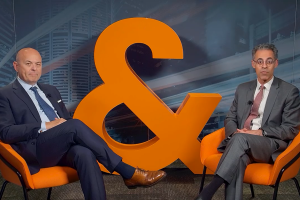
Ali Dibadj: Hi, everybody. I’m at the Janus Henderson Investment Conference here in Abu Dhabi, where over 100 clients were here to listen from our portfolio managers and broader insights that we have as a firm. I’m really thrilled to have with me, Matt Bullock, who runs our Portfolio Construction Strategies for EMEA, and Richard Clode, our technology portfolio manager. Thanks, guys.
You guys are fresh off stage. What did you tell the audience here?
Matthew Bullock: So, what really struck me, Ali, was just the amount of opportunities that are out there in the equity world right now. But at the heart of all of that is also a lot of uncertainty. And so that’s where it’s important to look through that noise and to look at what are going to be the key drivers of markets.
And this is where we break it down into three key areas. And the first one is looking at geopolitics. It’s a volatile market out there. It’s volatile time. But there are opportunities that come out of that. At the same time, you’ve got changing demographics. So that is you looking at the way we work, the way we live and also the aging population.
And then finally is a return of cost of capital. We saw rates peak last year and they have come down, but it’s nowhere near, you know, coming down to the levels we saw over a decade ago. So, what that does is it creates a lot of winners and losers. And that’s the other big theme that came out today, was just the need to be active, to identify the winners and to avoid the losers.
Dibadj: So, Richard, building on some of Matt’s points, it feels like this is a market for active investing. Although technology, oftentimes, people just say, I’m just going to put it in an index. Why may that not be the right answer right now?
Richard Clode: Exactly Ali. I mean, we always feel like the beginning of a new technology wave there’s new leadership and new companies that come to the fore. We’ve seen that with Nvidia in the last few years, so now is the perfect time to be an active [investor] and also a specialist in this sector. And you saw that last year, only two of the MAG 7 [Magnificent 7] outperformed the S&P 500.
And this is not new. If you go back, you know, just over ten years ago if you bought the ten largest tech companies in the index back at the end of 2014, you would have only had four companies that had outperformed. In fact, you would have had two companies that underperformed global equities. So, now is the time to be active as we try and identify those new AI leaders. We think that’s the way to generate a lot of alpha in the next few years.
Dibadj: So, Matt, as you look at the broader sectors that are out there, where do you see opportunities and risks?
Bullock: So, I want to go back to what I said before about, so, looking at the three key drivers of markets. And, you know, if we start on the geopolitical side of things, there’s a lot of emphasis right now on defence. And you’re especially seeing that in Europe with a lot of capital being put into that space. Now that benefits the whole European equity market.
But also, let’s look at other areas that are happening as part of the geopolitical realignment. Trade is changing all around the world. So, a lot of domestic producers, manufacturers, you know, they’re getting big tailwinds and a lot of government support. And, you know, I want to sort of touch on technology. I’ve got Richard sitting next to me here. AI is also, you know, in the heart of the geopolitical political spectrum right now as governments all around the world are trying to build out their own AI capabilities.
But sticking with AI and sticking with the technology side of things, going to the demographics, the changing demographic side. So, there’s many different aspects, whether it’s the way we live, the way we work, the way we travel, but also the aging population. And at the heart of all of that is technology.
We need technology to help us get to a better place. You’re seeing a lot of tailwinds with biotech in particular. That is a big beneficiary. Plus, you’ve got the M&A [mergers and acquisitions] activity that’s happening there as well. And just to sort of round that out and that sort of change, what else do you need when it comes to an aging population in health care more broadly?
Well, you need property. You need a physical building to house, you know, when it comes to nursing homes or hospitals. So, there’s ample opportunities in there.
But I want to go back to another key point. I mentioned my first, response, which is this is absolutely a critical time for active management. This is not as a place where you can just be passive. You’ve got to be able to go in there and identify the winners from the losers.
Dibadj: So, Richard, just to build a little bit on Matt’s point, you can’t talk about technology. In fact, you can’t talk about investing in anything these days without AI. What’s your view on what’s going on right now?
Clode: Yeah, so I think we’re going to see a broadening out of the use cases of this. You know, we build infrastructure, we build the platforms, and then we see the use cases and applications come through. I think that we just need to be careful as to who are the true beneficiaries of that going to be, you know, are these companies genuinely going to make more profit out of this, which would justify their share prices going up?
And it brings back memories of 20 years ago, high street retailers coming into the office and telling me that, you know, this new technology called the internet, and they’re going to be fantastic for them in a vacuum, yes. But obviously it brings new competition. And I think that’s where we got to hopefully, as specialists in this technology sector, we can think about not just the incumbents, but also those new companies coming through that could potentially disrupt and take big shares of those profitable.
We always think of the Jeff Bezos mantra of, you know, your margin is my opportunity. I think that’s going to very much be the case in AI as well. So, you know, there should be a big dispersion and again, a good time to be active if we can pick the winners and avoid the losers then.
Dibadj: Thank you Richard. Thank you, Matt. Thanks for your insight and all the work that you do for our clients. We have over 350 investment management people around the firm, just like these guys figuring out, teasing out the good and the bad, the winners and losers for you all. Thank you very much for joining here from Abu Dhabi.