Key takeaways:
- Investors have become nervous about the impact of rising energy costs on inflation, as seen in 2022. However, the resilience of the US labor market in 2026 and relatively higher real and nominal yields provide a level of reassurance.
- Geopolitics, sticky inflation and higher rates are contributing to uncertainty, but also driving wider dispersion across markets. Against this backdrop, credit quality and security selection are key to navigating risks and capturing relative value.
- Floating-rate and securitized assets like CLOs offer a compelling way to manage duration risk while enhancing income. Staying invested rather than trying to time the market is also likely to be a better approach long term.
Definitions
Active management: An investment management approach where a fund manager actively aims to outperform or beat a specific index or benchmark through research, analysis, and the investment choices they make. The opposite of passive investing.
Asymmetric returns: Traditional investments often exhibit a more balanced risk-reward profile, meaning the potential for gain is roughly equivalent to the potential for loss. Investment outcomes where the potential gains are disproportionately higher than the potential losses. In other words, asymmetric return investing seeks to capitalise on situations where the risk is relatively low compared to the potential reward.
Balanced: A balanced investment strategy combines asset classes in a portfolio in an attempt to balance risk and return. Typically, balanced portfolios are divided between stocks and bonds, either equally or with a slight tilt, such as 60% in stocks and 40% in bonds.
Bottom-up: Focuses on the analysis of individual securities rather than broader macroeconomic or market factors in order to identify the best opportunities in an industry, country, or region; the opposite of top-down investing.
Credit quality: A bond typically issued by governments or companies is perceived to have higher credit quality if there is a relatively low risk of defaulting on their payments, which is reflected in the higher rating given by credit ratings agencies (and vice versa).
Cyclicals: Companies that sell discretionary consumer items, such as cars, or industries highly sensitive to changes in the economy, such as mining.
Default: The failure of a debtor (such as a bond issuer) to pay interest or to return an original amount loaned when due.
Duration: Duration measures how long it takes (in years) for an investor to be repaid a bond’s price by the bond’s total cash flows. Duration can also measure the sensitivity of a bond’s or fixed-income portfolio’s price to changes in interest rates. The longer a bond’s duration, the higher its sensitivity to changes in interest rates, and vice versa.
Floating-rate instruments: A debt security where the interest payments are not fixed over the life of the instrument but vary in response to a reference rate, such as the overnight lending rate or the rate of inflation.
Idiosyncratic risk: Risk arising from factors that are specific to a particular company and have little or no correlation with market risk.
Liquidity: Liquidity is a measure of how easily an asset can be bought or sold in the market. Assets that can be easily traded in the market in high volumes (without causing a major price move) are referred to as ‘liquid’.
Nominal and real yields: ‘Nominal yield’ on a bond is the coupon—essentially the interest rate that the bond issuer promises to pay the holder. ‘Real yield’ is the nominal yield minus the rate of inflation.
Risk budget: Investments entail the acceptance of greater risk in exchange for potentially-higher returns. Risk budgeting is a risk modelling tool which aims to define the risk budget and allocate it among different investments in the most efficient manner.
Securitized assets: Certain types of assets are pooled so that they can be repackaged into interest-bearing securities together which constitutes a market for buying or selling. The interest and principal payments from the assets are passed through to the purchasers of the securities.
Senior bondholder: A bondholder who will be repaid before other lenders are repaid if the borrower gets into financial difficulty.
Collateralised Loan Obligations (CLOs): A structured finance product that is backed by a pool of loans and other assets such as mortgages, unsecured credit card debt, or personal loans. Although similar to CLOs, CDOs tend to be considered riskier given their concentrated focus and the use of complex derivatives that can obscure the relevant risk factors.
Volatility: The rate and extent at which the price of a portfolio, security, or index, moves up and down. If the price swings up and down with large movements, it has high volatility. If the price moves more slowly and to a lesser extent, it has lower volatility. The higher the volatility, the higher the risk of the investment.
Yield: The level of income on a security over a set period, typically expressed as a percentage rate. For equities, a common measure is the dividend yield, which divides recent dividend payments for each share by the share price. For a bond, in its simplest form, this is calculated as the coupon payment divided by the current bond price.
Yield curve: A graph that plots the yields of similar quality bonds against their maturities, commonly used as an indicator of investors’ expectations about a country’s economic direction. In normal conditions, a normal/upward sloping yield curve is expected, whereas yields for shorter-maturity bonds are lower than yields for bonds with a longer maturity. The shape of the yield curve can vary significantly, depending on where investors expect yields to trend in future.
View transcript
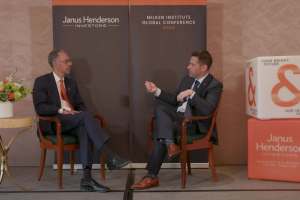
Ali Dibadj: Hi everybody, it’s Ali Dibadj. We’re here at the Asia Investment Summit with our fixed income experts, Greg Wilensky from US Fixed Income and Denis Struc from our Securitized teams. Guys, you just got off stage. What did you tell the audience here?
Greg Wilensky: I think the most important thing to think about right now is while we have some concern about what’s going on with higher energy prices, and people are having kind of PTSD responses back to what happened in 2022 when energy prices went up and bonds performed particularly poorly at the same time as equities, is that this year, the starting point is very different. We have seen a little bit of soft-term weakness, but the setup is extremely different versus 2022. The labor market is a much better balance compared to the very tight labor market there. And the starting point from a yield perspective, both real yields and nominal yields, is very different. So we don’t see the level of concern or for people to be able to look back and say, this is going to be a repeat of 2022.
Dibadj: Denis, what did you talk about?
Denis Struc: Yes, it’s interesting because if I was to pick on that theme, right, it’s what we’re telling to the fixed income investors is that it’s acknowledging that level of uncertainty will remain high. And remaining disciplined on the sources of the performance in the portfolio. And a very important part of the performance is level of income and recognizing that the level of income is what is helping you to shore up the volatility. So staying disciplined about fully recognizing which asset classes deliver what, level of income you see, and making sure that those levers remain stable and intact throughout the year.
Dibadj: So taking a step back, you both mentioned volatility and change in the world. We talk about three main themes here that our audience has heard a lot about. Geopolitical realignment, shifting lifestyles and demographics, and also cost of capital being higher, or the flip side of that is yields being higher too. How do you think about those three themes as you invest your portfolios on behalf of clients?
Wilensky: Yeah, so those are important things that we do consider as we’re making decisions almost every day. And it’s certainly going to, as you said, amplify uncertainty and volatility. And while that will create opportunities to implement strategies from kind of a top-down macro theme, I think we still need to recognize the ability to truly forecast how that will play out and essentially consistently win on making those calls is still relatively reduced. So while we’re certainly imparting that into the portfolio, we don’t want to let that overwhelm the risk budget of the strategy. We want to continue to essentially drive most of the risk budget from kind of that was bottom-up sector and security-level decisions. But the good news is those themes that you’re talking about will create asymmetric returns and volatility there. So I think that enhances our ability as an active manager to add value for our clients.
Dibadj: Denis?
Struc: What we see, so it’s important to decompose and understand what this geopolitical frame shifting what implications does it have, right? And the narrative is shifting. Geopolitics is impacting levels of inflation. And the big theme about inflation was that lowering inflation potentially will reduce the rates globally. That’s not necessarily the case in the short term, right? And that’s why this theme is playing out pretty well for securitized assets. It played out really well in this context through 2022. It generated because they’re predominantly floating-rate instruments. And that’s where if you’re uncertain about forecasting, what level of duration you need to have in the portfolio, what kind of rates you are going to see, what inflation is going to do. The best way is to probably put some allocation into the assets that can shore that up and allow you to generate those high levels of income because as rates go up, the level of income on the floating rate-assets will go up as well. And that’s exactly the theme we have observed working really well in broad fixed income allocations for 2022 to 2025. We thought that theme is going to tail off, but with the geopolitics developing, it is actually being reinforced again.
Struc: What we see, so it’s important to decompose and understand what this geopolitical frame shifting what implications does it have, right? And the narrative is shifting. Geopolitics is impacting levels of inflation. And the big theme about inflation was that lowering inflation potentially will reduce the rates globally. That’s not necessarily the case in the short term, right? And that’s why this theme is playing out pretty well for securitized assets. It played out really well in this context through 2022. It generated because they’re predominantly floating-rate instruments. And that’s where if you’re uncertain about forecasting, what level of duration you need to have in the portfolio, what kind of rates you are going to see, what inflation is going to do. The best way is to probably put some allocation into the assets that can shore that up and allow you to generate those high levels of income because as rates go up, the level of income on the floating rate-assets will go up as well. And that’s exactly the theme we have observed working really well in broad fixed income allocations for 2022 to 2025. We thought that theme is going to tail off, but with the geopolitics developing, it is actually being reinforced again.
Dibadj: Denis, you were on stage talking about CLOs [collateralized debt obligations] and securitized, and it felt like there was some lack of understanding about CLOs and securitized. Can you just talk about some of the misconceptions that are out there around that asset class?
Struc: The two biggest messages we get, CLOs is the asset class that blew up the world, financial world in 2008, that’s point #1. And #2, oh, you are cheaper than some other fixed income asset classes because you simply don’t have liquidity. And that’s the biggest two misconceptions that we’ve been working hard to explain to the clients. If I was to put it very simplistically, zero defaults in CLOs is not just an accident.
Dibadj: Zero defaults in CLOs.
Struc: Yes, as staggering as it sounds, not a single dollar was lost for CLO senior bond investors for its entire 30 years history. We reiterate that message. We actually take the most stringent definition of defaults. Not a single distribution of income was lost. And that is the type of experience is really hard to come by in fixed income overall. So we’re working hard to explain what really helps the introduction to products like ETF [exchange traded funds]. Because with ETFs, there is nowhere to hide. Everything is visible. The portfolio holdings are visible. The liquidity is visible. The cost of liquidity is visible too. And while the size of ETF market comparing to the size of the market overall is not very large, in the US it’s much larger with the large growth of CLOs ETF in the US, but that allows clients to have the very clear visibility of what liquidity actually looks like. And that certainly helped broadening up the appeal of CLOs.
Dibadj: So at Janus Henderson, we’re active asset managers. You two do fundamental, bottom-up, really tough research on the different securities that you invest in and the different asset pools you get access to. When you look at everything that you have underfoot, what’s your highest conviction areas of investment?
Wilensky: So I’ll give you two. One that’s kind of a more tactical, what’s been going on recently. We’ve had rates increase on the back of what’s been going on in Iran and higher energy prices. And when we kind of dive down and look and decompose those rate changes into what’s going on from an inflation expectation perspective and a real yield change, we were very surprised to see that a good chunk of the rise has actually been on this real yield side. And we think that is kind of illogical, counterintuitive, because higher energy prices are going to have a negative impact on growth, especially if we stay around. So we had been running underweight duration positions for quite a while. As we’ve seen this back up, we think it’s an opportunity to add in some duration into the portfolio, but with a particular focus more on the short to intermediate part of the yield curve, we think we can do that both to capture some reversal of returns when rates shift the other way, but it also gives us that kind of confidence that fixed income, kind of not like ‘22, will be in a position that if the economic situation were to deteriorate from here for, you can come up with a host of reasons, not our base case, but why that could happen, that fixed income will be in a good position to perform in that situation. And then one that’s a little bit more longer term is that we’ve been looking, you know, beyond the CLO discussion that Denis is doing a great job of highlighting is we are seeing the ability to add kind of high quality yield in the portfolio by moving up in credit quality into other areas in securitized credit relative to corporate credit as a way to add the income without adding a lot as much excess return volatility in the portfolio.
Dibadj: Denis, what do you see?
Struc: If I stay on the theme of moving up the [credit] quality, I think it’s important to stay in the right quality fundamentally from the bottom up. If I bring examples from CLOs, you’ve got over 70 individual managers who run CLOs in Europe, over 150 of them in the US, they all very actively express the views and they have to work harder these days. They’re dealing with the narrative of the changing fundamental values in software. They’re dealing with the narrative of changing fundamental values in cyclicals with energy sort of implications, what the cost is going to be there. So the point I’m making, the most important positioning for us today is backing the right investments, making sure that you’re picking the managers who have very well-established investment philosophy, fully understand and can explain what the risk is. It doesn’t mean to say that they don’t take a view, but they need to have a very clear framework what that view has been expressed in the portfolio. And that’s why we believe the strategies will outperform if you pick the managers who can withstand volatility, limit the specific idiosyncratic risk, which eventually is going to convert into some defaults. What does that mean for senior bondholders? Less market volatility, and even more important for junior investments in CLOs because you are a little bit closer to that fundamental-type risk, and that will help you see through this volatile period without necessarily going down the quality.
Dibadj: Thank you very much for your fixed income expertise. We’ve heard a lot from clients about their desire to get more yield and do it in a safe manner, whether it be securitized or other elements of fixed income, which allows you to have some equities exposure too. We’re here to support you at Janus Henderson. Thank you very much for joining.