
Key takeaways:
- A decisive outcome for July’s general election is expected to have provided a degree of political stability, in contrast to other European countries.
- This wave of good news has driven the FTSE 100 over 7% higher since the start of the year.
- For income, the UK stock market is striking, in terms of longevity and consistency. Since 2002, the FTSE 100 has yielded between 3% and 4.5% each year.
In the summer of 2024, the sun has shone on the UK – at least from a stock picker’s perspective.
A decisive outcome for July’s general election is expected to have provided a degree of political stability, in contrast to other European countries. The Bank of England has begun the slow process of unwinding its 5%+ interest rates. This followed CPI inflation gliding back to the targeted 2% range in the Spring, with July’s slight rise the first real hiccup in the process.
In combination, this wave of good news has driven the FTSE 100 over 7% higher since the start of the year.
This moment in the sun follows a period that had some headlines asking what the FTSE 100 is actually for. And yes, the index has lagged its peers in stock price terms over multiple years. This has in turn encouraged some companies to list on other markets. However, as income investors know, there is one area where the UK’s market consistently stands out, regardless of the noise surrounding it (unless that noise is a global pandemic).
For income, the UK stock market is striking, in terms of longevity and consistency. Since 2002, the FTSE 100 has yielded between 3% and 4.5% each year. In the same period, the S&P 500 has averaged a dividend yield below 2%, save for the 2008-9 period when the yield climbed above 3% on the back of a collapse in share prices. The gap has only widened since the financial crisis.For income, the UK stock market is striking, in terms of longevity and consistency.
Investors in The City of London Investment Trust have benefitted from similar consistency. The trust has yielded above 3% since 2002 and over the last five years (to 19 August 2024) has yielded above 4%.
To achieve a consistent yield, with a compound annual growth rate of 3.4% over the last ten years, the trust has made sensible use of the investment trust structure. This includes using revenue reserves to ‘top up’ investors’ dividends in 2020 when dividends in the UK fell by 38% amid the uncertainty of the pandemic – happily, these have now recovered.
Another tool available to the trust is gearing. Simply put, this means borrowing money to fund additional investments when needed. This borrowing can attract lower rates than retail loans as the trust negotiates long-term financing options ahead of time. At times when market valuations are particularly attractive, this has proven a prudent choice in the past – although it does increase risk. Currently, the trust’s gearing sits at around 7%.
A final aspect of CTY’s consistent dividend yield has been its active management. Simply put, the trust has yielded more than the index in the majority of the last 10 years – which can be attributed to actively investing in only a select group of the FTSE 100 and in stocks listed outside it.
To find out more about The City of London Investment Trust click here.
There is no guarantee that past trends will continue, or forecasts will be realised.
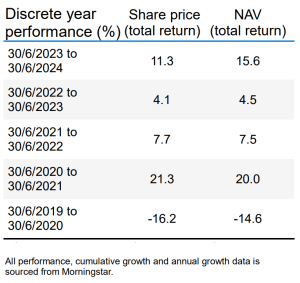
Source: Morningstar as at 30/06/2024. Past performance does not predict future returns.
Consumer price index (CPI)
A measure that examines the price change of a basket of consumer goods and services over time. It is used to estimate inflation. ‘Headline’ CPI inflation is a calculation of total inflation in an economy, and includes items such as food and energy, where prices tend to be more volatile. ‘Core’ CPI inflation is a measure of inflation that excludes transitory/volatile items such as food and energy.
Dividend
A variable discretionary payment made by a company to its shareholders.
Gearing
Gearing is a measure of a company’s debt relative to its equity, showing how far its operations are funded by lenders versus shareholders. Investment trusts: The effect of borrowing money for investment purposes (financial gearing). The amount a company can “gear” is the amount it can borrow in order to invest.
Index
A statistical measure of group of basket of securities, or other financial instruments. For example, the S&P 500 Index indicates the performance of the largest 500 US companies’ stocks. Each index has its own calculation method, usually expressed as a change from a base value.
Inflation
The rate at which the prices of goods and services are rising in an economy. The Consumer Price Index (CPI) and Retail Price Index (RPI) are two common measures. The opposite of deflation.
Investment trust
An investment trust is a form of investment fund, specifically a publicly traded collective investment scheme that invests its shareholders’ money in the shares of other companies.
Share price
The price to purchase (or sell) one share in a company, not including fees or taxes.
Underlying yield
The underlying yield calculates the annualised income of a fund, including expenses, as a percentage of the unit price. It provides a snapshot of the fund at the given date, as an indicator of the potential income that investors they could expect to receive. It is not guaranteed and does not include any tax that investors may be liable to pay.