
Key takeaways:
- International equities could see further upside if improving profitability supports a sustained re-rating. Many markets still trade at discounts that appear inconsistent with emerging improvements in ROE.
- Corporate reform is becoming a key catalyst across international markets. Policymakers, regulators and shareholders are driving changes that aim to improve capital allocation, governance and shareholder returns.
- The investment case is shifting from cheap valuations to improving quality. Markets such as Japan, South Korea and parts of Europe are showing signs of stronger profitability that could narrow the gap with the US over time.
For much of the past two decades, international equities have lagged the US. While differences in economic and earnings growth rates have played a role, the gap in corporate profitability has been just as important.
Historically, markets that generate higher returns on equity (ROE) have typically and consistently command higher valuations. The US has excelled at delivering superior profitability and shareholder returns. By contrast, many international markets struggled with lower profitability, weaker capital allocation and subdued returns, resulting in persistent underperformance.
However, there are growing signs that this long-standing trend is beginning to shift.
One of the questions we are most frequently asked is whether the international equity rally that began in 2025 can continue.
The answer may depend less on macroeconomics and more on whether international companies can deliver a sustained improvement in profitability. If they can, today’s valuation discounts may prove difficult to justify.
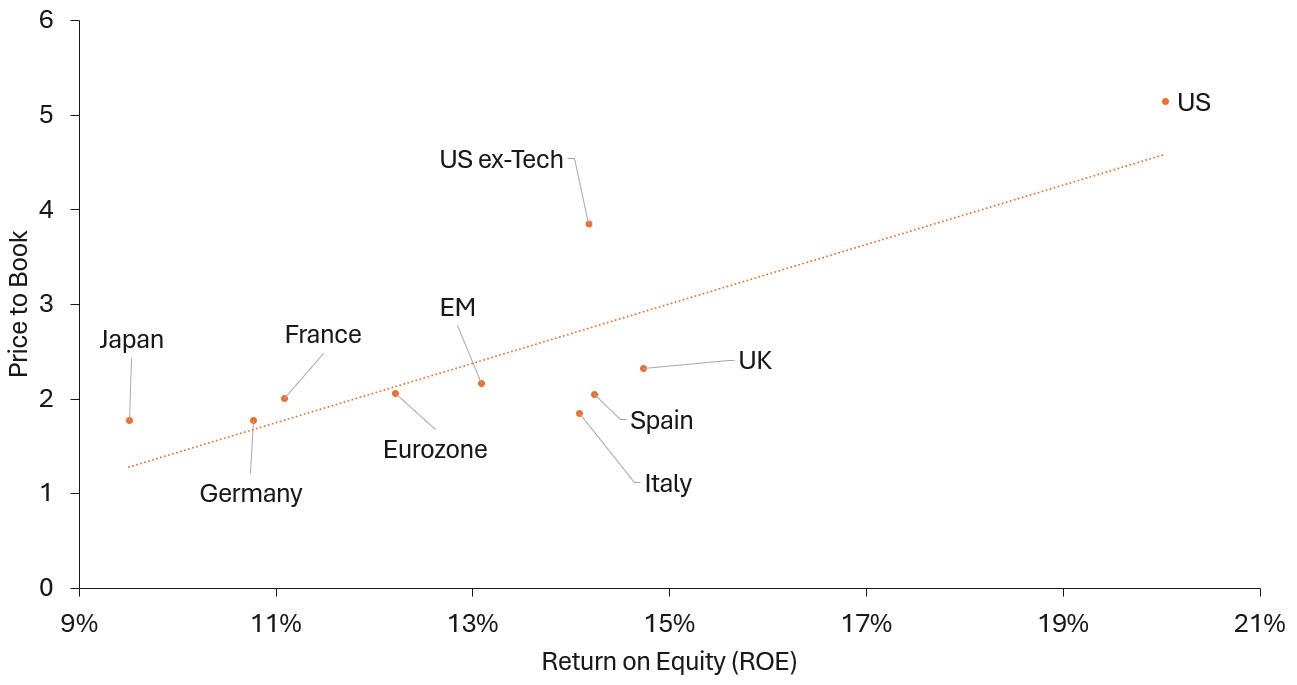
Chart 1: Equity valuations tend to reflect profitability – some ex-US markets look potentially undervalued
Source: Barclays Investment Research, Janus Henderson Investors, LSEG Workspace, indices represented by the Datastream index for the representative region. Data as at 8 May 2026. Past performance does not predict future results.
Chart 1 plots major equity markets by ROE and valuation (price-to-book). The relationship is intuitive: more profitable markets tend to attract higher valuations. The US sits at one end of the spectrum, combining industry-leading profitability with premium valuations, while many international markets occupy the opposite end. While this is a top-down assessment of those markets, it ultimately derives from the qualities of individual businesses. Companies that generate more profit from shareholders’ capital are, all else equal, more valuable. Within the US, for example, the picture looks quite different when we exclude the tech sector, with the broader market’s ROE much closer to the rest of the world.
However, there is another important observation; many international markets sit below where the historical relationship between ROE and valuation would suggest. If recent developments indicate a sustained improvement in ROEs, there is plenty of room for valuations to potentially move higher over time and deliver great returns for equity investors.
Pressure from the top and the bottom
International equity underperformance has not been accidental. Following the Global Financial Crisis, many markets experienced a prolonged period of tighter regulation, lower risk appetite and weaker innovation. Improving profitability and shareholder returns often became secondary priorities.
Combined with entrenched governance issues, inefficient balance sheets and sprawling conglomerate structures, this created little reason for investors to pay higher valuations.
What makes today different is that pressure for change is now coming from both the top and the bottom.
Governments, regulators and stock exchanges across Europe and Asia are increasingly focused on improving corporate returns. At the same time, investors and activist shareholders are pushing management teams to address excess cash, underperforming assets, cross-shareholdings and low payout ratios.
The result is an emerging wave of corporate reform. Across many international markets, companies are simplifying structures, improving capital allocation and placing greater emphasis on shareholder returns, echoing changes seen in the US over previous decades.
Japan provides one of the clearest examples of this shift.
Chart 2: Value of share buybacks (Trn ¥)
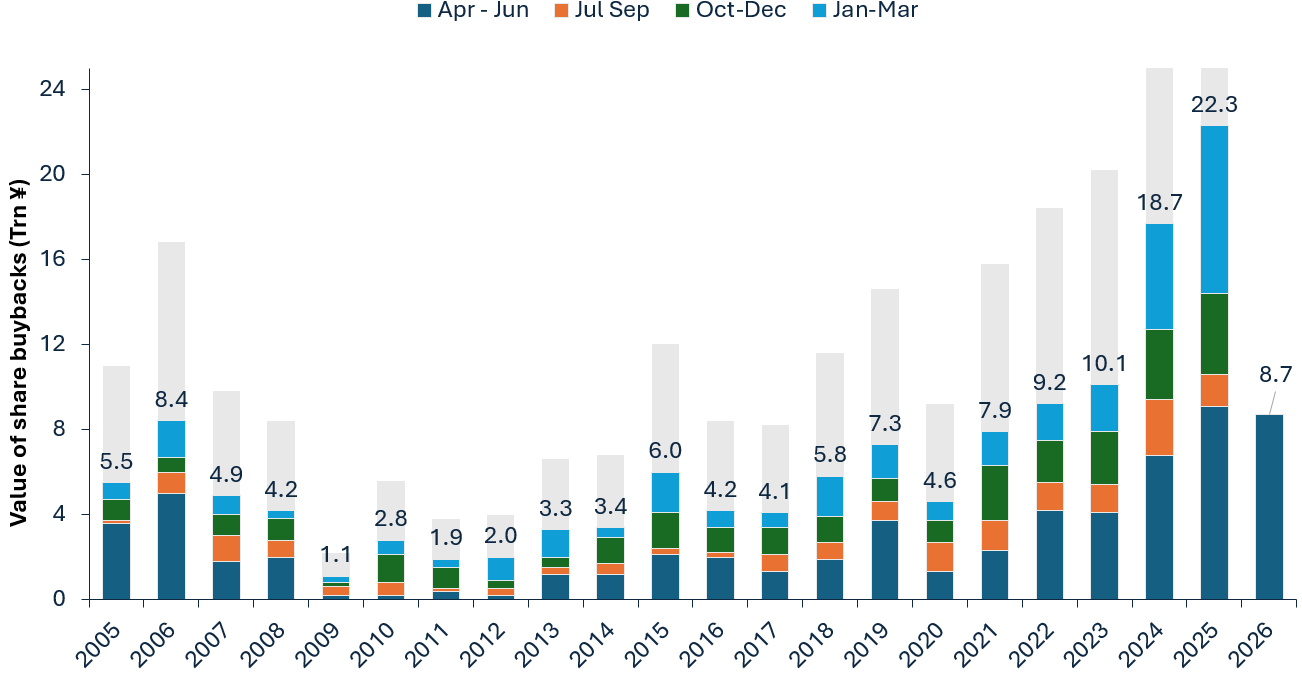
Source: JPMorgan, Nikkei Quick, Bloomberg, Janus Henderson Investors analysis, as at 30 June 2026. Chart showing the value of buybacks by companies within the Tokyo Stock Exchange First Section in Trn ¥. There is no guarantee that past trends will continue, or forecasts will be realised.
Corporate reform reshaping Asia’s equity markets
For decades, Japanese companies were characterised by low ROE, excessive cash holdings and limited focus on shareholder returns. That began to change when policymakers concluded that weak corporate profitability was constraining both economic growth and stock market performance.
The Tokyo Stock Exchange played a pivotal role, urging companies to improve capital efficiency and focus on valuations, while broader governance reforms strengthened board accountability and shareholder engagement.
The impact has been tangible. Share buybacks have increased, dividend payout ratios have risen, balance sheets have become more efficient and ROEs have improved. Japanese equities now trade at levels not seen for more than 30 years.
South Korea is pursuing a similar path. Its “Value-Up” reforms aim to improve corporate governance, strengthen shareholder rights and increase capital efficiency. As in Japan, the goal is simple: improve returns and close the valuation gap with global peers.
If these reforms lead to lasting behavioural change, the investment implications could be significant.
Europe and the UK: Reform driven by necessity
While Japan and South Korea have pursued explicit corporate reforms, Europe and the UK are being pushed in the same direction by necessity.
Years of weaker equity returns have created challenges that policymakers can no longer ignore. First, the region has not benefited from the same wealth effect as the US, partly due to performance and partly due to much lower allocation of savings to domestic equities in the region. Second, demographics are becoming impossible to ignore. Ageing populations and insufficient retirement savings are turning pension adequacy into a growing political issue. Without stronger long-term investment returns, pension shortfalls are likely to widen. Third, companies themselves are signalling dissatisfaction with the status quo. A growing number of firms are choosing to delist or pursue US listings, attracted by the prospect of higher valuations and deeper pools of capital.
For policymakers, this is about far more than stock market performance. Stronger equity markets support investment, innovation and entrepreneurship, helping to drive productivity, economic growth and job creation. As a result, improving corporate profitability and shareholder returns is increasingly becoming an economic priority.
A changing landscape creates opportunity
International markets trade at a discount today because many companies have historically delivered lower profitability, weaker capital discipline and poorer shareholder returns than their US peers.
The key question is whether that is beginning to change.
For investors, the opportunity is clear. Many international markets continue to trade at valuation levels that appear inconsistent with the improving profitability now emerging beneath the surface. It will not take a dramatic shift to drive attractive returns from current levels. Even modest but sustained improvements in ROE can support meaningful re-ratings, particularly in markets trading below what their profitability would historically imply.
In our view, the most attractive opportunities may be found where these changes are already underway, but where valuations have yet to fully reflect the progress being made.
Activist shareholder: An investor who seeks to influence a company’s management, strategy, governance, or capital allocation to improve shareholder value.
Balance sheet: A financial statement showing a company’s assets, liabilities and shareholders’ equity at a specific point in time.
Capital allocation: The process by which management decides how to invest, distribute, or retain a company’s financial resources.
Capital discipline: A company’s ability to deploy capital efficiently and avoid investments that fail to generate adequate returns.
Capital efficiency: A measure of how effectively a company uses its capital to generate profits and growth.
Corporate governance: The system of rules, practices and oversight through which a company is directed and controlled.
Cross shareholdings: A structure in which companies own shares in one another, often creating complex ownership relationships.
Discount: Refers to a situation when a security is trading for lower than its fundamental or intrinsic value. The opposite of trading at a premium.
Dividend payout ratio: The percentage of a company’s earnings distributed to shareholders as dividends.
Earnings: A company’s profit after expenses, taxes and other costs have been deducted from revenue.
Economic growth: An increase in the production of goods and services in an economy, typically measured by GDP growth.
Equities: Ownership interests in companies, typically represented by shares or stocks.
Equity re-rating: An increase in a company’s or market’s valuation multiple due to improved investor perceptions, prospects or profitability.
Global Financial Crisis (GFC): The severe worldwide financial downturn that began in 2007-2008 and led to significant economic disruption.
International equities: Shares of companies listed outside an investor’s domestic market.
Market valuation: The value assigned by investors to a company or market, often expressed using valuation ratios.
Price-to-book (P/B) ratio: A valuation measure comparing a company’s market value with its book value (net assets).
Return on equity (ROE): A measure of profitability that shows how effectively a company generates profits from shareholders’ equity.
Share buyback: When a company repurchases its own shares from investors, reducing the number of shares outstanding.
Shareholder engagement: Interaction between shareholders and company management regarding strategy, governance and performance.
Valuation: An assessment of the worth of a company, asset or market.
Valuation discount: A situation where a company, sector or market trades at a lower valuation than comparable peers or historical norms.
South Korea’s corporate “Value-Up” programme is a government and market-led initiative launched in 2024 by the Financial Services Commission to fix the “Korea discount” by boosting capital efficiency, shareholder returns, and corporate governance.
Wealth effect: The tendency for consumers to spend more when the value of their assets, such as equities or property, increases.
These are the views of the author at the time of publication and may differ from the views of other individuals/teams at Janus Henderson Investors. References made to individual securities do not constitute a recommendation to buy, sell or hold any security, investment strategy or market sector, and should not be assumed to be profitable. Janus Henderson Investors, its affiliated advisor, or its employees, may have a position in the securities mentioned.
Past performance does not predict future returns. The value of an investment and the income from it can fall as well as rise and you may not get back the amount originally invested.
The information in this article does not qualify as an investment recommendation.
There is no guarantee that past trends will continue, or forecasts will be realised.
Marketing Communication.