
Key takeaways:
- The AI infrastructure buildout remains a dominant narrative, driving an exceptionally bifurcated market with heightened performance dispersion, volatility, and index concentration risk.
- We believe in selectively participating in the AI theme but see midcap growth as one of the better places to find a mix of business models and drivers that can support portfolio diversification.
- We continue to see opportunities in healthcare innovation and industrials and transports — areas potentially offering durable, differentiated growth beyond the AI narrative.
The AI infrastructure buildout has become central to nearly every corner of the U.S. equity market, and midcaps are no exception. The intense focus on companies tied to data center construction, power systems, and specialized hardware has created an exceptionally bifurcated market environment with heightened performance dispersion and volatility.
We believe a market being carried by one narrative makes portfolio construction more important, not less. It also strengthens the case for mid-cap growth as one of the better places to find a mix of business models and growth drivers — diversification that has become harder to find in other parts of the market.
Concentration risk in indices and in valuations
Concentration shows up in two places today: the benchmark itself, and the valuations assigned to the stocks driving it.
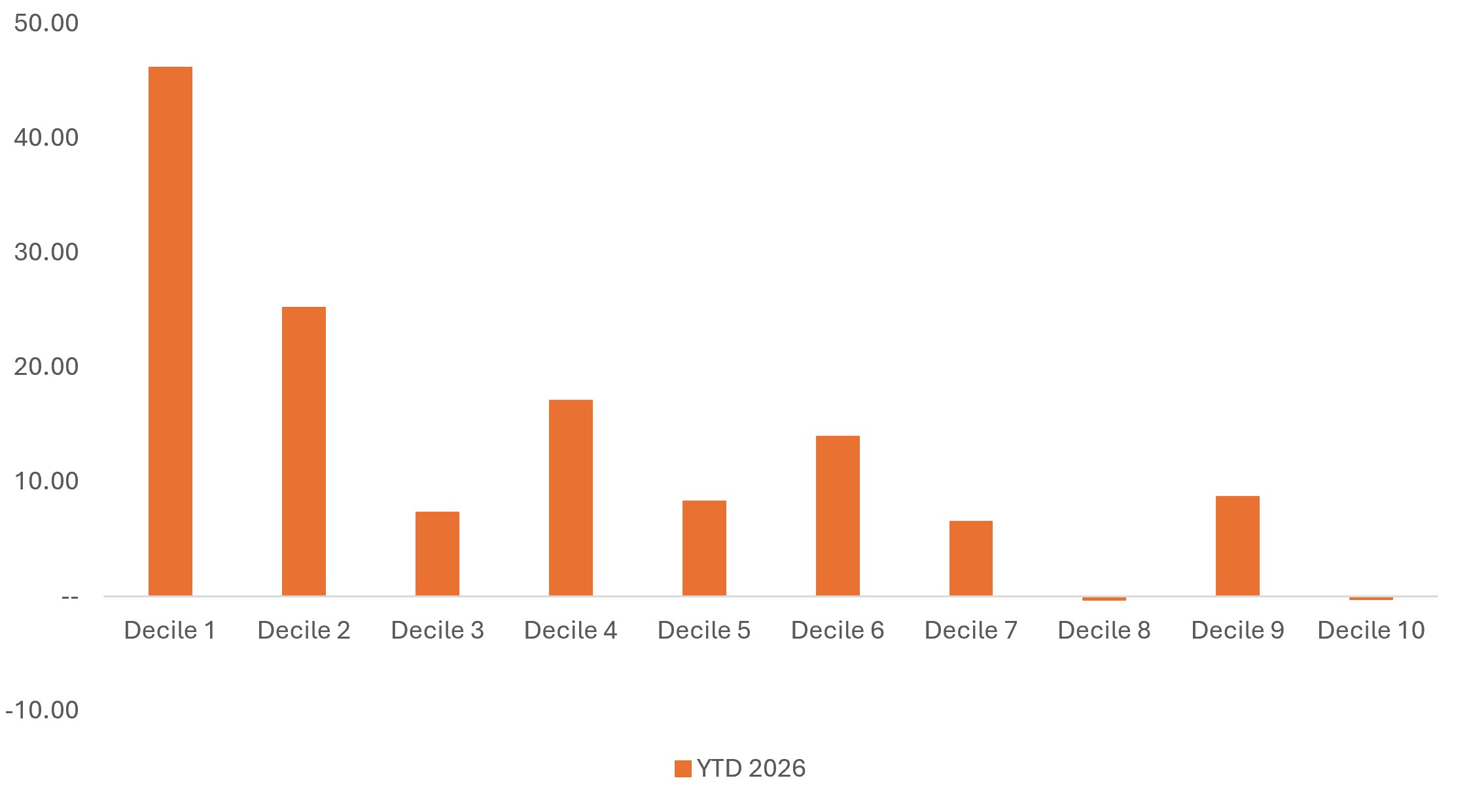
Equity indices have grown more concentrated than at any point in recent history, both in the number of holdings driving index returns and in the industries behind them. With the Russell Midcap Growth Index, its elevated risk profile becomes clear when examining performance by valuation metrics. In the first half of 2026, the top decile by price-to-sales ratio returned more than 45%, while the second most expensive decile returned about 25%. The remaining 80% of the index posted an average return of 7.6% (Exhibit 1).
Exhibit 1: Total return by price-to-sales decile (%) of the Russell Midcap Growth Index
Expensive stocks continued to drive returns in first half of 2026.
Source: FactSet, Bloomberg, as of 30 June 2026.
When high concentration is embedded in an index, its makeup can shift quickly. Following Russell’s annual reconstitution on June 27, several AI beneficiaries graduated out of the Russell Mid Cap Growth Index, while several others entered. Interestingly, the changes pushed the Technology sector weighting up more than 12% and the Consumer Discretionary weighting down about 8%.
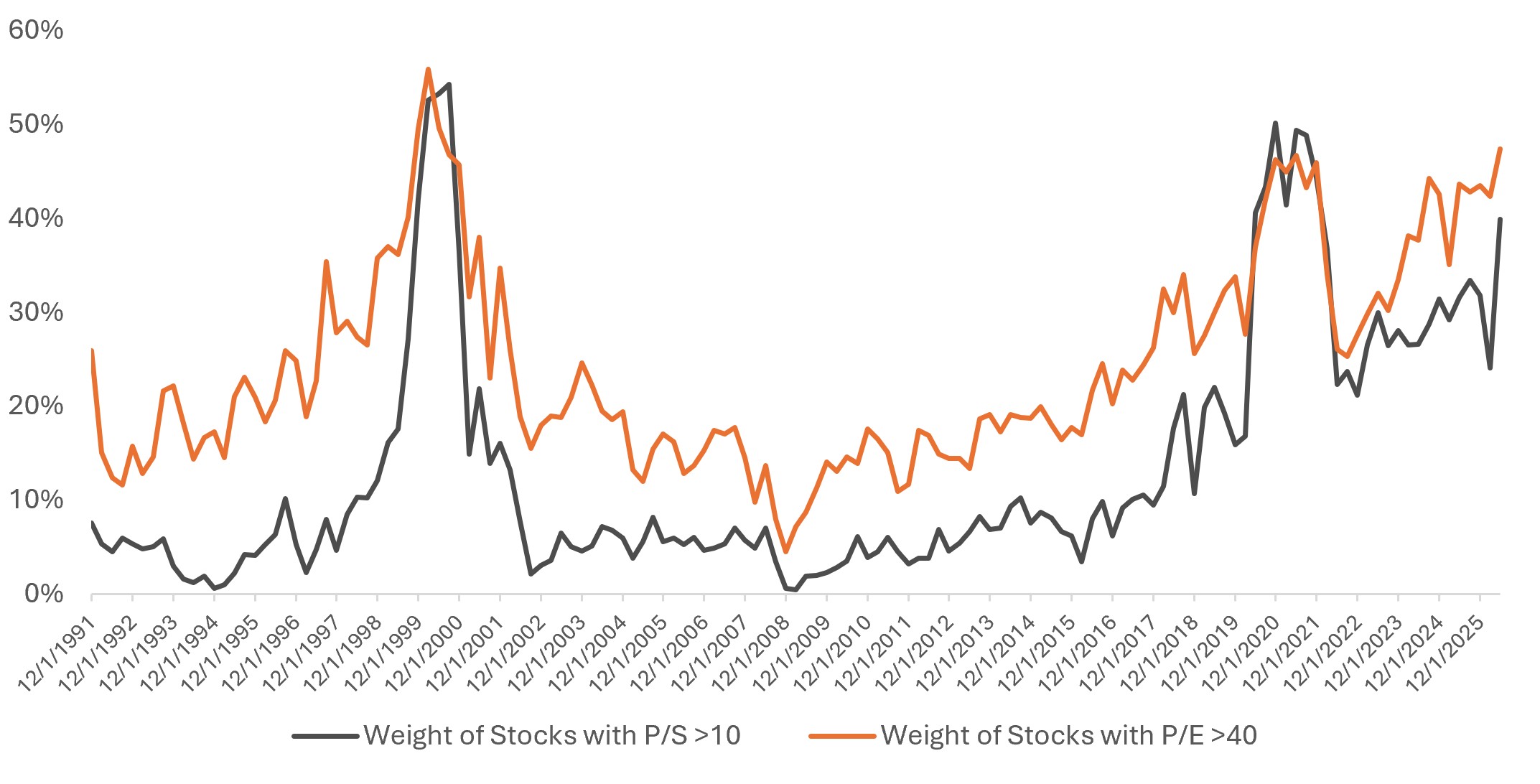
The same dynamic shows up in price: When one theme drives most of the market’s return, the stocks tied to it are often priced for perfection, leaving little room for error if the trend slows.
Exhibit 2: Percent weight of Russell Midcap Growth Index stocks with price-to-sales greater than 10 and price-to-earnings greater than 40
Valuations remain elevated relative to history.
Source: Janus Henderson Investors, FactSet, as of June 30, 2026.
This concentration can benefit investors when the dominant theme performs well, but it becomes a liability the moment that theme falters. In large cap, AI has become so dominant that other secular themes are effectively diluted. According to Bloomberg Intelligence, its thematic AI basket – 44 companies representing roughly 45% of the S&P 500® Index’s market cap – has generated most of the Index’s earnings growth since 2024 and margin expansion since 2022.1
That is less true in midcap, where AI infrastructure stocks and other beneficiaries currently represent about 20%-25% of the Russell Midcap Growth Index. We believe a diversified portfolio in midcap can still capture AI infrastructure growth alongside a range of other, less crowded growth drivers — which is where we see some of the more attractive opportunities today.
AI beneficiaries: Remaining selective
Overall, we’re constructive on AI’s potential to drive growth and transform the economy. The capital spending against this opportunity has already become a significant component of gross domestic product (GDP) and a key driver of its expansion.
We continue to see durable strength in advanced compute, memory, semiconductor process control, and in the data center power, cooling, and manufacturing platforms serving hyperscalers. But we remain selective, favoring companies with durable competitive advantages and sustainable growth underpinned by market share gains or service-oriented revenues that stand to benefit under a range of scenarios for AI CapEx growth.
Importantly, valuations must be supported by expected earnings growth over the next three to five years. AI momentum has pushed valuations in parts of the mid-cap market to extreme levels. The largest large-cap technology companies trade around 20 to 25 times earnings, while some mid-cap AI beneficiaries have soared to 60 or 70 times. Multiples on many AI infrastructure stocks require CapEx spend to continue growing at high rates for many years to come, which may be hard to sustain.
Healthcare innovation
Outside AI, we see healthcare innovation as one of the most compelling growth areas, with opportunities across life science tools, biotechnology, and medical devices.
Life science tools are emerging from a prolonged post-pandemic downturn as inventories normalize. In biotechnology, we see novel therapies in areas of significant unmet medical need and large pharmaceutical companies increasingly acquiring innovative pipelines to replace expiring patents – activity that can lead to substantial shareholder returns.
In medical devices, we expect steady growth in surgical and clinical procedure volumes driven by demographic demand. Many of these stocks are currently out of favor and disconnected from their long-term growth potential, but we believe improved capital allocation and operating discipline could create substantial value over the next three to five years.
Industrials and transports
We are also constructive on industrials and transports, as reindustrialization and decarbonization are creating a better multi-year backdrop for the industrial economy than we have seen in years. Electrification is accelerating across transportation, machinery, consumer devices, and infrastructure, with semiconductors and specialized equipment among the beneficiaries.
Transportation, in particular, is emerging from a cyclical downturn that has persisted since the pandemic-era shipping boom of 2020 and 2021. We are seeing early signs this downturn is bottoming as inventories normalize, and tighter federal regulation on commercial driver capacity could accelerate a recovery in freight pricing and profitability once the market tightens.
Maintaining exposure to varied growth drivers
Markets tend to overreact to short-term results, reward the most exciting current narrative, and discount businesses delivering steadier, longer-term growth. That mismatch between the market’s time horizon and the time many investment theses take to play out is where we see opportunity.
AI beneficiaries, healthcare innovators, and industrial businesses are unlikely to progress on the same timeline. Some opportunities may be recognized quickly. For others, it may take years for a recovery, operating improvement, or secular trend to become visible.
And that is a central benefit of diversification today: It keeps investors exposed to a varied set of growth drivers, so that when one theme dominates sentiment, the rest of the story playing out in the background is not lost.
Price-to-Earnings (P/E) Ratio measures share price compared to earnings per share for a stock or stocks in a portfolio.
Price-to-sales (P/S) ratio is an investment metric used to determine a company’s valuation by comparing its stock price to its revenue.
Russell Midcap® Growth Index reflects the performance of U.S. mid-cap equities with higher price-to-book ratios and higher forecasted growth values.
IMPORTANT INFORMATION
Artificial intelligence (“AI”) focused companies, including those that develop or utilize AI technologies, may face rapid product obsolescence, intense competition, and increased regulatory scrutiny. These companies often rely heavily on intellectual property, invest significantly in research and development, and depend on maintaining and growing consumer demand. Their securities may be more volatile than those of companies offering more established technologies and may be affected by risks tied to the use of AI in business operations, including legal liability or reputational harm.
Diversification neither assures a profit nor eliminates the risk of experiencing investment losses.
Health care industries are subject to government regulation and reimbursement rates, as well as government approval of products and services, which could have a significant effect on price and availability, and can be significantly affected by rapid obsolescence and patent expirations.
Smaller capitalization securities may be less stable and more susceptible to adverse developments, and may be more volatile and less liquid than larger capitalization securities.
1Bloomberg Intelligence US Equities 2H26 Outlook, May 12, 2026.
These are the views of the author at the time of publication and may differ from the views of other individuals/teams at Janus Henderson Investors. References made to individual securities do not constitute a recommendation to buy, sell or hold any security, investment strategy or market sector, and should not be assumed to be profitable. Janus Henderson Investors, its affiliated advisor, or its employees, may have a position in the securities mentioned.
Past performance does not predict future returns. The value of an investment and the income from it can fall as well as rise and you may not get back the amount originally invested.
The information in this article does not qualify as an investment recommendation.
There is no guarantee that past trends will continue, or forecasts will be realised.
Marketing Communication.