Chart to Watch: Are rising bond yields getting you down?
It has been a tough year for traditional fixed income benchmarks given the sharp rise in government bond yields, with the G7 Government Index and Global Aggregate Bond Index (Global Agg) returning -2.5% and 1.5% respectively.*
In the US, lacklustre performance has been driven by a surge in yields (the 10-year U.S. Treasury has risen 83 basis points (bps) since the beginning of the year) on the back of reaccelerating inflation due to the Iran War, robust corporate earnings, heavy government and corporate debt issuance, large fiscal deficits, and a more hawkish Federal Reserve.
Globally, the story in other developed nations has been similarly bleak, with yields rising sharply on 10-year government bonds in Germany (+48 bps), Japan (+72 bps), the UK (+89 bps), and France (+146 bps).
Portfolio Managers John P Kerschner, Denis Struc and Nick Childs discuss why AAA rated collateralised loan obligations (CLOs) have outperformed benchmark fixed income indices with lower volatility thus far in 2026.
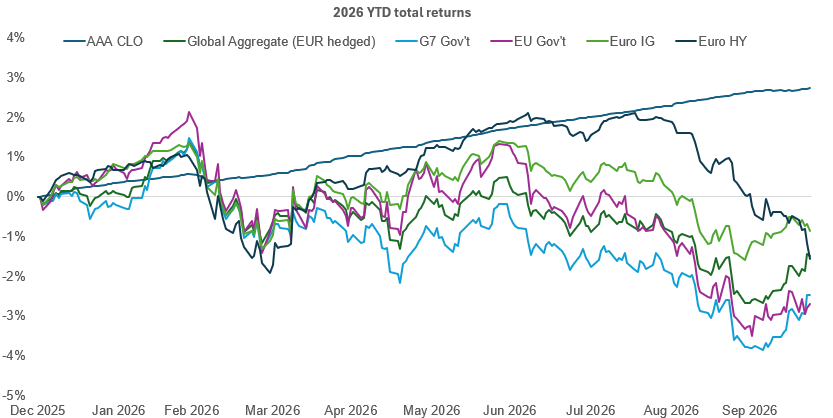
Source: Bloomberg, as of 23 October 2026. All returns are in Euros or EUR hedged. Indices used to represent asset classes: Global Agg = Bloomberg Global Aggregate Bond Index (EUR hedged), G7 Gov't = Bloomberg G7 Government Bond Index; EU Gov't — Bloomberg Euro Aggregate Treasury Index; Euro IG= ICE BofA Euro Corporate Index; Euro HY= ICE BofA Euro High Yield; European AAA CLOs = J.P. Morgan CLOIE AAA Index. Past performance does not predict future results.
Carry, or coupon income, is the most significant contributor to long-term returns on fixed income assets. Changes to bond prices are a secondary driver of returns, and can either add to, or detract from, carry returns. Long-duration bonds move more than short-term bonds when yields fluctuate, all else equal. Our preferred approach in the present environment is to a) focus on high-coupon bonds, b) be up in credit quality, and c) keep duration low to protect against fluctuations in yields. Currently yielding around 4%*** with a AAA rating and almost no duration risk, AAA CLOs check all the boxes, in our view, and have shown why they have been a consistent standout performer.
Key takeaways
- Looking across traditional fixed income sectors, investor returns in 2026 have been dragged down by poor performance within sovereign debt. In contrast, European AAA CLOs have returned nearly 3% year to date and have exhibited 90% less volatility than the Global Agg and corporate credit indices, supported by floating-rate income and lower spread duration. **
- AAA CLO credit spreads have remained tight amid robust economic growth, while this floating-rate structure means they stand to benefit when rates rise, as their coupons reset quarterly. Even if cash rates eventually fall, the additional credit spread on AAA CLOs can help cushion the impact on income.
- Given the heightened geopolitical and monetary policy uncertainty, we think fixed income investors should seek to maximise carry while keeping portfolio volatility to a minimum in the current environment. Attractive starting yields and supportive technicals suggest carry could remain a key driver of AAA CLO returns into 2027.
* Source: Bloomberg, in Euros, 31 December 2025 to 23 October 2026.
** Source: Bloomberg, daily year-to-date standard deviation as of 23 October 2026. Year-to-date annualised daily volatility is only 0.2% for Euro AAA CLOs, much lower than the circa 3% seen in European investment grade corporate and government markets.
*** Source: Bloomberg, as at 29 October 2026. J.P. Morgan CLOIE AAA Index.
Collateralized Loan Obligations (CLOs) are debt securities issued in different tranches, with varying degrees of risk, and backed by an underlying portfolio consisting primarily of below investment grade corporate loans. The return of principal is not guaranteed, and prices may decline if payments are not made timely or credit strength weakens. CLOs are subject to liquidity risk, interest rate risk, credit risk, call risk and the risk of default of the underlying assets.
Fixed income securities are subject to interest rate, inflation, credit and default risk. The bond market is volatile. As interest rates rise, bond prices usually fall, and vice versa. The return of principal is not guaranteed, and prices may decline if an issuer fails to make timely payments or its credit strength weakens.
Securitized products, such as mortgage- and asset-backed securities, are more sensitive to interest rate changes, have extension and prepayment risk, and are subject to more credit, valuation and liquidity risk than other fixed-income securities.
Credit quality ratings are measured on a scale that generally ranges from AAA (highest) to D (lowest).
A credit spread is the difference in yield between a corporate or securitized bond and a government bond (such as a U.S. Treasury) of the same maturity. It compensates investors for the risk that the borrower might default.
Spread duration: A measure of how sensitive a bond or other fixed income security’s price is to changes in its credit spread. A lower spread duration means its price is less sensitive to movements in credit spreads.
Volatility measures risk using the dispersion of returns for a given investment.
These are the views of the author at the time of publication and may differ from the views of other individuals/teams at Janus Henderson Investors. References made to individual securities do not constitute a recommendation to buy, sell or hold any security, investment strategy or market sector, and should not be assumed to be profitable. Janus Henderson Investors, its affiliated advisor, or its employees, may have a position in the securities mentioned.
Past performance does not predict future returns. The value of an investment and the income from it can fall as well as rise and you may not get back the amount originally invested.
The information in this article does not qualify as an investment recommendation.
There is no guarantee that past trends will continue, or forecasts will be realised.
Marketing Communication.