
Key takeaways:
- Higher interest rates have restored attractive income opportunities, driving strong demand for fixed maturity bond funds as investors seek to lock in yields and greater income certainty.
- Fixed maturity bond funds combine predictable income and a defined maturity date with diversification and professional credit oversight, helping reduce the concentration risk of holding a single bond.
- For investors satisfied with current yields, fixed maturity portfolios can provide greater certainty over future income and capital return, making short-term rate fluctuations less important.
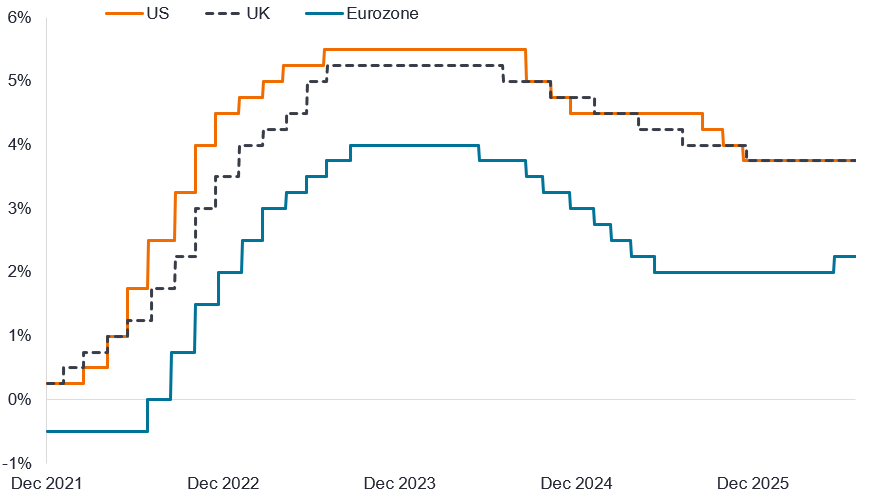
Do you remember the summer of 2022? It was a pivotal year for interest rates because July was when the European Central Bank (ECB) finally ended its negative interest rate policy that had been in place for almost a decade, lifting rates from -0.5% to 0%. By September of 2022, the key deposit rate was hiked from 0% to 0.75%. It has become something of a cliche to talk about a paradigm shift, but the aftermath of the Covid pandemic and Ukraine War set in motion a return to a more normalised interest rate environment.
Figure 1: Central bank policy interest rates
Source: US Federal Reserve, European Central Bank, Bank of England, 31 December 2021 to 31 July 2026.
The income drought that had tormented investors was over. The rapid uplift in yields as bonds repriced created something of an opportunity. Why not lock in higher yields in case rates came down?
We have said before that investors value the predictability of steady income and the return of capital at a defined maturity date that a single bond offers. But this comes with a high degree of concentration risk – what if the bond defaults?
A potential solution is fixed maturity bond funds, which combine the core features of a single bond (regular predictable coupon and fixed maturity date) with the key benefits offered by a fund (diversification across many bonds, together with security selection and monitoring by investment professionals).
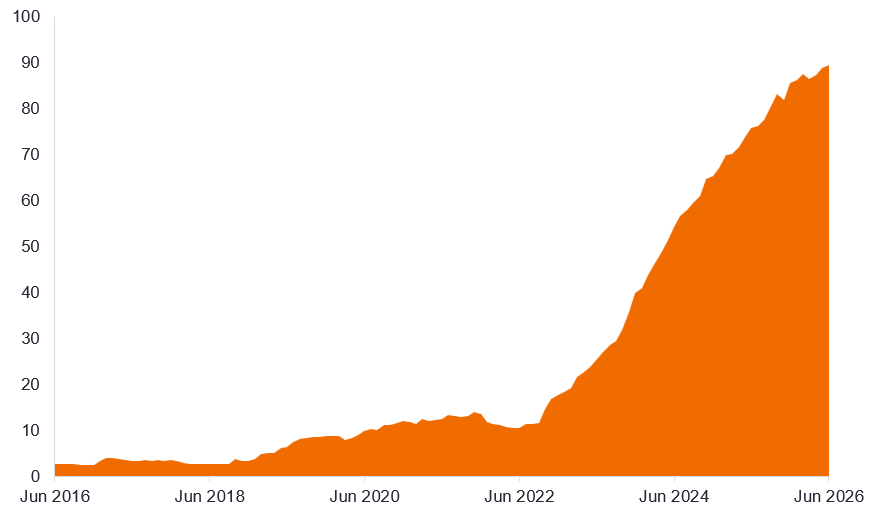
Investors concurred. The last three years saw massive investor interest in fixed maturity bond funds across the industry, as investors were keen to lock in the higher level of income available given the uncertain path for interest rates.
Figure 2: Morningstar Category: Fixed Term Bond assets
Assets under management (€ billion)
Source: Morningstar Direct, Morningstar EAA Fixed Term Bond Category, assets under management, in billions of euro, assets show only funds available in Europe, Asia or Africa, 30 June 2016 to 30 June 2026.
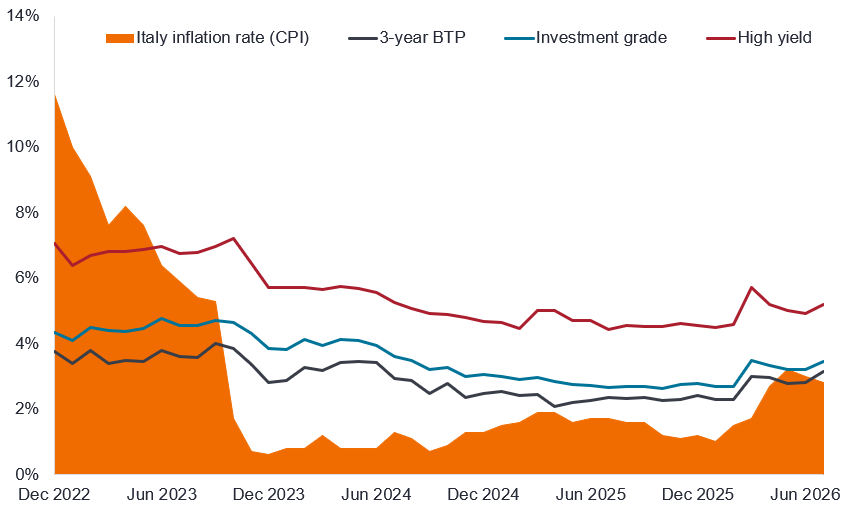
As inflation receded from its cyclical peak investors in shorter-dated bonds have typically benefited from positive real yields (i.e. yields that have been above inflation), helping to maintain purchasing power as seen in Italy, for example (Figure 3). Many fixed maturity bond portfolios are structured with terms of around three years to maturity, so Figure 3 uses asset classes and indices that have relatively short durations (between 2 to 3 ½ years).
Figure 3: Italian inflation and yields on European bonds
Source: Bloomberg, Italy inflation rate (consumer price index), year-on-year % change, 3-year BTP : Bloomberg generic 3-year Italian government bond, Euro investment grade: ICE BofA 1-3 Year BBB Euro Corporate Index, Euro high yield: ICE BofA BB-B Euro High Yield Index, yield to worst, 31 December 2022 to 31 July 2026. Yield to worst is the lowest yield a bond can achieve provided the issuer does not default and accounts for any applicable call feature (i.e. the issuer can call the bond back at a date specified in advance). Yields may vary over time and are not guaranteed.
Where now for rates?
Should investors be worried about the more elevated inflation of recent months? Clearly, the conflict in the Middle East, together with the costs of the build out of artificial intelligence and the El Niño weather effects on crops have had an impact on inflation.
The ECB has been quick to respond, however, lifting interest rates in June (see Figure 1) and may even raise rates again at their September policy meeting.1 It is a moot point whether such hikes are misguided. Could the ECB be committing the same mistake they made back in 2011, when they raised rates into an energy price spike, only to have to reverse course six months later as the economy slowed?
A fixed maturity bond portfolio is designed to provide investors with a stable and relatively predictable level of income over a set investment period. This naturally involves a trade-off. Should interest rates fall, the income generated by the portfolio is expected to remain steady. Conversely, if rates rise, investors are unlikely to capture the full benefit of those higher market yields.
When evaluating a fixed maturity bond portfolio, investors should consider whether the current yield meets their income objectives over the investment horizon. Provided they are satisfied with that yield, fluctuations in interest rates become less significant, since the investment is intended to maintain an income stream close to today’s levels.
Different approaches, same goal
There are different ways to construct fixed maturity bond portfolios. One way is to create a portfolio of corporate bonds with maturities that are close to the maturity date. Another is to create a portfolio of corporate bonds synthetically using government bonds as a base, overlaid with credit default swaps (derivatives that can help generate additional income and offset risk, allowing a portfolio manager to express a view on a corporate bond). Both methods have their merits. The first is less complex but requires careful cash management as the maturity date approaches. The second involves more structuring work but can offer better alignment with the maturity date. Either method is ultimately seeking to deliver a regular level of income for investors.
Credit discipline
In our view, fixed maturity portfolios need to be built around a clear maturity date, income profile and risk budget and not simply be a static basket of bonds. Credit losses could potentially endanger the level of income paid out, so it is important to employ a management team with deep credit expertise and who can respond to changing circumstances. This is where a management team with experience in constructing and managing this type of portfolio is key. A global research footprint can help source the best opportunities, which may mean including high yield alongside investment grade to exploit price inefficiencies and enhance yield. The result is a more selective, conviction-led approach to income generation. In a market where European growth remains uncertain and credit dispersion is likely to persist, this matters.
For investors content with current bond yields and keen to have a degree of certainty over the income their portfolio generates and a known maturity date, we believe a fixed maturity bond portfolio may offer a compelling proposition.
1Source: Bloomberg, World Interest Rate Projections, 87% chance of a 25-basis point rate hike implied by markets, 4 August 2026. One basis point equals 1/100 of a percentage point. 1 bp = 0.01%, 100 bps = 1%. There is no guarantee that past trends will continue, or forecasts will be realised.
High-yield or “junk” bonds involve a greater risk of default and price volatility and can experience sudden and sharp price swings.
Fixed income securities are subject to interest rate, inflation, credit and default risk. The bond market is volatile. As interest rates rise, bond prices usually fall, and vice versa. The return of principal is not guaranteed, and prices may decline if an issuer fails to make timely payments or its credit strength weakens.
Corporate bond: A bond issued by a company. Bonds offer a return to investors in the form of periodic payments and the eventual return of the original money invested at issue on the maturity date.
Credit default swap (CDS): A derivative that enables an investor to swap or offset their credit risk (the risk that a borrower defaults on meeting its repayment obligations). It allows the transfer of credit risk from one counterparty to another. CDS can therefore be useful in fund management as it allows a fund manager to express a positive or negative view on a corporate bond.
Credit rating: A score given by a credit rating agency such as S&P Global Ratings, Moody’s and Fitch on the creditworthiness of a borrower. For example, S&P ranks investment grade bonds from the highest AAA down to BBB and high yields bonds from BB through B down to CCC in terms of declining quality and greater risk, i.e. CCC rated borrowers carry a greater risk of default.
Credit risk: The risk that a borrower will default on its contractual obligations to investors, by failing to make the required debt payments. Anything that improves conditions for a company can help to lower credit risk.
Coupon: A regular interest payment that is paid on a bond, described as a percentage of the face value of an investment. For example, if a bond has a face value of €100 and a 5% annual coupon, the bond will pay €5 a year in interest.
Default: The failure of a debtor (such as a bond issuer) to pay interest or to return an original amount loaned when due.
Duration: Duration can measure how long it takes (in years) for an investor to be repaid a bond’s price by the bond’s total cash flows. Duration can also measure the sensitivity of a bond’s or fixed-income portfolio’s price to changes in interest rates. The longer a bond’s duration, the higher its sensitivity to changes in interest rates, and vice versa.
El Niño: The warm phase of the El Niño–Southern Oscillation (ENSO), a natural climate pattern that shifts global weather patterns as ocean temperatures rise, often bringing drought in some regions and heavier rains and flooding in others.
High yield: A bond that has a lower credit rating than an investment grade bond. Sometimes known as a sub-investment grade bond. These bonds carry a higher risk of the issuer defaulting on their payments, so they are typically issued with a higher coupon to compensate for the additional risk.
Inflation: The rate at which prices of goods and services are rising in the economy.
Investment grade: A bond typically issued by governments or companies perceived to have a relatively low risk of defaulting on their payments. The higher quality of these bonds is reflected in their higher credit ratings.
Maturity: The maturity date of a bond is the date when the principal investment (and any final coupon) is paid to investors. Shorter-dated bonds generally mature within five years, medium-term bonds within five to 10 years, and longer-dated bonds after 10+ years.
Reinvestment risk: The risk that an investor will be unable to reinvest cash flows or proceeds from an investment at a rate comparable to the current rate of return. Callable bonds are seen as especially vulnerable to reinvestment risk because these bonds are typically called (redeemed) by the issuer when interest rates decline.
Spread/credit spread: The difference in yield between a corporate bond and that of a government bond of equivalent maturity.
Yield: The level of income on a security, typically expressed as a percentage rate. For a bond, at its most simple, this is calculated as the annual coupon payment divided by the current bond price.
These are the views of the author at the time of publication and may differ from the views of other individuals/teams at Janus Henderson Investors. References made to individual securities do not constitute a recommendation to buy, sell or hold any security, investment strategy or market sector, and should not be assumed to be profitable. Janus Henderson Investors, its affiliated advisor, or its employees, may have a position in the securities mentioned.
Past performance does not predict future returns. The value of an investment and the income from it can fall as well as rise and you may not get back the amount originally invested.
The information in this article does not qualify as an investment recommendation.
There is no guarantee that past trends will continue, or forecasts will be realised.
Marketing Communication.