Key takeaways:
- CLOs may offer resilience in uncertain rate environments, combining floating-rate exposure with high credit quality and diversification, which may help investors navigate volatility across interest rates and macro risks.
- Misconceptions around CLOs often centre on liquidity and credit risk, yet their underlying diversification and active trading market mean they have historically demonstrated greater resilience than many investors might expect.
- A global active approach is critical in CLO investing, as differences in manager risk appetite, regional exposures (such as lower tech concentration in European CLOs), and portfolio construction can materially influence risk-adjusted outcomes.
IMPORTANT INFORMATION
Actively managed portfolios may fail to produce the intended results. No investment strategy can ensure a profit or eliminate the risk of loss.
Artificial intelligence (“AI”) focused companies, including those that develop or utilize AI technologies, may face rapid product obsolescence, intense competition, and increased regulatory scrutiny. These companies often rely heavily on intellectual property, invest significantly in research and development, and depend on maintaining and growing consumer demand. Their securities may be more volatile than those of companies offering more established technologies and may be affected by risks tied to the use of AI in business operations, including legal liability or reputational harm.
Bank loans often involve borrowers with low credit ratings whose financial conditions are troubled or uncertain, including companies that are highly leveraged or in bankruptcy proceedings.
Collateralized Loan Obligations (CLOs) are debt securities issued in different tranches, with varying degrees of risk, and backed by an underlying portfolio consisting primarily of below investment grade corporate loans. The return of principal is not guaranteed, and prices may decline if payments are not made timely or credit strength weakens. CLOs are subject to liquidity risk, interest rate risk, credit risk, call risk and the risk of default of the underlying assets.
Diversification neither assures a profit nor eliminates the risk of experiencing investment losses.
Fixed income securities are subject to interest rate, inflation, credit and default risk. As interest rates rise, bond prices usually fall, and vice versa. High-yield bonds, or “junk” bonds, involve a greater risk of default and price volatility. Foreign securities, including sovereign debt, are subject to currency fluctuations, political and economic uncertainty and increased volatility and lower liquidity, all of which are magnified in emerging markets.
Technology industries can be significantly affected by obsolescence of existing technology, short product cycles, falling prices and profits, competition from new market entrants, and general economic conditions. A concentrated investment in a single industry could be more volatile than the performance of less concentrated investments and the market as a whole.
Securitised products, such as mortgage- and asset-backed securities, are more sensitive to interest rate changes, have extension and prepayment risk, and are subject to more credit, valuation and liquidity risk than other fixed-income securities.
Volatility measures risk using the dispersion of returns for a given investment.
1 Janus Henderson Investors as at 31 March 2026.
2 JP Morgan, Global Securitised Products Research as at 3 February 2026.
Active management: An investment approach in which a portfolio manager makes discretionary decisions on asset selection, allocation, and risk exposure with the objective of achieving risk-adjusted returns above a benchmark.
Capital stack: The hierarchy of tranches within a securitised structure that determines the order in which losses are absorbed and cash flows are distributed to investors.
Cash flow: The net balance of cash that moves in and out of a company. Positive cash flow shows more money is moving in than out, while negative cash flow means more money is moving out than into the company.
CLO manager: The specialist investment manager responsible for selecting, monitoring and actively managing the underlying loan portfolio within a CLO, including decisions on credit risk, diversification and trading.
Credit enhancement: This is used in a securitisation to improve the credit quality and ratings of debt tranches.
Credit quality: An assessment of the creditworthiness of a borrower or security, reflecting the likelihood that financial obligations will be met in full and on time.
Credit risk: The risk that a borrower will fail to meet its contractual obligations in full or on time, resulting in financial loss to investors.
Default: The failure of a borrower to meet the legal obligations of a debt instrument, including interest or principal payments.
Diversification: The practice of spreading investments across a range of assets or exposures to reduce the impact of any single investment on the overall portfolio.
Drawdown risk: A measure of historical risk that looks at the difference between the highest and lowest price of a portfolio or security during a specific period. It is used to evaluate the possible risk and reward of an investment.
Duration: Duration can measure how long it takes (in years) for an investor to be repaid a bond’s price by the bond’s total cash flows. Duration can also measure the sensitivity of a bond’s or fixed-income portfolio’s price to changes in interest rates. The longer a bond’s duration, the higher its sensitivity to changes in interest rates, and vice versa.
Exchange-traded fund (ETF) An investment fund that is traded on an exchange and typically tracks an index or basket of assets, offering intraday liquidity.
Floating-rate instrument: A security with an interest rate that resets periodically based on a reference rate, reducing sensitivity to changes in market interest rates.
Fundamental analysis: The evaluation of a borrower’s financial condition, business model, and economic environment to assess creditworthiness and investment value.
Interest rate risk: The risk that changes in prevailing interest rates will adversely affect the value of a fixed income investment.
Leveraged loans: Loans extended to companies with below investment grade credit ratings, typically carrying higher yields to compensate for increased risk.
Liquidity risk: The risk that an investor may not be able to buy or sell a security quickly enough at a fair price due to limited market activity.
Macro risks Broad economic or geopolitical factors, such as inflation, monetary policy, or global events, that can affect financial markets.
Portfolio construction: The process of selecting and weighting assets within a portfolio to achieve specific investment objectives and manage risk.
Risk-adjusted return: A measure of investment performance that considers both the return generated and the level of risk taken to achieve that return.
Securitised products: Financial instruments created through securitisation, such as asset-backed securities and mortgage-backed securities, which are backed by pools of underlying assets.
Spread: The additional yield earned by a security relative to a specified benchmark, such as a government bond yield curve, swap rate, or risk-free rate. In securitised markets, spread reflects compensation for credit risk, liquidity risk, structural features, prepayment uncertainty, and other risks embedded in the transaction.
Tranche: A distinct class of securities within a securitisation that has specific risk, return, and priority of payment characteristics.
Volatility: The degree of variation in the price of a financial instrument over time, often used as a measure of risk.
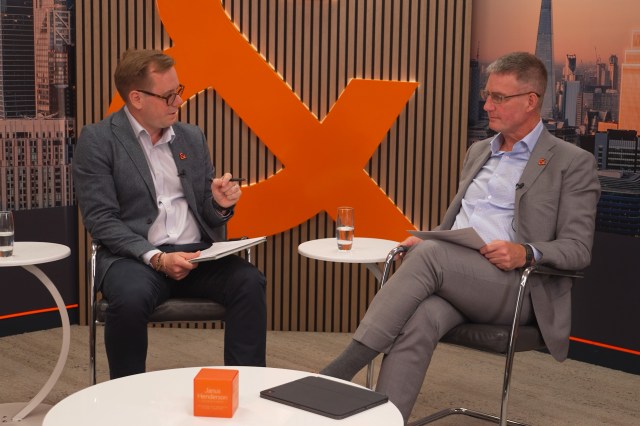
Matthew Bullock (MB): Hello and welcome. I’m Matthew Bullock. I’m the Head of Portfolio Construction and Strategy for EMEA and APAC here at Janus Henderson. Today I’m joined by John Kerschner, who is our Global Head of Securitised Products. So, John, you’re in London this week, meeting clients to talk about securitised fixed income and specifically around collateralised loan obligations, or CLOs.
So can we start with the very basics, which is what are CLOs and what makes them so well suited to the current environment.
John Kerschner (JK): Yeah, and thanks for having me. Pleasure to be here, particularly during Wimbledon and got some World Cup going on and F1. So great week to be here. But yeah for CLOs I think people make them out to be more complicated than they need to be. CLOs are a securitisation like any other securitisation, a portfolio of loans that you put together, put a framework around it, a rating, and then divide up the cash flows from those loans into different layers of risk. So that can be mortgage loans, credit card loans, auto loans. And in the case of CLOs, it’s corporate loans.
So why are CLOs important for this type of environment. I think what we’ve seen and we talked about it earlier this morning in a roundtable, is that there’s a lot of uncertainty out there, particularly when it comes to rates, whether it’s tariffs or what’s going on in the Middle East or what’s going on with the central banks globally, supply chain issues.
I think a lot of people who, if they’ve been around for a while and are used to rates just kind of being a tailwind and going down, that is no longer a case. CLOs are floating rate, but very high credit quality and often are very liquid as well. So they’re a very good addition to the portfolio because you get diversification, you get that ability to be defensive versus rates. But at the same time it’s a very high credit quality, high-yielding product. So all those things are good for our clients.
MB: So I think I mean, you touched on a little bit of it, but from your conversations, what would you say are the common misconceptions or what people are most surprised about when you explain what CLOs have offered throughout the years?
JK: Volatility and liquidity are two things that come up time and time again. What I mean by that. People think that there’s a lot of drawdown risk in CLOs. They think there’s a lot of credit risk. But when you think of a CLO, a CLO manager is buying two to 400 different leveraged loans to put in a CLO. And then our products, which are often ETFs – not all of them, some are funds, but often ETFs of CLOs – have several hundred line items as well. So when you have a big issue dislocation in the loan market, usually it’s a very small part of the underlying product. And, you know, investors and traders understand that. So that just because you have a default over here doesn’t mean it’s going to affect the CLO or CLO ETF. In fact, it’s quite the opposite.
And then at the same time, it’s a US$1.3 trillion market globally, trading billions of dollars a day. Probably within fixed income, I would argue the third most liquid market behind US treasuries, US agency mortgages, and then comes CLOs because again, not a credit product and very large. So those two misconceptions we dispel every day.
MB: So you and the team are responsible for managing, well, it’s very close to US$70 billion1 now of assets in the securitised space. So you have a very broad perspective of what’s happening in the market. So what would you say the main differences are between CLOs in the US and the EMEA market, both as an investment opportunity set, but also how clients view and use securitised assets?
JK: Yeah. One interesting thing is the market over here in Europe, in the UK is smaller for CLOs – it’s about a third the size, still large, but not nearly as large as the US. But what’s very pertinent today and front of mind of investors is software and technology and AI. And it turns out in the US CLOs on average, the average number, have about 14 – 15% of exposure to that industry.2
It’s much lower here in Europe, just not as tech focused or tech centric. So particularly down the capital stack in triple B’s and single A’s, we’re actually buying European CLOs in order to get less exposure to that software that we, you know, we’re still doing our bottom-up fundamental analysis, but this is a risk that could just be kind of contagious throughout all markets, right. And so we want to protect against that as much as possible.
So I think that is one of the most interesting differences between the US and Europe. But because there are fewer industries in European CLOs, the credit enhancement or the support or the safety, all different words of the same thing, is actually higher over here. So more safety and actually more spread, alongside less exposure to software. All those things are very good for how we’re investing in this space.
MB: And then a final question to you, John. So you obviously take an active approach to CLO investing. So what would you say are the key benefits to doing that. And then on the back of that what are your highest conviction views right now?
JK: Well look there are 130, give or take, CLO managers and most are very good. But they approach risk very differently. Some are very much risk seekers. They tend to invest for the bottom of the capital stack. They actually own their own equity. They’re very upfront saying that. Some are more risk averse because maybe they are managers for insurance companies, we tend to be more attracted to those types of managers. But you just have to understand their story and make sure what they’re telling us actually is reflected in the portfolio. And I think that’s paramount for us.
But what we’re really trying to do when we’re building a portfolio of CLOs is obviously get the best risk- adjusted returns, and there are many ways of doing that depending on what managers you’re using, what kind of loans they’re investing in. And then maybe most importantly, how much risk they’re willing to take. And so that’s what we’re doing every day. And I think we do it better than any of our competition. And that’s why we’ve had the growth we’ve had.
MB: Great. Well, thank you very much, John. I know that you’re a regular contributor on our insights page on our website. So to the audience, if you’re looking for more information on CLOs, please feel free to visit our website. So with that, thank you all very much for listening.
JK: Thank you.
These are the views of the author at the time of publication and may differ from the views of other individuals/teams at Janus Henderson Investors. References made to individual securities do not constitute a recommendation to buy, sell or hold any security, investment strategy or market sector, and should not be assumed to be profitable. Janus Henderson Investors, its affiliated advisor, or its employees, may have a position in the securities mentioned.
Past performance does not predict future returns. The value of an investment and the income from it can fall as well as rise and you may not get back the amount originally invested.
The information in this article does not qualify as an investment recommendation.
There is no guarantee that past trends will continue, or forecasts will be realised.
Marketing Communication.
Important information
Please read the following important information regarding funds related to this article.
- An issuer of a bond (or money market instrument) may become unable or unwilling to pay interest or repay capital. If this happens or the market perceives this may happen, the value of the bond will fall.
- When interest rates rise (or fall), the prices of different securities will be affected differently. In particular, bond values generally fall when interest rates rise (or are expected to rise). This risk is typically greater the longer the maturity of a bond investment.
- While high yield (non-investment grade) bonds generally offer higher rates of interest than investment grade bonds, they are more speculative and more sensitive to adverse changes in market conditions.
- Asset-Backed Securities (ABS) and other forms of securitised investments may be subject to greater credit / default, liquidity, interest rate and prepayment and extension risks, compared to other investments such as government or corporate issued bonds and this may negatively impact the realised return on investment in the securities.
- Some bonds (callable bonds) allow their issuers the right to repay capital early or to extend the maturity. Issuers may exercise these rights when favourable to them and as a result the value of the Fund may be impacted.
- High exposure to a particular country or geographical region carries a higher level of risk than a more broadly diversified portfolio.
- Derivatives may be used to help achieve the investment objective. This can result in leverage (higher levels of debt), which can magnify an investment outcome. Gains or losses may therefore be greater than the cost of the derivative. Derivatives also introduce other risks, in particular, that a derivative counterparty may not meet its contractual obligations.
- When the Fund, or a share/unit class, seeks to mitigate exchange rate movements of a currency relative to the base currency (hedge), the hedging strategy itself may positively or negatively impact the value of the Fund due to differences in short-term interest rates between the currencies.
- Securities could become hard to value or to sell at a desired time and price, especially in extreme market conditions when asset prices may be falling, increasing the risk of investment losses.
- The Fund may incur a higher level of transaction costs as a result of investing in less actively traded or less developed markets compared to a fund that invests in more active/developed markets.
- Some or all of the ongoing charges and other costs of the Fund may be taken from capital, which may erode capital or reduce potential for capital growth.
- In addition to income, this share class may distribute realised and unrealised capital gains and original capital invested. Fees, charges and expenses are also deducted from capital. Both factors may result in capital erosion and reduced potential for capital growth. Investors should also note that distributions of this nature may be treated (and taxable) as income depending on local tax legislation.
- Losses could be incurred if a counterparty became unwilling or unable to meet its obligations, or as a result of failure or delay in operational processes or the failure of a third party provider.