
Key takeaways:
- Physical AI, where intelligence is embedded in machines that can see, adapt and act, is moving from research demo to commercial reality. A week touring Japan’s robotics ecosystem, arguably the world’s deepest, provided a front-row view of this shift. In a world facing labour shortages, robotics is as much a sustainability technology as an industrial one, aligning closely with our Knowledge & Technology, Efficiency, Safety and Quality of Life themes.
- The opportunity is vast because automation remains limited. Industry estimates suggest only a small fraction of automotive manufacturing tasks are fully automated today. AI is lowering the programming barrier that has historically kept robots out of sectors such as agriculture, food service, warehousing, healthcare and construction.
- The caveat is equally real: Chinese robot makers have gone from roughly a quarter of their home market to more than half in four years; in 2024 they outsold foreign suppliers in China for the first time. The incumbents’ premium rests on precision, reliability and the economics of failure – a genuine moat, but one where durability must now be re-proven year by year. That is an underwriting question, and answering it is precisely the purpose of a a disciplined process. Field research of this kind – enacted before the market asks the questions – is how we aim to earn an edge, in terms of gauging its value.
The most memorable 30 seconds of our week in Japan involved no slide deck. At FANUC’s Central Technical Center in Yamanashi, in the foothills of Mount Fuji, a six-axis robot arm hoisted a vehicle body weighing roughly two tonnes into the air, swung it through an arc, and brought it to a dead stop with barely a tremor. The demonstration was not about strength. It was about deceleration – the ability to stop an enormous moving mass precisely, smoothly, millions of times, without stressing the machine or missing by a millimetre. Everything that matters about the robotics industry, including who wins and who loses in the decade ahead, was contained in that pause.
The setting was a week-long bus tour of company visits, from factory floors and machining halls to showrooms and management meetings across Japan’s robotics ecosystem. It was a fascinating moment: the arrival of what the industry now calls physical AI, artificial intelligence leaving the screen and entering the machine. This piece sets out what we saw, why we travel to see it, and why the most honest thing we heard all trip, that China is catching up, sharpens our discipline rather than our doubts.
Why a sustainable equity fund rides a robotics bus
A fair question first: our portfolio’s direct exposure to robotics today is deliberately selective. Factory automation and industrial inspection player Keyence is our principal holding in the space, so why devote a week to it?
Simply put, this is the purpose of primary research. Industries are not underwritten at the moment you invest in them; they are underwritten in the years beforehand, on the ground, while the picture is still forming. You cannot judge the durability of a precision moat from a spreadsheet, and you cannot watch AI change what a machine can do from a screen. Experiencing the demonstrations, walking the factories and hearing incumbents describe their challenges in their own words builds the industry understanding that sharpens stock selection. This is knowledge that is vital to the industry, from the robot makers themselves and the component suppliers beneath them, to the holdings elsewhere in the portfolio whose fortunes automation touches.
The output of a trip like this is therefore not a list of stocks. It is a working model of how an industry is evolving – where value is migrating, which moats are widening and which are quietly eroding – refreshed at the source rather than second-hand. That model informs how we frame the entire automation value chain, and it is why uncomfortable findings, some of which we address later, are as valuable to us as the exciting ones.
Robots are a sustainability technology
It may seem odd to describe a factory robot in the language of sustainability, but Japan makes the case unanswerable. The country is the world’s demographic frontier: a shrinking, ageing workforce, legally capped overtime, and industries from construction to shipping that told us plainly they cannot find the people to meet demand. In that world, automation is not about replacing workers who exist; it is about performing work for workers who do not. It removes humans from dangerous, repetitive and physically punishing tasks, raises the productivity that funds rising wages, and lets societies grow older without growing poorer.
Every developed economy is travelling down Japan’s demographic road a decade or two behind. That is why we frame robotics through our sustainable development themes: Knowledge & Technology for the intelligence, Efficiency for the productivity, Safety for the humans taken out of harm’s way, and ultimately Quality of Life for the societies that must do more with fewer hands.
The first of our two questions – is the world a better place because of this company? – is rarely easier to answer than here. It is the second question where the real work begins – will this company grow wealth?
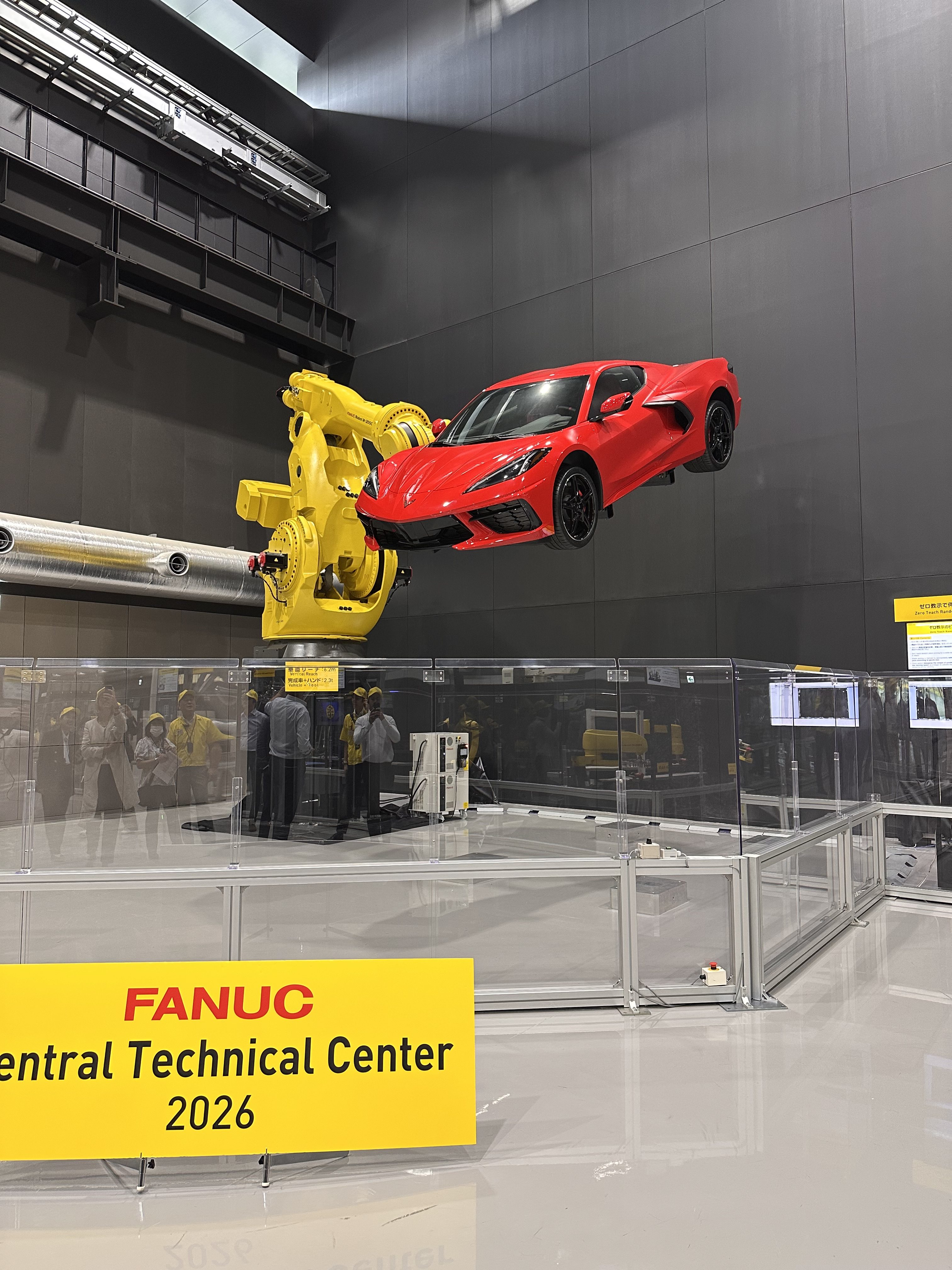
The two-tonne lift: A heavy-payload robot holding a full vehicle body aloft at FANUC’s Central Technical Center – a demonstration of precise deceleration, not strength.
Source: Janus Henderson Investors, published with the host company’s permission.
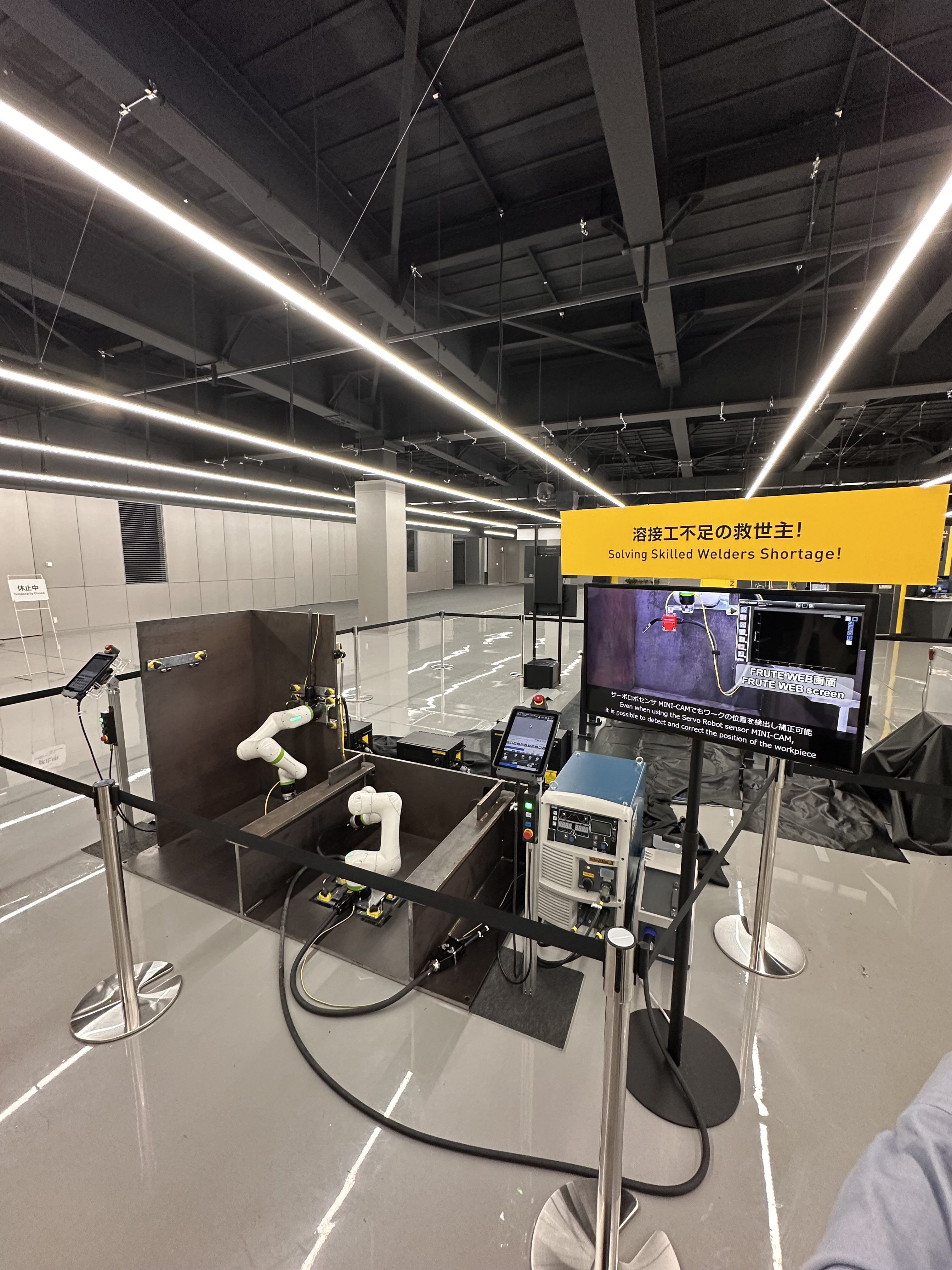
Solving the skilled welders shortage: Collaborative welding robots with vision-guided seam tracking, aimed at industries that cannot find the people.
Source: Janus Henderson Investors, published with the host company’s permission.
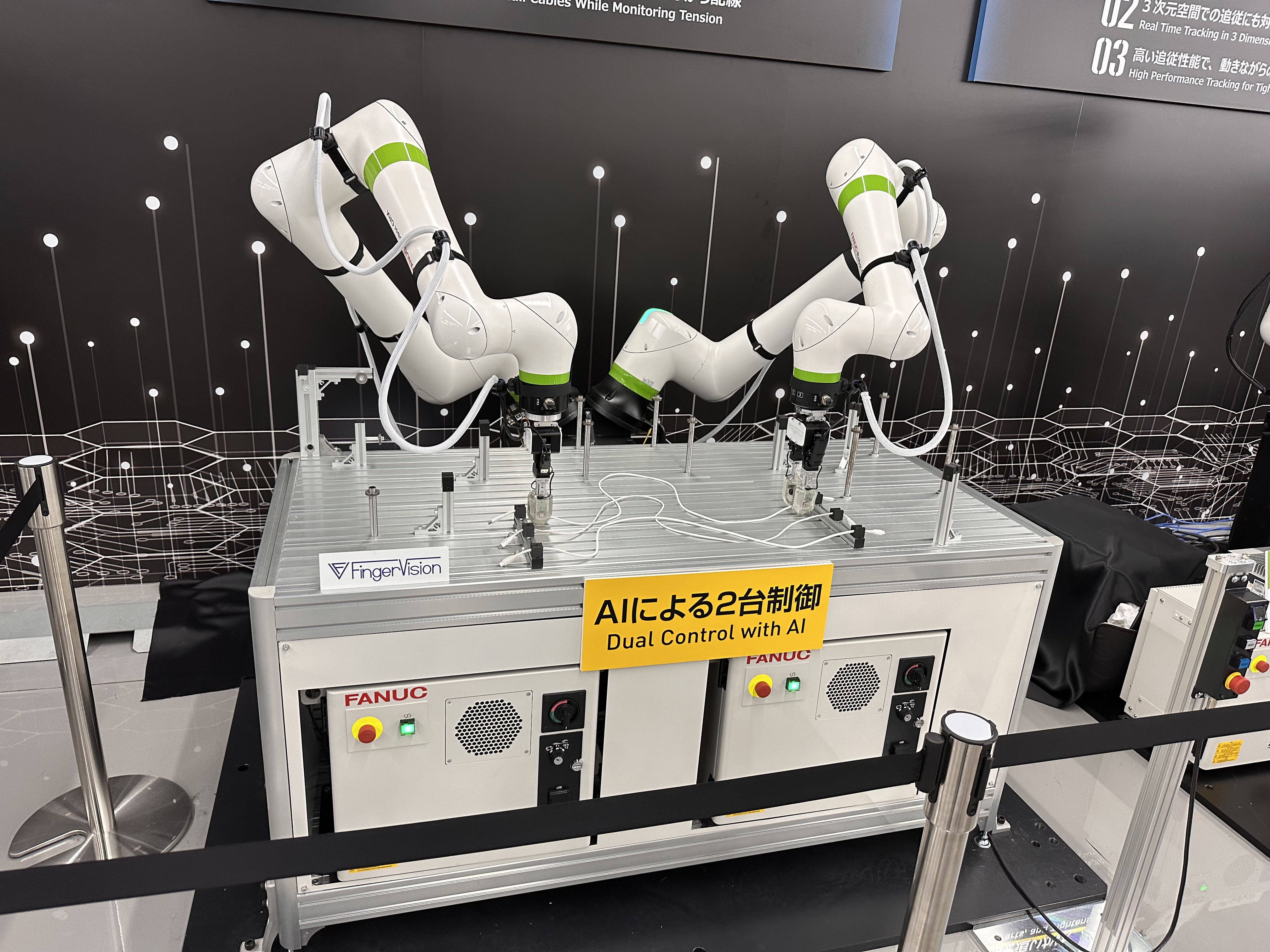
Two arms, one AI: Dual-station collaborative robots (‘cobots’) routing flexible cables – the kind of deformable-object task classical robotics found nearly impossible.
Source: Janus Henderson Investors, published with the host company’s permission.
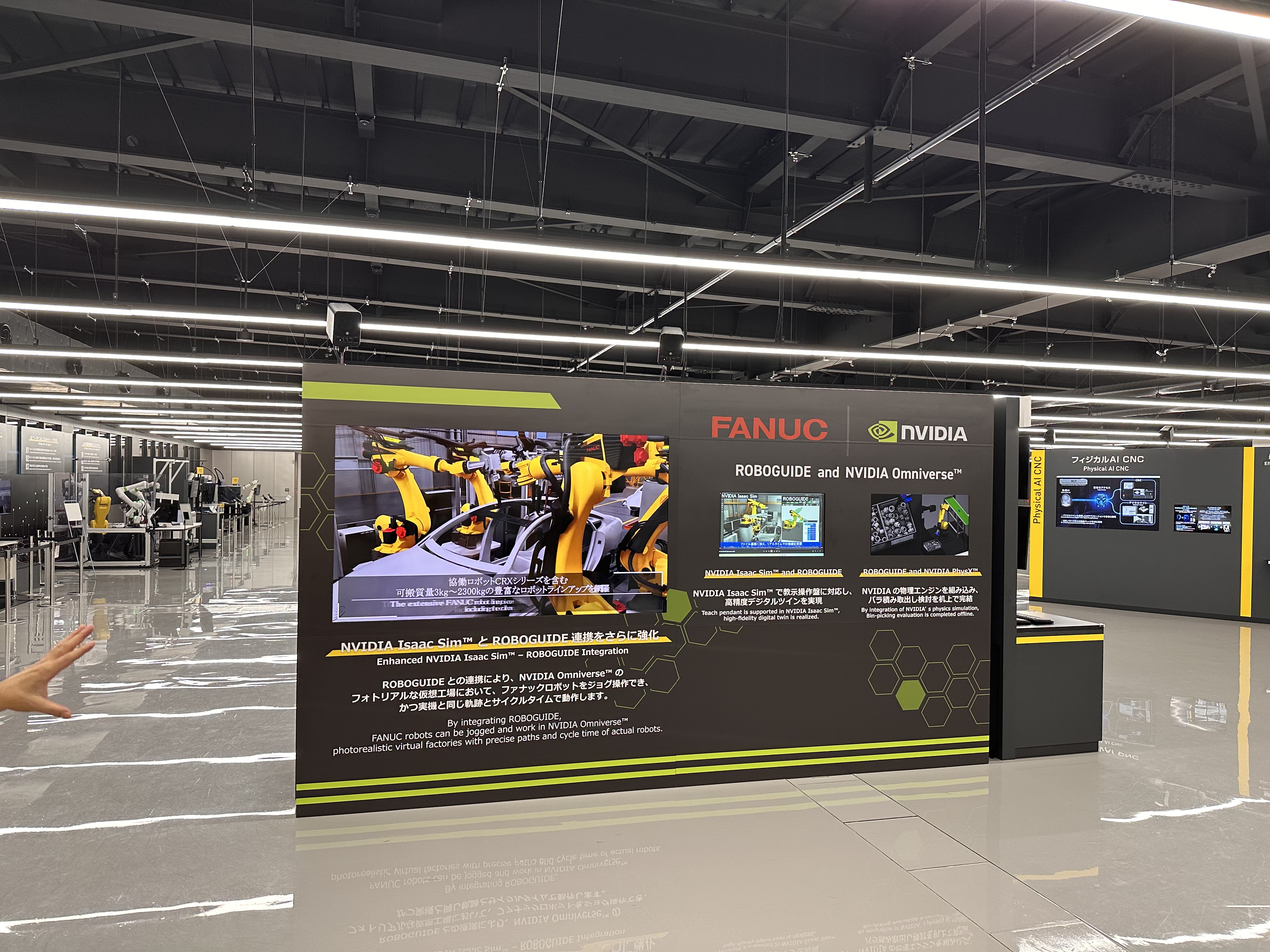
Designed in simulation: FANUC’s robot library inside NVIDIA’s Isaac Sim and Omniverse, so automation is built and tested virtually before a single machine moves.
Source: Janus Henderson Investors, published with the host company’s permission.
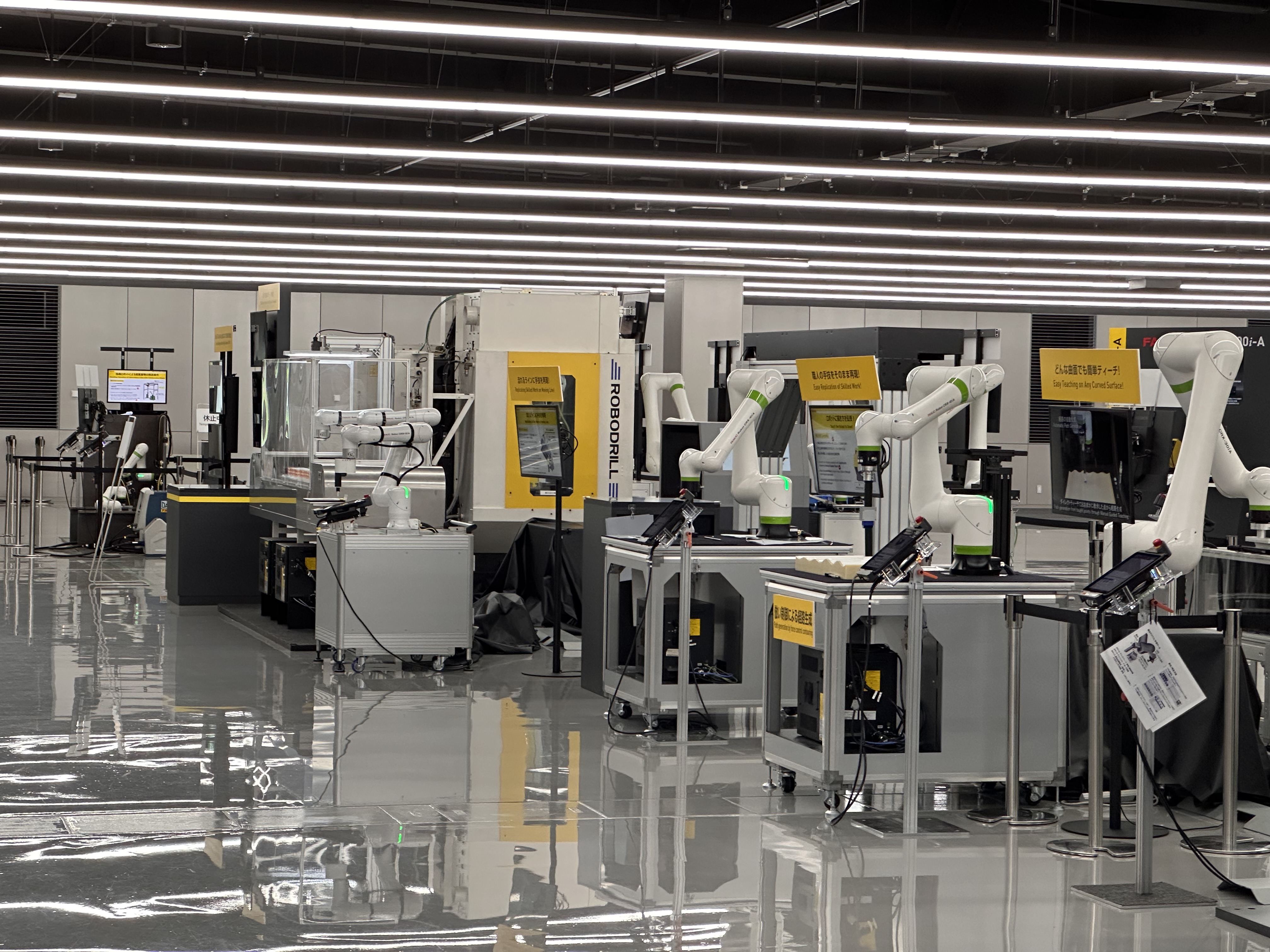
The showroom floor: Machining cells and rows of AI-enabled collaborative robots.
Source: Janus Henderson Investors, published with the host company’s permission.
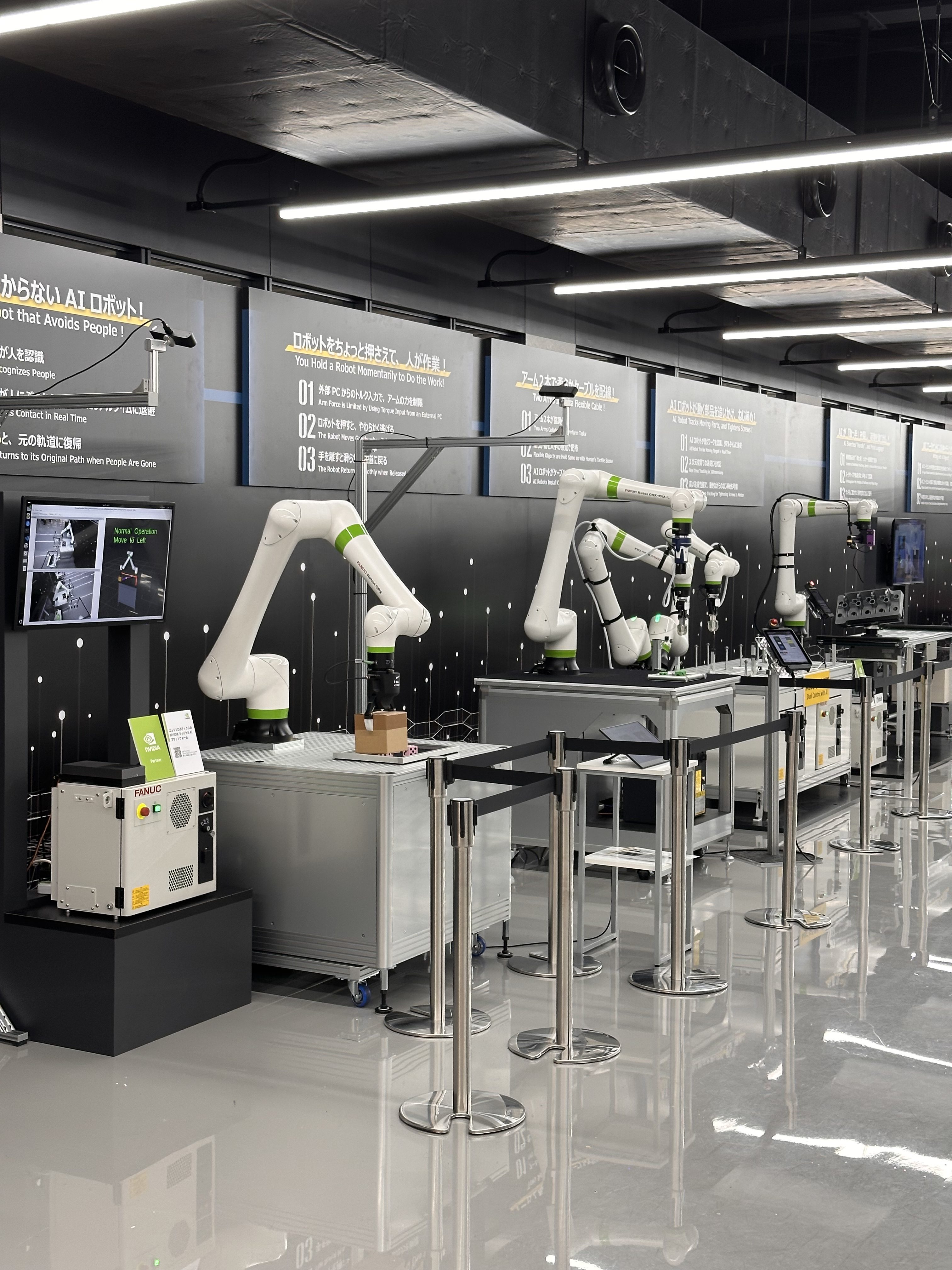
Teachable machines: Demonstrations of robots that recognise and avoid people, and can be guided by hand.
Source: Janus Henderson Investors, published with the host company’s permission.
What physical AI actually changes
The industrial robot is 60 years old, and for most of that time it has been brilliant and blind: a machine that repeats a programmed motion with superhuman precision but no awareness at all, fenced off from people, and economic only where repetition is high and variation is low. That is why automation conquered car body shops and electronics lines – and largely stopped there. One leading manufacturer estimated to us that even in automotive, the most automated industry on earth, only a modest fraction of total processes are fully automated. The rest of the economy – farms, food processing, logistics, construction, care – has barely begun.
Physical AI attacks exactly this frontier, and it is no longer a slideware concept. FANUC – whose showroom, machining and servo factories we toured in Yamanashi – launched its Physical AI initiative in December 2025, merging artificial intelligence with industrial robotics, and has publicly reported more than a thousand related robot orders. Its robot library now sits inside NVIDIA’s Omniverse and Isaac Sim platforms, so customers can design and test automation in simulation before a single machine moves. NVIDIA processors are being embedded in the robot controller itself, giving the machine enough on-board computing power to see what is in front of it and decide in real time.
Yaskawa’s adaptive MOTOMAN NEXT robots are commercially deployed and now paired with Google DeepMind’s robotics models. The showroom made the abstraction physical: we watched collaborative robots detect an approaching person and adjust course to avoid them, handle deformable objects like fabric and cabling that classical robotics found nearly impossible – and, yes, fold t-shirts, though not yet faster than we can, as we verified.
The commercial logic is subtle but powerful: intelligence collapses the cost of programming a robot, which is what kept automation out of smaller businesses and messier industries. The machine becomes teachable rather than programmable and the addressable market widens from the factory to much of the physical economy. Industry conversations kept returning to shipbuilding, where a structural shortage of welders is drawing in collaborative robots designed to work alongside crews rather than replace them. It spanned agriculture, food processing, logistics and construction, sectors with barely any robot deployment today, with humanoid platforms the speculative outer edge of the ambition.
Figure 1: Three eras of automation – and what each one could unlock
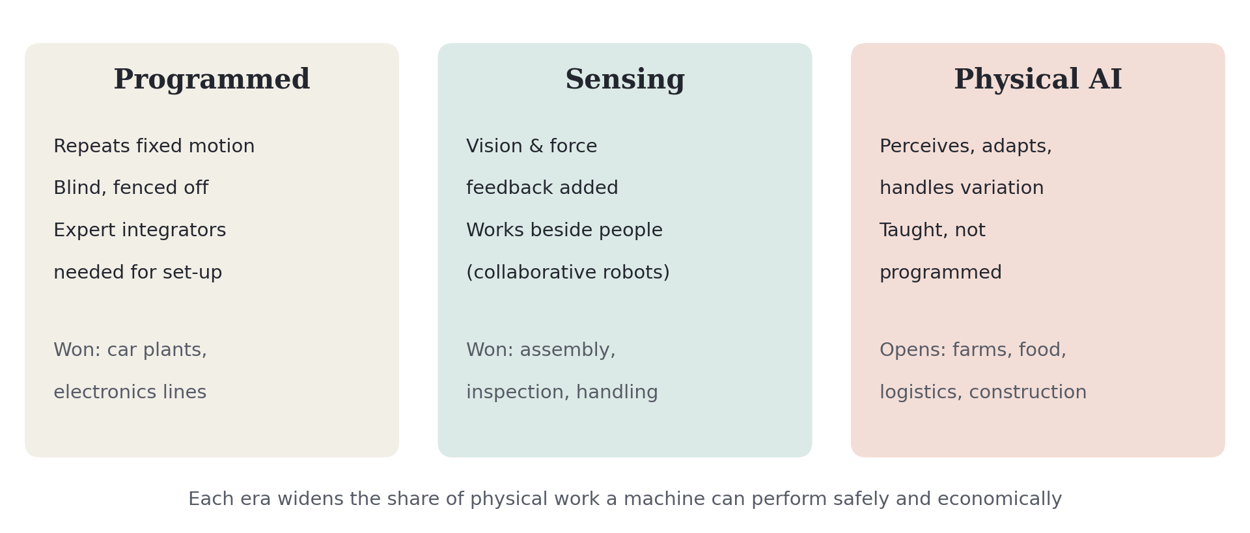
Source: Janus Henderson Investors, Global Sustainable Equity Team, September 2026.
The value hides in the joints
Spend a day inside this industry and a second lesson emerges: the intelligence gets the headlines, but much of the durable value sits in unglamorous mechanical places. A modern industrial robot is a stack of specialised components – precision reduction gears in every joint, servo motors and drives, the controller that orchestrates them, and the sensors now feeding the AI. In several of these layers, Japanese suppliers hold commanding global positions built over decades of materials science and accumulated process knowledge.
The moat here is not the specification sheet; it is the economics of failure. On a high-duty production line, hundreds of robots with six joints apiece run around the clock, and the cost of one gear failing is measured not in the price of the component but in the line it stops. That is why customers pay a premium for parts proven over decades – and why, as one supplier put it to us, challengers whose products are “a generation or two behind” struggle to convert cheaper into chosen. It is the same lifecycle logic as the two-tonne demonstration: what is being sold is not motion but certainty.
Figure 2: Anatomy of an industrial robot – where the specialist value sits
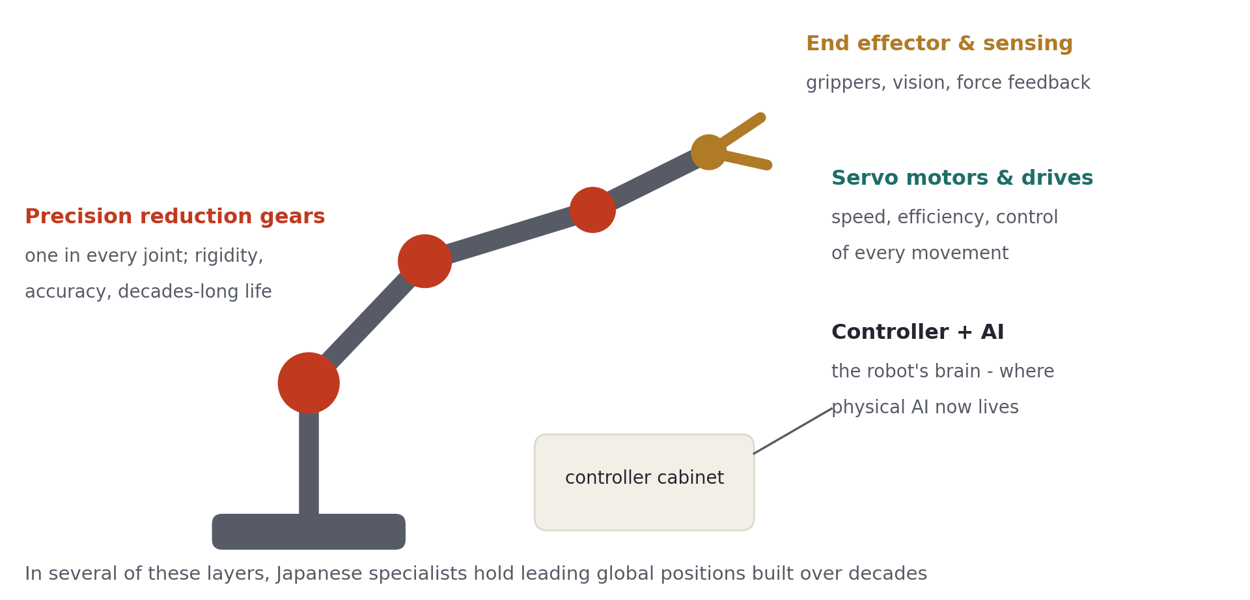
Source: Janus Henderson Investors, Global Sustainable Equity Team, September 2026.
The caveat: The fastest challenger in industrial history
Now the uncomfortable part – and to their considerable credit, the Japanese incumbents raised it themselves. In meeting after meeting, management teams told us candidly that Chinese competitors are improving rapidly: gaining share at home first, closing the quality gap steadily, and forcing incumbents to retreat up the value curve. The public data confirms it emphatically. According to the International Federation of Robotics, Chinese manufacturers’ share of robot installations in their own market (the largest in the world, absorbing over half of all robots deployed globally), hovered around 28% for a decade, then surged: to roughly 30% in 2020, 36% in 2022, 47% in 2023 and 57% in 2024.
This was the first year Chinese makers outsold foreign suppliers at home. In segments such as metal and machinery, domestic suppliers now command around 85% of the Chinese market.
Figure 3: The crossover – share of industrial robot installations in China, by supplier origin
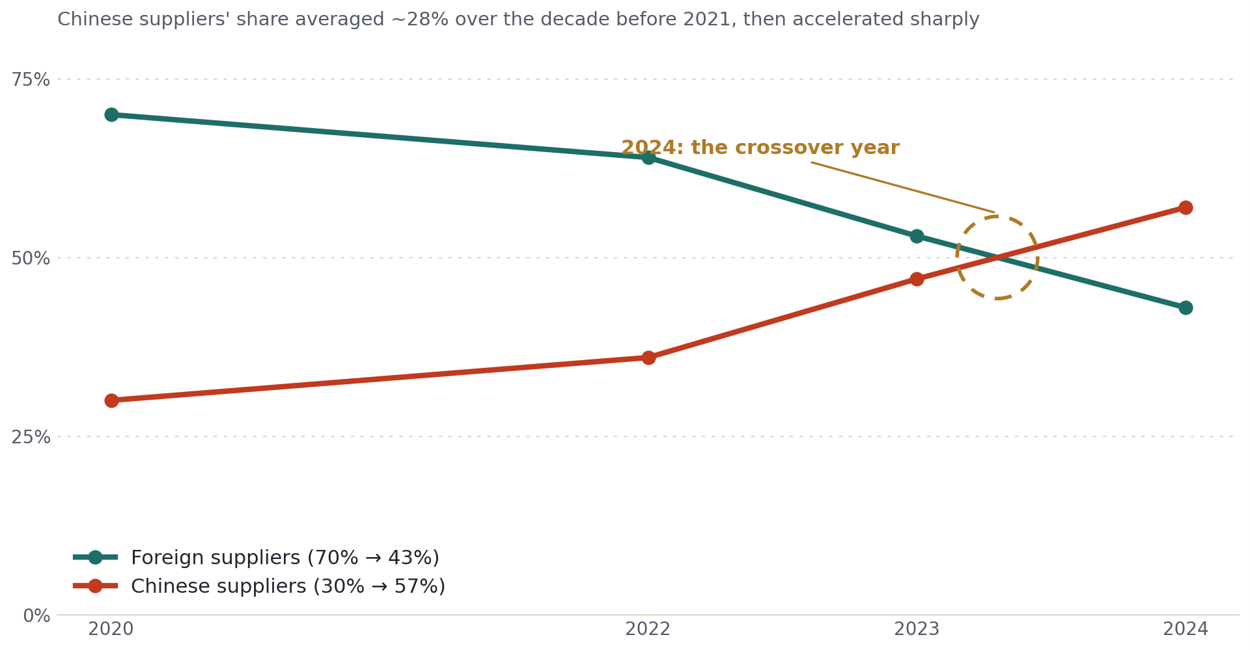
Share of annual industrial robot installations in China supplied by Chinese vs foreign manufacturers. Source: International Federation of Robotics (IFR), World Robotics reports 2023–2025 press releases. 2021 not shown as no comparable figure was published. Past performance does not guarantee future results.
How worried should investors in the incumbents be? Two things can be true at once. The volume tiers of the market are being won by local challengers on price, speed and state support, and no management team we met claimed a permanent barrier. Yet the premium tier, where precision, uptime and lifecycle economics decide the purchase, has so far proved far more resistant. It is notable that even leading Chinese manufacturers continue to build their own products around Japanese and European precision components and to deploy foreign robots on their most demanding lines. The incumbents’ strategy is coherent: concede the commodity floor, keep moving the frontier, and let reliability carry the argument.
A moat is not a certificate. It is a hypothesis that must be re-proven every year – and nowhere is the annual exam harder than in robotics.
– Suney Hindocha, Associate Portfolio Manager, Global Sustainable Equities Team
What this means for a sustainable portfolio
It would be easy to draw one of two lazy conclusions from all this: that physical AI is the next unstoppable trade, or that Chinese competition makes the whole space untouchable. We think both are wrong, and for the same reason – each substitutes a narrative for underwriting.
Our process asks two questions of every company, and robotics illuminates why both are necessary. On the first – does the company make the world better? – the case is unusually strong. In an ageing world, machines that perform dangerous, repetitive and unfilled work are part of the social infrastructure of the future, squarely within our sustainability themes. On the second – can it grow wealth over many years? – the honest answer is: only where the moat survives the exam. That means favouring the layers of the value chain where advantage compounds – proprietary materials know-how, installed bases with prohibitive switching costs, reliability records that took decades to earn – and demanding evidence, not assertion, that the quality gap over challengers is being maintained. It means valuing these businesses on the durability of their premium, not on the excitement of the theme. And it means remembering the lesson of our four-lens framework: exposure to a powerful technology is something to be chosen deliberately, company by company, rather than bought as a story.
We left Japan more convinced than we arrived that intelligence entering the physical world is one of the defining sustainability technologies of the coming decade, and more disciplined than we arrived about how to invest in it. The robot that stopped a two-tonne car body in mid-air was built by engineers who have spent 60 years earning the right to be trusted with that moment. The next decade will decide who earns it for the next 60 years. That, ultimately, is the return on a week aboard a bus: not a shopping list, but a sharper lens. Watching this contest up close, with our two questions in hand, is exactly where we want to be.
- IFR, 5 May 2026 – “China Makes AI-powered Robots Core of National Strategy”
Supports: 2020 = 30% and 2024 = 57% (the stated 2020→2024 span); Chinese suppliers at ~85% domestic share in metal and machinery; 59% in electronics. Basis for the article’s 85% metal-and-machinery sentence.
- IFR, 26 Sep 2023 – President’s Report, World Robotics 2023
Supports: 2022 = 36% (described as a surge from 28%), in the context of China’s industrial robot installations (record 553,000 global installations in 2022; China 52% of the total).
- IFR, 24 Sep 2024 – World Robotics 2024 press release
Supports: 2023 = 47%, and the ~28% decade-average annotation.
- IFR, 24 Sep 2024 – World Robotics 2024 China press release (PDF)
Supports: unit counts behind the 2023 split – 130,516 units from Chinese suppliers vs 145,772 from foreign suppliers (47.2% / 52.8%), and the statement that the foreign count includes foreign-brand robots manufactured in China. Used to validate the derived foreign-share line.
- IFR, 25 Sep 2025 – World Robotics 2025 press release
Supports: 2024 = 57%; first year Chinese manufacturers outsold foreign suppliers at home; China = 54% of global deployments in 2024 (295,000 units installed; operational stock above 2 million). Basis for the article’s “over half of all robots deployed globally” and “first year Chinese makers outsold foreign suppliers” sentences.
Physical AI: Artificial intelligence embedded in machines that perceive and act in the physical world – robots that use sensors and AI models to adapt their actions rather than repeat fixed programmes.
Collaborative robot (cobot): A robot designed with force limits and sensing that allow it to work safely alongside people without protective fencing, often taught by physically guiding its arm.
Precision reduction gear: The gearbox inside each robot joint that converts a motor’s fast rotation into slow, extremely accurate and rigid movement; a critical determinant of a robot’s precision and lifespan.
Servo motor: An electric motor paired with feedback control, enabling exact regulation of position, speed and torque in automated machinery.
Humanoid robot: A robot with a human-like form intended to operate in environments built for people; largely pre-commercial today.
Moat: A durable competitive advantage that protects a company’s returns on capital from competition over time.
These are the views of the author at the time of publication and may differ from the views of other individuals/teams at Janus Henderson Investors. References made to individual securities do not constitute a recommendation to buy, sell or hold any security, investment strategy or market sector, and should not be assumed to be profitable. Janus Henderson Investors, its affiliated advisor, or its employees, may have a position in the securities mentioned.
Past performance does not predict future returns. The value of an investment and the income from it can fall as well as rise and you may not get back the amount originally invested.
The information in this article does not qualify as an investment recommendation.
There is no guarantee that past trends will continue, or forecasts will be realised.
Marketing Communication.
Important information
Please read the following important information regarding funds related to this article.
- Shares can lose value rapidly, and typically involve higher risks than bonds or money market instruments. The value of your investment may fall as a result.
- Shares of small and mid-size companies can be more volatile than shares of larger companies, and at times it may be difficult to value or to sell shares at desired times and prices, increasing the risk of losses.
- The Fund follows a growth investment style that creates a bias towards certain types of companies. This may result in the Fund significantly underperforming or outperforming the wider market.
- Due to the Fund’s Sustainability Approach, it may exclude or invest less or more in certain companies and may therefore perform differently to funds that have a similar financial objective, but that do not have a binding Sustainability Approach. Political, regulatory or investor sentiment about sustainability initiatives may change over time and impact the Fund’s performance.
- Derivatives may be used with the aim of reducing risk or managing the portfolio more efficiently. However, this introduces other risks, in particular, that a derivative counterparty may not meet its contractual obligations.
- If the Fund holds assets in currencies other than the base currency of the Fund, or you invest in a share/unit class of a different currency to the Fund (unless hedged, i.e. seeks to mitigate exchange rate movements between the share/unit class currency and the base currency of the Fund), the value of your investment may be impacted by changes in exchange rates.
- When the Fund, or a share/unit class, seeks to mitigate exchange rate movements of a currency relative to the base currency (hedge), the hedging strategy itself may positively or negatively impact the value of the Fund due to differences in short-term interest rates between the currencies.
- Securities could become hard to value or to sell at a desired time and price, especially in extreme market conditions when asset prices may be falling, increasing the risk of investment losses.
- Losses could be incurred if a counterparty became unwilling or unable to meet its obligations, or as a result of failure or delay in operational processes or the failure of a third party provider.