
Key takeaways:
- Constraints on data center supply, specialization in artificial intelligence (AI) workloads and the physical demands of next-generation chips could extend the useful economic lives of older GPUs beyond conventional assumptions.
- Longer useful lives and additional rental income could support higher GPU residual values, strengthening collateral coverage and reducing refinancing risk for data centers.
- This increases investment opportunities across the GPU-financing stack, favoring debt and equity structures where conservative residual value assumptions may understate the potential.
Graphics processing units (GPUs) are a critical component in artificial intelligence (AI) processing. Designed to perform large numbers of calculations simultaneously, GPUs are widely used to provide the computing power required to train and run artificial intelligence models. The consensus is that GPU collateral loses value fast: for example, each new generation of GPU from NVIDIA, the technology giant, makes the last one obsolete, and lenders financing chips are ultimately lending against a melting ice cube.
We think otherwise. Three forces are moving together: politics is capping new supply; workloads are splitting into specialized jobs; and the latest silicon requires physical characteristics in buildings that most of the existing stock cannot provide. In our view, these three components make capacity that is already installed and powered worth more, not less, and argues for greater persistence in existing equipment and technology. For credit, that means better collateral coverage on deployed data centers and less refinancing risk at maturity. For equity, it means improved value accruing to those taking residual value risk.
1. Politics is now a supply constraint, and constraints hold up residuals
The bear case on residuals assumes supply is unlimited, so new capacity floods in and reprices everything older through obsolescence. We believe that argument does not hold when it is progressively harder to bring on incremental power.
As we have discussed previously, we believe the current political environment will lead to a slower, yet longer buildout. In the US mid-term elections on November 3, voters decided 41 local data center ballot measures, backing limits on data centers in 40 of them.1In Ohio, one measure in the city of Trenton blocks the land annexation path for a planned 1GW (1GW = 1,000MW), 18-building, 601-acre Amazon campus.2Meanwhile, Texas’s governor-elect has pledged to keep data center approvals paused until the legislature passes ratepayer and water protections.3Investment bank Goldman Sachs estimates that states likely to tighten data center buildout rules hold about 45% of planned US capacity.4
Our view is that this keeps new US grid capacity additions (i.e., front-of-meter) roughly capped in the 15–20GW-a-year range, with potentially more from off-grid power and conversions of facilities previously used for Bitcoin mining operations.5Front-of meter (power infrastructure located on the utility side of the electric meter, i.e., coming directly from the standard grid) is likely to continue to handle the lion’s share of data center adds. Behind-the-meter (which sits on the customer’s side and feeds directly to the site, typically resembling a “bring your own power” setup using on-site gas turbines, reciprocating engines or fuel cells) should continue to provide some level of bridge capacity. That said, behind-the-meter power generally possesses its own set of requisite permits. When new capacity is gated by permits and politics, rather than chip availability, value should accrue to the rack that is already powered.
Exhibit 1: GPU rental prices have turned higher
Silicon data rental price index, US$ per GPU-hour
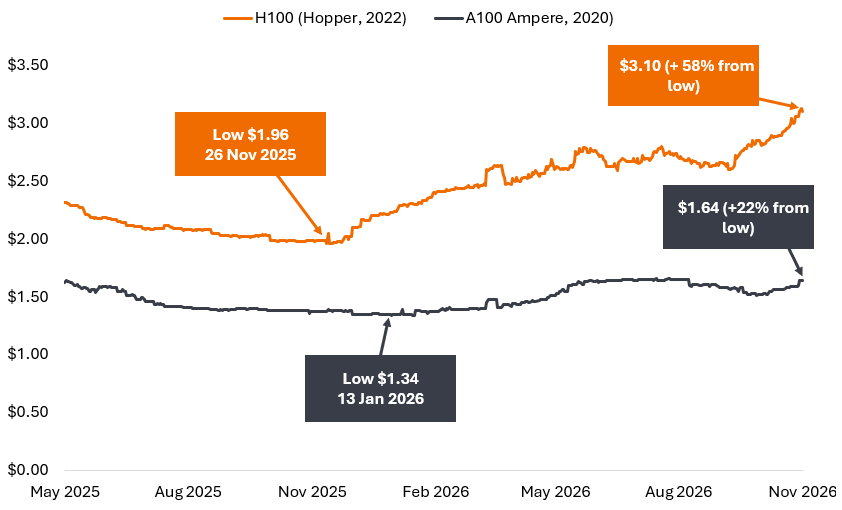
Source: Bloomberg, Silicon Data H100 and A100 rental price indices (SDH100RT and SDA1001RT), 15 May 2025 to 15 November 2026. The indices are published daily as a standardized, hourly rate expressed in USD per GPU-hour, drawn from observations across neo-cloud providers and marketplaces. Hopper is the name of a GPU launched by NVIDIA in 2022. Ampere is the name of a GPU launched by NVIDIA in 2020.Past performance does not predict future returns.
The pricing data already show this. Nebius, an AI-specialist cloud computing provider, closed Q3 2026 contracts above $25m per MW, up from $20–25M in Q2.6CoreWeave, another AI-specialist cloud computing provider, is signing A100 (2020 vintage) at contract values above where they initially signed, demonstrating that at present, GPUs appear to be appreciating, not depreciating.7
2. Specialization gives older silicon a second and third job
In practice, workloads have split up and resemble a digital assembly line. Training, where AI analyzes datasets and is taught model rules and logic to recognize patterns, and inference (and inference sub-tasks), where AI uses the learned knowledge to complete live tasks, now run on different hardware.
Inference itself now has two phases: (i) prefill (the first phase of large language model inference)readsthe prompt in one parallel pass and is limited by compute; (ii) decodeanswersthe prompt, produces tokens one at a time, and is limited by memory bandwidth. Disaggregated serving runs the two phases on separate GPU pools that are sized independently. With the increasing role and popularity of XPUs (X being a catch-all letter to represent any or all forms of accelerated silicon, be it ASICs or GPUs), the go-forward roadmap for both users and suppliers of compute appears to accept that inference is a set of distinct jobs.
For residuals, this matters a lot. An older GPU no longer needs to be the best chip in the building. It just needs to be the cheapest chip that can handle one phase of the work. That supports a working life that runs from frontier training, to frontier inference, to decode, batch and background jobs. Every extra stage can potentially add rental income and correspond to higher residual values.
3. Adapting old buildings for new GPUs is not easy
Another detracting argument around GPU useful lives is that newer, higher performing silicon comes out on an annual cadence. That may be true, but the question is not whether a new GPU is simply better than an old one, it is whether the latest vintage of GPU can even be slotted into where the old one is.
Up to and including Hopper (a GPU launched by Nvidia in 2022), the answer was mostly ‘yes,’ but Blackwell (a GPU launched by Nvidia in 2024) changes that. While a crude analogy, prior vintages of GPUs were akin to selling an old gas vehicle and buying a new gas vehicle: they can both be slotted into your garage with no real change in physical requirements in said garage. The new paradigm is akin to buying an electric vehicle with an incremental charging station, though this is a material understatement to the changes in physical environments required in recent GPU vintages.
The volume product using Nvidia’s Blackwell is the rack-scale GB200 NVL72. It draws about 120 kW per rack, and requires direct-to-chip liquid cooling.8The average industry rack draws about 7.6 kW (1/15thof the power). Air cooling tops out around 20-30 kW per rack.9An NVL72 also needs coolant distribution units, manifolds and heat-rejection capacity built into the facility. As Exhibit 2 shows, the typical rack is under 15kw in 83% of data centers, with racks in the 120kw range (which would sit in the 50+ category in Exhibit 2) still relatively rare.
Exhibit 2: Average density in data centers
What is the most common (modal average) server rack density in your data center?
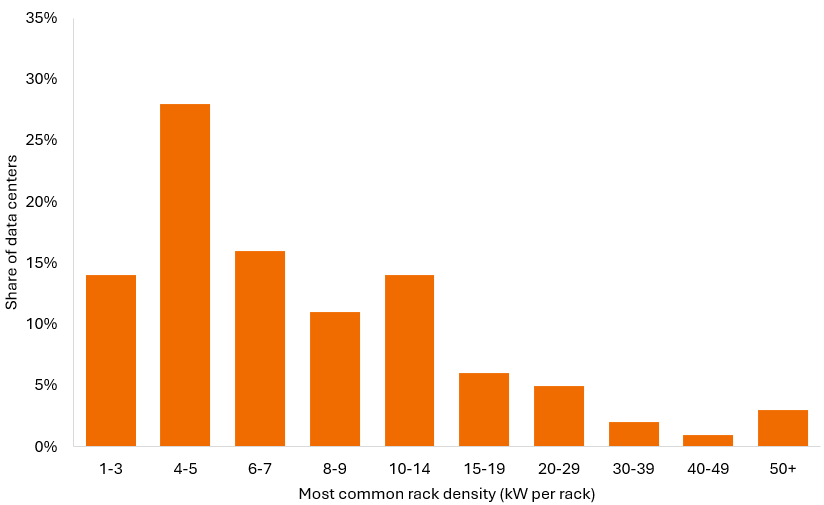
Source: Uptime Institute, Uptime Institute Global Data Center Survey 2026, covering 679 respondents in 2026, July 2026.
As a result, most of the existing data center stock cannot physically host the latest product. An operator is unable to cheaply swap Hoppers for Blackwells in a pre-2024 hall. It has to retrofit electrical and cooling systems, or build new, which runs straight into the permitting problem in section 1. In an environment as supply constrained as the present, we view it as unlikely that data center operators would undergo potentially 6+ months of downtime.
In short, we expect earlier vintages of GPU to extract higher economic rent than currently underwritten. We believe this dynamic ultimately benefits all layers of the GPU-financing stack, from the asset level down to the underlying debt and equity.
1Source: CNBC, 4 November 2026.
2Source: WVXU, 3 November 2026.
3Source: Texas Tribune, 4 November 2026.
4Source: Goldman Sachs, 4 November 2026.
5Source: Janus Henderson Investors, Wells Fargo, Wells Fargo estimates that the US grid can support ~15-30 GW of deliveries per year, 17 September 2026.
6Source: Nebius, Q3 2026 earnings results, 12 November 2026.
7Source: Coreweave, Q3 earnings call, 10 November 2026.
8Source: Nvidia DGX GB200 User Guide, 17 September 2026.
9Source: Ace Computers, Liquid Cooling vs Air Cooling for High-Density AI Racks, 3 September 2026.
References made to individual securities do not constitute a recommendation to buy, sell or hold any security, investment strategy or market sector, and should not be assumed to be profitable. Janus Henderson Investors, its affiliated advisor, or its employees, may have a position in the securities mentioned.
Fixed income securitiesare subject to interest rate, inflation, credit and default risk. The bond market is volatile. As interest rates rise, bond prices usually fall, and vice versa. The return of principal is not guaranteed, and prices may decline if an issuer fails to make timely payments or its credit strength weakens.
Accelerated silicon: Specialized computer chips designed to perform particular types of calculations faster and more efficiently than general-purpose processors.
Air cooling: A method of controlling the temperature of computing equipment by circulating cooled air around servers and other hardware.
Application-specific integrated circuit (ASIC): A semiconductor chip designed and optimized to perform a particular task or set of tasks rather than general-purpose computing.
Artificial intelligence (AI): Technology that enables computers and machines to perform tasks typically associated with human intelligence, such as learning, pattern recognition, reasoning and making decisions.
Batch processing: A method of processing groups of computing tasks or data together, rather than processing each task immediately as it arrives.
Bitcoin mining: Bitcoin is a digital currency that uses a process called mining to secure its network and validate transactions. Miners use computing power to compete to solve mathematical puzzles, known as proof of work, to validate transactions and earn rewards in newly-created Bitcoin.
Cloud computing: The provision of IT services remotely by specialized service providers over the internet.
Collatera: l: An asset pledged by a borrower to a lender as security for a loan. If the borrower fails to meet its repayment obligations, the lender may have a claim on the asset.
Collateral coverage: The value of assets pledged as collateral relative to the amount of debt they secure. Greater collateral coverage can provide lenders with more protection against potential losses.
Compute: The processing power and resources used by computer systems to perform calculations, process data and run applications.
Coolant distribution unit (CDU): Equipment used in liquid-cooled data centers to control and distribute cooling fluid between a facility’s cooling infrastructure and computing equipment.
Credit: Credit is typically defined as an agreement between a lender and a borrower. It is often narrowly used to describe corporate borrowings, which can take the form of corporate bonds, loans or other fixed-interest asset classes.
Data center: A facility that houses computing infrastructure, such as servers, data storage and networking equipment, together with the power and cooling systems needed to operate it.
Decode: The stage of AI inference in which a model generates an output sequentially, such as producing individual text tokens one at a time. Its performance can be constrained by memory bandwidth.
Depreciation: Refers to the measurement of how much value physical assets lose over time. It is an accounting method that allocates the cost of a tangible asset over its useful life to reflect its decreasing value through use and obsolescence.
Direct-to-chip liquid cooling: A cooling system that circulates liquid directly to components attached to high-powered computer chips, allowing heat to be removed more efficiently than conventional air cooling.
Disaggregated serving: An approach to running AI inference in which different stages of a workload, such as prefill and decode, are handled by separate pools of computing hardware.
Equity: A security representing ownership, typically listed on a stock exchange. ‘Equities’ as an asset class means investments in shares, as opposed to, for instance, bonds.
Fixed income/fixed interest: A bond is a debt security issued by a company or a government used as a way of raising money. The investor buying the bond is effectively lending money to the issuer. Bonds offer a return through fixed-periodic payments and the eventual return at maturity of the original amount invested.
Frontier inference: The use of advanced AI models to process new information or requests and generate outputs, typically using high-performance computing infrastructure.
Frontier training: The development and training of advanced AI models, which typically requires substantial computing power and large datasets.
Front-of-meter: Power infrastructure located on the utility side of the electricity meter, with power supplied through the standard electricity grid.
Fuel cell: A method of generating electricity through an electrochemical reaction.
Graphics processing unit (GPU): A specialized processor designed to perform large numbers of calculations simultaneously. GPUs are widely used to provide the computing power required to train and run artificial intelligence models.
Inference: The process in which an artificial intelligence model uses knowledge learned during training to generate an output or complete a task in response to new data or instructions.
Memory bandwidth: The rate at which data can be transferred between a computer processor and its memory. Higher memory bandwidth can allow data-intensive computing tasks to be completed more quickly.
Maturity: The maturity date of a bond is the date when the principal investment and any final coupon is paid to investors. Shorter-dated bonds generally mature within five years, medium-term bonds within five to 10 years, and longer-dated bonds after 10+ years.
Prefill: The initial stage of AI inference in which a model processes the input or prompt before beginning to generate its response.
Rack: A physical structure used in a data center to house servers, processors and associated computing and networking equipment.
Rack density: The amount of computing equipment or electrical power concentrated within a data center rack, commonly measured in kilowatts (kW) per rack.
Rack-scale system: A computing system in which multiple processors, servers and supporting components housed within an entire rack operate together as an integrated system.
Reciprocating engines: A heat engine that typically uses gas or diesel to create power.
Refinancing: The process of revising and replacing the terms of an existing borrowing agreement, including replacing debt with new borrowing before or at the time of the debt maturity.
Residual value: The estimated value of an asset at the end of its expected useful life or at a specified point in the future, after accounting for its use, age and potential obsolescence.
Risk/risk taking: The acceptance of greater risk in exchange for potentially higher returns. An assessment of investors’ attitude to risk forms a fundamental part of identifying a suitable investment strategy for their objectives.
Silicon: A semiconductor material widely used in the manufacture of computer chips. The term is also commonly used as shorthand for processors and other semiconductor devices.
Token: A unit of data processed or generated by an AI model. For language models, a token can represent a word, part of a word or an individual character.
Training: The process of teaching an artificial intelligence model to recognize patterns and relationships in data by analyzing datasets and adjusting the model according to what it learns.
Watt: A unit of power. 1kW = 1,000 Watts. 1MW = 1,000kW, 1GW = 1,000MW.
Workload: A computing task, application or group of processes that uses computing resources. In AI, different workloads can include model training and inference.
XPU: A catch-all term used for different types of specialized or accelerated computing processors, including graphics processing units (GPUs) and application-specific integrated circuits (ASICs).
These are the views of the author at the time of publication and may differ from the views of other individuals/teams at Janus Henderson Investors. References made to individual securities do not constitute a recommendation to buy, sell or hold any security, investment strategy or market sector, and should not be assumed to be profitable. Janus Henderson Investors, its affiliated advisor, or its employees, may have a position in the securities mentioned.
Past performance does not predict future returns. The value of an investment and the income from it can fall as well as rise and you may not get back the amount originally invested.
The information in this article does not qualify as an investment recommendation.
There is no guarantee that past trends will continue, or forecasts will be realised.
Marketing Communication.