
Key takeaways:
- Rating agencies are updating their CLO methodologies to reflect a larger pool of historical performance data, recognising stronger realised default and recovery outcomes than previous assumptions implied.
- The rating upgrades expected across parts of the CLO market are largely a technical adjustment, with the potential to improve liquidity, support spreads and broaden the eligible investor base for certain tranches.
- Nevertheless, active analysis through specialist expertise remains ever more essential. Assessing collateral quality, deal structures and CLO manager behaviour will continue to be more important than ratings alone when identifying opportunities across the CLO market.
Rating recalibration better reflects history
The collateralised loan obligation (CLO) market has grown substantially in both Europe and the US since the Global Financial Crisis (GFC). This has been supported by attractive yields on a risk-adjusted basis and a broad spectrum of rated securities that appeals to a range of investor types. Strengthened underwriting, structural protections and regulatory oversight have been underpinning the growth in the sector post-GFC.
As the market has matured, rating agencies have accumulated a far deeper dataset of default and recovery experience than was available when many of their existing CLO methodologies were first developed. Figure 1 shows the actual default experience in CLOs. Against this backdrop, both Moody’s and Fitch have recently proposed or implemented changes to their CLO rating methodologies that are expected to result in rating upgrades across the US and European market.
Figure 1: Default rates for CLOs
European CLO cumulative default rates, conditional on survival, 2002‑2025 (%) 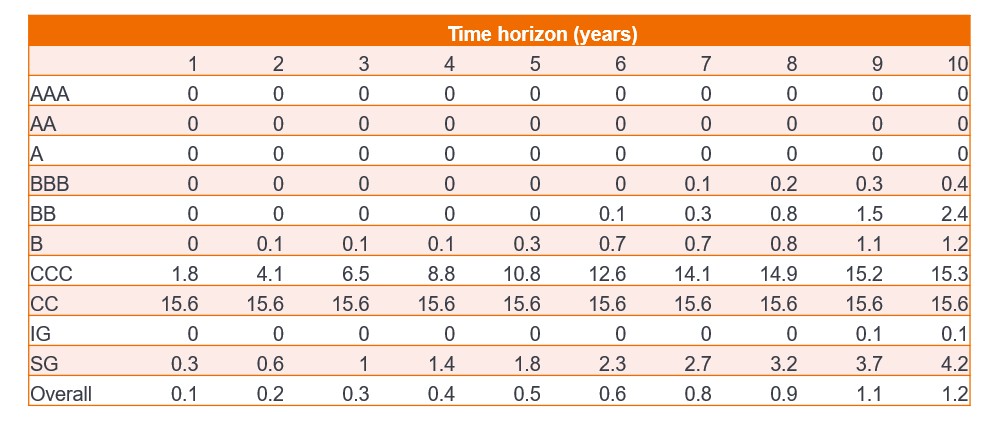
US CLO cumulative default rates, conditional on survival, 1997‑2025 (%)
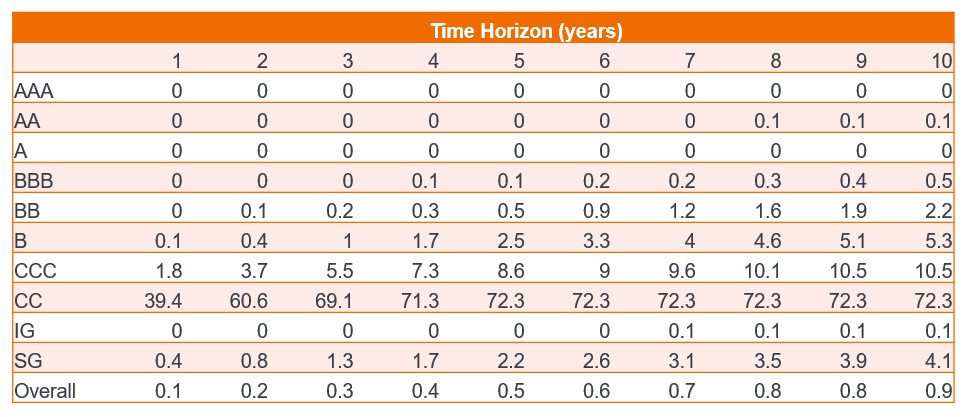
Source: S&P Global Ratings Credit Research & Insights and S&P Global Market Intelligence’s CreditPro. IG=Investment Grade. SG=Speculative Grade. Data as at end 2025. Past performance does not predict future returns.
While some investors may initially view upgrades with scepticism, we believe these changes should largely be viewed as a recalibration of rating assumptions to better reflect observed historical performance rather than a loosening in underwriting standards.
What has changed?
Fitch
- Revised its recovery assumptions to better reflect realised historical recoveries on the underlying loans of CLOs.
- Greater emphasis on characteristics such as seniority, collateral security, jurisdiction and historical recovery performance when estimating recoveries.
Moody’s
- Incorporated a larger historical default dataset into its analysis and concluded that actual CLO portfolios have experienced lower default rates than previously assumed.
- Greater emphasis on the characteristics of the actual underlying portfolio rather than relying primarily on portfolio limits and documentation assumptions.
What is the expected outcome?
- Fitch estimates 5-15% of its CLO ratings could be upgraded with most expected to be 1-2 notches.
- Moody’s estimates that around 33% of sub-AAA CLO tranches could receive a 1-2 notch upgrade.
- The greatest rating migration is expected in investment grade tranches below AAA (AA, A and BBB), though AA tranches appear to have the most potential to migrate upwards.
- Some lower mezzanine tranches may also benefit depending on the specific transaction and methodology applied.
A positive technical factor for CLOs
For investors, the implications are likely to be predominantly technical rather than fundamental. Higher ratings may support tighter spreads, improved secondary market liquidity and a broader pool of eligible investors, particularly where investment mandates, capital requirements or regulatory frameworks are linked to credit ratings. Certain tranches that migrate into higher rating categories may benefit from increased demand from such rating-constrained investors.
It is noteworthy that the methodology changes are driven by evidence. CLOs have generally exhibited stronger default and recovery outcomes than many of the assumptions embedded in older rating models. The agencies are therefore seeking to better align ratings with realised performance rather than redefining risk itself.
The long-term track record of the asset class also provides useful context. CLO ratings have historically demonstrated considerable stability, supported by structural protections, limited idiosyncratic risk and substantial diversification. Since the inception of the CLO market in the late 90’s, around 95% of AAA-rated tranches have maintained their rating through maturity.1
As active investors, we view ratings as only one reference point. Fundamental analysis of collateral quality, CLO manager behaviour, deal structures and portfolio construction remains critical. We will continue to monitor rating actions as Fitch resolves its review population and Moody’s finalises its methodology updates.
As more rating actions emerge, the market should gain a clearer understanding of which upgrades are genuinely attributable to the revised methodologies, and which reflect the normal seasoning, deleveraging and performance evolution that occurs throughout a CLO’s lifecycle. Ultimately, we believe these developments represent a constructive recognition of the asset class’s historical resilience.
IMPORTANT INFORMATION
Collateralised Loan Obligations (CLOs) are debt securities issued in different tranches, with varying degrees of risk, and backed by an underlying portfolio consisting primarily of below investment grade corporate loans. The return of principal is not guaranteed, and prices may decline if payments are not made timely or credit strength weakens. CLOs are subject to liquidity risk, interest rate risk, credit risk, call risk and the risk of default of the underlying assets.
Diversification neither assures a profit nor eliminates the risk of experiencing investment losses.
High-yield or “junk” bonds involve a greater risk of default and price volatility and can experience sudden and sharp price swings.
Fixed income securities are subject to interest rate, inflation, credit and default risk. As interest rates rise, bond prices usually fall, and vice versa. High-yield bonds, or “junk” bonds, involve a greater risk of default and price volatility. Foreign securities, including sovereign debt, are subject to currency fluctuations, political and economic uncertainty and increased volatility and lower liquidity, all of which are magnified in emerging markets.
Securitised products, such as mortgage- and asset-backed securities, are more sensitive to interest rate changes, have extension and prepayment risk, and are subject to more credit, valuation and liquidity risk than other fixed-income securities.
1 Source: S&P Global, 16 June 2026.
Capital requirements: Rules that determine how much financial cushion institutions must hold against certain investments.
Collateral: Assets used to support or secure a loan or investment; in CLOs, this usually refers to the pool of underlying loans.
Collateralised Loan Obligation (CLO): A securitised portfolio of corporate leveraged loans rated below investment grade (a rating on a bond where the borrower is perceived as having a relatively low risk of defaulting on repayment). The underlying loan pool is financed through the issuance of bonds that are structured into tranches with differing risk profiles, where interest and principal payments are prioritised according to each tranche’s position in the capital structure.
Credit rating: An independent assessment of the creditworthiness of a borrower by a recognised agency such as Standard & Poor’s, Moody’s, or Fitch. Standardised scores such as ‘AAA’ (a high credit rating) or ‘B’ (a low credit rating) are used, although other agencies may present their ratings in different formats.
Credit spread: The difference in yield between securities with similar maturity but different credit quality, often used to describe the difference in yield between corporate bonds and government bonds. Widening spreads generally indicate a deteriorating creditworthiness of corporate borrowers, while narrowing indicates improving.
Default: The failure of a debtor (such as a bond issuer) to pay interest or to return an original amount loaned when due.
Deleveraging: A company reducing its borrowing/debt as a proportion of its balance sheet (the opposite of leveraging ).
Diversification: A way of spreading risk by mixing different types of assets or asset classes in a portfolio on the assumption that these assets will behave differently in any given scenario. Assets with low correlation should provide the most diversification.
High-yield bond: A bond with a lower credit rating than an investment-grade bond, also known as a sub-investment grade bond, or ‘junk’ bond. These bonds usually carry a higher risk of the issuer defaulting on their payments, so they are typically issued with a higher-interest rate (coupon ) to compensate for the additional risk. Speculative grade is another term for high yield.
Idiosyncratic risk: Factors that are specific to a particular company and have little or no correlation with market risk.
Investment grade: A fixed income security typically issued by governments or companies perceived to have a relatively low risk of defaulting on their payments, which is reflected in the higher rating given by credit ratings agencies.
Liquidity: A measure of how easily an asset can be bought or sold in the market. Assets that can be easily traded in the market in high volumes (without causing a major price move) are referred to as ‘liquid’.
Mezzanine tranche: A middle layer of a CLO’s capital structure that typically carries more risk than senior tranches but may offer higher potential income.
Rating agency: An organisation that assesses the creditworthiness of borrowers or debt investments, such as Moody’s or Fitch.
Recovery rate: The proportion of money investors may recover if a borrower defaults.
Risk-adjusted basis: A way of comparing investment returns after taking account of the level of risk involved.
Secondary market: The market where existing investments are bought and sold after they have first been issued.
Securitised products: The pooling of certain types of assets so that they can be repackaged into interest-bearing securities together which constitutes a market for buying or selling. The interest and principal payments from the assets are passed through to the purchasers of the securities.
Seniority: Determines the order in which investors are paid in the event of a default, with implications for the bond’s risk, pricing and investment return.
Tranche: A slice of a structured investment such as a CLO, with each tranche carrying different levels of risk, return, and payment priority.
Underwriting standards: The criteria lenders or investors use to assess the quality and risk of loans before they are made or included in a portfolio.
Yield: The level of income on a security over a set period, typically expressed as a percentage rate. For equities, a common measure is the dividend yield, which divides recent dividend payments for each share by the share price. For a bond, in its simplest form, this is calculated as the coupon payment divided by the current bond price.
These are the views of the author at the time of publication and may differ from the views of other individuals/teams at Janus Henderson Investors. References made to individual securities do not constitute a recommendation to buy, sell or hold any security, investment strategy or market sector, and should not be assumed to be profitable. Janus Henderson Investors, its affiliated advisor, or its employees, may have a position in the securities mentioned.
Past performance does not predict future returns. The value of an investment and the income from it can fall as well as rise and you may not get back the amount originally invested.
The information in this article does not qualify as an investment recommendation.
There is no guarantee that past trends will continue, or forecasts will be realised.
Marketing Communication.
Important information
Please read the following important information regarding funds related to this article.
- Repayments from underlying loans are used to repay CLO securities after a specified period, but the timing is uncertain. Faster repayments can lead to early prepayment of securities trading above par, causing mark-to-market losses and forcing reinvestment at lower yields, reducing income. Slower repayments extend maturity, which can also result in losses. CLOs and callable securities may be redeemed early by issuers or equity holders, creating reinvestment challenges and potential income decline.
- Losses could be incurred if a counterparty became unwilling or unable to meet its obligations, or as a result of failure or delay in operational processes or the failure of a third party provider.
- Securities could become hard to value or to sell at a desired time and price, especially in extreme market conditions when asset prices may be falling, increasing the risk of investment losses.
- Collateralised Loan Obligations (CLOs) are investments backed by pools of corporate loans. They carry risks from both the loans and the structure of the CLO. Risk varies by tranche, and credit ratings are not guarantees— even highly rated tranches can lose value in stressed markets. Key risks include liquidity, interest rate changes, credit defaults, and uncertainty around repayments.
- The performance of the sub-fund’s investments in CLOs will depend in part upon the performance and operational effectiveness of the managers of the CLOs. The sub-fund will invest in CLOs which are subject to management and performance fees charged by the managers of the CLOs. These are in addition to the fees charged to the sub-fund.
- Derivatives may be used with the aim of reducing risk or managing the portfolio more efficiently. However, this introduces other risks, in particular, that a derivative counterparty may not meet its contractual obligations.
- An issuer of a bond (or money market instrument) may become unable or unwilling to pay interest or repay capital. If this happens or the market perceives this may happen, the value of the bond will fall.
- The Company may use options for efficient portfolio management and to increase income. Options can be volatile and may sometimes result in loss of capital.
Specific risks
- An issuer of a bond (or money market instrument) may become unable or unwilling to pay interest or repay capital. If this happens or the market perceives this may happen, the value of the bond will fall.
- Active management techniques that have worked well in normal market conditions could prove ineffective or negative for performance at other times.
- Derivatives may be used with the aim of reducing risk or managing the portfolio more efficiently. However, this introduces other risks, in particular, that a derivative counterparty may not meet its contractual obligations.
- Securities could become hard to value or to sell at a desired time and price, especially in extreme market conditions when asset prices may be falling, increasing the risk of investment losses.
- Losses could be incurred if a counterparty became unwilling or unable to meet its obligations, or as a result of failure or delay in operational processes or the failure of a third party provider.
- Collateralised Loan Obligations (CLOs) are investments backed by pools of corporate loans. They carry risks from both the loans and the structure of the CLO. Risk varies by tranche, and credit ratings are not guarantees— even highly rated tranches can lose value in stressed markets. Key risks include liquidity, interest rate changes, credit defaults, and uncertainty around repayments.
- Repayments from underlying loans are used to repay CLO securities after a specified period, but the timing is uncertain. Faster repayments can lead to early prepayment of securities trading above par, causing mark-to-market losses and forcing reinvestment at lower yields, reducing income. Slower repayments extend maturity, which can also result in losses. CLOs and callable securities may be redeemed early by issuers or equity holders, creating reinvestment challenges and potential income decline.
- The performance of the sub-fund’s investments in CLOs will depend in part upon the performance and operational effectiveness of the managers of the CLOs. The sub-fund will invest in CLOs which are subject to management and performance fees charged by the managers of the CLOs. These are in addition to the fees charged to the sub-fund.
Specific risks
- Derivatives may be used with the aim of reducing risk or managing the portfolio more efficiently. However, this introduces other risks, in particular, that a derivative counterparty may not meet its contractual obligations.
- An issuer of a bond (or money market instrument) may become unable or unwilling to pay interest or repay capital. If this happens or the market perceives this may happen, the value of the bond will fall.
- The performance of the sub-fund’s investments in CLOs will depend in part upon the performance and operational effectiveness of the managers of the CLOs. The sub-fund will invest in CLOs which are subject to management and performance fees charged by the managers of the CLOs. These are in addition to the fees charged to the sub-fund.
- Losses could be incurred if a counterparty became unwilling or unable to meet its obligations, or as a result of failure or delay in operational processes or the failure of a third party provider.
- Collateralised Loan Obligations (CLOs) are investments backed by pools of corporate loans. They carry risks from both the loans and the structure of the CLO. Risk varies by tranche, and credit ratings are not guarantees— even highly rated tranches can lose value in stressed markets. Key risks include liquidity, interest rate changes, credit defaults, and uncertainty around repayments.
- Repayments from underlying loans are used to repay CLO securities after a specified period, but the timing is uncertain. Faster repayments can lead to early prepayment of securities trading above par, causing mark-to-market losses and forcing reinvestment at lower yields, reducing income. Slower repayments extend maturity, which can also result in losses. CLOs and callable securities may be redeemed early by issuers or equity holders, creating reinvestment challenges and potential income decline.
- Securities could become hard to value or to sell at a desired time and price, especially in extreme market conditions when asset prices may be falling, increasing the risk of investment losses.
- The Company may use options for efficient portfolio management and to increase income. Options can be volatile and may sometimes result in loss of capital.
Specific risks
- An issuer of a bond (or money market instrument) may become unable or unwilling to pay interest or repay capital. If this happens or the market perceives this may happen, the value of the bond will fall.
- When interest rates rise (or fall), the prices of different securities will be affected differently. In particular, bond values generally fall when interest rates rise (or are expected to rise). This risk is typically greater the longer the maturity of a bond investment.
- While high yield (non-investment grade) bonds generally offer higher rates of interest than investment grade bonds, they are more speculative and more sensitive to adverse changes in market conditions.
- Asset-Backed Securities (ABS) and other forms of securitised investments may be subject to greater credit / default, liquidity, interest rate and prepayment and extension risks, compared to other investments such as government or corporate issued bonds and this may negatively impact the realised return on investment in the securities.
- Some bonds (callable bonds) allow their issuers the right to repay capital early or to extend the maturity. Issuers may exercise these rights when favourable to them and as a result the value of the Fund may be impacted.
- High exposure to a particular country or geographical region carries a higher level of risk than a more broadly diversified portfolio.
- Derivatives may be used to help achieve the investment objective. This can result in leverage (higher levels of debt), which can magnify an investment outcome. Gains or losses may therefore be greater than the cost of the derivative. Derivatives also introduce other risks, in particular, that a derivative counterparty may not meet its contractual obligations.
- When the Fund, or a share/unit class, seeks to mitigate exchange rate movements of a currency relative to the base currency (hedge), the hedging strategy itself may positively or negatively impact the value of the Fund due to differences in short-term interest rates between the currencies.
- Securities could become hard to value or to sell at a desired time and price, especially in extreme market conditions when asset prices may be falling, increasing the risk of investment losses.
- The Fund may incur a higher level of transaction costs as a result of investing in less actively traded or less developed markets compared to a fund that invests in more active/developed markets.
- Some or all of the ongoing charges and other costs of the Fund may be taken from capital, which may erode capital or reduce potential for capital growth.
- In addition to income, this share class may distribute realised and unrealised capital gains and original capital invested. Fees, charges and expenses are also deducted from capital. Both factors may result in capital erosion and reduced potential for capital growth. Investors should also note that distributions of this nature may be treated (and taxable) as income depending on local tax legislation.
- Losses could be incurred if a counterparty became unwilling or unable to meet its obligations, or as a result of failure or delay in operational processes or the failure of a third party provider.