
Key takeaways:
- Uncertainty around central bank interest rate policy, inflation, AI-driven disruption and geopolitics is contributing to greater dispersion across some credit markets. In this environment, collateralised loan obligations (CLOs) offer a differentiated source of floating-rate income, combining diversification, active management and structural protections that can help mitigate idiosyncratic risk.
- In this uncertain rate environment, investors may be increasingly rewarded for harvesting carry rather than relying on directional market calls. Attractive spreads, resilient technicals and a broadening investor base continue to support the relative value case for CLOs.
- CLOs can complement traditional fixed income allocations by introducing a source of floating-rate income with different return drivers. We show how incorporating AAA CLOs can improve a portfolio’s risk-adjusted return potential.
Floating rate comes to the fore
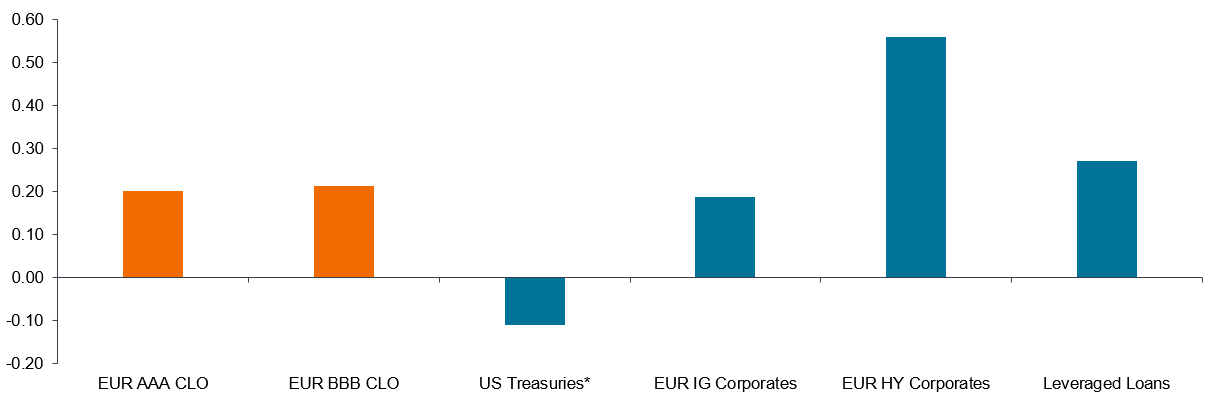
As the European Central Bank raises rates for a second time this year and the US Federal Reserve joins the tightening party, fixed income investors are solving the puzzle of fortifying their portfolios against rate rises while capturing attractive relative value amid tight credit spreads. Floating-rate investments, such as collateralised loan obligations (CLO), are seeing strong demand in this uncertain environment. The income return of a CLO moves with interest rates and consists of a credit spread and an underlying cash rate. CLOs therefore provide attractive income or carry while being largely immunised from interest rate volatility, helping to add diversification to portfolios (Figure 1).
Figure 1: CLO diversification benefits to equities
Source: Janus Henderson Investors, Bloomberg, JP Morgan, as at 31 August 2026.
Notes: Daily return correlations from 02 January 2018 to 31 August 2026 relative to EU Stoxx 50® Index and U.S. Equities (S&P 500 Index). Indices used to represent asset classes: EUR AAA CLOs (J.P. Morgan EUR CLO AAA Index), BBB CLOs (J.P. Morgan EUR CLO BBB Index), US Treasuries (Bloomberg US Treasury Index), High Yield (Bloomberg Pan-European High Yield Index), Leveraged Loans (Credit Suisse Leveraged Loan Index), IG Corporate (Bloomberg Euro Aggregate Corporate Bond Index).
Beyond their floating rate characteristics, another attribute attracting flows to the CLO market is their structural resilience. CLOs use multiple forms of credit enhancement (embedded safety features) to increase the credit quality of the debt they issue. Over a 30-year history, no AAA, AA, or A‑rated European CLO tranche has ever defaulted – even during the Global Financial Crisis and the pandemic. Typically, portfolio losses need to be above 40% before the most senior bonds, rated AAA, start to be impacted. This implies that losses would need to exceed two and a half times the Global Financial Crisis peak before a AAA-rated bond could begin to incur losses.1
Diversification benefits
Alongside these structural safeguards, it is also worth considering a CLO’s diversification and active management over its lifecycle. A CLO holds around 100-300 underlying loans (depending on jurisdiction), which are curated by a CLO manager who is responsible for ensuring the robustness of the loan portfolio over time. For investors, a CLO strategy also adds diversification at the portfolio level across many CLO deals and managers. This matters, as CLO managers differ in their investment philosophy, risk appetite and credit selection, which can lead to materially different outcomes over time.
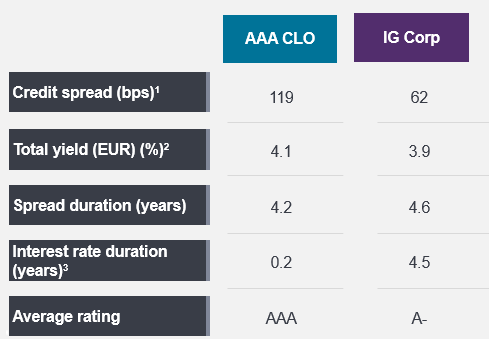
Understanding these differences requires specialist expertise. At Janus Henderson, we have invested in CLOs since before the Global Financial Crisis, globally and across the credit rating spectrum. In our view, CLOs offer a “specialist premium”, reflecting the depth of due diligence and underwriting required. Investors need to understand the structure, collateral, controls, managers and other counterparties. Such multi-layered analysis therefore requires specialist expertise, creating a barrier to entry and explaining why CLOs offer a spread advantage over comparable corporate bond markets and often in a higher rating category.
Figure 2: CLOs offer attractive relative value versus equivalently rated corporate bonds
Source: Janus Henderson Investors, JP Morgan, ICE indices, Bloomberg, as at 31 August 2026.
Note: 1 For CLO, based on discount Margin, for corporate credit, Swap OAS. 2For JHI Securitised, total yield is calculated as credit spread plus the swap rate corresponding to weighted average life. For corporate credit, Yield to Worst is presented. 3Credit indices based on effective duration. Yields may vary and are not guaranteed.
With fixed income spreads, particularly in corporate bonds, trading near the tight end of historical ranges, capturing higher spreads, such as those offered by CLOs, can support future returns. This is especially important now given macro and geopolitical uncertainty that could interrupt positive spread momentum, despite strong corporate fundamentals. Just like other markets, during periods of volatility, dispersion between CLO managers and deals becomes more prevalent, even in the highest-rated AAA CLO cohort. This can create opportunities as well as risks, reinforcing the importance of active management in identifying the CLO deals with the most compelling risk-adjusted return potential.
Safety first
Against this backdrop and AI disruption, markets are becoming more discerning about idiosyncratic risk. This can be seen in the continued bifurcation in the leveraged loan and high yield market, as well as the volatility in software and service sectors. As mentioned, diversification in CLOs can help mitigate these risks. Rather than relying on the outcome of individual borrowers, investors can access the income potential of the broader leveraged loan market while benefiting from CLO managers’ ability to identify changing risks, rebalance exposures and navigate periods of increasing dispersion.
With uncertainty around the path of interest rates and developed markets at different hiking stages, CLOs enable investors to generate returns primarily through carry rather than relying on directional views on rates. Floating-rate coupons and attractive credit spreads support higher yields than many similarly rated areas of traditional fixed income, allowing investors to benefit from a strong income stream while reducing dependence on capital gains to drive returns. Even when interest rates decline, spread forms a greater proportion of the overall yield, attracting flows from investors seeking to maintain income. These dynamics have underpinned demand for CLOs across market cycles, providing ample liquidity during periods of stress.
CLO technicals remain favourable because investor demand continues to broaden while issuance is being absorbed efficiently in an actively refinancing market. The buyer base is expanding beyond traditional institutional investors to include insurers, bank treasuries, wealth managers and ETF investors, supporting liquidity and valuations. At the same time, CLO spreads have not compressed to the same extent as corporate credit, leaving investors with an attractive combination of carry and technical support.
While corporate markets continue to face heavy issuance from banks, technology companies and AI-related borrowers, securitised markets benefit from stronger supply-demand dynamics that support resilience. These favourable technicals complement the structural characteristics of CLOs that have historically supported more stable return profiles.
Why CLOs behave differently in volatile markets
As well as their floating rate structure, which acts as a shield from interest rate volatility, AAA CLOs also tend to have a low spread duration (sensitivity to spread movements). Another factor that supports price stability is that CLOs are typically issued with a 2-year non-call feature, so if they trade materially above par, investors immediately price them to call. In dislocated markets, when CLOs trade below par, new buyers emerge to purchase them, allowing the CLOs to accrete towards par, providing an implicit backstop to price falls and spread widening.
Results of adding 10%, 20% and 30% AAA CLO allocation to your fixed income portfolio (10 years)
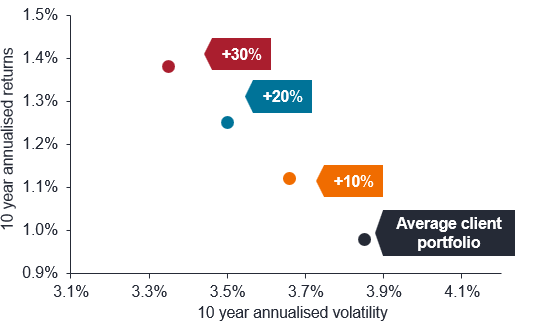
Source: Janus Henderson Investors, Bloomberg, Morningstar, JPMorgan. as at 31 July 2026. Indices used as representative in hypothetical portfolios: Global Bonds – Bloomberg Global Aggregate TR Hdg EUR; Euro IG – ICE BofA Euro Corporate TR EUR; Euro Govt. – Bloomberg Euro Agg GvtR TR EUR; Euro HY – Bloomberg Pan Euro HY TR EUR; Global HY – Bloomberg Global High Yield TR EUR; EM Debt – Bloomberg EM Hard Currency Agg TR USD; Bank Loans – Credit Suisse Western European Leveraged Loan TR Hdg EUR; US Bonds – Bloomberg US Agg Bond TR EUR; Convertibles – Refinitiv Europe CB TR EUR; Cash – ICE BofA EUR Ccy 3M Dep BdRt CM TR EUR (Cash). Average client portfolio is based on the average of Janus Henderson European clients’ fixed income portfolios. Portfolios are hypothetical and performance is based on historic index returns. Investors should not assume they will have a similar investment experience. Past performance does not predict future returns.
The portfolio benefits of incorporating CLOs are illustrated by Janus Henderson’s Portfolio Construction and Strategy Team, whose research shows how adding 10%, 20% or 30% in CLOs to a diversified fixed income portfolio can improve risk-adjusted return potential. A stable return profile, floating rate characteristics and secured cashflows enable access to yield, diversification and resilience. When investors face multiple moving variables, from inflation and elections to geopolitics and rates, it is no wonder then that capturing carry feels more reliable than having a convicted view on the direction of rates or markets.
1 Source: Moody’s Investors Services Credit Suisse/UBS, as at 31 December 2024. S&P Global, as at 31 December 2025, reflecting CLO default rates 2001 to 2025.
These are the views of the author at the time of publication and may differ from the views of other individuals/teams at Janus Henderson Investors. References made to individual securities do not constitute a recommendation to buy, sell or hold any security, investment strategy or market sector, and should not be assumed to be profitable. Janus Henderson Investors, its affiliated advisor, or its employees, may have a position in the securities mentioned.
Past performance does not predict future returns. The value of an investment and the income from it can fall as well as rise and you may not get back the amount originally invested.
The information in this article does not qualify as an investment recommendation.
There is no guarantee that past trends will continue, or forecasts will be realised.
Marketing Communication.