Key takeaways:
- Investors should view ENSO as a dynamic system rather than isolated El Niño or La Niña events. The financial impacts of each phase do not simply offset one another; instead, sequential weather disruptions can compound operational and economic pressures over multiple years.
- The same region or sector can face different forms of disruption across both ENSO phases. For example, El Niño-induced flooding may damage infrastructure and agricultural yields, while a subsequent La Niña can prolong drought, heat stress, or wildfire risk, creating sustained challenges rather than a recovery period.
- Portfolio resilience matters more than predicting a single climate outcome. As climate change may be altering the frequency, duration and intensity of ENSO events, investors should focus on companies with strong adaptation capabilities, such as diversified operations, robust supply chains, effective water management and the ability to recover quickly from disruptions.
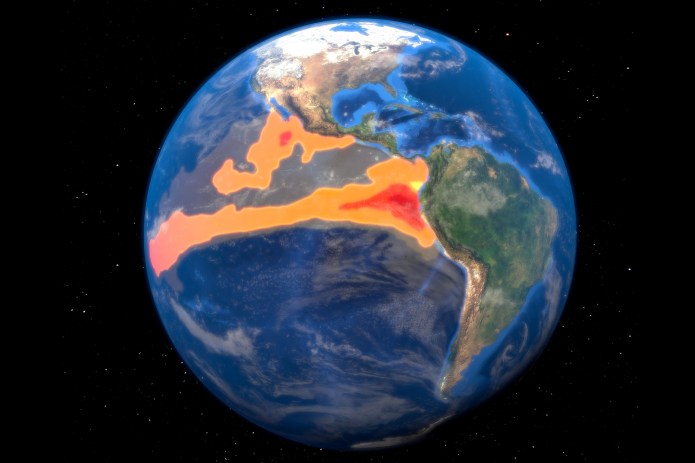
As climate phenomena go, El Niño often receives considerable media attention because of its dramatic effects on global weather. Yet it forms part of a larger oscillating system known as the El Niño-Southern Oscillation, or ENSO, which also includes the often-overlooked La Niña phase.1
While El Niño and La Niña are considered opposite phases,2 investors risk overlooking the fact that the climate and financial impacts of one are not necessarily equal to, or offset by, those of the other. Instead, investors should look beyond individual El Niño or La Niña events and consider ENSO as a larger dynamic system capable of creating compounding, multi-year effects.
From ocean temperatures to investment outcomes
ENSO originates in the tropical Pacific Ocean, but its effects extend across global weather patterns.3,4 Under neutral conditions, trade winds push warm surface water towards Asia while cooler water rises near South America.5 During El Niño, the central and eastern Pacific become warmer than usual, and the trade winds weaken.6 Rainfall consequently shifts towards the central and eastern Pacific, causing parts of Asia and Australia to become drier.7,8 By comparison, La Niña strengthens the normal circulation and associated weather patterns.11
These changes matter because they alter the location and severity of droughts, floods, storms, and extreme heat.12 The resulting financial-market impacts may include lower crop yields, disrupted mining operations, reduced hydropower generation, damaged infrastructure, adjustments to insurance claims, and changing commodity prices.13,14,15
Yet accounting for these changes in portfolios should not simply mean allocating holdings to sectors or regions that may benefit from one phase, such as El Niño, and reversing those positions when the other appears. The same sector can sometimes be negatively affected under both phases. Furthermore, understanding these compounding risks is likely to be even more important as some emerging evidence indicates that climate change may be altering the strength, duration, and frequency of both. While uncertainty remains over the precise evolution of the system, evidence points towards stronger and more persistent El Niño events, as well as more frequent and multi-year La Niña conditions.16
When more rain does not mean recovery
Consider the drought-prone southwestern United States. El Niño can bring higher precipitation, potentially benefiting agriculture, mining and other water-intensive industries. But the timing and intensity of that rainfall matter.
After a prolonged drought, compacted soil and vegetation loss can limit water absorption, causing rainwater to flow across the surface rather than percolate into the soil and replenish groundwater.17,18,19 Under heavy rainfall, the compacted soil may increase the risk of flooding rather than providing relief.20 Additionally, where wildfires have removed vegetation, the same rainfall can trigger landslides.21 Consequently, an event that initially appears positive for water availability may also damage crops, mines, and infrastructure.
Climate events such as El Niño are not just macroeconomic phenomena but real-world stress tests for business models. Our focus is not on predicting the severity or duration of the next weather cycle as markets efficiently price in near term disruptions. Instead, we focus on identifying those companies whose business model durability is underestimated because they can adapt, recover, and expand their competitive advantage through a wide range of operating environments, including extreme weather events like El Niño.
– Matt Culley, Portfolio Manager, Emerging Market Equity Team
Worse yet, El Niño may be followed by La Niña, a transition that is more likely after stronger El Niño events.22 La Niña can then amplify normal conditions, making the region even hotter and drier. Rather than allowing the region to recover from reduced rainfall, La Niña may instead extend the drought and increase wildfire risk.
Combined, the overall impact to the region is flooding under El Niño and renewed drought under La Niña. Instead of cancelling each other out, they create successive operating and financial pressures for businesses in the affected region.
A comparable pattern can emerge in normally wet regions. In Indonesia, for example, El Niño-related drought would reduce agricultural output, including on crops such as palm oil.23 A subsequent La Niña may bring unusually heavy rainfall and flooding, which can damage crops through a different mechanism.24 Agricultural production could therefore remain under pressure across both phases for an extended period.
Why investors should pay attention to ENSO and how to respond
No two El Niño or La Niña events are identical, and their strength, frequency, and duration may be changing. Investors should therefore be cautious about relying on historical impacts. The more useful exercise may be to identify companies that can remain resilient across several plausible conditions.
For example, for a mining company, relevant considerations include the geographic diversification of production, water management, infrastructure resilience and the speed at which output can recover after disruption. For food and consumer businesses, supply-chain diversification, inventory management, purchasing power and the ability to reformulate products may be important. For insurers, investors can examine whether temporary reductions in claims are being treated as sustainable improvements or used to prepare for future loss years.
Overall, for investors, the central lesson is that El Niño and La Niña should not be viewed as isolated climatic events, but instead as drivers of sector dispersion and macroeconomic volatility whose effects may persist, overlap and compound. Understanding what may come after the initial shock can be just as important as understanding the shock itself.
This perspective complements our recent article and whitepaper on climate resilience in a super El Niño environment by considering how the broader ENSO cycle can create compounding effects across multiple years.
1,2,3,5,11 Source: NOAA, What are El Niño and La Niña?, Updated 23, September 2026.
4,7,12 Source: NOAA, Climate.gov, Global impacts of El Niño and La Niña, 9 February 2016.
6 Source: NASA, El Niño, 14 February 2017, Updated 2 October 2024.
8 Source: NOAA, Climate.gov, EN… SO?, 10 July 2014.
13 Source: Barclays – Cross Asset Research, Super El Niño: The Climate Risk Trade, 15 May 2026.
14 Source: Nature Communications, Nonlinear El Niño impacts on the global economy under climate change, 21 September 2023.
15 Source: Insurance NewsNet, The Super El Niño Effect on insurance and what it means for clients, 2 June 2026.
16,22 Source: Nature Communications, Super El Niño events drive climate regime shifts with enhanced risks under global warming, 12 December 2025.
17 Source: University of Minnesota, Soil Compaction, 2018.
18 Source: UC Master Gardeners of Santa Clara County, Watering Hydrophobic Soil.
19,20 Source: BBC, Thunderstorms: Why drought can lead to dangerous flooding, 15 August 2022.
21 Source: NOAA, National Weather Service, Burn Scar Flash Flood & Debris Flow Risks.
23 Source: International Monetary Fund, El Niño Good Boy or Bad?, March 2016.
24 Source: Bloomberg, Fifth La Niña in six years to disrupt crops and supply chains, 14 December 2025.
Climate change: Long-term changes in global temperatures and weather patterns that can create physical and transition risks and opportunities across economies, industries, and financial markets.
Commodity: A physical good such as oil, gold, or wheat.
Dispersion: The extent to which a distribution of data points is stretched or squeezed. If the data points cluster around certain values, then dispersion is low, whereas if they are more spread out, then dispersion is high. For example, dispersion in stocks measures the range of returns for a group of stocks. Higher dispersion opens up opportunities for stock pickers to outperform by selecting the winners and avoiding the losers, given that stock returns are spread more widely on either side of the benchmark.
Diversification: A way of spreading risk by mixing different types of assets or asset classes in a portfolio on the assumption that these assets will behave differently in any given scenario. Assets with low correlation should provide the most diversification.
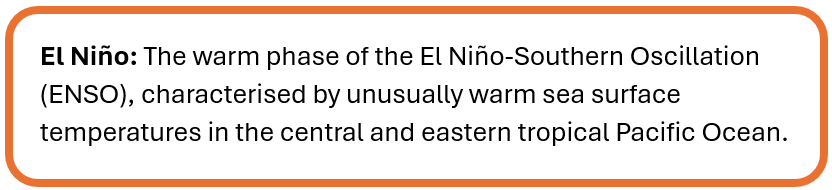
El Niño: The warm phase of the El Niño-Southern Oscillation (ENSO), characterised by unusually warm sea surface temperatures in the central and eastern tropical Pacific Ocean.
Emerging market: The economy of a developing country that is transitioning to become more integrated within the global economy. This can include making progress in areas such as depth and access to bond and equity markets and development of modern financial and regulatory institutions.
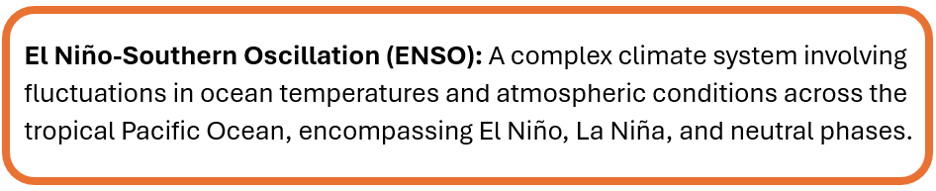
El Niño-Southern Oscillation (ENSO): A complex climate system involving fluctuations in ocean temperatures and atmospheric conditions across the tropical Pacific Ocean, encompassing El Niño, La Niña, and neutral phases.
Hydropower: Electricity generated using the movement of water, typically through dams or river systems. Hydropower production can be affected by droughts and changes in precipitation patterns.
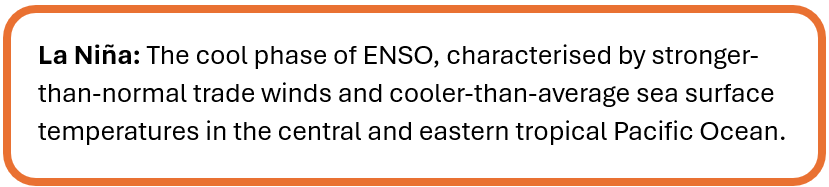
La Niña: The cool phase of ENSO characterised by stronger-than-normal trade winds and cooler-than-average sea surface temperatures in the central and eastern tropical Pacific Ocean.
Macroeconomics: Macroeconomics is the branch of economics that considers large-scale factors related to the economy, such as inflation, unemployment, or productivity.
Portfolio: A grouping of financial assets such as equities, bonds, commodities, properties, or cash. Also often called a ‘fund’.
Purchasing power: This refers to how much you can buy with a specific amount of money. It goes up and down over time according to various economic factors such as inflation.
Risk: The acceptance of greater risk in exchange for potentially higher returns. This can apply to both individual investors and companies. An assessment of investors’ attitude to risk forms a fundamental part of identifying a suitable investment strategy for their objectives.
Supply chain diversification: The practice of sourcing materials, products, or services from multiple suppliers, regions, or production locations to improve resilience and reduce disruption risk.
Volatility: The rate and extent at which the price of a portfolio, security, or index moves up and down. If the price swings up and down with large movements, it has high volatility. If the price moves more slowly and to a lesser extent, it has lower volatility. The higher the volatility, the higher the risk of the investment.
These are the views of the author at the time of publication and may differ from the views of other individuals/teams at Janus Henderson Investors. References made to individual securities do not constitute a recommendation to buy, sell or hold any security, investment strategy or market sector, and should not be assumed to be profitable. Janus Henderson Investors, its affiliated advisor, or its employees, may have a position in the securities mentioned.
Past performance does not predict future returns. The value of an investment and the income from it can fall as well as rise and you may not get back the amount originally invested.
The information in this article does not qualify as an investment recommendation.
There is no guarantee that past trends will continue, or forecasts will be realised.
Marketing Communication.