

Key takeaways:
- China’s biotech sector is transitioning from a manufacturing and fast-follow market to a source of globally competitive drug innovation.
- Monetisation via licencing partnerships with multinational pharmaceutical companies, co-development, profit-sharing and NewCo structures or self-commercialisation allows greater participation in an asset’s potential returns.
- Investors should have a selective focus on high-quality innovators with differentiated and broader pipelines given clinical, competitive and geopolitical risks may likely create a widening gap between the winners and losers.
Traditional Chinese medicine (TCM) dates back more than 2000 years, with Huangdi Neijing (The Yellow Emperor’s Classic of Medicine) said to be written around 2600 BC, and evidence of therapeutic puncturing possibly being an early form of acupuncture. However, many may not realise that today, China is continuing that early wave of innovation – Suzhou in the northwest, and Shanghai, are key biotechnology hubs for drug discovery, clinical development and biopharmaceutical innovation.
China’s biotechnology sector is no longer just a manufacturing hub or mainly domestic facing. Leading companies are increasingly competing in the global arena, with drug discoveries and biotech innovation that is now being monetised through licensing, partnerships and overseas commercialisation.
Biomedicine is among the six strategic and emerging pillar industries identified by China. The recently unveiled 15th Five-year Plan (2026-30) for Pharmaceutical Industry Development outlined a roadmap to accelerate development in the sector. Among the key quantifiable goals are the aim to achieve operating revenue of pharmaceutical industrial enterprises above a designated size to exceed 3.5 trillion yuan by 2030, and a growth rate of more than 20% for innovative drugs.1
Investors are acknowledging this strong growth area of the Chinese market. The Hang Seng Biotech Index has rallied by more than 130% since it bottomed in July 2024,2 when in May, investor focus shifted towards AI and there were heightened geopolitical concerns. Many China biotech stocks now look well positioned to be on a long-term structural uptrend.
In our view, there are three key reasons for this:
- China has moved from being primarily a consumer, fast follower of foreign drug innovation, and manufacturing hub, to becoming one of the largest sources of biotech innovation.
- China is increasingly adept at retaining more of the value from innovation through various monetisation routes.
- Biotech has been a strategic priority area for China for some years now, supported by policy initiatives, regulatory reform and funding.
From ‘fast-follower’ to global competitor in innovation
Historically, many Chinese biopharma companies followed a ‘fast-follow’ strategy. Instead of taking the full risk of discovering new drug, they focused on more quickly, developing and/or improving drugs that were similar to successful medicines developed elsewhere, and manufactured it at lower cost.
While this lowered development risk, it also created crowded pipelines and a lack of innovation. For example, Humira (developed by Abbott Laboratories at the time) was the first fully human monoclonal antibody approved by the US FDA, treating several chronic autoimmune diseases, making it a best-selling drug for years. In 2018, 25 Chinese developers were working on creating Humira biosimilars.3
Over the past decade, however, the research and development (R&D) model of China’s biotech industry has been transformed. Regulatory reform, greater access to capital and a deeper scientific talent pool has allowed leading companies to move beyond fast-follow development towards differentiated best-in-class (BIC) and, increasingly, first-in-class (FIC) assets designed for global development.
China has made enormous gains in phase I drug development and is increasingly competing with, and in some areas surpassing, the US in the volume and speed of early-stage clinical trials. Key regulatory reforms have made China much faster than it was a decade ago:
- China moved to an implied approval system where many clinical trial applications can proceed if regulators do not object within a defined review period.
- Innovative drugs may benefit from expedited review pathways.
- Large patient populations and concentrated hospital networks can accelerate recruitment.
- Development costs are often lower than in the US.
The rise of next-generation drug development in China
Accounting for a major share of the global clinical pipeline, China-originated assets represent around a third of all innovative drugs under active clinical development. In addition, innovation output has ramped significantly, with roughly half of the global new molecular entities (NMEs) entering clinical trials this year.
Figure 1: A third of global clinical stage innovative drugs originate from China, with proportionally higher contribution from early phase 1 and NDA pipelines
# of global clinical-stage innovative drugs (by region and by stage) YTD 2026
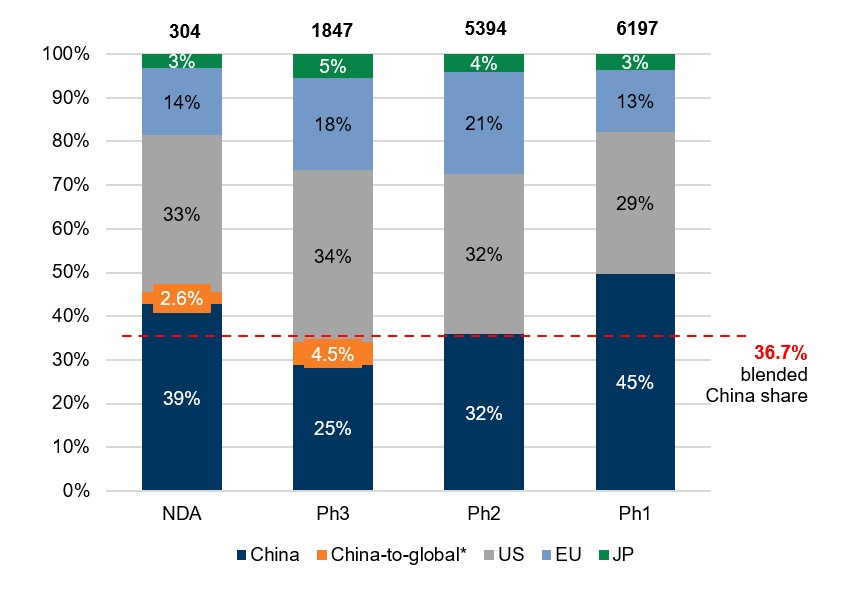
Source: PharmCube, Goldman Sachs as at 4 August 2026. NDA = formal application submitted to the US Food and Drug Administration (FDA) seeking approval to market and sell a new drug in the US.
China’s drug development engine has built an exceptionally strong position in the global transition toward next-generation, high-complexity therapeutic platforms. There has been a shift to next-generation modalities. While traditional small molecules and monoclonal antibodies remain the largest pharmaceutical markets, newer modalities are growing much faster, such as Antibody-Drug Conjugates (ADCs) and bispecific/multi-specific antibodies.
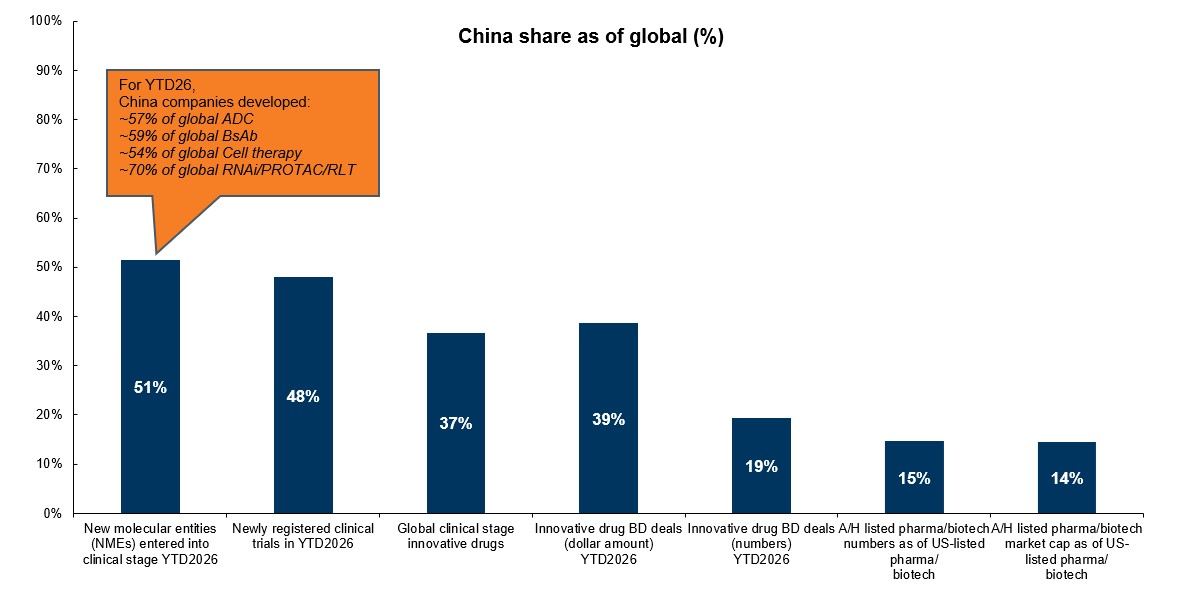
Source: Goldman Sachs analysis as at July 2026. BD = business development; A/H = China A shares/Hong-Kong listed; ADC = Antibody-Drug Conjugate; BsAb = Bispecific Antibody; RNAi = RNA Interference; PROTAC = Proteolysis-Targeting Chimera; RLT = Radioligand Therapy.
Why we believe China biotech is at an inflection point for investors
China spent the last decade building biotech capabilities; the investable inflection is happening now because global demand, funding diversification and stronger balance sheets, is finally allowing the winners to convert those capabilities into sustained profitability:
- The global pharma patent cliff has created a pipeline replacement need: A wave of blockbuster drugs are due to lose exclusivity over the coming years, including some of the industry’s largest products. Drugs facing loss of exclusivity represent tens of billions of dollars of annual sales, increasing pressure on large pharma companies to replace future revenue through external innovation, licensing and mergers and acquisitions (M&A). As global pharma looks outside its own labs to refill pipelines, it is increasingly turning to the innovation capacity China has built over the past decade, creating a more structural buyer base for Chinese assets.
- Licensing income is reshaping biotech funding models: While one of the sector’s key vulnerabilities post-COVID was its dependence on external capital to fund long-duration R&D, funding models are now more diversified. Licensing has emerged as a meaningful alternative source of capital. Outbound licensing upfronts and milestones (contractual payments paid by a global pharmaceutical to a biotech company when a drug candidate reaches predefined development, regulatory or commercial targets) now contribute approximately 70% of China’s biotech sector funding.4
- Dramatic runway extension: Through aggressive operational downsizing, focus on high-margin core pipelines, and non-dilutive licensing inflows, corporate balance sheets have rebounded. The median cash runway ie. the length of time existing cash can support operations of listed Chinese biotechnology companies, has nearly doubled.5
- The sector is increasingly focused on capturing a greater share of long-term economic value, rather than simply maximising deal activity: Better-capitalised innovators can increasingly use licensing, co-development, profit-sharing and NewCo (new company) structures or self-commercialisation, to retain greater participation in the monetisation/capture of an asset’s potential returns.
What criteria should investors look for when investing in China biotech?
We think the investment opportunity lies in companies that can deliver on two fronts: firstly, have differentiated pipelines with strong R&D and management execution, and sufficient financial capacity to carry development risk. Secondly, have reliable and consistent monetisation routes, rather than relying solely on traditional out-licensing to generate revenues.
Key risks facing China’s biotechnology sector
Despite the improving backdrop, China’s biotech industry faces a number of challenges as it becomes more global. Rising US-China tensions are unlikely to stop collaboration altogether, but they could make cross-border partnerships, clinical trials, manufacturing and approvals more complex and costly. Competition is another risk, with companies targeting the same areas. Companies with a broader pipeline, differentiated technologies and multiple growth drivers would seem better placed to withstand setbacks and generate more consistent long-term value.
Conclusion
China’s biotech industry has evolved from a fast follower to an increasingly important source of global drug innovation, and in particular, next-generation therapies. For investors, the most compelling opportunities are likely to be found in companies that combine differentiated innovation with the ability to retain and monetise a greater share of the value they create. In our view, these companies are well positioned to drive growth and returns in China’s biotech sector for many years to come.
IMPORTANT INFORMATION
There is no guarantee that past trends will continue, or forecasts will be realised.
References made to individual securities do not constitute a recommendation to buy, sell or hold any security, investment strategy or market sector, and should not be assumed to be profitable. Janus Henderson Investors, its affiliated advisor, or its employees, may have a position in the securities mentioned.
Equity securities are subject to risks including market risk. Returns will fluctuate in response to issuer, political and economic developments.
Health care industries are subject to government regulation and reimbursement rates, as well as government approval of products and services, which could have a significant effect on price and availability, and can be significantly affected by rapid obsolescence and patent expirations.
1 Xinhua.net; China Focus: China aims to cement its place at forefront of biomedical innovation with new 5-year plan; 18 September 2026.
2 Bloomberg, Hang Seng Biotech Index price returns to 10 July 2024 to 21 September 2026. Past performance does not predict future returns. The Hang Seng Biotech Index (“HSBIO”) reflects the overall performance of the 30 largest biotech companies that are listed in Hong Kong and tradable under the Southbound Stock Connect, including stocks listed through the Listing Rules Chapter 18A of Hong Kong Exchange.
3 Goldman Sachs research, China healthcare: Takeaways from our 47th Global Healthcare Conference, 19 June 2026.
4 GBI, Morgan Stanly Research, as at 28 May 2026.
5 FactSet; Morgan Stanley research as at 28 May 2026, cash runway grew from 2.6 years in FY2023 to 4.9 years in FY2025.
Antibody-drug conjugate (ADC): A targeted cancer treatment that combines an antibody with a cancer-killing drug, helping deliver treatment directly to tumour cells.
Best-in-Class (BIC): A drug candidate designed to outperform existing treatments through better efficacy, safety, convenience, dosing, durability, or patient outcomes.
Bispecific antibody: A type of engineered antibody designed to bind to two different targets simultaneously.
First-in-class drug: A medicine that works through a new biological mechanism not previously approved for treatment.
Licensing agreement: An arrangement where a company grants another company the rights to develop, manufacture or sell a product in exchange for payments or royalties.
Milestone payment: A payment received when pre-defined development or commercial targets are achieved.
NewCo: NewCo (new company) structure refers to a deal where a biotech company contributes one or more drug assets into a newly created company, usually alongside financial backing from external investors and sometimes strategic partners. Rather than simply licensing a drug to a large pharmaceutical company in exchange for upfront payments, milestones and royalties, the Chinese biotech company transfers the asset into a NewCo, receiving an ownership stake in the new entity.
New molecular entity (NME): A drug containing an active ingredient that has never previously been approved for use.
Out-licensing: The process of granting another company rights to commercialise a drug while retaining certain economic benefits.
These are the views of the author at the time of publication and may differ from the views of other individuals/teams at Janus Henderson Investors. References made to individual securities do not constitute a recommendation to buy, sell or hold any security, investment strategy or market sector, and should not be assumed to be profitable. Janus Henderson Investors, its affiliated advisor, or its employees, may have a position in the securities mentioned.
Past performance does not predict future returns. The value of an investment and the income from it can fall as well as rise and you may not get back the amount originally invested.
The information in this article does not qualify as an investment recommendation.
There is no guarantee that past trends will continue, or forecasts will be realised.
Marketing Communication.
Important information
Please read the following important information regarding funds related to this article.
- Shares can lose value rapidly, and typically involve higher risks than bonds or money market instruments. The value of your investment may fall as a result.
- The Fund follows a growth investment style that creates a bias towards certain types of companies. This may result in the Fund significantly underperforming or outperforming the wider market.
- Emerging markets expose investors to higher volatility and greater risk of loss than developed markets; they are susceptible to adverse political and economic events, and may be less well regulated with less robust custody and settlement procedures.
- The Fund may invest in China A-shares via a Stock Connect programme. This may introduce additional risks including operational, regulatory, liquidity and settlement risks.
- High exposure to a particular country or geographical region carries a higher level of risk than a more broadly diversified portfolio.
- Derivatives may be used with the aim of reducing risk or managing the portfolio more efficiently. However, this introduces other risks, in particular, that a derivative counterparty may not meet its contractual obligations.
- If the Fund holds assets in currencies other than the base currency of the Fund, or you invest in a share/unit class of a different currency to the Fund (unless hedged, i.e. seeks to mitigate exchange rate movements between the share/unit class currency and the base currency of the Fund), the value of your investment may be impacted by changes in exchange rates.
- Securities could become hard to value or to sell at a desired time and price, especially in extreme market conditions when asset prices may be falling, increasing the risk of investment losses.
- Losses could be incurred if a counterparty became unwilling or unable to meet its obligations, or as a result of failure or delay in operational processes or the failure of a third party provider.