

For many years, climate change, energy and national security were largely treated as separate issues, addressed by different parts of government, industry and the investment community. Increasingly, that distinction is breaking down. This was the topic of a recent insightful Janus Henderson event in London, which included a former UK Cabinet Office national security strategy expert and executives from prestigious investment groups.
Russia’s invasion of Ukraine made energy security an immediate strategic priority for Europe. Conflict in the Middle East continues to disrupt shipping routes and influence insurance costs and energy prices. At the same time, floods, droughts, extreme heat and wildfires are putting pressure on the infrastructure, supply chains and public services that countries rely on during periods of crisis.
Climate change and geopolitics remain distinct risks, but they increasingly converge around the same assets, infrastructure and investment decisions. For investors, what matters is not simply identifying individual risks, but understanding where they overlap and which systems are most exposed when they do.
Climate security is becoming national resilience
Over the short term, the global risk environment is dominated by geopolitical, societal and technological pressures, including geoeconomic confrontation, armed conflict, misinformation and cyber insecurity. Over a ten-year horizon, environmental risks such as extreme weather, biodiversity loss and natural-resource shortages become more prominent.
These risks do not simply sit beside one another. They can reinforce each other (Exhibit 1).
A conflict or trade dispute can interrupt energy supplies, while drought can constrain hydropower and industrial production. Extreme weather can damage transmission networks at the same time as cyberattacks target the grid. Shortages of critical minerals can then delay the infrastructure intended to make the energy system more secure.
The practical bridge between these risks is resilience: the ability to keep essential functions operating under environmental stress, geopolitical pressure or deliberate disruption.
The same electricity grid may need to withstand a storm, cyberattack and energy-supply shock while supporting electrification, industrial growth and defence requirements. A port may be exposed to flooding, sabotage and disrupted shipping routes. Critical minerals may support wind turbines, batteries, communications equipment and defence technologies.
The institutions responsible for these systems may remain separate, but the underlying assets and dependencies increasingly do not. This raises difficult questions about governance, capital allocation and accountability. Who sets the resilience standard? Who pays for redundancy? When does climate adaptation also constitute a security investment?
Exhibit 1: Short-term and long-term risks are converging
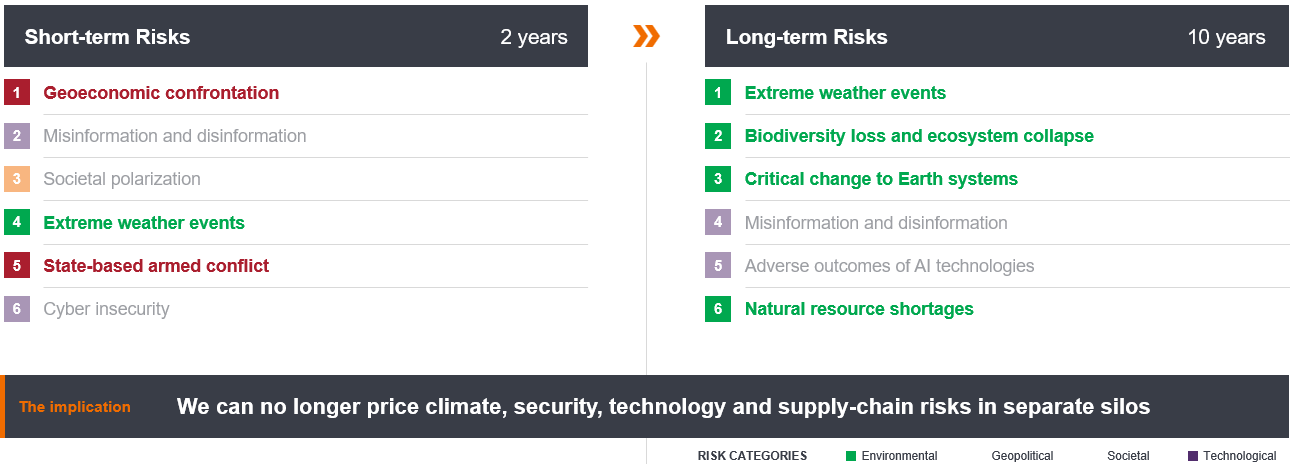
Source: World Economic Forum Global Risks Perception Survey 2025-2026
Energy shocks can delay the transition and strengthen it
The convergence is especially visible in energy markets, where security concerns can push the transition in two directions.
In the short term, an energy shock tends to reinforce the existing system. Governments prioritise affordability, reliability and physical supply. Fossil-fuel assets may operate for longer, emergency infrastructure may be built and transition timelines can slip.
Europe’s response to the loss of Russian energy supplies illustrated this dynamic. Governments filled gas storage, secured alternative pipeline supplies, chartered floating liquefied natural gas terminals and, in some cases, temporarily relied on coal or reserve capacity.
The structural response can point in the opposite direction. Once reliance on imported energy is recognised as a strategic vulnerability, domestic low-carbon power gains additional value. Wind, solar, hydro and nuclear power can contribute to a more diversified energy system, although the infrastructure itself may still depend on imported minerals, components and fuel-cycle services.
The transition is therefore neither simply accelerating nor stalling. It is being reshaped. Security concerns may slow aspects of it in the near term while strengthening the longer-term case for domestic power, grids, storage and system flexibility.
Artificial intelligence adds another dimension. Compute may appear weightless, but it depends on physical assets, including buildings, semiconductors, electricity, cooling water and land. The International Energy Agency estimates that global data-centre electricity consumption could reach approximately 945 terawatt-hours by 2030, more than double its 2024 level.
Because data centres cluster geographically, their impact is local. They can place significant pressure on individual grids and water basins. Always-on computing also requires firm power, backup capacity and redundancy, applying the same continuity logic found in national-resilience planning.
AI is therefore becoming an energy-security issue. In the near term, new demand may draw on whichever generation is available, including fossil fuels. Structurally, it may accelerate demand for clean power, grid capacity and storage.
Exhibit 2: System shocks affect the transition at two speeds
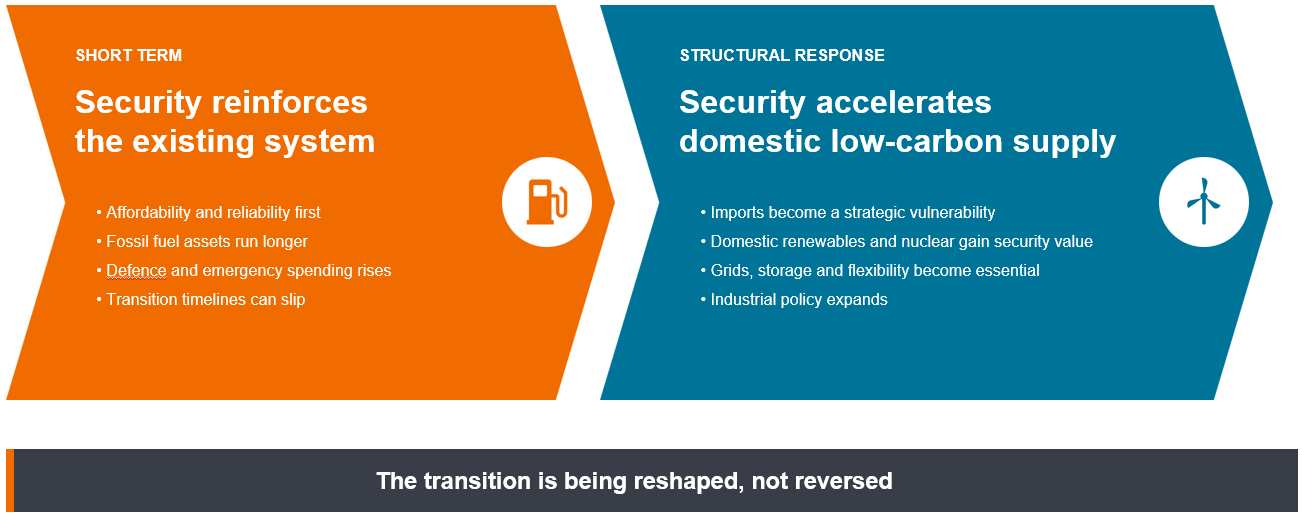
Source: Janus Henderson Investors and UC Berkeley ExecEd.
The transition is rewiring strategic dependencies
The energy transition reduces certain dependencies while creating others.
Europe has spent years addressing its reliance on imported oil and gas. Attention is now turning to concentrated supply chains for solar equipment, batteries, rare-earth processing and other critical technologies. Dependency is shifting from fossil-fuel molecules towards minerals, processing, manufacturing, technology and grids.
Europe has mineral resources, a long mining tradition and established industrial capabilities. However, geology does not automatically become usable supply. Resources must be permitted, financed, mined, processed and transported.
Environmental impacts, biodiversity considerations and community consent are therefore not secondary communications concerns. They can determine project timing, cost and deliverability.
For investors, the relevant question is not whether a technology has no environmental footprint. All physical infrastructure has one. The question is whether the complete system produces a better economic, security and environmental outcome, and whether its trade-offs are being managed credibly.
From a portfolio management perspective, resilience requires us to look beyond the apparent diversification of individual holdings and examine their underlying dependencies. Different businesses may rely on the same grid connection, port, supplier or technology provider, creating concentrations of risk that traditional sector analysis may not capture. We therefore need to assess whether resilience investment is adequately funded, how quickly essential services can recover from disruption and whether these factors are appropriately reflected in expected cash flows and valuations.
– Tal Lomnitzer, Senior Investment Manager
From efficiency to continuity
Resilience should not become a vague premium assigned to any asset described as critical infrastructure. It needs to be tested through the investment case.
This starts with dependencies. Which grid connection, port, supplier, processor, cable or cloud provider could interrupt the business? A portfolio can appear diversified while multiple holdings depend upon the same infrastructure.
Investors must also consider capital. Is resilience expenditure explicit, funded and recoverable through regulated returns, customer pricing, insurance or public co-financing? If disruption occurs, which revenues stop, which costs rise and how quickly can services be restored?
Exhibit 3: An investor framework for assessing resilience
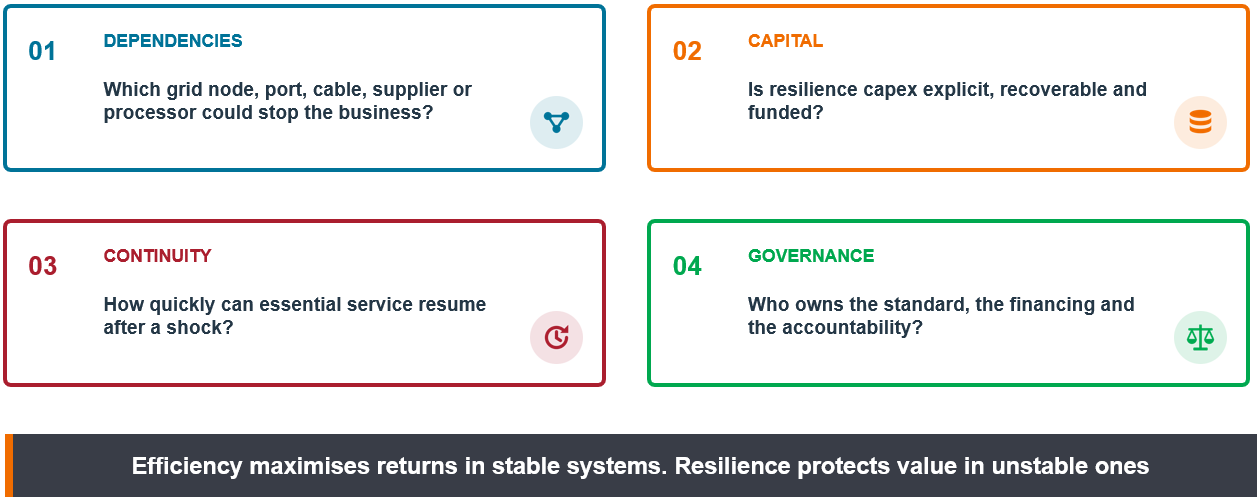
Source: Janus Henderson Investors; UK CIO speaking notes; Berkeley Module 1.
For decades, markets often rewarded concentrated supply chains, lean inventories and just-in-time delivery. These models can maximise efficiency in stable conditions, but limited redundancy can become expensive when several systems come under pressure simultaneously.
The investment lens may therefore be shifting from pure efficiency towards continuity. This does not imply a universal “resilience premium”. It requires investors to identify where continuity, recovery capacity and strategic optionality might be underappreciated in expected cash flows and valuations.
Climate change, national security, technology and supply chains remain distinct issues. But they increasingly converge in the systems on which economies and companies depend. Governments, however, are not necessarily structured to address these issues in the same integrated way. In the UK, policy discontinuity and departmental silos can complicate long-term planning.
Europe seems better positioned, but its strengths shift the challenge towards grids, permits, capacity, physical climate risk and public acceptance. Different national structures, priorities and domestic interests can also make coordination difficult, so while there is broad recognition of the need for greater resilience, considerable work remains to translate that into joined-up policy and delivery.
The energy transition is no longer solely a climate project. It is becoming an infrastructure, industrial-policy and national-resilience project. For investors, understanding what will grow remains important. Increasingly, so does understanding what will continue to function when the system is tested.
Capital: When referring to a portfolio, capital reflects the net asset value of a fund. More broadly, it can refer to the financial value of an amount invested in a company or an investment portfolio.
Cash flow: The net balance of cash that moves in and out of a company. Positive cash flow shows more money is moving in than out, while negative cash flow means more money is moving out than into the company.
Diversification: A way of spreading risk by mixing different types of assets or asset classes in a portfolio, on the assumption that these assets will behave differently in any given scenario. Assets with low correlation should provide the most diversification.
Infrastructure investment: Investment into the physical assets of a nation or company, such as roads, railways, bridges, water, sewerage, port facilities or telecommunications. Given that it usually requires large amounts of money, it is typically undertaken by governments or specialised investment strategies.
Net zero: A state in which greenhouse gases, such as carbon dioxide (CO2), being released into the atmosphere are balanced by their removal from the atmosphere.
Portfolio: A grouping of financial assets such as equities, bonds, commodities, properties or cash. Also often called a fund.
Risk premium: The additional return an investment is expected to provide in excess of the risk-free rate. The riskier an asset is deemed to be, the higher its risk premium to compensate investors for the additional risk.
Secular themes/trends: Long-term investment themes with strong growth potential, such as climate change, AI, clean energy or changing demographics.
These are the views of the author at the time of publication and may differ from the views of other individuals/teams at Janus Henderson Investors. References made to individual securities do not constitute a recommendation to buy, sell or hold any security, investment strategy or market sector, and should not be assumed to be profitable. Janus Henderson Investors, its affiliated advisor, or its employees, may have a position in the securities mentioned.
Past performance does not predict future returns. The value of an investment and the income from it can fall as well as rise and you may not get back the amount originally invested.
The information in this article does not qualify as an investment recommendation.
There is no guarantee that past trends will continue, or forecasts will be realised.
Marketing Communication.