
Key takeaways:
- As deglobalization and artificial intelligence (AI) drive structural change, our investment teams are actively engaging with companies and seeking to capitalize on opportunities presented by these forces.
- Clients around the world are trying to determine how to navigate structural change while staying true to core values like portfolio governance, resilience, and shareholder trust.
- As these forces continue to impact global growth, productivity, and ultimately investment outcomes, we see opportunities for active managers to differentiate themselves – particularly as investors become more forward looking and selective.
Definitions
Dispersion: The extent to which a distribution of data points is stretched or squeezed. If the data points cluster around certain values, then dispersion is low, whereas if they are more spread out, then dispersion is high. For example, dispersion in stocks measures the range of returns for a group of stocks. Higher dispersion opens up opportunities for stock pickers to outperform by selecting the winners and avoiding the losers, given that stock returns are spread more widely on either side of the benchmark.
Onshoring / reshoring: The process of bringing business operations back in-house, or relocating them within domestic (or regional, in the case of the EU) borders. While it can be more expensive to run local operations due to higher wages or the cost of regulation, it offers more control and helps reduce the impact of geopolitical uncertainty or currency changes.
Russell 2000® Index reflects the performance of U.S. small-cap equities.
S&P 500® Index reflects U.S. large-cap equity performance and represents broad U.S. equity market performance.
IMPORTANT INFORMATION
Investing involves risk, including the possible loss of principal and fluctuation of value.
Actively managed portfolios may fail to produce the intended results. No investment strategy can ensure a profit or eliminate the risk of loss.
Artificial intelligence (“AI”) focused companies, including those that develop or utilize AI technologies, may face rapid product obsolescence, intense competition, and increased regulatory scrutiny. These companies often rely heavily on intellectual property, invest significantly in research and development, and depend on maintaining and growing consumer demand. Their securities may be more volatile than those of companies offering more established technologies and may be affected by risks tied to the use of AI in business operations, including legal liability or reputational harm.
Equity securities are subject to risks including market risk. Returns will fluctuate in response to issuer, political and economic developments.
Smaller capitalization securities may be less stable and more susceptible to adverse developments, and may be more volatile and less liquid than larger capitalization securities.
View transcript
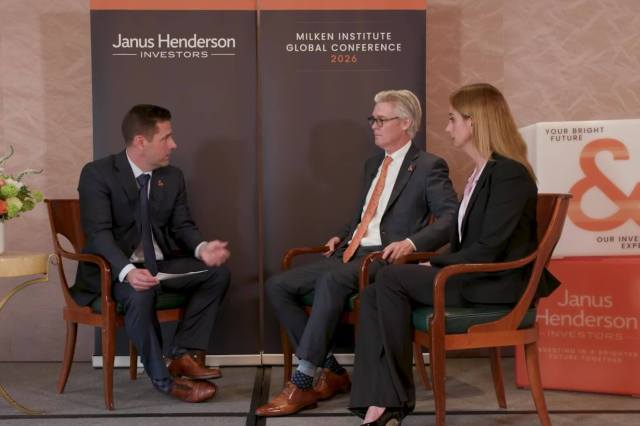
Seth Meyer: Hey, everyone, it’s Seth Meyer here at the Milken Institute Global Conference in Beverly Hills. I’m delighted to be joined today by two of our thought leaders. And we’ve spent the last couple of days learning from a lot of our clients around the world about what’s driving their investment decisions and how they’re thinking about the future of investing.
With me today is Kelly Cavagnaro, the head of U.S. institutional, and Jonathan Coleman, a U.S. equity portfolio manager.
Kelly, obviously, we’re here where a lot of the largest clients in the world are present. What do they really want to talk to you about today?
Kelly Cavagnaro: We’re having so many interesting conversations with clients here at Milken. It’s been so fun so far, Seth. Thank you. You know, one of the deep trends that’s emerging, certainly, is this idea of massive structural change across every geography and every institutional client channel. And the topics differ, whether it’s AI or geopolitics or energy transition. But underlying all of that, absolutely, is this question of how to navigate all of this structural change while still staying true to core values like portfolio governance and resiliency and shareholder trust.
And the answer that’s emerging is that while people still definitely want resiliency, they want it with accountability and with deep research and backed up by forward-looking thoughts with very strong partners.
Meyer: Great. So, Jonathan switching to you … Kelly weaved in a couple investment themes. What has been interesting for you over the conference over the past couple of days?
Jonathan Coleman: Yeah, I’d actually like to pick up on a thread that Kelly was talking about in terms of structural change. And one of the things that we see from talking to lots of companies every day as part of our fundamental due diligence process is the opportunities that are created from deglobalization.
So, we know that deglobalization is going to be inherently inflationary, if we do nearshoring and onshoring and we have to replace supply chains that have been built for efficiency but now will be built for redundancy. Intriguingly, I live in the small-cap world, and that’s a great opportunity for small-cap companies. That seems counterintuitive to most investors, but actually we’ve done a lot of research at Janus Henderson. Go back 50, 60 years, the single best decades in history for small-cap companies have been periods where we have had inflationary environments. So, the period of the 1970s and then the first decade in the year 2000, and we think we’re entering a period like that.
And interestingly, small caps have started to outperform large caps. That’s not well appreciated by many market participants. But over the last year, the small cap benchmark [the Russell 2000® Index].has outperformed the S&P [500® Index] by over 1000 basis points.* So, we’re excited about that.
Meyer: Yeah, I mean, it’s a really interesting theme when you’re talking about the geopolitical realignment. It’s been a theme we’ve been talking about quite a bit here at Janus Henderson. And if anything, it’s even more appropriate today than it was even a couple of years ago when we were discussing it. What does it mean – onshoring, reshoring … what it means for costs, what it means for inflation, and things you’re talking about.
So maybe, Kelly, as you’re thinking about the asset management industry as a whole, how are you thinking about the future of it as we look forward and kind of how our clients are thinking about what we do every day and how we can help them?
Cavagnaro: Yeah, absolutely. Well, you know, it’s interesting that the theme here at Milken is leading in a new era. And definitely the dominant tone here is one of adaptation and progress, but with, you know, thought and purpose. And the institutional community is definitely no different. They are definitely recalibrating right now, as well. At Janus Henderson, you know, our job is to partner together with our clients to really help them prepare to meet their investment objectives on a forward-looking basis.
Meyer: Jonathan, do you have anything to add to that?
Coleman: Yeah. So, I think another important theme that certainly has been much discussed at the Milken Conference this year has been the trends in AI. We really view that from a small-cap lens as creating a really wide dispersion of winners and losers. That’s always been the case in small cap, but I think it’s even more so now. And we really think that’s a great opportunity for active management to really differentiate itself from passive. And so that’s something we’re looking forward to and talking to clients about as we look to the next decade.
Meyer: Yeah, it’s been interesting. You made the point on small cap outperforming large cap, and a lot of people not really paying attention there. It’s also been permeated beyond just the Mag 7. So not just a small-cap phenomenon, but even in large cap equity, there’s now some opportunities that maybe in the narrowness of the market that we saw over the past couple of years are starting to broaden and benefit materials or energy or power or utilities.
So, any other any other kind of standout breakout sessions that you guys would like to highlight?
Cavagnaro: So many at Milken, as always Seth, of course. My favorites are always the ones that connect kind of those big themes of structural change with, you know, investor behavior. And a really good example of that is our CEO Ali Dibadj’s session. And it really asks the question, “Is AI rewriting the global growth model?” And I like it because it takes the, you know, tech theme and doesn’t put it in a little box but really connects it to consumer behavior and productivity and global growth. And a lot of sessions did that this week, really kind of took one specific theme and really connected it across a lot of different topics.
And the takeaway from all of those is absolutely that investors need to be more active and more selective in their partners and more forward looking, because those forces are going to continue to impact investment outcomes for years to come.
Meyer: Jonathan, do you have anything to add?
Coleman: Yeah, I would maybe take a little different tack. I’m always intrigued by leadership and studying great leaders and had the great opportunity this morning to hear from María Corina Machado, who could be a future president of Venezuela. She’s still campaigning for free elections in Venezuela and hearing her clear-eyed vision, her compelling case for bringing democracy to 30 million people and 8 million people in Venezuela who had been displaced all around the world, was really inspiring.
And I think you see those common threads of leadership between company CEOs that we meet with and heads of state, and so, just being able to see her up close and personal was interesting. And I hope to be able to kind of weave some common threads as we think about dynamic CEOs that can transform their businesses.
Meyer: Yeah, I too sat on that breakout session and found it not only inspiring, but really moving, actually. It makes you feel really optimistic about kind of how you look as you look forward.
Well, thank you guys, both for sharing your insights. And thank you so much for taking the time today to discuss the future of asset management and how you guys are thinking about the Milken conference as a whole. Obviously, this is what we’re doing every single day of our lives at Janus Henderson is really figuring out ways and innovative solutions to provide really accessible product to our clients. So, thank you so much for your time and goodbye for now.
*For the one-year period ending 30 April 2026, the Russell 2000 Index gained 44.41% and the S&P 500 Index returned 31.05%.
Related insights


These are the views of the author at the time of publication and may differ from the views of other individuals/teams at Janus Henderson Investors. References made to individual securities do not constitute a recommendation to buy, sell or hold any security, investment strategy or market sector, and should not be assumed to be profitable. Janus Henderson Investors, its affiliated advisor, or its employees, may have a position in the securities mentioned.
Past performance does not predict future returns. The value of an investment and the income from it can fall as well as rise and you may not get back the amount originally invested.
The information in this article does not qualify as an investment recommendation.
There is no guarantee that past trends will continue, or forecasts will be realised.
Marketing Communication.
Important information
Please read the following important information regarding funds related to this article.
The Janus Henderson Horizon Fund (the “Fund”) is a Luxembourg SICAV incorporated on 30 May 1985, managed by Janus Henderson Investors Europe S.A. Janus Henderson Investors Europe S.A. may decide to terminate the marketing arrangements of this Collective Investment Scheme in accordance with the appropriate regulation. This is a marketing communication. Please refer to the prospectus of the UCITS and to the KIID before making any final investment decisions.
- Shares can lose value rapidly, and typically involve higher risks than bonds or money market instruments. The value of your investment may fall as a result.
- Shares of small and mid-size companies can be more volatile than shares of larger companies, and at times it may be difficult to value or to sell shares at desired times and prices, increasing the risk of losses.
- Derivatives may be used with the aim of reducing risk or managing the portfolio more efficiently. However, this introduces other risks, in particular, that a derivative counterparty may not meet its contractual obligations.
- If the Fund holds assets in currencies other than the base currency of the Fund, or you invest in a share/unit class of a different currency to the Fund (unless hedged, i.e. seeks to mitigate exchange rate movements between the share/unit class currency and the base currency of the Fund), the value of your investment may be impacted by changes in exchange rates.
- When the Fund, or a share/unit class, seeks to mitigate exchange rate movements of a currency relative to the base currency (hedge), the hedging strategy itself may positively or negatively impact the value of the Fund due to differences in short-term interest rates between the currencies.
- Securities could become hard to value or to sell at a desired time and price, especially in extreme market conditions when asset prices may be falling, increasing the risk of investment losses.
- Losses could be incurred if a counterparty became unwilling or unable to meet its obligations, or as a result of failure or delay in operational processes or the failure of a third party provider.