
Key takeaways:
- Higher yields have restored the income generating potential of fixed income, with short-duration bonds potentially attractive given their reduced exposure to interest-rate volatility.
- Investors should remain alert to the risks of extending duration, chasing yield through lower-quality securities, or sacrificing liquidity when spreads offer limited compensation.
- Active management can help investors search globally across floating-rate, securitised and other less benchmark-constrained sectors, while prioritising security selection and downside risk.
Definitions
Active investing: An investment management approach where a fund manager aims to outperform a specific index or benchmark through research, analysis and investment selection.
Asset allocation: The allocation of a portfolio across different asset classes, sectors, geographical regions or types of security to meet specific risk, performance or time-horizon objectives.
Asset-backed securities (ABS): Financial securities backed by assets such as loans, credit-card debts or leases, which usually generate income or cash flow over time.
Basis point (bp): One-hundredth of a percentage point. One basis point is equal to 0.01%, while 100 basis points equal 1%.
Capital structure: The amount of debt and/or equity used by a company to fund its operations and finance its assets.
Collateralised loan obligation (CLO): A securitised portfolio of corporate leveraged loans rated below investment grade. The underlying loans are financed through bonds structured into tranches with different risk profiles and payment priorities.
Corporate bond: A bond issued by a company. It typically provides investors with periodic interest payments and repayment of the original investment at maturity.
Credit spread: The difference in yield between bonds with similar maturities but different credit quality. Widening spreads generally indicate that credit risk is rising, while narrowing spreads indicate that it is falling.
Downside risk: An estimate of how much a security or portfolio may lose if the market moves against it.
Duration: A measure of a bond’s or fixed-income portfolio’s sensitivity to changes in interest rates. The longer the duration, the more sensitive its price is to interest-rate movements.
Floating-rate asset: A debt security whose interest payments vary in response to a reference rate rather than remaining fixed throughout the life of the investment.
Front end: The part of the yield curve comprising bonds that mature within the next few years.
Global short duration: An investment strategy focused on generating returns from short-term, global fixed-income securities.
Investment grade: A bond issued by a government or company considered to have a relatively low risk of default, as reflected in the rating assigned by a credit-rating agency.
Liquidity: A measure of how easily an asset can be bought or sold in the market. An asset is considered liquid when it can be traded in high volumes without causing a significant movement in its price.
Multi-sector credit: An investment strategy that diversifies across different credit asset classes within the fixed-income market.
Risk assets: Financial securities that may experience significant price movements and therefore carry a greater degree of risk. Examples include equities, commodities, property and lower-quality bonds.
Risk-free rate: The rate of return on an investment with theoretically zero risk. The benchmark used to represent the risk-free rate varies between countries.
Securitisation: The process of pooling assets and repackaging them into interest-bearing securities. Interest and principal payments from the underlying assets are passed through to investors in the securities.
Security selection: The analysis and selection of individual investments that align with an investor’s objectives and tolerance for risk.
Sovereign bond: A bond issued by a government to raise money to finance spending or repay debt.
Volatility: The rate and extent to which the price of a portfolio, security or index moves up and down. Larger price movements indicate higher volatility and investment risk.
Yield: The income generated by a security over a set period, typically expressed as a percentage. For a bond, its simplest calculation is the coupon payment divided by the bond’s current price.
Yield curve: A graph plotting the yields of similar-quality bonds against their maturities. It is commonly used as an indicator of investors’ expectations about a country’s economic direction.
View transcript
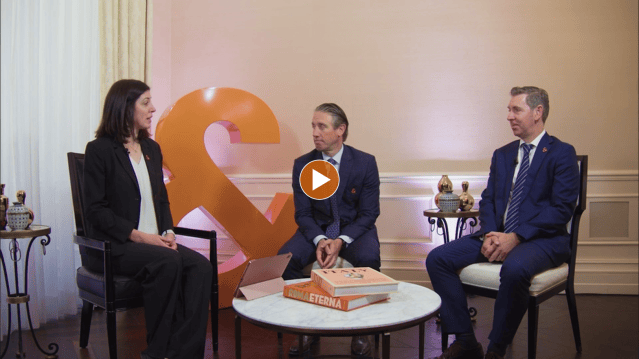
Jessica Leoncini: Welcome to the Janus Henderson Investment Summit in Rome. I’m Jessica Leoncini Head of Fixed Income Client Portfolio Management. And I’m delighted to be joined here today by Dan Siluk, Head of Global Short Duration and Liquidity. And John Lloyd, Global Head of Multi-Sector Credit.
Dan, you’ve been highlighting today for our audience the opportunity in short duration bonds. Why do you think this is of such interest in this environment?
Dan Siluk: Well currently income in fixed income is back. You know, after this decade of low interest rates, the reset that we saw in 22/23 with the reflationary selloff in yield has just brought the income back into fixed income. So really attractive time to be invested. And with this reset in rates, we think that the yield environment will remain higher for longer.
So, this means some really great opportunities in the front end of the curve where you can manage that interest rate volatility without having to extend duration.
Leoncini: Great. And John, you’ve been talking a little bit about how challenging it can be to find value when spreads are tight. Where are you searching for opportunities today?
John Lloyd: Yeah, I think because sovereign bond yields are higher, spreads are tight. But yields all in look attractive. Like Dan said today. And I think in a tight spread environment you want to focus on a couple things. One, because we have asymmetrical risk in the bond market, and there’s a lot of disintermediation out there with AI. You want to focus on the downside.
The next thing we really focus on is maximising that spread or yield per unit of volatility in this type of environment to get that income in this great income world.
Leoncini: And Dan, one of the things that we’ve been talking about as well is the new environment where central banks are hiking pretty much across the globe. What are some of the risks that investors may be missing in that type of environment?
Siluk: Yeah, I guess look, one of the large risks at the moment is extending duration. You know, unless you’re a believer that there’s going to be this reflationary environment where central banks need to cut rates aggressively, then you’re not really getting paid to take that additional risk. So, moving from the two-year to the ten-year point only picking up 30 basis points or so. So one of the big risks at the moment really is extending duration.
The other one for me is chasing yield as well. So as John mentioned, you’ve got this environment of tighter spreads. And so that can sometimes force people into lower grade product or going down the capital structure. And when you’re doing that in the more liquid part of your portfolio. Chasing yield can also be a risk.
The other risk is giving up liquidity. If risk assets sell off—because of geopolitical events or the broader economic impact of higher yields—investors need liquid holdings they can sell to invest in those riskier assets.
So, you also don’t want to give up liquidity. So, I think those are the three risks duration, and liquidity and really chasing yield.
Leoncini: So, security selection remains of utmost importance.
Siluk: Security selection asset allocation critical.
Leoncini: Great. And John certainly this creates opportunities as well as you have higher all-in yields as you mentioned. Where are you seeing the opportunities in a rising rate environment?
Lloyd: Yeah. So, I really like the floating rate sectors today. I think the technicals are going to be very strong there. So, and the spreads are a little bit wider in those sectors. So, sectors such as Securitised you have CLOs, ABS, CMBS and then also loans, all those sectors get to benefit from central banks raising rates over time. So I think those are opportunities out there.
And then I also agree with Dan. You want to be able to asset allocate across the globe today to find those best opportunities, which is why active management really matters.
Leoncini: Great. Maybe identifying some of the sectors outside of traditional benchmarks and big allocations.
Lloyd: Correct.
Leoncini: Great. Dan, what’s one thing you leave our audience with today?
Siluk: Well, as I sort of stated earlier on, I think income is back. That’s really the most important component. Again, the asset class is fixed income. With the level of yields today, you can get, you know, close to 5% in risk free. You add some really high grade corporate and securitised paper in there. And you know, you can get some really attractive yields.
So, income is back. Um, and you know, we think that that will remain the case for, for the next few years.
Leoncini: Great. And John, what about you?
Lloyd: Yeah. I also agree that income is back. I think you want an active manager, though, to be able to harvest that income with spreads being tight. You want your global opportunity set. You want to avoid the downside. And you really want to maximise that yield per unit of volatility.
Leoncini: Makes sense. Thank you both so much for joining us. Thank you for listening.
Related insights
These are the views of the author at the time of publication and may differ from the views of other individuals/teams at Janus Henderson Investors. References made to individual securities do not constitute a recommendation to buy, sell or hold any security, investment strategy or market sector, and should not be assumed to be profitable. Janus Henderson Investors, its affiliated advisor, or its employees, may have a position in the securities mentioned.
Past performance does not predict future returns. The value of an investment and the income from it can fall as well as rise and you may not get back the amount originally invested.
The information in this article does not qualify as an investment recommendation.
There is no guarantee that past trends will continue, or forecasts will be realised.
Marketing Communication.