Key takeaways:
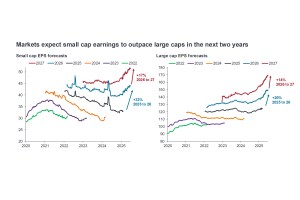
- We believe global small caps offer compelling opportunities across regions, supported by faster growth potential and currently attractive relative valuations.
- From an investment perspective, themes such as AI-driven capital expenditure are creating “picks and shovels” opportunities for smaller companies positioned within supply chains.
- Misconceptions around risk, interest rate sensitivity, and political influence may be obscuring long-term return potential, reinforcing the importance of a disciplined, active approach.
Definitions
Active management: An investment management approach where a fund manager actively aims to outperform or beat a specific index or benchmark through research, analysis, and the investment choices they make. The opposite of passive investing.
Balance sheet: A financial statement that summarises a company’s assets, liabilities and shareholders’ equity at a specific point in time.
Capital expenditure (Capex): Funds invested to acquire or upgrade fixed assets such as buildings, machinery, equipment, vehicles or technology in order to maintain or improve operations and foster future growth.
Compounding: The process by which investment returns are reinvested to generate additional returns over time, potentially increasing total returns.
Cyclical: Describes investments or sectors whose performance tends to fluctuate in line with the economic cycle.
Diversification: A way of spreading risk by mixing different types of assets or asset classes in a portfolio on the assumption that these assets will behave differently in any given scenario. Assets with low correlation should provide the most diversification.
Illiquidity: The characteristic of an asset that cannot be easily bought or sold in the market without affecting its price.
Large-cap: Refers to companies with a large market capitalisation, typically well-established businesses with significant scale.
Market capitalisation: The total market value of a company’s outstanding shares, calculated by multiplying the share price by the number of shares in issue.
Merger and acquisition (M&A):The consolidation of companies or assets through various financial transactions, including mergers, acquisitions or takeovers.
Operating leverage: The extent to which a company can increase profits by growing revenue, as fixed costs are spread over a larger base.
Small-cap: Refers to companies with a relatively small market capitalisation, typically offering higher growth potential but often with greater risk and volatility.
Stagflation: An economic environment characterised by slow growth, high inflation and rising unemployment.
Valuation multiple: A financial metric that compares a company’s market value to a specific financial measure, such as earnings or sales, to assess relative value.
Volatility: The rate and extent at which the price of a portfolio, security, or index, moves up and down. If the price swings up and down with large movements, it has high volatility. If the price moves more slowly and to a lesser extent, it has lower volatility. The higher the volatility, the higher the risk of the investment.
View transcript
Matthew Bullock (MB): Hello and welcome. I’m Matthew Bullock, Head of Portfolio Construction and Strategy for EMEA and APAC here at Janus Henderson. And today I’m joined by two special guests talking about small cap. We’ve got Nick Sheridan and we have Jonathan Coleman. Nick, Jonathan welcome.
Nick, if we start with you, you work within the small cap space and you’re sitting across many, many different markets across the world. So how dependent are the opportunities that you’re seeing right now on the broader macro environment. And do you think that small companies can actually thrive?
Nick Sheridan (NS): I think small companies in general can thrive. I think that unless you believe the law of large numbers is dead and I don’t. Then it continues to be the case that in small cap space it is much easier to grow your revenue line, your margin line, etc. I think if we look around the globe, it really doesn’t matter what geography you’re in on a relative basis to large cap, global small cap look extremely attractive.
If we look at the US traditionally, they grow quicker than anywhere else. If we look in Europe, you’re benefiting clearly from the spending on defence. If we look at the UK, it’s a valuation multiple argument. And if we look at Japan and Asia it’s a lot balance sheet realisation and also demand in Australia coming from China. So I think wherever you are in the world global small cap have their attractions.
MB: So Jonathan you specialize in the US. You’re based in the US. So how does the investing environment feel over there at the moment and which areas of the market are most exciting to you right now?
Jonathan Coleman (JC): Well, there’s certainly a lot of excitement around AI CapEx spend. We have a lot of ways to win within the small cap universe in the US and more broadly globally. We like to invest behind a theme we call picks and shovels – pickaxe to the miners. So the companies that are involved in spending for the data centre build outs of which the Magnificent Seven are spending an extraordinary amount of CapEx, and that’s flowing directly to our businesses, which can benefit from that.
MB: And so both of you deal with investors. So talking to end investors all around the world. So maybe if we start with you, what would you say are some of the common misconceptions around small cap investing?
NS: I think there’s a very big misconception around the risk that’s involved in small cap investing. I think people yes, it is cyclical, but I think if you look over the longer term, as I alluded to earlier, you’ll generally find that global small cap grow quicker than global large cap, but because they’re illiquid, when people decide that they want to sell that area, you get those extraordinary opportunities where not only can you get the operational compounding effect of growth being better, but you’re also able to get valuation, multiple expansion. And I think that is where we are at the moment. Because of people’s preconceptions about risk, they haven’t quite realised that opportunity yet.
JC: I would just add that I think it’s a common misconception that small caps need a very low interest rate environment to thrive. And in fact, history would tell you just the opposite. In fact, two of the decades of best small cap performance in recent stock market history would be the 1970s during a stagflationary environment, and then the first decade of the 2000s, both of which experienced higher interest rates.
That generally coincides with a reasonably robust economic environment. And to Nick’s earlier point, the power of operating leverage for small cap companies is very important because our profitability is generally at a lesser starting point than that of large caps. And so the magnitude of the earnings gains from operating leverage can be quite powerful.
MB: So another piece actually, Jonathan does with the US market in particular. So you’ve got the midterms coming up in November. So how much of an impact is that going to have on the small cap space. But also what are the key drivers could change the market in the year ahead?
JC: I do think as a general rule, that the perception of the impact of politics is perhaps a little bit overdone. Ultimately, we’re trying to find great businesses that can thrive in a variety of different economic environments. They can control their own destiny that have attractive return opportunities through their internal investments and through M&A.
And we’re able to find companies that are able to do that. So we pay attention to what’s going on politically, but I don’t think it’s a primary driver for the return profile of of the small cap market.
MB: And then finally, a question for both of you. You’ve both worked in the small cap industry and in the industry more broadly for a while, for quite some time. So if you had to give your younger self a one piece of advice on the small cap side, what would that be? And Nick, I’ll start with you.
NS: I think both in the small cap space and also anywhere really, just remember the law of compounding. Compounding both in investments and habits pays off. The longer you do it, the more return you get.
MB: Jonathan, you’re one piece of advice.
JC: I guess I’m a slight derivative on what Nick said, but I would say, uh, don’t don’t worry about the, uh, the variability, the ups and downs in the market. If I had learned to do that earlier in my career, I might have less gray hair than I have. So that’s what I’d tell myself.
MB: Wonderful. Well, Jonathan, Nick, thank you very much for joining. We could obviously talk for a lot longer, but we’ll save that for another time. So thank you very much, guys. And also thank you very much to our audience for listening.
Related insights


These are the views of the author at the time of publication and may differ from the views of other individuals/teams at Janus Henderson Investors. References made to individual securities do not constitute a recommendation to buy, sell or hold any security, investment strategy or market sector, and should not be assumed to be profitable. Janus Henderson Investors, its affiliated advisor, or its employees, may have a position in the securities mentioned.
Past performance does not predict future returns. The value of an investment and the income from it can fall as well as rise and you may not get back the amount originally invested.
The information in this article does not qualify as an investment recommendation.
There is no guarantee that past trends will continue, or forecasts will be realised.
Marketing Communication.
Important information
Please read the following important information regarding funds related to this article.
The Janus Henderson Horizon Fund (the “Fund”) is a Luxembourg SICAV incorporated on 30 May 1985, managed by Janus Henderson Investors Europe S.A. Janus Henderson Investors Europe S.A. may decide to terminate the marketing arrangements of this Collective Investment Scheme in accordance with the appropriate regulation. This is a marketing communication. Please refer to the prospectus of the UCITS and to the KIID before making any final investment decisions.
- Shares can lose value rapidly, and typically involve higher risks than bonds or money market instruments. The value of your investment may fall as a result.
- Shares of small and mid-size companies can be more volatile than shares of larger companies, and at times it may be difficult to value or to sell shares at desired times and prices, increasing the risk of losses.
- Derivatives may be used with the aim of reducing risk or managing the portfolio more efficiently. However, this introduces other risks, in particular, that a derivative counterparty may not meet its contractual obligations.
- If the Fund holds assets in currencies other than the base currency of the Fund, or you invest in a share/unit class of a different currency to the Fund (unless hedged, i.e. seeks to mitigate exchange rate movements between the share/unit class currency and the base currency of the Fund), the value of your investment may be impacted by changes in exchange rates.
- When the Fund, or a share/unit class, seeks to mitigate exchange rate movements of a currency relative to the base currency (hedge), the hedging strategy itself may positively or negatively impact the value of the Fund due to differences in short-term interest rates between the currencies.
- Securities could become hard to value or to sell at a desired time and price, especially in extreme market conditions when asset prices may be falling, increasing the risk of investment losses.
- Losses could be incurred if a counterparty became unwilling or unable to meet its obligations, or as a result of failure or delay in operational processes or the failure of a third party provider.
Specific risks
Janus Henderson Capital Funds Plc is a UCITS established under Irish law, with segregated liability between funds. Investors are warned that they should only make their investments based on the most recent Prospectus which contains information about fees, expenses and risks, which is available from all distributors and paying/facilities agents, it should be read carefully. This is a marketing communication. Please refer to the prospectus of the UCITS and to the KIID before making any final investment decisions. The rate of return may vary and the principal value of an investment will fluctuate due to market and foreign exchange movements. Shares, if redeemed, may be worth more or less than their original cost. This is not a solicitation for the sale of shares and nothing herein is intended to amount to investment advice. Janus Henderson Investors Europe S.A. may decide to terminate the marketing arrangements of this Collective Investment Scheme in accordance with the appropriate regulation.
- Shares can lose value rapidly, and typically involve higher risks than bonds or money market instruments. The value of your investment may fall as a result.
- Shares of small and mid-size companies can be more volatile than shares of larger companies, and at times it may be difficult to value or to sell shares at desired times and prices, increasing the risk of losses.
- The Fund follows a value investment style that creates a bias towards certain types of companies. This may result in the Fund significantly underperforming or outperforming the wider market.
- High exposure to a particular country or geographical region carries a higher level of risk than a more broadly diversified portfolio.
- The Fund invests in real estate investment trusts (REITs) and other companies or funds engaged in property investment, which involve risks above those associated with investing directly in property. In particular, REITs may be subject to less strict regulation than the Fund itself and may experience greater volatility than their underlying assets.
- If the Fund holds assets in currencies other than the base currency of the Fund, or you invest in a share/unit class of a different currency to the Fund (unless hedged, i.e. seeks to mitigate exchange rate movements between the share/unit class currency and the base currency of the Fund), the value of your investment may be impacted by changes in exchange rates.
- Derivatives may be used to help achieve the investment objective. This can result in leverage (higher levels of debt), which can magnify an investment outcome. Gains or losses may therefore be greater than the cost of the derivative. Derivatives also introduce other risks, in particular, that a derivative counterparty may not meet its contractual obligations.
- When the Fund, or a share/unit class, seeks to mitigate exchange rate movements of a currency relative to the base currency (hedge), the hedging strategy itself may positively or negatively impact the value of the Fund due to differences in short-term interest rates between the currencies.
- Securities could become hard to value or to sell at a desired time and price, especially in extreme market conditions when asset prices may be falling, increasing the risk of investment losses.
- Losses could be incurred if a counterparty became unwilling or unable to meet its obligations, or as a result of failure or delay in operational processes or the failure of a third party provider.