
Key takeaways:
- UK equities may offer a rare combination of income and growth potential, with valuations still trading at a significant discount to global peers despite improving company fundamentals. This disconnect creates opportunities for investors willing to take a contrarian, long-term view.
- Many UK-listed companies derive substantial revenues overseas, meaning investors may gain exposure to global growth while benefiting from UK market valuations.
- Dividend income provides investors with “patient capital” while waiting for value to be realised, whether through operational turnarounds, strategic changes, or structural growth trends. Attractive yields, combined with opportunities in areas such as infrastructure and defence, support the case for both resilience and capital appreciation.
The UK equity market has spent much of the past decade out of favour, with weak sentiment and subdued domestic growth weighing on investor appetite. Yet this overlooks a key point: the UK economy and stock market are not the same.
Many UK-listed companies generate a significant share of revenues overseas, meaning investors can access global businesses at discounted valuations. For patient investors, this creates an opportunity to capture both income and capital growth where expectations remain low.
Out of favour creates opportunity
UK equities continue to be seen as a contrarian allocation, allowing valuation gaps to persist even as fundamentals improve. Over time, however, earnings and valuations tend to reconnect.
Identifying companies where sentiment is anchored to the past while operational performance strengthens is key to unlocking returns.
Valuation and income: A powerful combination
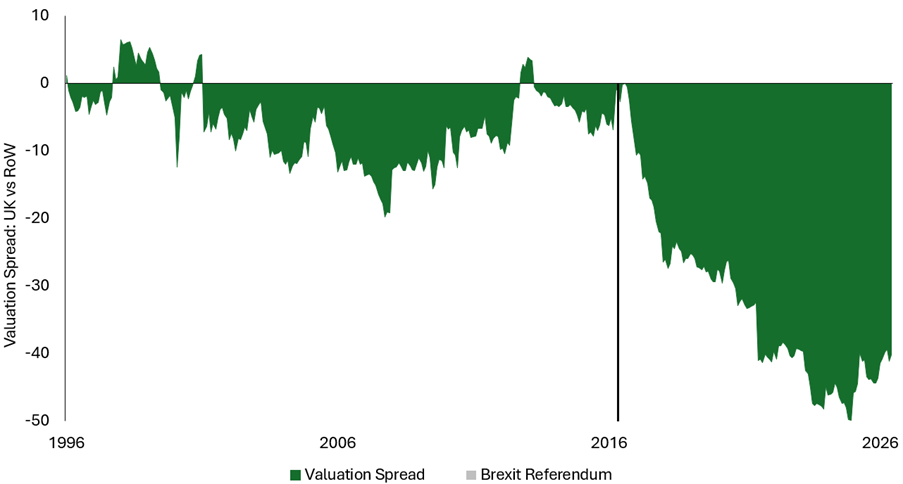
The UK market trades at a significant discount to global peers (Figure 1), particularly the US. While valuation alone is not a catalyst, it becomes compelling when paired with improving fundamentals.
This also supports dividend income. Higher yields allow investors to be paid while waiting for sentiment to recover. Ongoing takeover activity further suggests strategic buyers recognise value that public markets may still overlook.
Figure 1: Valuation spread: UK vs Rest of the World (RoW) equities
Source: Panmure Liberum, as at 31 June 2026.
Global exposure at UK prices
A common misconception is that UK equities reflect purely domestic growth. In reality, many companies have substantial international exposure.
Zigup, a commercial vehicle rental provider, illustrates this. Often viewed through a UK lens, its Spanish operations are driving stronger growth and profitability, highlighting how valuations can underestimate earnings potential.
Income as ‘patient capital’
Dividend income remains a defining feature of UK equities. Beyond providing returns, it enables investors to hold positions through uncertainty.
Turnarounds and cyclical recoveries rarely unfold quickly. Companies such as Halfords, Marshalls and Hilton Food are refocusing on core strengths but face mixed conditions. Attractive dividend yields make these opportunities easier to hold while waiting for improvements.
Turning points and structural growth
New management and strategic change can unlock value, as seen in companies like Marks & Spencer and Babcock. These turning points are often underappreciated early on.
At the same time, capital growth does not require strong UK GDP. Structural drivers such as infrastructure investment and defence spending are supporting companies including Costain, Balfour Beatty and Babcock.
Conclusion: Paid to wait for potential
UK equities remain overlooked, but that is where opportunity lies. Low valuations, strong income and underappreciated growth drivers create a compelling combination.
For investors, the appeal is balance: income provides stability and patience, while improving fundamentals offer capital growth potential. In many cases, investors are being paid to wait for that growth to emerge.
Capital growth: The increase in the value of an investment over time. It is realised when an asset is sold for a higher price than it was purchased.
Dividend: A payment made by a company to its shareholders, usually derived from profits.
Earnings: A company’s profits after expenses, often used as an indicator of its financial performance.
Equities: Shares representing ownership in a company.
Income: Money generated from an investment, typically through dividends or interest payments.
Index: A statistical measure representing the performance of a group of assets, often used as a benchmark for investment performance.
Valuation: An assessment of the worth of an asset or company, often based on metrics such as earnings, cash flow, or book value.
These are the views of the author at the time of publication and may differ from the views of other individuals/teams at Janus Henderson Investors. References made to individual securities do not constitute a recommendation to buy, sell or hold any security, investment strategy or market sector, and should not be assumed to be profitable. Janus Henderson Investors, its affiliated advisor, or its employees, may have a position in the securities mentioned.
Past performance does not predict future returns. The value of an investment and the income from it can fall as well as rise and you may not get back the amount originally invested.
The information in this article does not qualify as an investment recommendation.
There is no guarantee that past trends will continue, or forecasts will be realised.
Marketing Communication.