
Key takeaways:
- Commodities are becoming increasingly important as AI, electrification, energy security and infrastructure investment drive demand for the raw materials underpinning the global economy.
- Traditional passive commodity indices have often disappointed investors due to roll costs, deep drawdowns and diversification benefits that can weaken during market stress.
- A combination of active commodity derivatives and natural resource equities may offer broader exposure, greater flexibility and improved risk-adjusted outcomes than futures-only approaches.
Commodities are back in the spotlight
After years of underperformance and under-allocation, a growing number of investors are reconsidering the role of real assets within portfolios. Inflation remains structurally higher than many anticipated just a few years ago, geopolitical fragmentation is reshaping global supply chains, and a new investment cycle centred on electrification, artificial intelligence, energy security and infrastructure spending is driving demand for physical resources across the world.
Yet while the investment case for commodities appears increasingly compelling, the reality is that traditional commodity strategies have often fallen short of expectations. For many investors, the experience has been characterised by disappointing returns, prolonged drawdowns and diversification benefits that failed to materialise when they were needed most.
As the world enters a new phase of economic and industrial transformation, commodities remain highly relevant. However, we argue that capturing the opportunity requires a more modern approach than simply buying a passive commodity index.
The new economy still depends on the old economy
One of the defining misconceptions of recent years has been the belief that technological progress somehow reduces the importance of physical assets.
The opposite is true.
The technologies that are transforming the global economy are extraordinarily resource intensive. Artificial intelligence requires data centres, power generation and transmission networks. Electrification requires copper, nickel, lithium and rare earth metals (such as neodymium, dysprosium and praseodymium). Energy security demands investment across both traditional and renewable energy systems. Reindustrialisation and defence spending require steel, aluminium and other industrial inputs.
Beneath every digital trend sits a foundation of physical infrastructure and raw materials.
Industry estimates suggest the world may need to produce as much copper between now and 2050 as has been produced in all of human history.
– Robert Shimell, Portfolio Manager, Diversified Alternatives
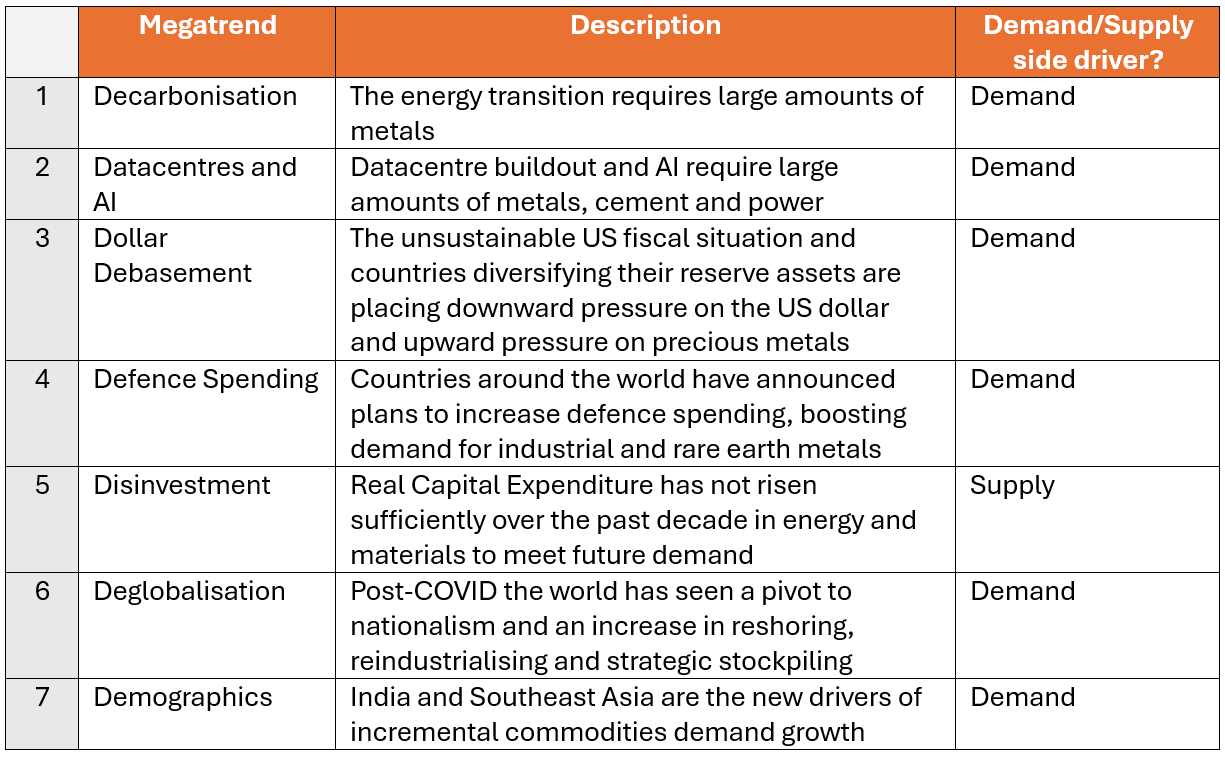
This dynamic forms part of what we describe as the “Seven Ds” (Exhibit 1) driving commodity markets: long-term structural themes that are reshaping both demand and supply. From decarbonisation and deglobalisation to demographics and defence spending, these forces are creating a supportive backdrop for real assets that could persist for many years. Whereas the last commodities Supercycle, in the 2000s, was predicated on Chinese growth and lack of supply the current Supercycle has 7 core structural drivers.1
Exhibit 1: The seven structural drivers of the new commodities supercycle
Source: Janus Henderson Investors
What is particularly striking is how underappreciated many of these commodity-related opportunities remain. While investors have enthusiastically embraced the beneficiaries of technological innovation, far less attention has been paid to the materials and infrastructure required to enable that growth.
In many respects, commodities look increasingly central to the future economic landscape while remaining peripheral in investment portfolios.
Why traditional commodity investing has struggled
The challenge is not the asset class itself. It is often the way investors access it.
For much of the past two decades, commodity investing has been synonymous with passive futures-based indices. The proposition seemed straightforward: gain direct exposure to commodities, diversify equity and bond portfolios, and provide portfolios with good performance during inflationary environments.
In practice, results have frequently been less compelling.
One reason is that commodity futures are not the same as owning physical commodities. Futures contracts expire and must be rolled forward. During periods when markets are in contango, meaning future contracts are more expensive than near-term contracts, investors can experience a persistent drag on returns through negative roll yield.
The consequence is that commodity prices may rise while investor returns lag considerably behind.
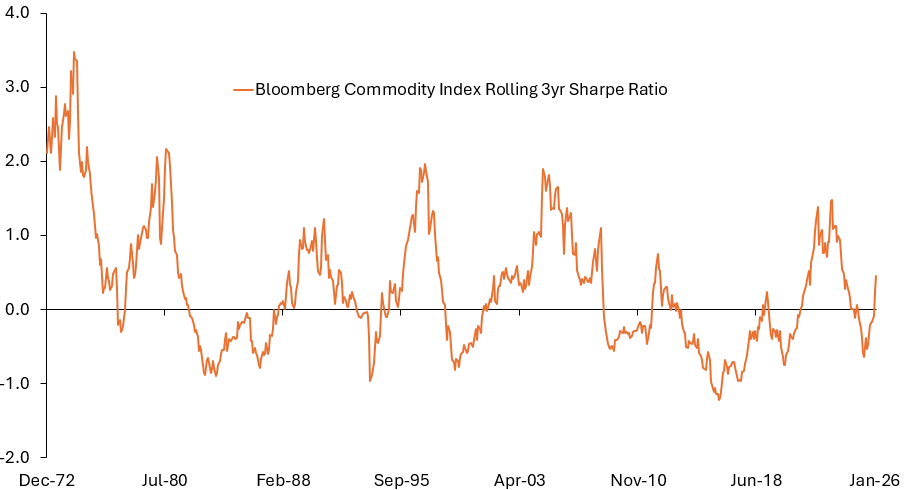
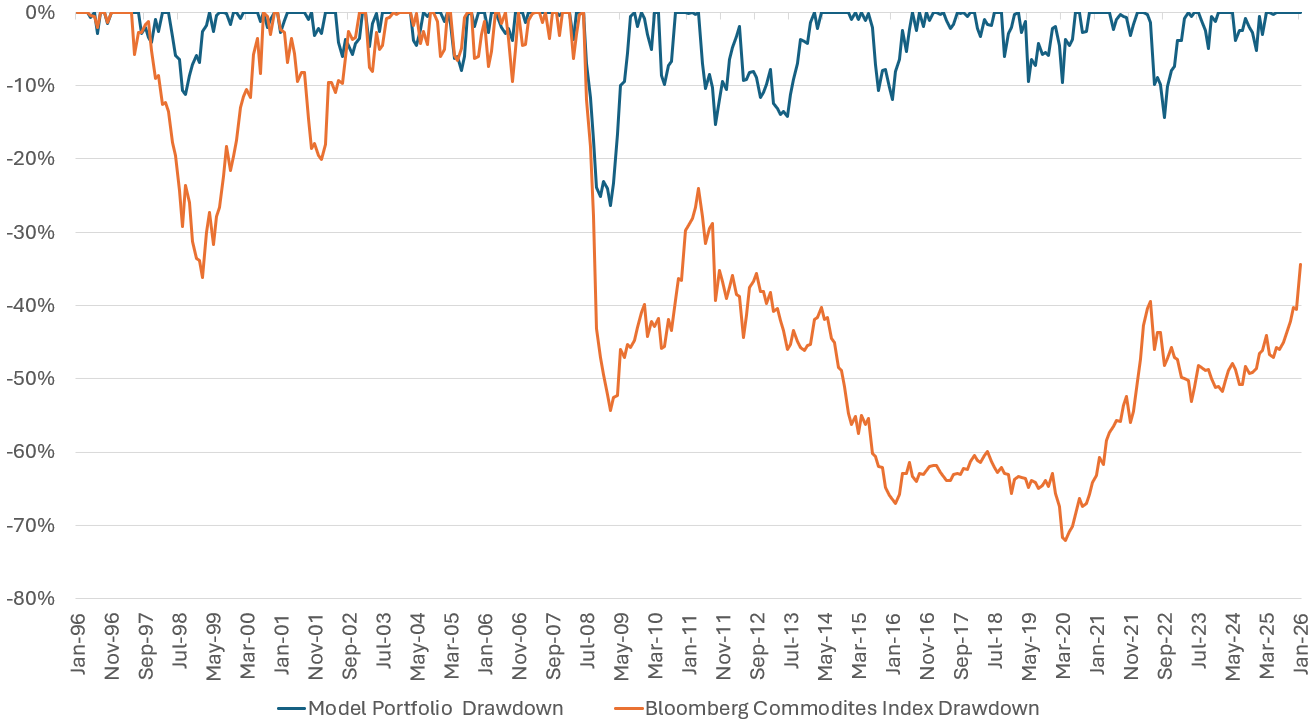
Another challenge is the severity of commodity bear markets. Long-only commodity indices can experience deep and prolonged drawdowns during periods of oversupply, weak economic growth or shifting policy environments (such as between mid-2011 and Q1 2020). Unlike active strategies, passive approaches have little flexibility to adapt when market conditions deteriorate.
Exhibit 2: Passive commodity investing has often fallen short of investor expectations
Source: Janus Henderson Investors, Bloomberg, data from 31 December 1969 to 31 January 2026.
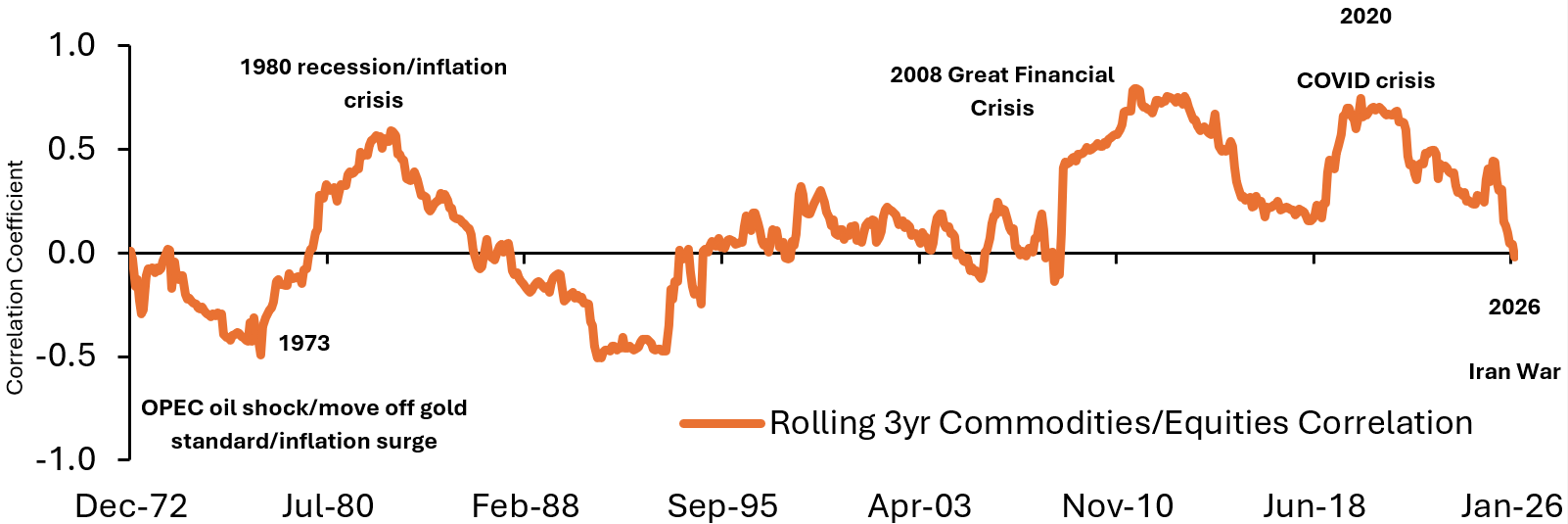
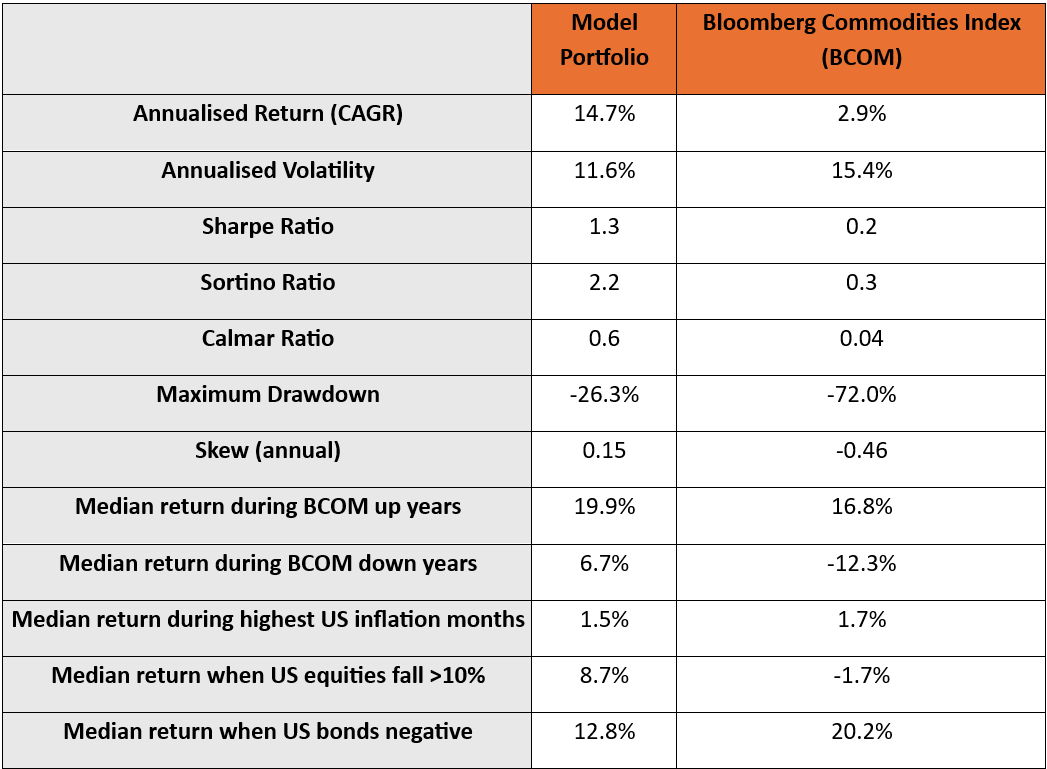
Diversification has also proved less dependable than many investors expected. Commodities are often viewed as a portfolio diversifier, yet correlations with equities have historically risen during periods of recession and market stress. When economic growth weakens, commodity demand often falls alongside corporate profits, causing both asset classes to come under pressure simultaneously (for example during the Great Financial Crisis (GFC) and COVID).
Exhibit 3: Commodity diversification benefits often weaken during market stress
Source: Janus Henderson Investors, Bloomberg, data from 31 December 1969 to 31 January 2026.
The result is that investors have often received a more volatile and cyclical experience than the original sales pitch implied.
The opportunity beyond futures
A further limitation of traditional commodity indices is that they only capture a portion of the broader real asset universe.
Most futures benchmarks focus on a relatively narrow set of exchange-traded contracts weighted according to production and liquidity. While this provides representative exposure to commodity futures, it excludes many areas that are becoming increasingly important in the modern economy.
Critical minerals such as lithium, uranium and rare earth elements are absent from traditional indices. So too are businesses operating across the broader commodity value chain, including processors, refiners, transport operators, utilities and infrastructure providers.
These companies often sit at the centre of major structural trends, yet they remain inaccessible through conventional commodity benchmarks. Their weights in broader equity benchmarks have also fallen significantly over the past 3 decades (during which the weight of the technology sector has surged), leaving many investors underexposed.
For investors seeking exposure to the full commodity opportunity set, we believe that futures alone can be insufficient.
A more comprehensive, more dynamic approach
If traditional commodity investing has limitations, what might a better solution look like?
We believe the answer lies in combining two distinct but complementary sources of return: active commodity derivatives and natural resource equities.
Active commodity derivatives can offer direct exposure to commodity price movements and provide the flexibility to profit from both rising and falling markets. A systematic long/short approach allows risk to be managed more actively while reducing the dependence on a single bullish commodity regime.
This flexibility is particularly valuable in an asset class known for boom/bust cycles and significant volatility. Rather than simply buying exposure and waiting for prices to rise, investors may potentially benefit from changing market conditions across both bull and bear markets.
Natural resource equities provide a different set of advantages. They broaden the opportunity set beyond futures markets and offer access to businesses operating across the global resource ecosystem. These companies can benefit not only from higher commodity prices but also from operational improvements, earnings growth and dividend income.
Importantly, they provide exposure to parts of the commodity complex that are otherwise difficult to access, including many of the resources most closely linked to decarbonisation, energy security and industrial transformation. In addition, natural resource equities can more easily facilitate sustainable investing principles than futures.
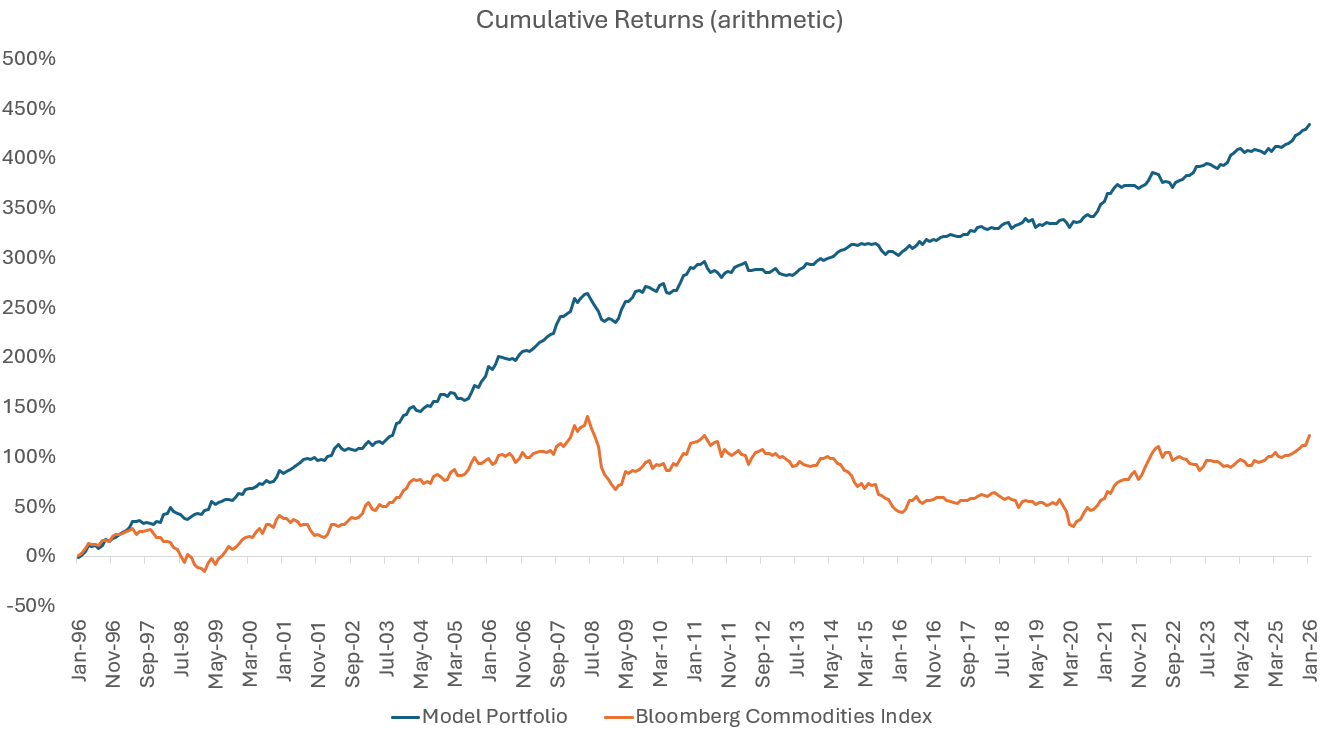
While each approach has strengths and weaknesses when viewed individually, together they can be highly complementary.
Exhibit 4: A modern commodity allocation could deliver better risk-adjusted outcomes
Source: Janus Henderson Investors, Bloomberg. For illustrative purposes only. Model portfolio is a simulated back test and does not represent live performance. Data is from 31December 1995 to 31 January 2026. All returns are gross in USD. Past performance is not a reliable indicator of future returns and should not be relied upon. Simulated Past performance does not predict future results.
Building a better real asset allocation
Commodity solutions can be engineered to deliver the specific outcomes investors seek – diversification, inflation resilience, attractive long-term returns and portfolio protection during changing macroeconomic environments. This requires an active approach.
Combining long/short commodity derivatives with natural resource equities can potentially create more balanced and resilient commodities exposure. Derivatives can potentially provide flexibility, liquidity and downside protection. Equities broaden the opportunity set, provide access to the wider natural resources value chain and allows the incorporation of sustainable investing principles and income via dividends.
Exhibit 5: Model portfolio vs BCOM – Rolling drawdown since inception
Source: Janus Henderson Investors, Bloomberg. For illustrative purposes only. Model portfolio is a simulated back test and does not represent live performance. Data is from 31December 1995 to 31 January 2026. All returns are gross in USD. Past performance is not a reliable indicator of future returns and should not be relied upon. Simulated Past performance does not predict future results
Taken together, they can create a more comprehensive, dynamic and adaptive approach than either futures-only or equity-only solutions.
Most importantly, they align more closely with the way commodity markets themselves are evolving.
Exhibit 6: Why a broader commodity approach may offer superior portfolio outcomes
Source: Janus Henderson Investors, Bloomberg. For illustrative purposes only. Model portfolio is a simulated back test and does not represent live performance. Data is from 31December 1995 to 31 January 2026. All returns are gross in USD. Past performance is not a reliable indicator of future returns and should not be relied upon. Simulated Past performance does not predict future results
Looking ahead
The world is entering a period that may prove increasingly supportive for real assets.
The transition to cleaner energy systems, the build-out of AI infrastructure, ongoing geopolitical tensions and renewed industrial investment all point towards sustained demand for natural resources. At the same time, supply growth remains constrained across many commodity markets after years of underinvestment.
For investors, the strategic case for commodities has rarely appeared stronger.
But simply owning a traditional commodity index may not be enough.
As the relationship between the physical and digital economies becomes ever more interconnected, investors need to rethink not only whether they allocate to commodities, but how they access the opportunity. A broader, more dynamic and outcome-oriented approach could ultimately prove better suited to capturing the next chapter of the commodities story.
1 Source: International Energy Forum, ‘Copper Mining and Vehicle Electrification’ (report).
Active investing: An investment management approach where a fund manager actively aims to outperform or beat a specific index or benchmark through research, analysis, and the investment choices they make. The opposite of passive investing.
Asset allocation: The allocation of a portfolio between different asset classes, sectors, geographical regions, or types of security to meet specific objectives of risk, performance, or time horizon.
Bear market: A bear market is one in which the prices of securities are falling in a prolonged or significant manner. A generally accepted definition is a fall of 20% or more in an index over at least a two-month period. Bearish sentiment suggests the expectation of negative market conditions.
Commodities: Physical goods such as energy products, metals and agricultural products that can be traded in financial markets.
Contango: A futures market condition in which longer-dated contracts trade at higher prices than near-term contracts.
Correlation: How far the price movements of two variables (e.g., equity or fund returns) move in relation to each other. A correlation of +1.0 means that both variables have a strong association in the direction they move. If they have a correlation of –1.0, they move in opposite directions. A figure near zero suggests a weak or non-existent relationship between the two variables.
Derivatives: A financial instrument for which the price is derived from one or more underlying assets such as shares, bonds, commodities, or currencies. It is a contract between two or more parties which allows investors to take advantage of price movements in the asset(s). Futures, options, and swaps are all examples of derivatives.
Diversification: A way of spreading risk by mixing different types of assets or asset classes in a portfolio on the assumption that these assets will behave differently in any given scenario. Assets with low correlation should provide the most diversification.
Drawdown: A measure of historic risk that looks at the difference between the highest and lowest price of a portfolio or security during a specific period. It is used to evaluate the possible risk and reward of an investment.
Equity: A security representing ownership, typically listed on a stock exchange. ‘Equities’ as an asset class means investments in shares, as opposed to, for instance, bond. To have ‘equity’ in a company means to hold shares in that company and therefore have part ownership.
Future/futures contract: A contract between two parties to buy or sell an asset, such as shares or commodities, at a specified later date using a price agreed today. A future is a form of derivative.
Inflation: The rate at which the prices of goods and services are rising in an economy. The consumer price index (CPI) and retail price index (RPI) are two common measures; the opposite of deflation.
Long/short: A portfolio that can invest in both long and short positions. The intention is to profit from combining long positions in assets in the expectation that they will rise in value, with short positions in assets expected to fall in value. This type of investment strategy has the potential to generate returns regardless of moves in the wider market, although returns are not guaranteed.
Passive investing: An investment approach that involves tracking a particular market or index. It is called passive because it seeks to mirror an index, either fully or partially replicating it, rather than actively picking or choosing stocks to hold. The primary benefit of passive investing is exposure to a particular market with generally lower fees than you might find on an actively managed fund, the opposite of active investing.
Reindustrialisation: The process of rebuilding or expanding industrial production capacity.
Risk-adjusted return: A calculation of an investment’s return or potential return that takes into account the amount of risk required to achieve it. Typical risk measures include alpha, beta, volatility, Sharpe ratio, and R2.
Roll yield: The gain or loss generated when a futures contract is replaced by another contract with a later expiry date.
Sharpe ratio: A measure of risk-adjusted return that compares excess return with portfolio volatility.
Sortino ratio: A measure of risk-adjusted return that considers only downside volatility.
Supercycle: A long-term period of above-average demand and sustained price strength within commodity markets.
Volatility: The rate and extent at which the price of a portfolio, security, or index, moves up and down. If the price swings up and down with large movements, it has high volatility. If the price moves more slowly and to a lesser extent, it has lower volatility. The higher the volatility, the higher the risk of the investment.
These are the views of the author at the time of publication and may differ from the views of other individuals/teams at Janus Henderson Investors. References made to individual securities do not constitute a recommendation to buy, sell or hold any security, investment strategy or market sector, and should not be assumed to be profitable. Janus Henderson Investors, its affiliated advisor, or its employees, may have a position in the securities mentioned.
Past performance does not predict future returns. The value of an investment and the income from it can fall as well as rise and you may not get back the amount originally invested.
The information in this article does not qualify as an investment recommendation.
There is no guarantee that past trends will continue, or forecasts will be realised.
Marketing Communication.
Important information
Please read the following important information regarding funds related to this article.
- Shares can lose value rapidly, and typically involve higher risks than bonds or money market instruments. The value of your investment may fall as a result.
- Active management techniques that have worked well in normal market conditions could prove ineffective or negative for performance at other times.
- Emerging markets expose investors to higher volatility and greater risk of loss than developed markets; they are susceptible to adverse political and economic events, and may be less well regulated with less robust custody and settlement procedures.
- The Fund is focused towards particular industries or investment themes and may be heavily impacted by factors such as changes in government regulation, increased price competition, technological advancements and other adverse events.
- Derivatives may be used to help achieve the investment objective. This can result in leverage (higher levels of debt), which can magnify an investment outcome. Gains or losses may therefore be greater than the cost of the derivative. Derivatives also introduce other risks, in particular, that a derivative counterparty may not meet its contractual obligations.
- Securities could become hard to value or to sell at a desired time and price, especially in extreme market conditions when asset prices may be falling, increasing the risk of investment losses.
- The Fund's exposure to commodities may be subject to rapid and substantial price movements resulting in high volatility. Developments affecting commodities instruments, such as changes in supply and demand, government programs and policies, political events and changes in interest rates may have an impact on the Fund.
- Losses could be incurred if a counterparty became unwilling or unable to meet its obligations, or as a result of failure or delay in operational processes or the failure of a third party provider.
- Swap returns are subject to the returns of the index or reference assets. Valuations of investments, the index tracked or replicated, or the financial instruments used to track or replicate the index may, in certain circumstances, only be available from a limited number of market participants who may also act as counterparties to these transactions. This means valuations can be subjective, and different sources may provide significantly different values.
- The Fund uses a proprietary trading model, using quantitative analysis and algorithms to select positively or negatively trending investments. There is a risk that the investments selected using the model may perform differently than expected and may not achieve positive returns or outperform. Where the model relies on data and technology risks include inaccurate data and system failures. These are mitigated through the Investment Manager’s internal governance and oversight processes.