
Key takeaways:
- The return of the cost of capital has increased stock-level dispersion, creating a more fertile environment for fundamental stock pickers.
- Higher inflation and more positive stock-bond correlations have challenged the traditional 60/40 portfolio model, increasing demand for diversified, less correlated sources of returns.
- Equity long/short strategies could be beneficial as they aim to capture opportunities on both the long and short side while seeking to limit drawdowns during periods of market stress.
Uncertainty and chaos favours stock picking
For much of the quantitative easing era, equity markets were shaped by low discount rates, abundant liquidity and a narrow set of dominant return drivers. Growth stocks, particularly US technology companies, led markets higher, while many other areas struggled to attract investor attention. For bottom-up investors, that created a challenging backdrop: correlations were high, dispersion was low and opportunities to generate differentiated alpha were more limited.
That environment began to shift in 2022 as we saw the return of the cost of capital when central banks moved decisively away from near-zero interest rates. We believe we are seeing a return to market conditions in which equity long/short strategies can be more effective. Investors also look to be agreeing with this view. Higher interest rates have led to the return of the cost of capital, made business fundamentals more important, and increased the dispersion between ‘winners and losers.’
In our view, dispersion matters because it gives active managers more to work with. When share prices move together, it is harder to build a portfolio that is genuinely independent of broader market direction. When company-level outcomes diverge, stock selection can become a more powerful driver of returns.
Looking beyond the 60/40 portfolio
The changing market backdrop is also forcing investors to reassess traditional asset allocation assumptions. The 60/40 portfolio has historically relied on bonds providing diversification when equities sell off. But in an environment of stickier inflation, higher rates and greater policy uncertainty, the relationship between equities and bonds has become less dependable.
Since 2022, bonds’ role as a reliable diversifier has been called into question
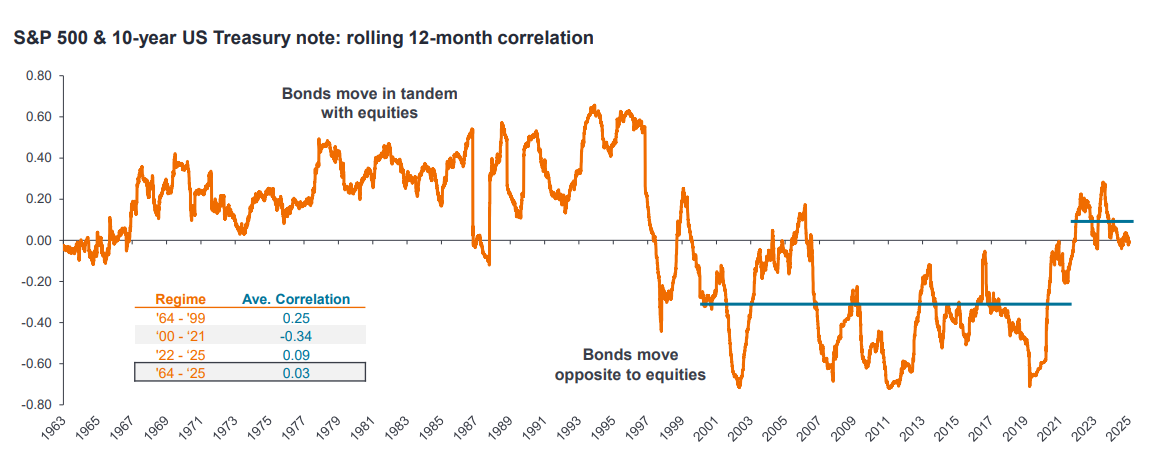
Source: Bloomberg, Janus Henderson Investors analysis, as at 29 December 2025.
Correlation between bonds (US 10-year Treasuries) and equities (S&P 500 Index) returns. Past performance does not predict future returns.
Recent market shocks have shown that equities and fixed income can come under pressure at the same time. This has increased interest in strategies that seek to deliver positive returns over time without relying primarily on market beta. Absolute return strategies are not a substitute for diversification, but they may help broaden the sources of return within a portfolio.
We believe the key to successful investing is not to add complexity. It is to identify liquid, transparent strategies that can offer differentiated return streams without relying heavily on leverage or illiquid assets. In this context, equity long/short strategies can play a useful role because they invest in familiar listed equity markets while retaining the flexibility to express both positive and negative views.
Luke Newman, Portfolio Manager
Avoiding large losses can be as important as capturing upside
The objective of an absolute return strategy is not to outperform a benchmark, but to aim to generate a consistent, positive return over time with lower sensitivity to broad market moves. A key feature is that minimising large drawdowns is not a secondary objective; it is central to the role absolute return strategies are designed to play in client portfolios.
Our experience during previous crises highlights this point. During the Global Financial Crisis, the team’s company-level research gradually led it to become increasingly cautious on banks, insurers and highly leveraged consumer-facing companies. The positioning was built stock by stock, rather than through a top-down macro call, and helped the strategy navigate the period with negative net exposure.
The Covid-19 crisis required a very different response. Rather than having a long period to reposition, markets moved rapidly. We were able to respond by using our flexible and liquid approach to reduce risk and add tactical shorts in areas such as travel, leisure and consumer-exposed companies that were likely to be affected by pandemic restrictions.
These examples illustrate an important feature of our approach: while macro awareness matters, our process remains rooted in fundamental stock research. The team aims to identify where risks are building at the company level and then use portfolio construction to try and reflect those risks quickly and efficiently.
Combining core convictions with tactical flexibility
We believe a complementary portfolio of core and tactical positions can work well. The core book consists of high conviction fundamental long and short positions. These are typically based on meaningful expected upside or downside, driven by factors such as management change, strategic repositioning, mergers and acquisitions, disposals, capital allocation or valuation anomalies.
Meanwhile, smaller tactical positions enable a quicker response to shorter-term dislocations, factor rotations and market stress. Positions are generally smaller and more flexible, and are aimed at capturing temporary mispricing opportunities, and may also be useful in times of sharp market sell-offs.
Investors are increasingly recognising the value of liquidity
As investors allocate more to alternatives, liquidity has become an increasingly important consideration. Private market strategies can play a valuable role in portfolios, but they may also involve long lock-up periods and limited flexibility. By contrast, a liquid alternatives strategy investing in large-cap listed equities can offer daily liquidity while still seeking differentiated return outcomes. Liquidity allows exposures to be adjusted quickly, manage risk during periods of stress, and provide investors with flexibility in their broader asset allocation.
Building resilience with absolute return strategies
In recent years, the post-quantitative easing (QE) environment has created a more complex investment landscape, but also a richer opportunity set for active managers. Higher dispersion, more volatile correlations and renewed focus on capital preservation all support the case for strategies that can be flexible, liquid and genuinely differentiated from traditional equity and bond exposures.
For investors seeking to build more resilient portfolios, absolute return strategies may offer a way to access company-specific opportunities while aiming to reduce dependence on broad market direction. In an environment where traditional diversification tools may be less reliable, we think an active approach combining stock selection, risk control and liquidity is likely to become increasingly valuable.
Note: Diversification neither assures a profit nor eliminates the risk of experiencing losses.
S&P 500 (Standard & Poor’s 500) is a stock market index that tracks the performance of 500 of the largest publicly traded companies in the United States.
US 10-year Treasury note is a long-term debt instrument issued by the Department of the Treasury to finance the US government’s spending needs.
60/40 portfolio: 60% invested in equities and 40% in bonds has long served as a foundation for portfolio construction given bonds’ tendency to offset declines in equities and cushion losses in times of market uncertainty.
Absolute return: A type of investment strategy that seeks to generate a positive return over time, regardless of market conditions or the direction of financial markets, typically with a low level of volatility.
Alpha: The return a portfolio generates above or below its benchmark after allowing for the level of risk taken. A positive alpha suggests the manager has added value.
Balance sheet: A financial statement that summarises a company’s assets, liabilities and shareholders’ equity at a particular point in time. Each segment gives investors an idea as to what the company owns and owes, as well as the amount invested by shareholders.
Beta: A measure of how sensitive an investment is to movements in the wider market. A lower beta means the investment is generally less tied to market direction.
Bottom-up investing: Bottom-up fund managers build portfolios by focusing on the analysis of individual securities rather than broader (top-down) macroeconomic or market factors in order to identify the best opportunities in an industry, country, or region.
Cash flow: The net balance of cash that moves in and out of a company. Positive cash flow shows more money is moving in than out, while negative cash flow means more money is moving out than into the company.
Correlation: A measure of how closely two investments move in relation to each other. If two assets often rise and fall together, they have a positive correlation.
Discount rate: The interest rate set by the US Federal Reserve for short-term loans to banks. During the 2008 financial crisis, the Fed expanded its discount window lending terms significantly to manage its economic challenges.
Dispersion: The extent to which a distribution of data points is stretched or squeezed. If the data points cluster around certain values, then dispersion is low, whereas if they are more spread out, then dispersion is high. For example, dispersion in stocks measures the range of returns for a group of stocks. Higher dispersion opens up opportunities for stock pickers to outperform by selecting the winners and avoiding the losers, given that stock returns are spread more widely on either side of the benchmark.
Diversification: Spreading investments across different assets, sectors or regions to reduce reliance on any single source of return. It does not eliminate the risk of loss.
Downside protection: Downside protection provides a safety net if an investment starts to fall in value. Investors typically mitigate downside risk through long/short strategies or diversification.
Drawdown: The fall in value of an investment from its previous peak to its lowest point over a given period.
Leverage: The use of borrowing to increase exposure to an asset/market. This can be done by borrowing cash and using it to buy an asset, or by using financial instruments such as derivatives to simulate the effect of borrowing for further investment in assets.
Liquidity: A measure of how easily an asset can be bought or sold in the market. Assets that can be easily traded in the market in high volumes (without causing a major price move) are referred to as ‘liquid’.
Long/short: A portfolio that can invest in both long and short positions. The intention is to profit from combining long positions in assets in the expectation that they will rise in value, with short positions in assets expected to fall in value. This type of investment strategy has the potential to generate returns regardless of moves in the wider market, although returns are not guaranteed.
Market beta: The part of an investment’s return that comes from broad market movements rather than from manager skill or individual stock selection.
Net exposure: The difference between a portfolio’s long positions and short positions. It indicates the extent to which the portfolio is positioned to benefit from rising or falling markets.
Post-quantitative easing environment: Refers to the economic environment after central banks stop creating new money to purchase financial assets (like government bonds) and begin tightening. This period is defined by higher borrowing costs, elevated inflation risks, and increased pressures on public finances.
Short position (shorting): Fund managers use this technique to borrow then sell what they believe are overvalued assets, with the intention of buying them back for less when the price falls. The position profits if the security falls in value.
These are the views of the author at the time of publication and may differ from the views of other individuals/teams at Janus Henderson Investors. References made to individual securities do not constitute a recommendation to buy, sell or hold any security, investment strategy or market sector, and should not be assumed to be profitable. Janus Henderson Investors, its affiliated advisor, or its employees, may have a position in the securities mentioned.
Past performance does not predict future returns. The value of an investment and the income from it can fall as well as rise and you may not get back the amount originally invested.
The information in this article does not qualify as an investment recommendation.
There is no guarantee that past trends will continue, or forecasts will be realised.
Marketing Communication.
Important information
Please read the following important information regarding funds related to this article.
- Shares can lose value rapidly, and typically involve higher risks than bonds or money market instruments. The value of your investment may fall as a result.
- High exposure to a particular country or geographical region carries a higher level of risk than a more broadly diversified portfolio.
- If the Fund holds assets in currencies other than the base currency of the Fund, or you invest in a share/unit class of a different currency to the Fund (unless hedged, i.e. seeks to mitigate exchange rate movements between the share/unit class currency and the base currency of the Fund), the value of your investment may be impacted by changes in exchange rates.
- Derivatives may be used to help achieve the investment objective. This can result in leverage (higher levels of debt), which can magnify an investment outcome. Gains or losses may therefore be greater than the cost of the derivative. Derivatives also introduce other risks, in particular, that a derivative counterparty may not meet its contractual obligations.
- When the Fund, or a share/unit class, seeks to mitigate exchange rate movements of a currency relative to the base currency (hedge), the hedging strategy itself may positively or negatively impact the value of the Fund due to differences in short-term interest rates between the currencies.
- Securities could become hard to value or to sell at a desired time and price, especially in extreme market conditions when asset prices may be falling, increasing the risk of investment losses.
- Losses could be incurred if a counterparty became unwilling or unable to meet its obligations, or as a result of failure or delay in operational processes or the failure of a third party provider.