Chart to Watch: When bond markets move together
What happens when global bond markets suddenly move in lockstep? Portfolio Manager Helen Anthony explores an unusually synchronised rise in yields across major markets.
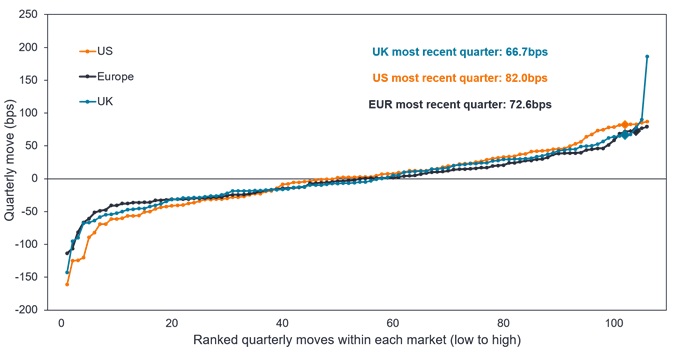
Source: Janus Henderson Investors, Bloomberg, 31 March 2000 to 30 September 2026. Yields may vary and are not guaranteed. Past performance does not predict future returns. Note: End of quarter moves standardised by each market’s full-sample discrete-quarter volatility. Diamonds highlight the latest completed quarter (Q3 2026). Indices used: USGG10YR Index (Bloomberg US Generic Government 10-Year Yield Index), GDBR10 Index (Bloomberg Germany Generic Government 10-Year Yield), GUKG10 Index (Bloomberg UK Generic Government 10-Year Yield). German Bunds are used here as a proxy for European bond markets.
Common forces are exerting unusually strong influence across sovereign bond markets. For investors, that makes understanding the sources and concentration of duration exposure increasingly important.
- The third quarter of 2026 saw an unusually large and synchronised rise in 10-year government bond yields across the US, UK and Europe.
- The moves were exceptionally similar, despite their size, suggesting common forces are increasingly driving sovereign bond markets, threatening diversification.
- When yields move together, the benefits of geographical diversification can reduce. Active investors can adjust the sources and concentration of portfolio duration risk as a mitigative strategy.
Government bond yields have risen sharply before. What makes the third quarter of 2026 unusual is just how synchronised that rise has been across major developed markets.
Looking at more than 100 quarters that have passed since 2000, the third quarter of 2026 ranks among the five largest quarterly increases in 10-year yields in the US, UK and Europe, each looked at individually. It is also the only quarter to appear in the worst five for all three markets – US Treasury yields rose 82 basis points (bps), compared with 72.5bps for German Bunds and 66.7bps for UK gilts.
The similarity of those moves is what looks particularly striking. The gap between the largest and smallest increases was just over 15 bps, making it the tightest spread among the largest synchronised bond market selloffs since 2000.
In terms of volatility, the increase in yields was also relatively large by recent standards. Relative to volatility over the previous year (four quarters), the US Treasury move was 7.3 times larger, while the change in Bund yields was 5.3 times larger, making them the biggest shocks of their kind since the 2013 taper tantrum, or the beginning of the 2022 hiking cycle.
Why does that matter? When government bond markets move independently, allocating across countries can help to diversify interest-rate risk. But when yields reprice both sharply and simultaneously, that diversification may become less effective, exactly when portfolios need it.
One quarter does not establish a new regime, but the breadth and uniformity of the move we saw in the third quarter is worth noting. They suggest that common forces are exerting unusually strong influence across sovereign bond markets. For investors, that makes understanding the sources and concentration of duration exposure increasingly important, rather than assuming that geographical diversification alone is enough to mitigate risk.
—–
IMPORTANT INFORMATION
These are the views of the author at the time of publication and may differ from the views of other individuals/teams at Janus Henderson Investors. References made to individual securities do not constitute a recommendation to buy, sell or hold any security, investment strategy or market sector, and should not be assumed to be profitable.
Janus Henderson Investors, its affiliated advisor, or its employees, may have a position in the securities mentioned. Past performance does not predict future returns. The value of an investment and the income from it can fall as well as rise and you may not get back the amount originally invested. The information in this article does not qualify as an investment recommendation. There is no guarantee that past trends will continue, or forecasts will be realised. Marketing Communication.
2022 hiking cycle: This was an aggressive series of interest rate increases in the US between March and December 2022 as the US Federal Reserve acted to try and rein in rising inflation pressures.
Basis points (bps): One basis point equals 1/100 of a percentage point. 1 bp = 0.01%, 100 bps = 1%.
Diversification: A way of spreading risk by mixing different types of assets or asset classes in a portfolio on the assumption that these assets will behave differently in any given scenario. Assets with low correlation should provide the most diversification.
Duration: This measures how long it takes (in years) for an investor to be repaid a bond’s price by the bond’s total cash flows. Duration can also measure the sensitivity of a bond’s or fixed-income portfolio’s price to changes in interest rates. The longer a bond’s duration, the higher its sensitivity to changes in interest rates, and vice versa.
German Bunds: Bonds issued by the federal government of Germany to finance public spending. They are issued with original terms of 7, 10, 15, and 30 years. Often used to refer to the 10-year Bund, one of the most widely watched benchmarks in financial markets.
Sovereign (government) bonds/debt: Bonds issued by governments to raise money to pay off debt or finance spending. Sovereign debt can also refer to the total of a country’s government debt.
Taper tantrum: The 2013 ‘taper tantrum’ was a market response to suggestions from US Federal Reserve Chair Ben Bernanke that the Fed might slow down its bond-buying program (quantitative easing). Investors panicked, US Treasury yields spiked sharply, the US dollar rose, and investors reduced their exposure to certain emerging markets, impacting local currencies.
Treasuries/US Treasury securities: Debt obligations issued by the US government. With government bonds, the investor is a creditor of the government. Treasury bills and US government bonds are guaranteed by the full faith and credit of the US government. They are generally considered to be free of the risk of default (credit risk) and typically come with lower yields than other securities.
UK Gilts: UK government bonds sold by the Bank of England used to finance public spending.
Volatility: The rate and extent at which the price of a portfolio, security, or index, moves up and down. If the price swings up and down with large movements, it has high volatility. If the price moves more slowly and to a lesser extent, it has lower volatility. The higher the volatility, the higher the risk of the investment.
Yield: The level of income on a security over a set period, typically expressed as a percentage rate. For equities, a common measure is the dividend yield, which divides recent dividend payments for each share by the share price. For a bond, in its simplest form, this is calculated as the coupon payment divided by the current bond price.
These are the views of the author at the time of publication and may differ from the views of other individuals/teams at Janus Henderson Investors. References made to individual securities do not constitute a recommendation to buy, sell or hold any security, investment strategy or market sector, and should not be assumed to be profitable. Janus Henderson Investors, its affiliated advisor, or its employees, may have a position in the securities mentioned.
Past performance does not predict future returns. The value of an investment and the income from it can fall as well as rise and you may not get back the amount originally invested.
The information in this article does not qualify as an investment recommendation.
There is no guarantee that past trends will continue, or forecasts will be realised.
Marketing Communication.