Key takeaways:
- President Xi’s Washington visit extended the trade truce and reinforced the commitment towards ongoing dialogue and avoidance of geopolitical escalation.
- Economic interdependence continues to encourage restraint, across strategic interests like energy, rare earths and AI.
- A more predictable geopolitical backdrop should improve the investment case for Chinese equities, creating selective stock-picking opportunities across areas such as AI, semiconductors, electric vehicles and biotechnology.
The second meeting this year between Donald Trump and Xi Jinping again attracted considerable global attention. In the same vein as the previous meeting in May, symbolism surrounding the meeting was notable. The language used by both governments reflected the significance attached to the meeting, with China calling it “unprecedented” and the US describing it as “historic”.
There were no major policy breakthroughs (as expected by the markets). But that should not obscure the meeting’s main significance. Investors were looking for continued commitment by both sides to maintain engagement. And they were not left disappointed – the two leaders reaffirmed a course of gradual stabilisation. Moreover, Trump and Xi are expected to meet twice more in 2026, at the The Asia-Pacific Economic Cooperation (APEC) summit in November and the Group of Twenty (G20) forum in December.
We believe strategic stability between the two largest economies remains an important outcome in its own right. This is because for investors in Chinese equities, it signals a gradual reduction in geopolitical uncertainty and, by extension, a moderation of the risk premium that has weighed on the asset class in recent years.
Trade truce extension
The most tangible outcome was a two-month extension of the existing trade truce that rolled back some of the most punitive tariffs and paused restrictions related to rare earth exports to 10 January 2027. This gives negotiators more time to work towards a broader agreement.
The two countries also supported more favourable tariff treatment for around US$30 billion of non-sensitive goods in each direction, and continued discussions on agriculture and market access. A new ‘Board of Investment’ is tasked to identify investment opportunities and address investment-related impediments between the two countries.
AI dialogue
The two sides agreed to hold a formal AI (artificial intelligence) dialogue and establish an official communication channel for AI-related issues, particularly around safety and incident reporting. But given US leadership in advanced AI technologies and China’s restricted access to leading-edge chips and foundation models, Beijing is unlikely to constrain its own AI development ambitions, which remains strategically important for economic competitiveness and global adoption of Chinese technology.
President Xi said that the US and China have an obligation to manage the development of artificial intelligence as “leading nations” in the industry. “We have both the capability and responsibility to develop and manage AI for good and ensure that the development of AI is always under human control and serves the well-being of the people.”
Mutual dependence is keeping tensions in check
- Energy security
Notably, both sides agreed that Iran should remain non-nuclear and that international waterways should remain open to free navigation. While these discussions produced few headline announcements, they reinforced the importance of continued communication on issues that carry significant implications for global trade flows, energy supply and market stability.
While China is the world’s largest crude oil importer, it is also the second largest exporter of refined oil products,1 making it a major force on both the demand and supply side in oil markets. The US called for China to produce more refined petroleum products. This is unsurprising given the recent significant increase in refining margins, making it more profitable to turn crude oil into fuels such as petrol (gasoline) and diesel. Increasing the global supply would serve to ease global inflationary pressures. China’s refined product exports have already accelerated: in August alone, China exports of refined oil products rose 13% year-on-year.2
Figure 1: China’s refined oil exports have accelerated
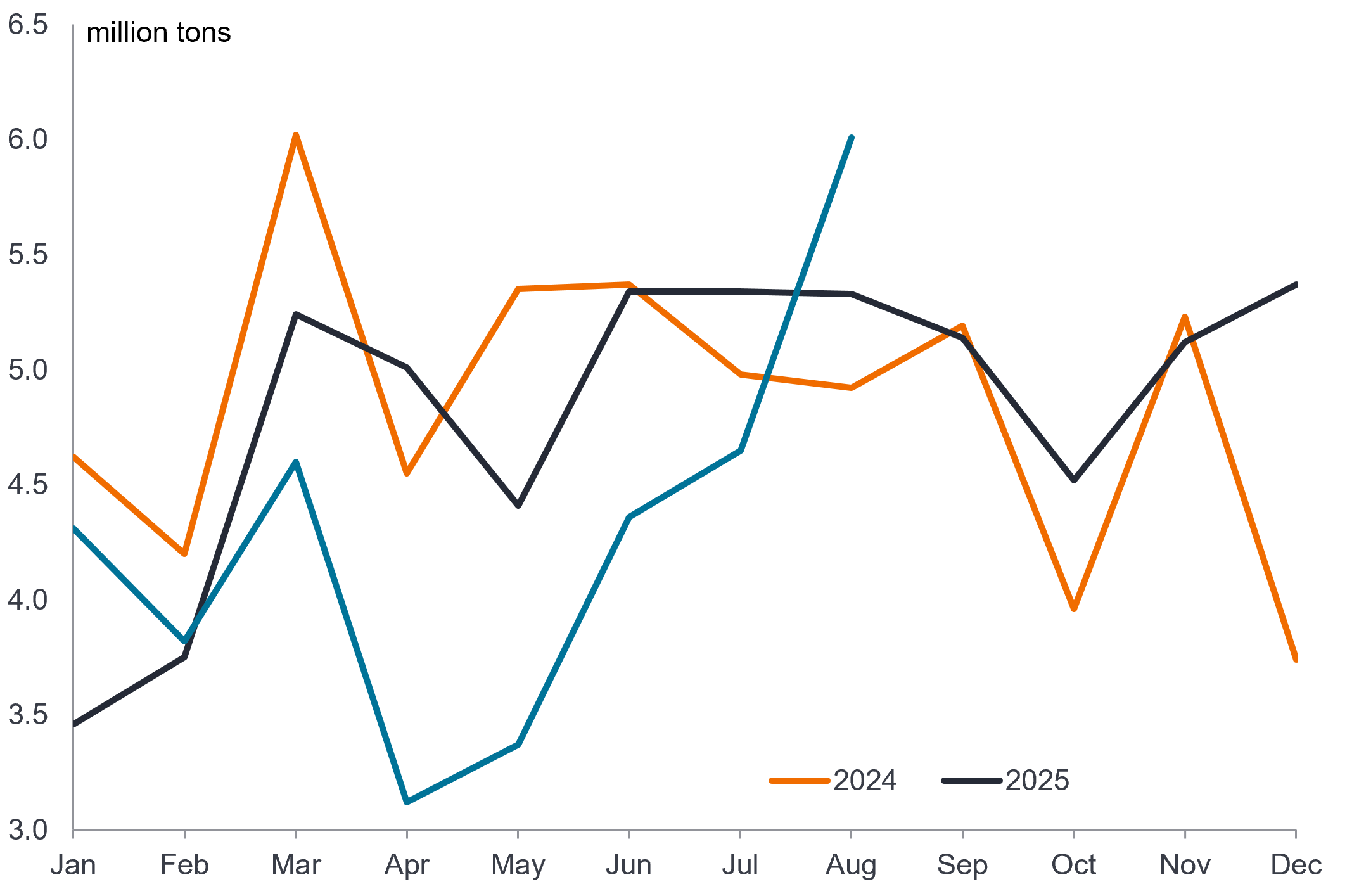
Source: China GAC, WIND, Macquarie Macro Strategy, 1 January 2024 to 31 August 2026.
- Rare earths
The US is highly dependent on Chinese supply chains for many rare-earth products, which are critical for the production of AI hardware, renewable energy infrastructure, electric vehicles and advanced manufacturing. Relating to China’s restrictions on exports of certain rare earths and related materials to the US, the White House indicated that talks would continue with the goal of restoring shipments to “appropriate levels”. To date, China’s export volume of rare-earth products has remained steady versus prior years.
Figure 2: China’s rare earth export volumes
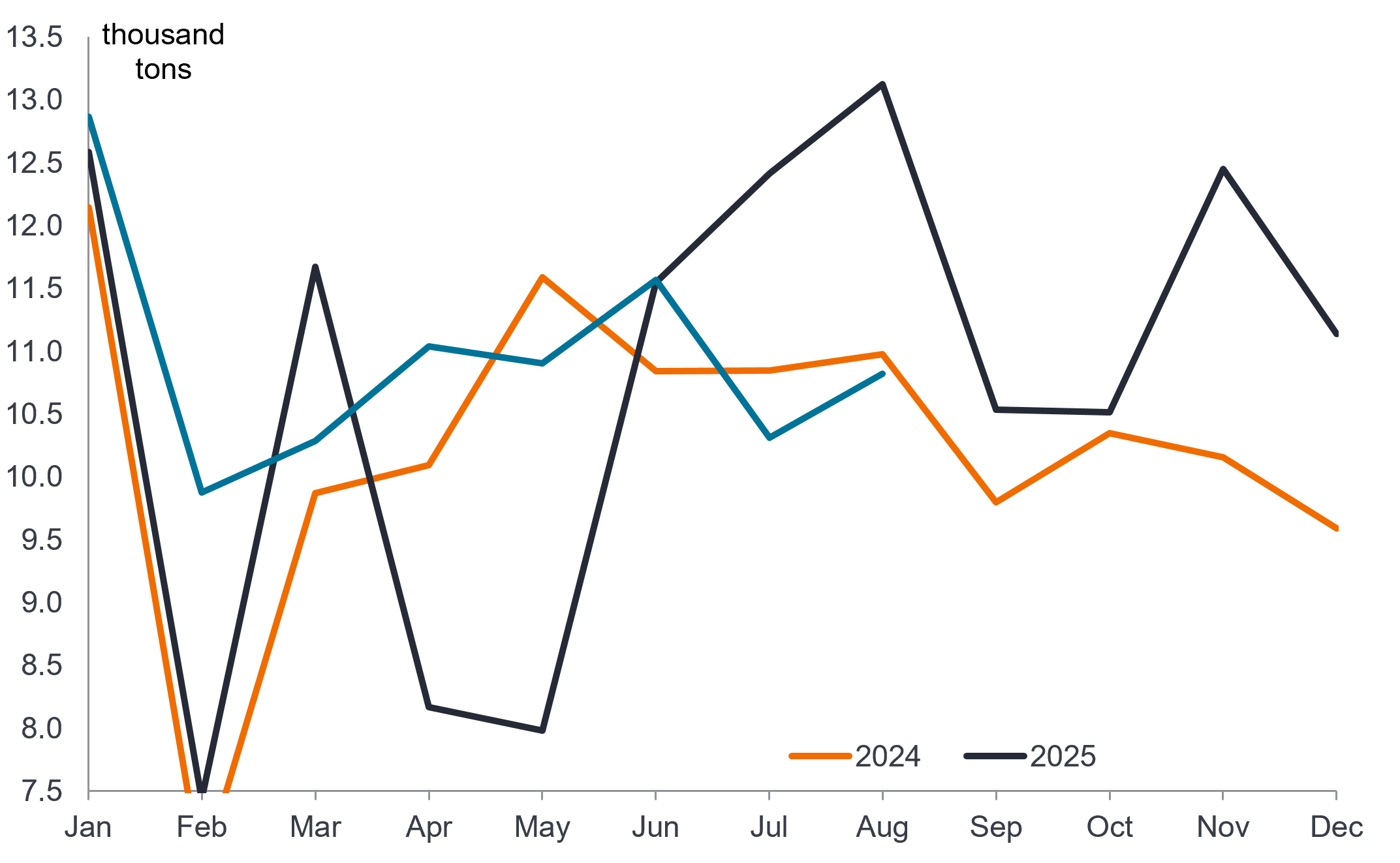
Source: China GAC, WIND, Macquarie Macro Strategy, 1 January 2024 to 31 August 2026.
China’s new growth drivers are creating opportunities
The meeting reinforced a gradual stabilisation pathway, with the potential for lower geopolitical risk to improve earnings visibility, company valuations and access to capital.
China’s growth model is changing, led by five new drivers:
- Technology-led growth (AI, semiconductors, electric vehicles and biotechnology);
- Coordinated policy support (monetary, fiscal and industrial policy);
- Consumption shift (services and higher-quality consumption, younger generation, lower tier cities);
- Export diversification (e.g. Belt and Road Initiative (BRI), with around 150 participating countries across Africa, Asia, Europe, Latin America, and Oceania, Association of Southeast Asian Nations (ASEAN); and
- Engineering excellence (commercialise innovation at scale).
In our view, the combination of a more supportive investment backdrop and new economic growth drivers offer a broad opportunity set for stock pickers, particularly in areas of strategic importance to both the US and China, including energy security, rare earth supply chains, geopolitics and AI development.
What lies ahead for US-China relations?
The US mid-term elections in November will bring uncertainty. Trump has played an important role in advancing talks with China; his desire to show progress increasing the likelihood of concessions in areas of US strategic interest. Interestingly, according to a recent Chicago Council on Global Affairs survey,3 Americans today are far less likely to view China as a critical threat and are more supportive of engagement with Beijing. This is especially true within the Democratic Party. Should they win control of one or both houses of Congress, there could be greater scope for diplomatic engagement and economic cooperation.
The leaders of China and the US committing to four meetings in a year is extraordinary and signals that, despite ongoing strategic competition, both sides continue to see value in maintaining a workable framework for dialogue where interests overlap.
For global markets, the benefit is a lower risk of sudden disruption across trade, energy, critical minerals and technology. For Chinese equities, it reinforces a selective, sector-driven approach focused on the companies best positioned for the country’s next phase of growth and supports the case for a more investable market.
IMPORTANT INFORMATION
There is no guarantee that past trends will continue, or forecasts will be realised.
Equity securities are subject to risks including market risk. Returns will fluctuate in response to issuer, political and economic developments.
Emerging market investments have historically been subject to significant gains and/or losses. As such, returns may be subject to volatility.
Foreign securities are subject to currency fluctuations, political and economic uncertainty, increased volatility and lower liquidity, all of which are magnified in emerging markets. Fixed income securities are subject to interest rate, inflation, credit and default risk. As interest rates rise, bond prices usually fall, and vice versa.
Meeting information sourced from:
Whitehouse.gov; Fact Sheet: President Donald J. Trump Advances a Fair and Reciprocal Relationship with China While Hosting Historic State Visit; 25 September 2026.
Fmprc.gov.cn; Ministry of Foreign Affairs People’s Republic of China; President Xi Jinping Holds Talks with U.S. President Donald J. Trump; 25 September 2026.
HSBC Global Investment Research; Bigger deal later? : Xi-Trump meeting: Second of the four in 2026; 27 September 2026.
Macquarie Desk Strategy; Trump-Xi Washington Summit: Largely symbolic, but still significant; 27 September 2026.
Association of Southeast Asian Nations (ASEAN) includes Brunei Darussalam, Cambodia, Indonesia, Lao PDR (Laos), Malaysia, Myanmar, the Philippines, Singapore, Thailand, Timor-Leste, and Vietnam.
Belt and Road Initiative (BRI) includes over 150 participating countries across Africa, Asia, Europe, Latin America, and Oceania. The initiative spearheaded by the Chinese government and endorsed by President Xi Jinping in late 2013 aims to improve trade and economic integration across regions.
1 The Economist; China is now the world’s great oil power; 9 August 2026.
2 Macquarie Desk Strategy; Trump-Xi Washington Summit: Largely symbolic, but still significant; 27 September 2026.
3 The Chicago Council on Global Affairs; As Fears of China Wane, Americans Favor Greater Engagement with Beijing; 21 September 2026.
Capital flows: Money moving into or out of a market, country or asset class.
Company valuation: How much a company is worth can be gauged by evaluating a company’s performance, financial health, and expectations for future earnings.
Export controls: Government restrictions on the sale of certain goods or technologies to another country.
Geopolitics: The study of the way a country’s size, position, etc. influence its power and its relationships with other countries.
Rare earths: A group of elements used in electronics, electric vehicles, renewable-energy equipment and defence systems.
Risk premium: The additional return investors seek for accepting greater uncertainty or risk.
Trade truce: A temporary agreement to pause or limit new trade restrictions while negotiations continue.
These are the views of the author at the time of publication and may differ from the views of other individuals/teams at Janus Henderson Investors. References made to individual securities do not constitute a recommendation to buy, sell or hold any security, investment strategy or market sector, and should not be assumed to be profitable. Janus Henderson Investors, its affiliated advisor, or its employees, may have a position in the securities mentioned.
Past performance does not predict future returns. The value of an investment and the income from it can fall as well as rise and you may not get back the amount originally invested.
The information in this article does not qualify as an investment recommendation.
There is no guarantee that past trends will continue, or forecasts will be realised.
Marketing Communication.