
Key takeaways:
- European large caps derive much of their growth from international markets, yet many still trade at significant discounts to global peers, based on perception of the region.
- Europe’s biggest obstacle is not the slow pace of regulatory reform. It is the shortage of patient capital needed to help businesses scale and grow, thereby enabling innovation to break through.
- Active stock selection can uncover global industry leaders with strong market position and growing earnings. Competition for resources, the rise of applied AI and stronger financials are fertile hunting grounds for European equity investors.
For many investors, Europe remains associated with sluggish economic growth, heavy regulation, high political risks and years of market underperformance. At the same time, the increasing concentration of global equity markets into a relatively small group of US technology and Artificial Intelligence (AI)-related stocks has heightened interest in diversification.
What strikes me is that many investors still view Europe through a macroeconomic lens. Yet when I look at the European large-cap universe today, I see something quite different. I see global businesses, operating across international markets, often trading at attractive valuations despite possessing leading positions in their industries.
Looking at listed Europe rather than ‘macro’ Europe
For much of the past two decades, European equity markets and the European economy have broadly moved together. Today, that relationship has weakened considerably. Many of Europe’s largest listed companies generate the majority of their revenues outside the region, outweighing domestic dependence. European large cap equity returns have significantly outpaced European economic growth over the past decade and a half (Exhibit 1).
Exhibit 1: Listed Europe has become disconnected from the underlying economy
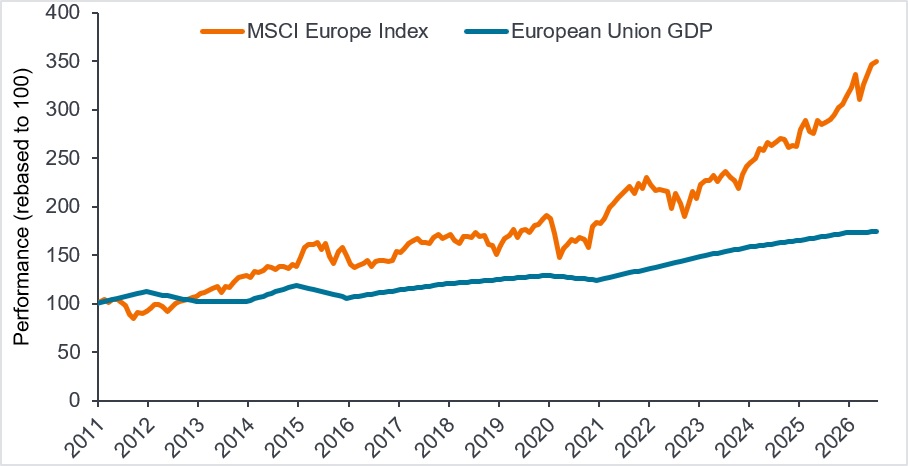
Source: Bloomberg, Eurostat, Janus Henderson Investors Analysis, as at 31 July 2026.
Note: MSCI Europe EUR Net Total Return Index and European Union Gross Domestic Product (GDP) rebased to 100 on 1 January 2010. From 2026, European Union GDP is an estimate using European Central Bank projections. Past performance does not predict future returns.
This evolution did not happen by accident. Over the past 15 to 20 years, European companies have navigated a remarkable sequence of challenges: from the global financial crisis and subsequent eurozone crisis, to COVID, tariffs and the wars in Ukraine and the Middle East (with their related supply chain and energy shocks). Uncertainty has been so persistent that it has become the new certainty.
Businesses have been forced to learn how to operate in this new paradigm, and some companies that failed to adapt have disappeared. Those large cap businesses that survived have often emerged stronger, becoming more disciplined with capital, and more efficient in their operations. The outcome is that the opportunity set in European large caps has evolved.
Scarcity is now a defining investment theme
We increasingly live in a world where access to capital, scarce resources, energy and strategic infrastructure matters. Electrification, energy, artificial intelligence (AI) and the energy transition are pushing demand, yet supply remains constrained. Conflict in the Middle East has restricted shipping through the Strait of Hormuz and the Bab al-Mandab Strait, while Ukraine’s strategy has shifted to targeting the energy supplies that fund the Russian economy and its war efforts.
The global significance of these supply restrictions has reinforced the importance of energy security. Both price and supply reliability are equally critical. We see a range of world-class businesses in Europe that can play an important role in building out the world’s energy infrastructure. This is not limited to just mining companies, but also businesses providing equipment, technologies and services that support production.
Another area in which we continue to see opportunities is financials. The backdrop has improved meaningfully for European banks after a long process of repairing their balance sheets. Interest rates have normalised, moving away from the ‘near zero’ rate environment that constrained profitability for many years. The short end of the yield curve now hovers around a ‘sweet spot’ between two and four per cent. We see this as a much more supportive environment for European financial stocks than we have seen for some time.
The opportunity in financials extends beyond traditional banking. In our view, financial services businesses, capital market operators and wealth management firms also seem well placed as potential beneficiaries.
Europe’s biggest challenge is capital
One reason Europe continues to trade at a discount in the eyes of many international investors is its difficulty in converting innovation into scale.
Europe does not have a talent problem. Strong education systems, skilled workforces and meaningful support for innovative start-ups are a good foundation. The challenge comes later. When a company needs to raise larger-scale investment to accelerate growth, it often runs into a glass ceiling.
Part of the problem is regulation. Europe has spent years positioning itself as the global benchmark for regulation. While motivated by good intention, too often the result has been to make growth and expansion more difficult.
The bigger issue, however, in our view, is capital. Much of Europe remains heavily dependent on bank lending, while many countries lack large pools of private pension capital deployed in the market. Similarly, banks faced increased capital requirements, which caused lending to be selective, favouring parts of the economy they perceive as lower risk. The outcome is that Europe’s innovative smaller companies can struggle to access the capital they need to fund their development.
The challenge for Europe, in our view, is to address these operational barriers to innovation, while acting to deepen capital markets (along with incentives for banks to finance a wider range of businesses). If the bloc can address these obstacles, it opens the door to unlocking its full potential.
In the meantime, entry price remains one of the most compelling arguments for an allocation. While consensus forecasts point to accelerating earnings growth[1], European equities continue to trade at substantial discounts to their global peers[2] (Exhibit 2).
Exhibit 2: European equities at multi-decade valuation lows
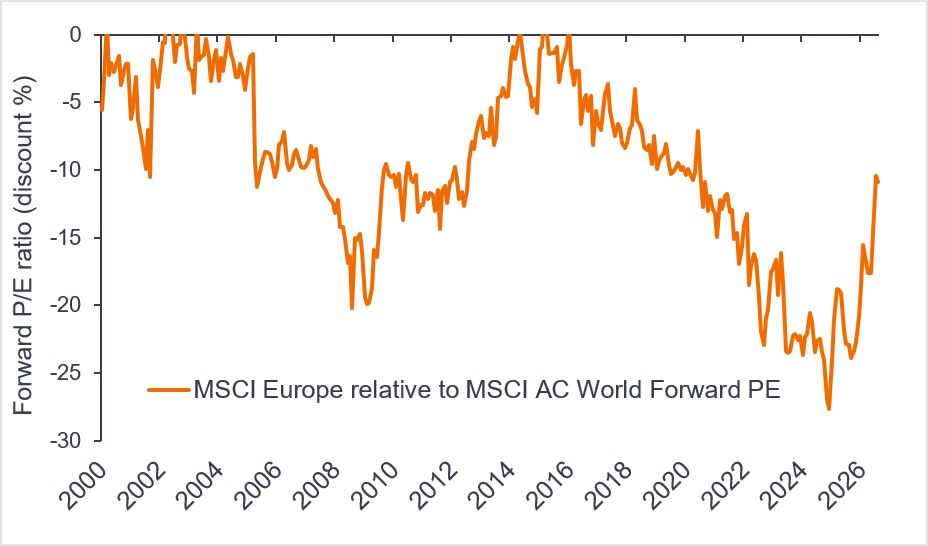
Source: Bloomberg consensus forecasts, Janus Henderson Investors Analysis, 1 January 2000 to 31 August 2026. The discount indicates European equities are cheaper relative to global equities, in terms of P/E valuation. There is no guarantee that past trends will continue, or forecasts will be realised.
Can Europe still catch up in the field of artificial intelligence?
While a highly pertinent topic, we think this question is not necessarily the right one for investors to focus on. When people talk about AI, they often focus on who will build the leading models in China or the US. I think the more interesting question is where value will be created as AI becomes increasingly commoditised.
Right now, we see the cost of tokens (the basic unit of data that an AI model uses) falling and, for many applications, older models can often deliver effective results without high costs. This seems supportive for companies that already have strong products, established customer relationships and leading market positions.
The potential of AI seems huge, but the real opportunity for us is identifying the companies that can use AI to make already strong products even better. This applies to companies that are embedding AI into their workflows, engineering processes, manufacturing systems and enterprise software being used by customers around the world.
Alpha through transformation
Europe faces real challenges, from regulation and fragmented capital markets to a shortage of patient capital. Yet beneath those challenges sits a universe of resilient global businesses with international exposure and attractive valuations. We continue to see opportunities in stronger financial institutions, businesses linked to scarce resources and energy security, and companies already utilising AI to solve specific real-world problems and automate tasks.
As always, active stock selection matters, with discipline in both buying and selling. The challenge is identifying where long-term change is being underestimated by the market. In our view, the opportunity is not to see Europe as a single investment idea, but to identify the companies that can potentially benefit from the major changes currently underway.
[1] Source: Bloomberg, consensus forecasts, as at 31 August 2026. Past performance does not predict future returns.
[2] Source: MSCI Europe Index relative to MSIC AC World Index. Forward price/earnings ratio (forward PE), as at 31 August 2026.
Active investing (active stock selection): An investment management approach where a fund manager actively aims to outperform or beat a specific index or benchmark through research, analysis, and the investment choices they make. Alpha: The difference between a portfolio’s return and its benchmark index after adjusting for the level of risk taken. This measure is used to help determine whether an actively managed portfolio has added value relative to a benchmark index, taking into account the risk taken. A positive alpha indicates that a manager has added value. Balance sheet: A financial statement that summarises a company’s assets, liabilities, and shareholders’ equity at a particular point in time. It gives investors an idea as to what the company owns and owes, as well as the amount invested by shareholders. It is called a balance sheet because of the accounting equation: assets = liabilities + shareholders’ equity. Capital requirement (banks): A mandatory regulatory standard that dictates the minimum amount of money (or other assets) that a financial institution (eg. banks) must hold relative to the amount that it lends. This buffer is designed to ensure that financial institutions can remain solvent in the event of unexpected losses or economic downturns. Discount: Refers to a situation when a security is trading for lower than its fundamental or intrinsic value. Eurozone crisis (European sovereign debt crisis): The financial and debt crisis that persisted across the eurozone from 2009 to 2018, precipitated by the Global Financial Crisis, threatening the stability of the European Union and the euro. Forward price-to-earnings (P/E) ratio: A version of the P/E ratio used to value a company’s shares that utilises forecasted earnings in its calculation. The P/E is calculated by dividing the current share price by its earnings per share. Global financial crisis (GFC): The global economic crisis from mid-2007 to early 2009 that began with losses related to mortgage-backed financial assets in the US and spread to affect financial markets and banks globally. Also known as the ‘Great Recession’. Gross Domestic Product (GDP): A measure of the size and heath of a country’s economy over a specific period, usually either quarterly or yearly. Interest rates: The amount charged for borrowing money, shown as a percentage of the amount owed. Base interest rates (the Bank Rate) are generally set by central banks, such as the Federal Reserve in the US or Bank of England in the UK, and influence the interest rates that lenders charge to access their own lending or saving. Large-cap stocks: Well-established companies with a valuation (market capitalisation) at the larger end of the market scale. Macroeconomics: The branch of economics that considers large-scale factors related to the economy, such as inflation, unemployment, or productivity. Valuations: Investors use various methods to calculate the theoretical or intrinsic value of a company and its shares, measuring the worth of fundamentals like cash flows, dividends and debt. Valuation metrics are used to decide if a stock’s current market price is fair, undervalued (trading for less than it is worth), or overvalued (trading for more than it is worth). —– Important information: These are the views of the author at the time of publication and may differ from the views of other individuals/teams at Janus Henderson Investors. References made to individual securities do not constitute a recommendation to buy, sell or hold any security, investment strategy or market sector, and should not be assumed to be profitable. Janus Henderson Investors, its affiliated advisor, or its employees, may have a position in the securities mentioned. Past performance does not predict future returns. The value of an investment and the income from it can fall as well as rise and you may not get back the amount originally invested. The information in this article does not qualify as an investment recommendation. There is no guarantee that past trends will continue, or forecasts will be realised. Marketing Communication.
These are the views of the author at the time of publication and may differ from the views of other individuals/teams at Janus Henderson Investors. References made to individual securities do not constitute a recommendation to buy, sell or hold any security, investment strategy or market sector, and should not be assumed to be profitable. Janus Henderson Investors, its affiliated advisor, or its employees, may have a position in the securities mentioned.
Past performance does not predict future returns. The value of an investment and the income from it can fall as well as rise and you may not get back the amount originally invested.
The information in this article does not qualify as an investment recommendation.
There is no guarantee that past trends will continue, or forecasts will be realised.
Marketing Communication.
Important information
Please read the following important information regarding funds related to this article.
- Shares can lose value rapidly, and typically involve higher risks than bonds or money market instruments. The value of your investment may fall as a result.
- Active management techniques that have worked well in normal market conditions could prove ineffective or negative for performance at other times.
- High exposure to a particular country or geographical region carries a higher level of risk than a more broadly diversified portfolio.
- When a portfolio is concentrated (has a significant portion of its assets invested in a limited number of holdings), an adverse event impacting even a small number of holdings could create significant volatility or losses.
- Derivatives may be used with the aim of reducing risk or managing the portfolio more efficiently. However, this introduces other risks, in particular, that a derivative counterparty may not meet its contractual obligations.
- Securities could become hard to value or to sell at a desired time and price, especially in extreme market conditions when asset prices may be falling, increasing the risk of investment losses.
- Losses could be incurred if a counterparty became unwilling or unable to meet its obligations, or as a result of failure or delay in operational processes or the failure of a third party provider.
Specific risks
- Shares can lose value rapidly, and typically involve higher risks than bonds or money market instruments. The value of your investment may fall as a result.
- High exposure to a particular country or geographical region carries a higher level of risk than a more broadly diversified portfolio.
- Derivatives may be used with the aim of reducing risk or managing the portfolio more efficiently. However, this introduces other risks, in particular, that a derivative counterparty may not meet its contractual obligations.
- If the Fund holds assets in currencies other than the base currency of the Fund, or you invest in a share/unit class of a different currency to the Fund (unless hedged, i.e. seeks to mitigate exchange rate movements between the share/unit class currency and the base currency of the Fund), the value of your investment may be impacted by changes in exchange rates.
- When the Fund, or a share/unit class, seeks to mitigate exchange rate movements of a currency relative to the base currency (hedge), the hedging strategy itself may positively or negatively impact the value of the Fund due to differences in short-term interest rates between the currencies.
- Securities could become hard to value or to sell at a desired time and price, especially in extreme market conditions when asset prices may be falling, increasing the risk of investment losses.
- Losses could be incurred if a counterparty became unwilling or unable to meet its obligations, or as a result of failure or delay in operational processes or the failure of a third party provider.
Specific risks
- Shares can lose value rapidly, and typically involve higher risks than bonds or money market instruments. The value of your investment may fall as a result.
- High exposure to a particular country or geographical region carries a higher level of risk than a more broadly diversified portfolio.
- If the Fund holds assets in currencies other than the base currency of the Fund, or you invest in a share/unit class of a different currency to the Fund (unless hedged, i.e. seeks to mitigate exchange rate movements between the share/unit class currency and the base currency of the Fund), the value of your investment may be impacted by changes in exchange rates.
- Derivatives may be used to help achieve the investment objective. This can result in leverage (higher levels of debt), which can magnify an investment outcome. Gains or losses may therefore be greater than the cost of the derivative. Derivatives also introduce other risks, in particular, that a derivative counterparty may not meet its contractual obligations.
- When the Fund, or a share/unit class, seeks to mitigate exchange rate movements of a currency relative to the base currency (hedge), the hedging strategy itself may positively or negatively impact the value of the Fund due to differences in short-term interest rates between the currencies.
- Securities could become hard to value or to sell at a desired time and price, especially in extreme market conditions when asset prices may be falling, increasing the risk of investment losses.
- The Fund involves a high level of buying and selling activity and as such will incur a higher level of transaction costs than a fund that trades less frequently. These transaction costs are in addition to the Fund's ongoing charges.
- Losses could be incurred if a counterparty became unwilling or unable to meet its obligations, or as a result of failure or delay in operational processes or the failure of a third party provider.
Specific risks
- Shares can lose value rapidly, and typically involve higher risks than bonds or money market instruments. The value of your investment may fall as a result.
- High exposure to a particular country or geographical region carries a higher level of risk than a more broadly diversified portfolio.
- Derivatives may be used with the aim of reducing risk or managing the portfolio more efficiently. However, this introduces other risks, in particular, that a derivative counterparty may not meet its contractual obligations.
- If the Fund holds assets in currencies other than the base currency of the Fund, or you invest in a share/unit class of a different currency to the Fund (unless hedged, i.e. seeks to mitigate exchange rate movements between the share/unit class currency and the base currency of the Fund), the value of your investment may be impacted by changes in exchange rates.
- When the Fund, or a share/unit class, seeks to mitigate exchange rate movements of a currency relative to the base currency (hedge), the hedging strategy itself may positively or negatively impact the value of the Fund due to differences in short-term interest rates between the currencies.
- Securities could become hard to value or to sell at a desired time and price, especially in extreme market conditions when asset prices may be falling, increasing the risk of investment losses.
- Losses could be incurred if a counterparty became unwilling or unable to meet its obligations, or as a result of failure or delay in operational processes or the failure of a third party provider.