
Key takeaways:
- AI is not a single trade; it is a general-purpose technology rippling through every industry at different speeds. We categorise companies through four lenses: AI Enabler, Physical Bottleneck, AI Beneficiary and AI Resilient – to understand precisely where the risks concentrate, and where the compounding opportunities lie.
- The framework reveals a deliberately balanced construction: meaningful participation in the companies building and physically enabling AI, a substantial cohort using AI to strengthen already-durable franchises, and a foundation of businesses whose moats – physical networks, proprietary data, regulated infrastructure – are insulated from disruption.
- Each lens maps naturally onto our sustainable development themes, from Knowledge & Technology to Cleaner Energy and Efficiency. AI has not changed our two-question process; it has given it a new dimension along which to be applied – and, we would argue, made disciplined, sustainability-led stock selection more valuable, not less.
Every technology cycle eventually produces its own vocabulary of fear and greed, and this one is no exception. Equity markets in 2026 increasingly trade as a momentum-driven referendum on a single question: Is this company an AI winner or an AI loser? With valuations swinging violently as the narrative reassigns companies from one camp to the other, sometimes on little more than a product announcement or a conference remark.
We understand why. AI is the most consequential general-purpose technology since the internet, and its effects on competitive advantage will be profound. But we believe the binary framing is analytically lazy, and that it creates precisely the kind of mispricing a disciplined, long-horizon process can exploit. A technology that touches everything does not divide the world into two clean categories. It creates a spectrum of exposure, and understanding where each business sits on that spectrum, and why, has become one of the most important tasks in constructing a resilient portfolio.
That is why the Global Sustainable Equity Team categorises companies through four distinct lenses.
The four lenses
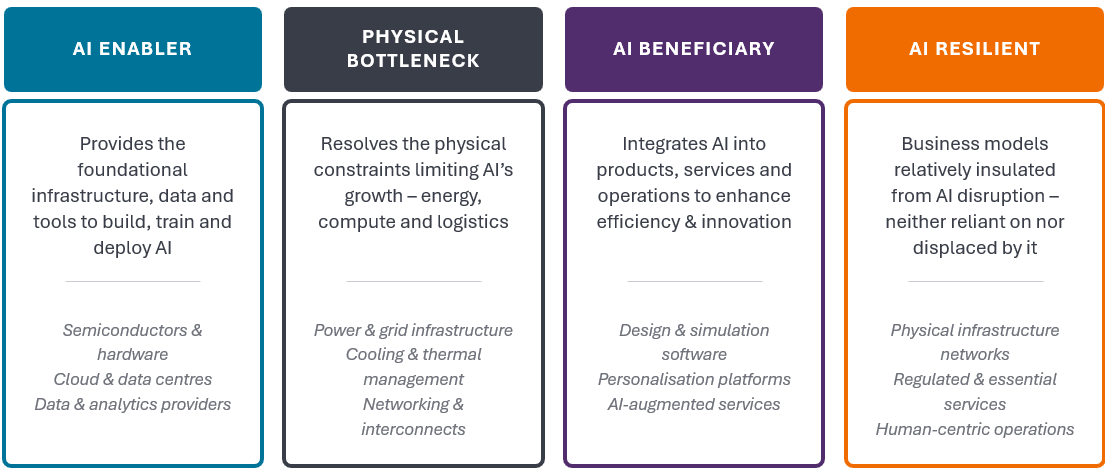
Figure 1: Our four-lens framework for categorising the AI value chain
Source: Janus Henderson Investors, Global Sustainable Equity Team. For illustrative purposes only.
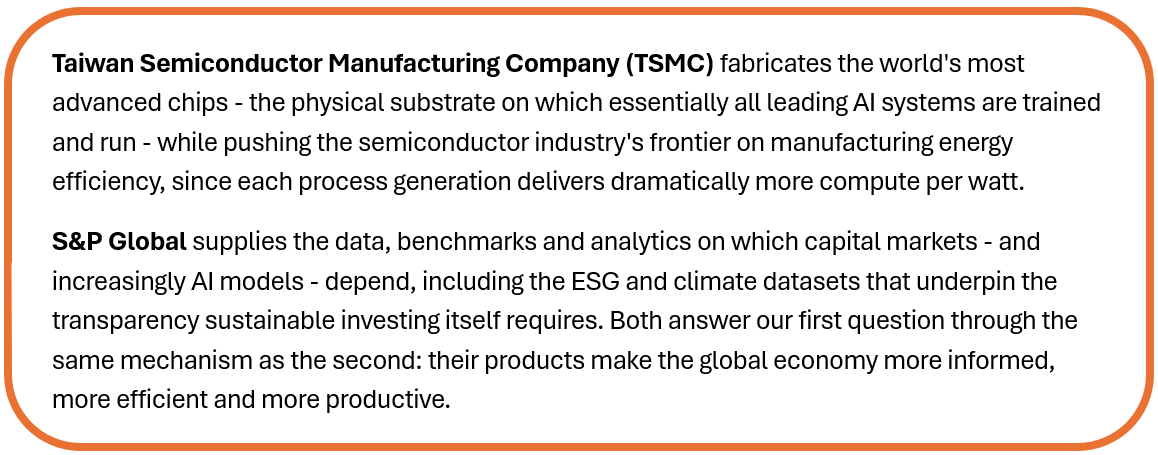
AI Enablers provide the foundational infrastructure, data and tools required to build, train and deploy AI systems: advanced semiconductors, cloud platforms and data centres, specialised software, and the data and analytics that feed the models themselves. These businesses sit at the source of the AI value chain, and many map directly onto our Knowledge & Technology theme. Critically for our process, the best of them pass both of our questions convincingly: the diffusion of intelligence through the economy is a powerful social good – in scientific discovery, healthcare, education and productivity – and the enablers’ economics, characterised by deep intellectual property moats and structural demand growth, are among the most attractive in global equities.
EXAMPLES
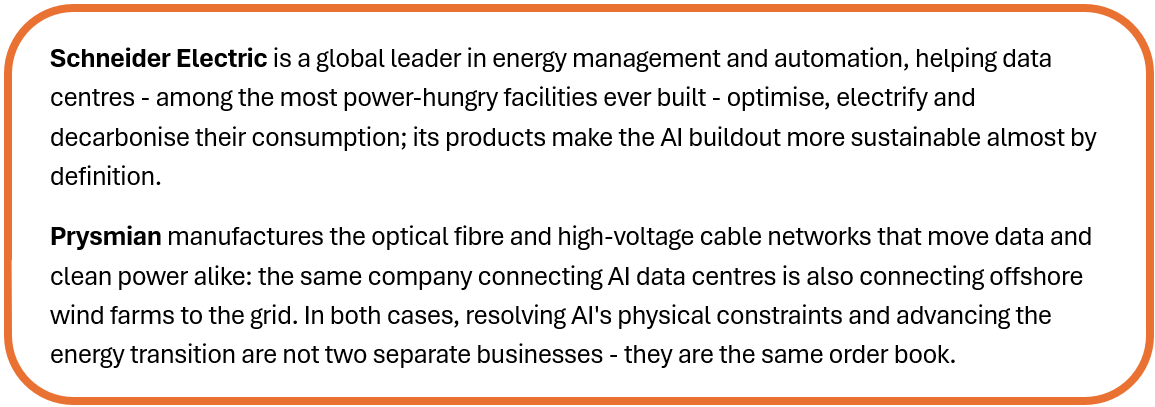
Physical Bottlenecks are the companies resolving the real-world constraints that limit AI’s growth – power generation and grid infrastructure, cooling and thermal management, advanced networking and interconnects. This is where the AI story and the sustainability story become quite literally the same story. The single greatest obstacle to AI scaling is energy – its availability, its cost and its carbon intensity – which means the companies solving for grid capacity, electrification and energy efficiency are simultaneously enabling the technology and decarbonising it. These holdings can span our Cleaner Energy and Efficiency themes, for example, and they illustrate a point we have long made: the energy transition is not a constraint on technological progress but a precondition for it.
EXAMPLES
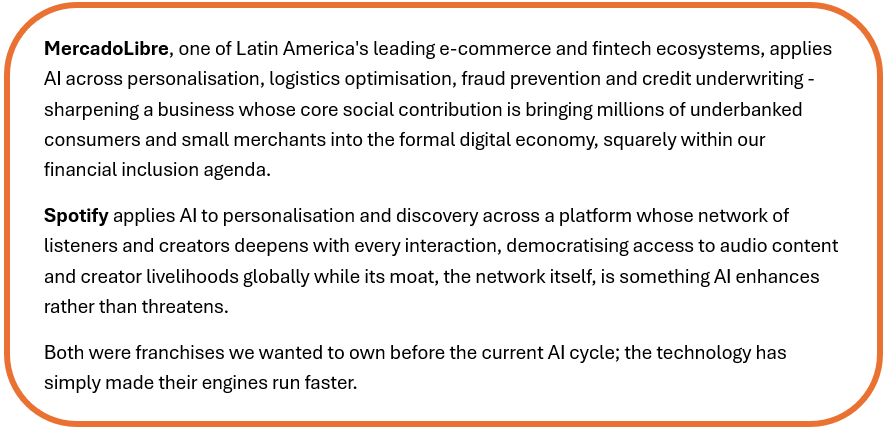
AI Beneficiaries integrate AI into their products, services and operations to enhance efficiency, customer experience and innovation. They benefit from AI adoption rather than enabling it – design software that automates and simulates, platforms that personalise at scale, service businesses compressing cost and cycle times. This is, deliberately, where many of our portfolio holdings sit. These are companies with franchises we already wanted to own – durable moats, strong returns on capital, clear thematic alignment – for which AI acts as an accelerant in an existing engine rather than the engine itself. The distinction matters: a beneficiary’s investment case does not depend on the AI narrative holding but is strengthened if it does.
EXAMPLES
AI Resilient businesses are those whose models are relatively insulated from AI disruption – neither heavily reliant on AI, nor likely to be displaced by it in any foreseeable timeframe. Their moats live in the physical and institutional world: infrastructure networks built over decades under regulatory and permitting regimes that will not be granted twice; essential local services whose route density economics support only one or two rational operators; businesses grounded in physical presence and human interaction. AI will make these companies more productive; it cannot make them unnecessary. In a portfolio context, this cohort is the ballast – a source of uncorrelated, idiosyncratic compounding that does not rise and fall with the AI narrative.
EXAMPLES
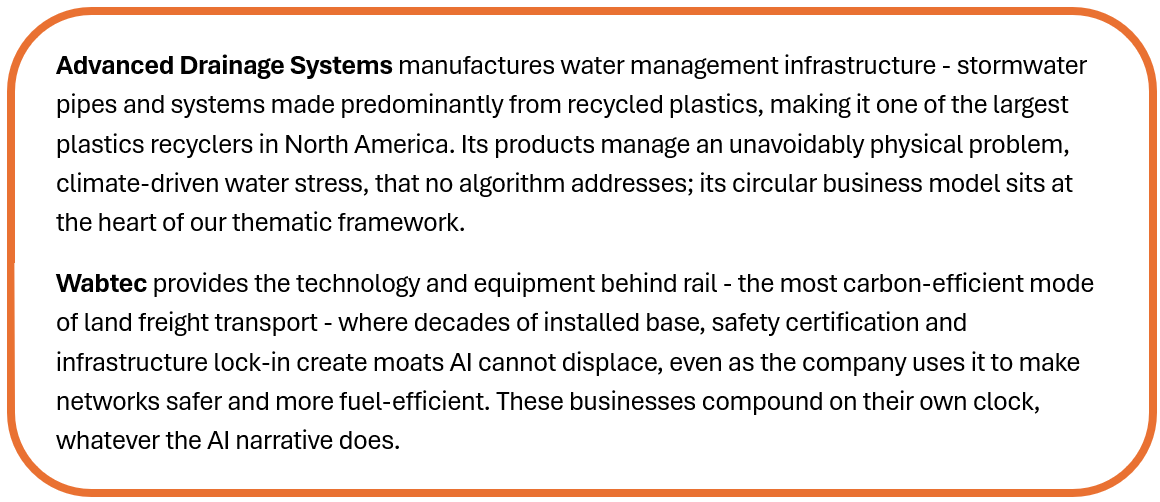
Two important nuances. First, the lenses are not mutually exclusive: many holdings legitimately span more than one category – an enabler of AI that is also a beneficiary of its own tools, or a resilient infrastructure business that is simultaneously solving a physical bottleneck. We treat this overlap as information, not inconvenience: Businesses that screen well through multiple lenses are often the most robust of all. Second, categorisation is a living judgement, revisited continuously as the technology and each company’s positioning evolve. A lens assignment is the beginning of the debate, not the end of it.
What the framework reveals
Mapping the investible universe through the four lenses aims to create balance by design, not by accident. No single lens dominates, and no single version of the AI future is required.
This is a deliberate response to what we see as the defining risk of the current market – narrative concentration. When a single theme drives an outsized share of index returns, portfolios that simply ride the theme are making an implicit, highly correlated bet – and portfolios that avoid it entirely are making the opposite one. Our approach is to be exposed to AI the way we want to be exposed: Through companies that clear our sustainability and wealth-creation hurdles individually, diversified across the value chain, with a substantial foundation of holdings whose compounding does not depend on how the AI story unfolds. If the buildout accelerates, the enablers, bottleneck-solvers and beneficiaries participate fully. If it disappoints, the resilient cohort and the beneficiaries’ standalone franchises provide the stability. In neither scenario are we hostage to a single narrative.
Moats in the AI era: Broader than they appear
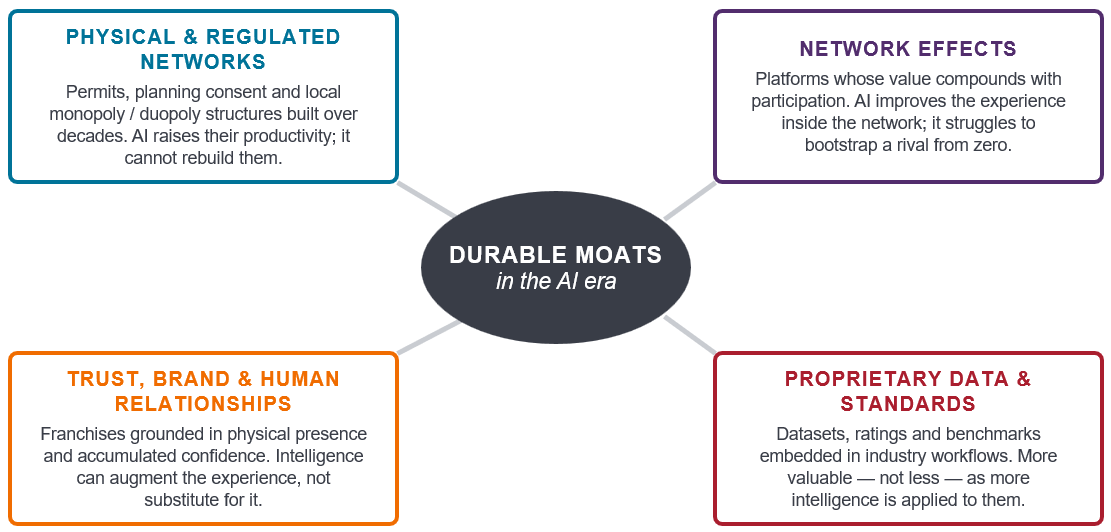
Running the investible universe through the framework can also sharpen our thinking on what constitutes a durable competitive advantage in an AI world. The instinctive answer – physical assets are safe, digital businesses are vulnerable – turns out to be far too simple. Durable moats in the AI era come in several distinct forms:
Figure 2: Four sources of durable competitive advantage in the AI era
Source: Janus Henderson Investors, Global Sustainable Equity Team. For illustrative purposes only.
- Physical and regulated networks: Infrastructure assembled over decades under permitting regimes and local market structures – often natural monopolies or duopolies – that no amount of algorithmic capability can replicate. AI makes these assets more productive; it cannot rebuild them.
- Network effects: Platforms whose value compounds with participation – marketplaces, ecosystems and two-sided networks where each additional user deepens the moat. AI can improve the experience inside the network; it struggles to bootstrap a rival network from zero.
- Proprietary data and standards: Businesses whose datasets, ratings, scores and benchmarks are embedded in the workflows and regulations of entire industries. Far from being disrupted by AI, these companies own the very raw material AI needs – their data becomes more valuable as more intelligence is applied to it.
- Trust, brand and human relationships: Franchises grounded in physical presence, service and accumulated confidence, where the product is ultimately a human experience that intelligence can augment but not substitute.
The common thread is duration, which we deem to be an essential component of a holistic definition of sustainability. In each case, the moat’s source is something slow to build and slow to erode, which is exactly what allows us to underwrite these businesses over the multi-year horizons our process demands, and to hold a collection of genuinely non-correlated, idiosyncratic compounders rather than one crowded bet expressed many times over.
Sustainability is the through-line
It would be easy to read all of this as a technology piece with a sustainability wrapper. We would argue the causality runs the other way. Our sustainable development themes are what led us to define opportunities in the first place, and AI has amplified the relevance of nearly every one of them.
The Knowledge & Technology theme captures the enablers democratising access to intelligence and information. Cleaner Energy and Efficiency capture the bottleneck-solvers ensuring the AI buildout is powered, cooled and connected sustainably – arguably the largest electrification and efficiency investment programme in history. Our Health, Water, Efficiency and Quality of Life themes are populated with beneficiaries and resilient compounders whose services the world needs regardless of the technology cycle, and which AI is making more productive.
And through it all, the two questions remain the constant. Is the world a better place because of this company? AI has raised the stakes on this question – a technology this powerful creates its own environmental footprint and social risks, and we aim to hold AI-exposed companies to account on energy sourcing, resource intensity, responsible deployment and workforce impact through active engagement. Is this company going to grow wealth? AI has raised the stakes here too – accelerating the compounding of the well-positioned and shortening the runway of the complacent. A process that insists on both answers, is in our view better suited to this environment than either uncritical AI enthusiasm or reflexive AI avoidance.
Conclusion: Resilience is a portfolio property
The market wants AI to be a simple story of winners and losers. Our framework insists on a more granular truth: That a technology touching everything demands a holistic approach to the whole value chain – enabling it, solving its physical constraints, benefiting from it, and compounding independently of it – with every holding, in every lens, still required to make the world better and grow wealth at the same time.
That is not hedging. It is about participating fully in progress while refusing to bet the outcome on any single version of the future. In a black-and-white momentum market, we think that balance – and the discipline behind it – is itself a source of durable advantage.
Active engagement: Ongoing dialogue between investors and company management aimed at improving corporate behaviour, disclosure and long-term performance.
Environmental, Social and Governance (ESG) factors: Relate to the quality and functioning of the natural environment, the rights, well-being and interests of people and communities, and the governance of companies and their stakeholders.
General-purpose technology: A technology – such as electricity, the internet or AI – whose applications spread across virtually all sectors of the economy, transforming productivity and competitive dynamics broadly rather than within a single industry.
Idiosyncratic return: Return attributable to company-specific factors – competitive position, execution, capital allocation – rather than to broad market or thematic exposure.
Moat: A durable competitive advantage that protects a company’s returns on capital from competition over time.
Network effect: A dynamic in which a product or platform becomes more valuable as more people use it, creating a self-reinforcing competitive advantage.
These are the views of the author at the time of publication and may differ from the views of other individuals/teams at Janus Henderson Investors. References made to individual securities do not constitute a recommendation to buy, sell or hold any security, investment strategy or market sector, and should not be assumed to be profitable. Janus Henderson Investors, its affiliated advisor, or its employees, may have a position in the securities mentioned.
Past performance does not predict future returns. The value of an investment and the income from it can fall as well as rise and you may not get back the amount originally invested.
The information in this article does not qualify as an investment recommendation.
There is no guarantee that past trends will continue, or forecasts will be realised.
Marketing Communication.
Important information
Please read the following important information regarding funds related to this article.
- Shares can lose value rapidly, and typically involve higher risks than bonds or money market instruments. The value of your investment may fall as a result.
- Shares of small and mid-size companies can be more volatile than shares of larger companies, and at times it may be difficult to value or to sell shares at desired times and prices, increasing the risk of losses.
- The Fund follows a growth investment style that creates a bias towards certain types of companies. This may result in the Fund significantly underperforming or outperforming the wider market.
- Due to the Fund’s Sustainability Approach, it may exclude or invest less or more in certain companies and may therefore perform differently to funds that have a similar financial objective, but that do not have a binding Sustainability Approach. Political, regulatory or investor sentiment about sustainability initiatives may change over time and impact the Fund’s performance.
- Derivatives may be used with the aim of reducing risk or managing the portfolio more efficiently. However, this introduces other risks, in particular, that a derivative counterparty may not meet its contractual obligations.
- If the Fund holds assets in currencies other than the base currency of the Fund, or you invest in a share/unit class of a different currency to the Fund (unless hedged, i.e. seeks to mitigate exchange rate movements between the share/unit class currency and the base currency of the Fund), the value of your investment may be impacted by changes in exchange rates.
- When the Fund, or a share/unit class, seeks to mitigate exchange rate movements of a currency relative to the base currency (hedge), the hedging strategy itself may positively or negatively impact the value of the Fund due to differences in short-term interest rates between the currencies.
- Securities could become hard to value or to sell at a desired time and price, especially in extreme market conditions when asset prices may be falling, increasing the risk of investment losses.
- Losses could be incurred if a counterparty became unwilling or unable to meet its obligations, or as a result of failure or delay in operational processes or the failure of a third party provider.