
Key takeaways:
- Government bond yields have moved materially higher as geopolitical disruption, most notably around the Strait of Hormuz, has reignited inflation concerns and pushed markets to price out rate cuts and even consider further hikes. This has lifted corporate bond yields to attractive absolute levels, especially in investment grade, but reflects macro and political risk rather than a benign growth backdrop.
- While yields look appealing in absolute terms, credit spreads are close to historical tights, implying limited compensation for downside risk. Strong corporate earnings, sector-specific tailwinds (energy, European chemicals, AI-related capex beneficiaries), and solid demand for new issuance have kept spreads compressed even as tail risks from geopolitics, inflation, and policy uncertainty remain elevated.
- Earnings resilience and supportive technicals have underpinned credit markets so far, but risks are building. Potential demand destruction from higher prices, pressure on rate-sensitive sectors, heavy issuance, and the possibility of further rate hikes all argue for caution. With spreads pricing in little negative surprise, this is not an environment that rewards taking excessive credit risk.
Geopolitics and politics more locally is having an outsized impact on fixed income markets this year. Politics is notoriously difficult to predict so credit investors are left trying to understand what the repercussions might be based on the existing economic backdrop and corporate fundamentals.
Underlying change
There has been a recent notable shift higher in government bond yields. This is principally driven by inflation concerns as the closure of the Strait of Hormuz feeds into higher oil prices. Expectations for rate cuts have given way to potential rate rises as central banks look to keep inflation in check. The yield moves have been notable at the short end but also further along the yield curve, particularly in the UK where political concerns around government spending, together with a relatively high level of inflation-linked debt has made markets uneasy.
For credit investors the rise in government bond yields has lifted yields across corporate bonds. Relative to the last 20 years (using yield data in Figure 1), yields are around the middle of the pack (44th percentile) for global high yield bonds and high historically for global investment grade bonds (73rd percentile). What this means is that compared with today, yields have been lower on investment grade bonds 73% of the time over the last 20 years.
Figure 1: Global corporate yields look relatively attractive (%)
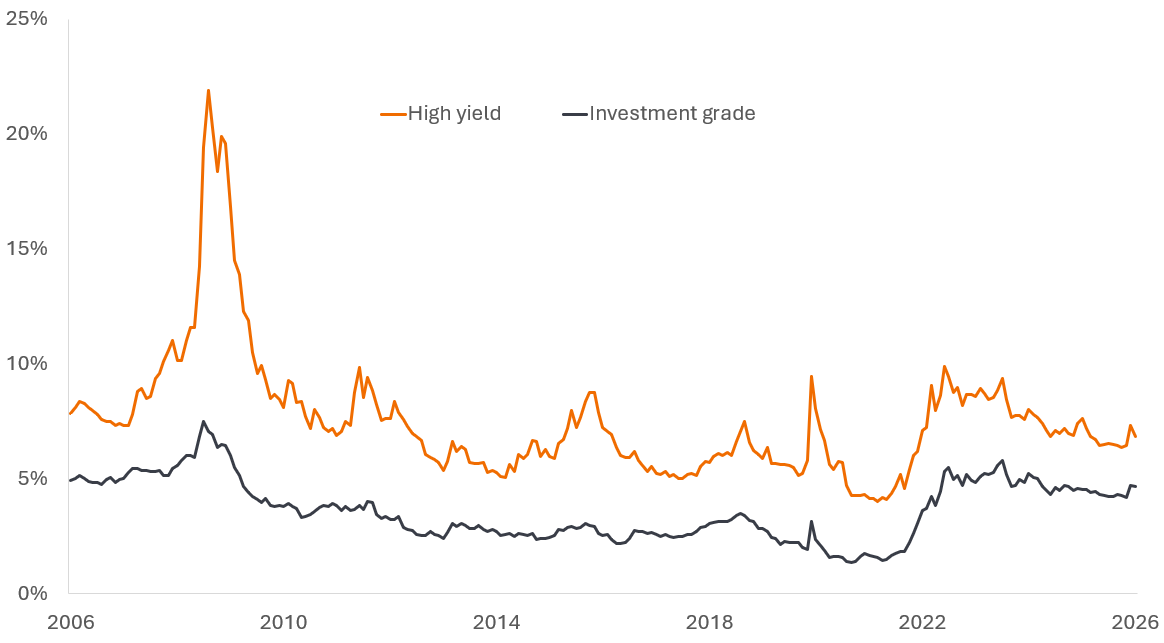
Source: LSEG Datastream, ICE BofA Global High Yield Bond Index, ICE BofA Global Corporate Bond Index (investment grade), yield to worst, 30 April 2006 to 30 April 2026. Yield to worst is the lowest yield a lowest yield a bond with a special feature (such as a call option) can achieve provided the issuer does not default. Yields may vary over time and are not guaranteed.
Of course, as credit investors, we are not just interested in yield. We want to know how much extra yield compensation we are receiving for the credit risk of investing in a corporate bond as opposed to the corresponding government bond. This is the credit spread and it is the difference between the yield on a corporate bond and the yield of a government bond of similar maturity. It is typically quoted in basis points. On this measure, credit looks less appealing (Figure 2). High yield is at the 5th percentile and investment grade at 8th percentile, so spreads have rarely been lower.
Figure 2: Global credit spreads are near their tights (basis points)
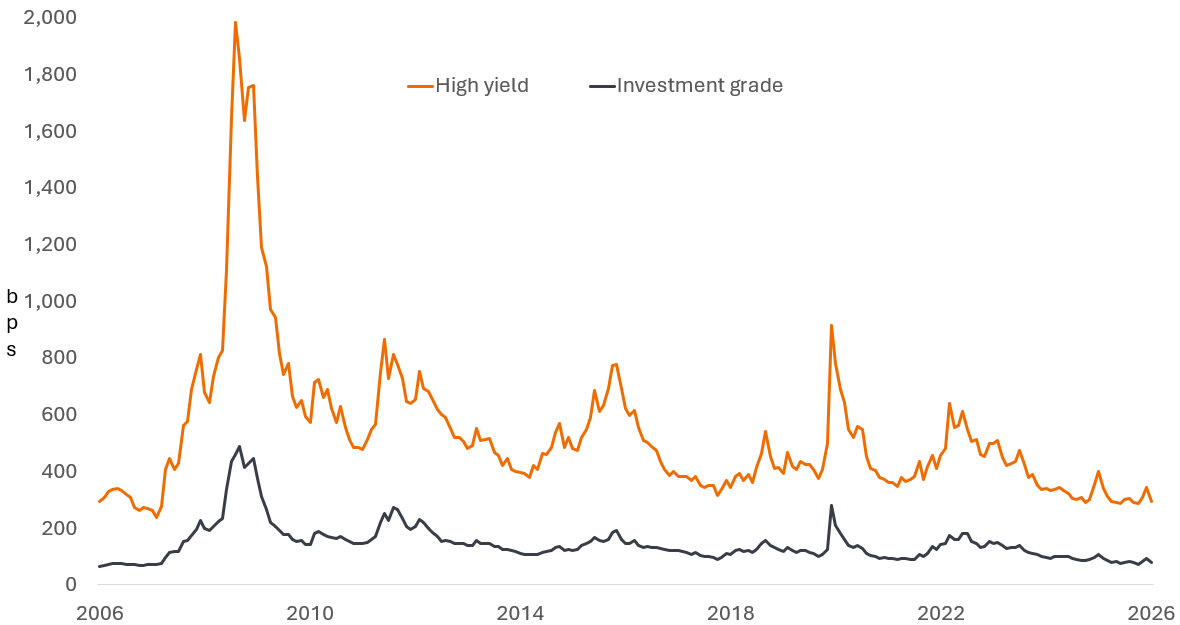
Source: LSEG Datastream, ICE BofA Global High Yield Bond Index, ICE BofA Global Corporate Bond Index (investment grade), option-adjusted spread over government bonds (OAS Govt), 30 April 2006 to 30 April 2026. Basis point (bp) equals 1/100 of a percentage point, 1bp = 0.01%, 100bps = 1%. Spread percentile ranges based on same data as this chart. Yields may vary over time and are not guaranteed.
That might seem an odd state of affairs when you consider that geopolitical tensions are elevated. There are, however, several factors that seem to be holding spreads at tight levels.
Earnings strength (in unexpected places)
With many companies having reported first quarter earnings for 2026, we have a reasonably good idea of earnings strength. In the US, at the time of writing in early May, some 317 of the 500 companies in the S&P 500 Index had reported, with first quarter earnings 25% higher year-on-year, although closer to 17% if non-operating gains in Big Tech are stripped out.1 It is a similar story in Europe, where 115 out of 244 companies in the MSCI Europe Index have reported, with average earnings growth of 6.8%.2
As might be expected, energy companies globally are benefiting from higher prices, but a less obvious beneficiary is the European chemicals sector. Here, a combination of anti-dumping measures against imported chemicals, together with reduced competition from Asia as raw materials and shipping routes are disrupted, is leading to higher profit margins.
Similar effects can be seen among suppliers meeting the capex spend of hyperscalers. As Big Tech builds datacenters to support artificial intelligence (AI) it is leading to increased demand for energy supply from utilities and electronic equipment makers.
We are mindful that the longer disruption goes on, the higher prices could increasingly lead to demand destruction. It is notable that autos (a big discretionary spend and often requiring financing, which may itself rise if interest rates rise) and travel and leisure (where potential fuel shortages and expiring hedges on fuel could shrink earnings) have seen the steepest downward revisions in earnings recently.3
Technicals
Supply of corporate bonds has been elevated with US investment grade issuance tracking at US$795 billion (up 20% year-on-year). That compares with US high yield issuance of US$111bn (up 49% yoy), European investment grade at €258 bn (+9% yoy), and European high yield at €44bn (+34% yoy).4
So far this year, supply has been well met by investors. A large element of the increase in investment grade supply is related to hyperscaler capex on datacenters to support AI. Given that many of these companies are highly cash-generative and have relatively low borrowing levels, there has been strong appetite from investors.
With the rump of the Q1 earnings season in the rear-view mirror, we think that more companies might approach the market and seek to issue or refinance in the coming weeks. There may be a spot of indigestion, therefore, which could create opportunities in the primary (new issue) market for credit investors as companies may need to offer higher concessions to attract investors.
Valuations the key sticking point
Taken together, credit markets are engaged in a fine balancing act: relatively tight spreads reflect strong corporate fundamentals but signify a market that is pricing in little negative tail risk. For now, the global economy has proved resilient but some of the lagged effects of the Middle East conflict have yet to take effect even if the Strait of Hormuz is reopened. For example, Europe will need to restock its depleted gas inventories over the summer. AI capex has been underpinning growth, so anything that causes this to falter could have negative repercussions. And fixed income markets may have to contend with actual rate hikes if inflationary concerns trump growth prospects among central bankers. In our view, now does not feel like the time to be taking on excessive risk.
1Source: BofA Earnings Tracker, 3 May 2026.
2Source: Morgan Stanley, Earnings Season Monitor, 1 May 2026. Consensus earnings based on IBES data.
3Source: Deutsche Bank, IG and HY Strategy, 28 April 2026.
4Source: Morgan Stanley, year to date to 27 April 2026.
Basis point (bp): One basis point equals 1/100 of a percentage point. 1 bp = 0.01%, 100 bps = 1%.
Bond: A debt security issued by a company or a government used as a way of raising money. The investor buying the bond is effectively lending money to the issuer of the bond. Bonds offer a return to investors in the form of fixed-periodic payments (a coupon), and the eventual return at maturity of the original amount invested—the par value. Because of their fixed-periodic interest payments, they are also often called fixed-income instruments.
Capital expenditure: Money invested to acquire or upgrade fixed assets such as buildings, machinery, equipment, or vehicles in order to maintain or improve operations and foster future growth.
Corporate bond: A bond issued by a company. Bonds offer a return to investors in the form of periodic payments and the eventual return of the original money invested at issue on the maturity date.
Credit spread: The difference in yield between securities with similar maturity but different credit quality, often used to describe the difference in yield between corporate bonds and government bonds. Widening spreads generally indicate a deteriorating creditworthiness of corporate borrowers, while narrowing indicates improving.
High-yield bond: A bond with a lower credit rating than an investment-grade bond, also known as a sub-investment grade bond, or ‘junk’ bond. These bonds usually carry a higher risk of the issuer defaulting on their payments, so they are typically issued with a higher-interest rate (coupon ) to compensate for the additional risk.
Inflation: The rate at which the prices of goods and services are rising in an economy. The consumer price index (CPI) and retail price index (RPI) are two common measures; the opposite of deflation.
Primary market/secondary market: Newly-issued bonds are traded on the primary market, with issuers selling their bonds directly to investors to raise capital (borrow). The purchase or sale of any existing bond occurs in the secondary market, between investors.
Valuation metrics: Metrics used to gauge a company’s performance, financial health, and expectations for future earnings, e.g. P/E ratio and ROE.
Queste sono le opinioni dell'autore al momento della pubblicazione e possono differire da quelle di altri individui/team di Janus Henderson Investors. I riferimenti a singoli titoli non costituiscono una raccomandazione all'acquisto, alla vendita o alla detenzione di un titolo, di una strategia d'investimento o di un settore di mercato e non devono essere considerati redditizi. Janus Henderson Investors, le sue affiliate o i suoi dipendenti possono avere un’esposizione nei titoli citati.
Le performance passate non sono indicative dei rendimenti futuri. Tutti i dati dei rendimenti includono sia il reddito che le plusvalenze o le eventuali perdite ma sono al lordo dei costi delle commissioni dovuti al momento dell'emissione.
Le informazioni contenute in questo articolo non devono essere intese come una guida all'investimento.
Non vi è alcuna garanzia che le tendenze passate continuino o che le previsioni si realizzino.
Comunicazione di Marketing.
Important information
Please read the following important information regarding funds related to this article.
- Gli emittenti di obbligazioni (o di strumenti del mercato monetario) potrebbero non essere più in grado di pagare gli interessi o rimborsare il capitale, ovvero potrebbero non intendere più farlo. In tal caso, o qualora il mercato ritenga che ciò sia possibile, il valore dell’obbligazione scenderebbe.
- L’aumento (o la diminuzione) dei tassi d’interesse può influire in modo diverso su titoli diversi. Nello specifico, i valori delle obbligazioni si riducono di norma con l'aumentare dei tassi d'interesse. Questo rischio risulta di norma più significativo quando la scadenza di un investimento obbligazionario è a più lungo termine.
- Pur offrendo tassi di interesse generalmente più elevati rispetto alle obbligazioni investment grade, le obbligazioni ad alto rendimento (non-investment grade) sono più speculative e più sensibili a variazioni sfavorevoli delle condizioni di mercato.
- Alcune obbligazioni (obbligazioni callable) consentono ai loro emittenti il diritto di rimborsare anticipatamente il capitale o di estendere la scadenza. Gli emittenti possono esercitare tali diritti laddove li ritengano vantaggiosi e, di conseguenza, il valore del Fondo può esserne influenzato.
- I CoCo (Obbligazioni contingent convertible) possono subire brusche riduzioni di valore in caso d’indebolimento della solidità finanziaria di un emittente e qualora un evento trigger prefissato comporti la conversione delle obbligazioni in azioni dell’emittente o il loro storno parziale o totale.
- Un’esposizione elevata a un determinato paese o a una specifica regione geografica comporta un livello di rischio più elevato rispetto a un Fondo più ampiamente diversificato.
- Qualora il Fondo detenga attività in valute diverse da quella di base del Fondo, o l’investitore detenga azioni/quote di una valuta diversa da quella del Fondo (a meno che non sia coperta, ovvero cerchi di mitigare i movimenti del tasso di cambio tra la valuta della classe di azioni/quote e la valuta di base del Fondo), il valore dell’investimento potrebbe subire le oscillazioni del tasso di cambio.
- I derivati possono essere utilizzati per aiutare a raggiungere l’obiettivo di investimento. Ciò potrebbe determinare una “leva” (livelli più elevati di debito), che potrebbe amplificare i risultati dell’investimento Le perdite o i guadagni potrebbero superare il costo del derivato. I derivati comportano rischi aggiuntivi, in particolare il rischio che la controparte del derivato non adempia ai suoi obblighi contrattuali.
- Se il Fondo, o una sua classe di azioni con copertura, intende attenuare le fluttuazioni del tasso di cambio tra una valuta e la valuta di base, la stessa strategia di copertura potrebbe generare un effetto positivo o negativo sul valore del Fondo, a causa delle differenze di tasso d’interesse a breve termine tra le due valute.
- I titoli potrebbero diventare difficili da valutare o da vendere nel momento e al prezzo desiderati, specialmente in condizioni di mercato estreme caratterizzate da una discesa dei prezzi delle attività, con conseguente incremento del rischio di perdite sull’investimento.
- Il prelievo dal capitale di tutte le spese correnti, o di una parte di esse, e di altri costi del Fondo può erodere il capitale o ridurre il suo potenziale di crescita.
- Potrebbero verificarsi perdite qualora una controparte non intendesse più o non fosse più in grado di adempiere ai propri obblighi, o a causa di un errore o di un ritardo nei processi operativi o di una negligenza di un fornitore terzo.