Chart to Watch: When markets are on edge, it pays to be prepared
Portfolio Manager Luke Newman makes the case for why market uncertainty can open the door for more flexible investment approaches.
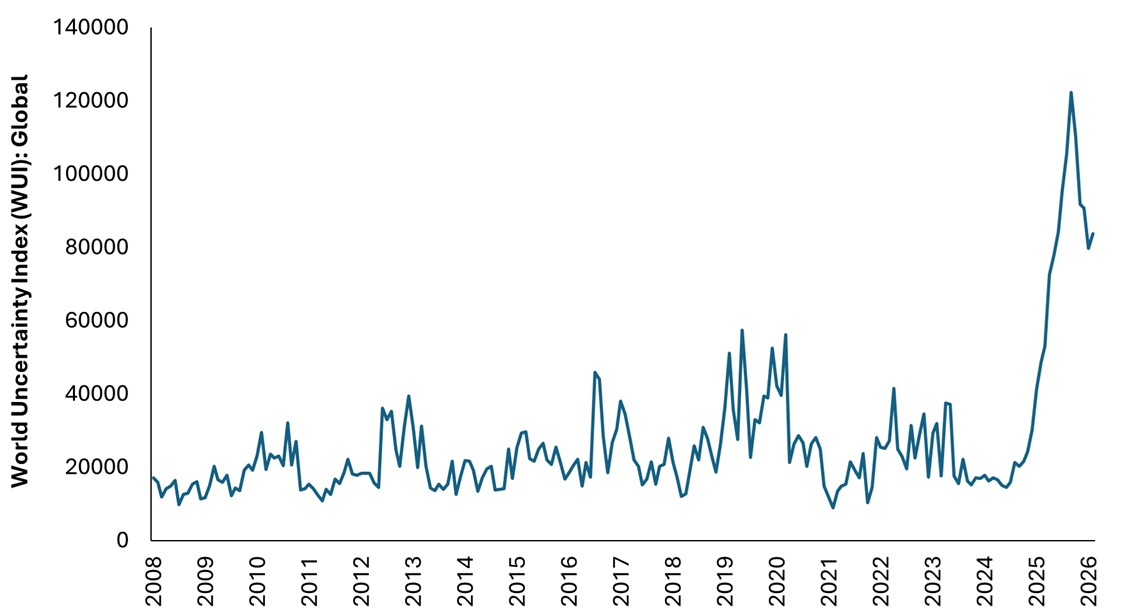
Source: World Uncertainty Index, GDP-weighted average, 1 January 2008 to 31 March 2026. Note: The WUI is computed by counting the percent of word “uncertain” (or its variants) in the Economist Intelligence Unit country reports, spanning 143 countries, before multiplying by 1,000,000. A higher number indicates higher uncertainty and vice versa. For example, an index of 200 corresponds to the word uncertainty accounting for 0.02 percent of all words.
Unlike past episodes driven by singular shocks, uncertainty today is more diffuse. – Luke Newman
Key Takeaways
- The World Uncertainty Index highlights rising global uncertainty, often linked to major market stress and volatility.
- Today’s uncertainty is broad and persistent, driven by trade shifts, policy change, and technological disruption.
- For absolute return strategies built around fundamental stock analysis, higher uncertainty can widen dispersion, improving stock selection opportunities across both long and short positions.
The World Uncertainty Index tracks the frequency of the word “uncertainty” across country reports compiled by the Economist Intelligence Unit, offering an insight into how policymakers and economists globally perceive the prevailing outlook.
Elevated readings have historically coincided with major stress events, from financial crises to geopolitical shocks. Tracking these shifts can help investors manage their exposure to risk.
What makes the current backdrop notable is not just the level of uncertainty, but its source. Unlike past episodes driven by singular shocks, uncertainty today is more diffuse. Trade relationships are shifting, supply chains are being reconfigured, and industrial policy is becoming more interventionist and confrontational, while technological disruption is bringing both opportunity and dislocation.
For long-only investors, these market conditions can be an obstacle, introducing the risk of higher share price volatility and weaker conviction. For absolute return investors employing long/short strategies, this dispersion can be a source of opportunity.
Companies with strong balance sheets, pricing power, or structural growth drivers may continue to perform, while more vulnerable businesses can see amplified downside risks. For long/short investors, this creates a richer opportunity set on both sides of the book. Assessing the level of market uncertainty can also help to frame risk management, serving as an early warning signal that encourages investors to reassess exposures, recalibrate position sizing, and ensure portfolios remain sufficiently flexible.
Absolute return investing: A type of investment strategy that seeks to generate a positive return over time, regardless of market conditions or the direction of financial markets, typically with a low level of volatility.
Balance sheet: A financial statement that summarises a company’s assets, liabilities, and shareholders’ equity at a particular point in time. Each segment gives investors an idea as to what the company owns and owes, as well as the amount invested by shareholders. It is called a balance sheet because of the accounting equation: assets = liabilities + shareholders’ equity.
Downside risk: An estimation of how much a security or portfolio may lose if the market moves against it.
Long position: A security that is bought with the intention of holding over a long period in the expectation that it will rise in value.
Long/short strategies: A portfolio that can invest in both long and short positions. The intention is to profit from combining long positions in assets in the expectation that they will rise in value, with short positions in assets expected to fall in value. This type of investment strategy has the potential to generate returns regardless of moves in the wider market, although returns are not guaranteed.
Pricing power: A company has pricing power when it can raise prices regardless of the economic backdrop without losing to competitors, whether that is due to the unique nature of its product, or specific market demand.
Short investing: Fund managers use this technique to borrow then sell what they believe are overvalued assets, with the intention of buying them back for less when the price falls. The position profits if the security falls in value.
ボラティリティ:ポートフォリオ、個別資産、または指数の価格が上下に変動する度合いを示す指標です。価格の変動幅が大きい場合は、ボラティリティが高い状態を指します。一方で、価格の変動が小さく緩やかな場合は、ボラティリティは低いとされます。一般に、ボラティリティが高いほど投資のリスクも高くなると考えられます。
World Uncertainty Index (WUI): A measure that tracks uncertainty across the globe. The WUI is computed by counting the percent of word “uncertain” (or its variant) in the Economist Intelligence Unit country reports, across 143 countries. The WUI is then rescaled by multiplying by 1,000,000. A higher number means higher uncertainty and vice versa.
ご留意事項
本資料は、機関投資家の社内利用のための情報提供を目的として、ジャナス・ヘンダーソン・インベスターズ・ジャパン株式会社(以下「当社」といいます。)が、当社の関係会社(本資料において「ジャナス・ヘンダーソン」又は「ジャナス・ヘンダーソン・インベスターズ」といいます。)が作成した資料を和訳・編集したものであり、金融商品取引契約の締結の勧誘や特定の金融商品等の勧誘を目的とするものではありません。本資料は投資助言を意図するもの又は有価証券の売買の勧誘又は推奨を行うものでもありません。
本資料に記載された見解は、ジャナス・ヘンダーソンの運用チームによるものであり、必ずしも全てのチームの見解が同一であるとは限らず、ジャナス・ヘンダーソンが提供する運用戦略やポートフォリオに反映しているものでもありません。市場環境やその他の当資料中の情報は示された日付現在のものです。いかなる分析、意見、試算又は予測も将来の動向や予測の実現を保証するものではなく、予告なくこれを変更することがあります。
当社及びジャナス・ヘンダーソンは、本資料の一部又は全部の第三者への違法な配布、あるいは本資料を基に作成された情報に対する責任を負うものではありません。また、提供された情報の正確性、完全性、適時性について保証するものではなく、これを使用したことによる結果について何ら保証するものではありません。全ての投資と同様、固有のリスクがあることにご留意ください。