
Key takeaways:
- Lula’s victory removed most hopes that the Brazil could begin to rein in high sovereign debt loads and instead has left the market bracing for the effects of four more years of 15%-plus interest rates.
- Brazil is mired in a low-growth trajectory, and with a Lula government prioritizing handouts to households instead of productivity-enhancing investment, the country is highly unlikely to grow its way out of its current debt burden.
- We are avoiding Brazil’s domestic cyclicals sector, and while the country is home to some attractive secular-growth companies and world-class natural resources producers, investors should recognize the risks posed by low productivity, high interest rates, and a weakening currency.
The recent electoral trend toward economic liberalization in Latin America suffered a setback on Sunday with the surprise reelection of Brazilian President Luiz Inácio Lula da Silva (Lula) in the region’s largest economy. Investors must now come to terms with the implications of this unprecedented comeback after Lula placed second in the election’s first round. Lula won by leaning heavily into his Bolsa Familia ethos of large-scale government programs aimed at providing economic support to his working-class base.
Having been rewarded with a victory, we have little doubt that Lula will seek to follow through on his wide-ranging campaign promise. We do not see this program as a recipe for success – a view likely shared by the market’s early reaction to his surprise victory. Brazil’s economy has largely muddled through two years of elevated interest rates, and investors began to pin optimism on a more reformist Flavio Bolsonaro administration taking steps to put the country on a more sustainable economic path.
With that off the table and an emboldened Lula likely to double down on economic populism, we believe Brazilian assets – equities, bonds, and its currency, the real – will quickly reprice to reflect the havoc that potentially four more years of roughly 15% sovereign interest rates would wreak on the country’s economy.
We are particularly cautious toward Brazil’s domestic cyclical sector. The country remains home to quality secular growth companies and world-class commodities firms that could potentially benefit from a weakening real. But the headwind presented by the cumulative deleterious effects of high interest rates is, in our view, a force that will likely further expose structural weaknesses in an economy at risk of becoming a low-growth, redistributive welfare state.
Past does not make precedent
A former union leader, Lula benefited by having his first two terms coincide with the global commodities supercycle of the early 2000s. The tax receipts generated by demand for Brazil’s vast natural resources likely gave Lula’s Workers Party false confidence that its Bolsa Familia agenda was viable. We view any economic and fiscal success from that period as unrepresentative of what would likely be the outcome during a high interest-rate, low-growth environment.
As seen in Exhibit 1, the bill started coming due during the administrations of Lula’s immediate successors in the form of higher public debt taking up a higher share of gross domestic product (GDP).
Exhibit 1: Brazil’s public debt to GDP under recent administrations
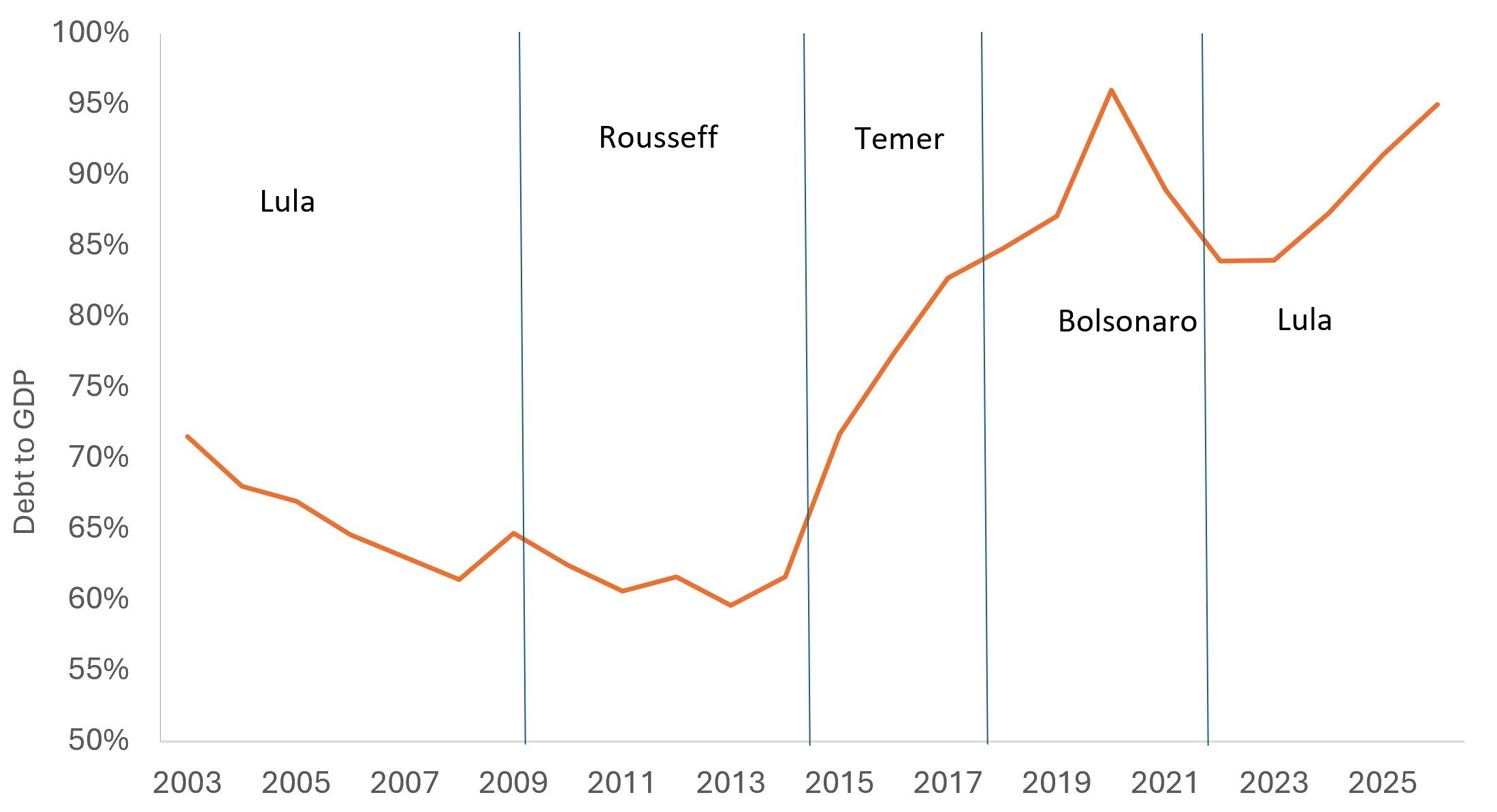
Source: Janus Henderson Investors, International Monetary Fund, as of October 2026. Note: 2025 and 2026 are estimates.
Jair Bolsonaro enjoyed some early success in taming government finances, but that largely ended with the onset of the Covid-19 pandemic. We see Lula’s third term as the precedent for his fourth term. Most octogenarians – especially those who’ve enjoyed an unprecedented political career – are unlikely to change their stripes. This is especially true for Lula, whose final electoral triumph was delivered by promises of an aggressive populist agenda.
One moderating influence on Lula’s worst fiscal impulses could be the rise of the conversative bloc in Brazil’s senate, as their votes, at least at the margin, could deprive the president of consensus on more substantive changes to the country’s economy governance.
An unfavorable backdrop
Lula’s economic strategy is premised on the concept of spend now, pay for it later, once economic growth arrives. Among the myriad problems with that approach is the country is running deficits not by investing in projects that could increase productivity but instead by funding subsidies to households. Lacking investment in the country’s capital stock, Brazil is likely mired in a real economic growth range of 2.0% to 2.50%. Meanwhile, with many of Lula’s handouts and pension costs indexed to inflation, deficits are likely to increase in a self-perpetuating cycle as the government seeks to maintain its base’s standard of living.
Furthermore, Brazilian households are already notoriously in debt. We believe it’s unrealistic for consumption to become a meaningful lever in generating economic growth. And even if an extension of the current period of elevated interest rates only modestly hampered consumption, the higher cost of capital represented by Brazil’s “risk-free” rate would eventually permeate though the economy and deprive the corporate sector of the oxygen it needs to invest in attractive projects. The market also cannot overlook the damage potentially incurred on the country’s banks should Lula seek to fulfill his campaign promise of renegotiating – or forgiving – consumer loans.
Living with the consequences
Elections have consequences. By doubling down on economic populism, Lula achieved the improbable. But markets – and especially bond investors – get to cast a vote, too. Two years of high interest rates have resulted in middling economic growth. That could continue into early parts of Lula’s fourth term. But with unemployment already relatively low and household finances already levered, we don’t see a realistic path to a higher growth trajectory.
Similarly, it’s highly doubtful that Lula 4.0 will champion many pro-growth reforms within the private sector. Without those, and with higher deficits and the cumulative pressure of a punitive cost of capital, we believe Brazilian financial assets will ultimately reflect what is likely to be an unfavorable economic outcome.
Brazil remains one of the world’s 10 largest economies and is home to many companies capable of compounding earnings. But we believe investors need to consider company and country when approaching emerging markets.
We think many Brazilian enterprises can grow even with an unfavorable macro backdrop. These, however, are largely concentrated within the secular growth category rather than in more vulnerable domestic, cyclical names. Brazilian assets are also likely to remain volatile – experiencing both downdrafts and recoveries – as the market gets a better grip on Lula’s forthcoming economic agenda.
Still, with the exception of high-quality companies exposed to secular growth themes, natural resource producers generating U.S.-dollar denominated revenues, and enterprises least exposed to high interest rates, this election’s outcome dims many of Brazil’s investment prospects as they are weighed down by the inescapable forces of high debt ratios and borrowing costs pushing the country further off a fiscally sustainable course.
Brazil’s external debt had largely priced a Bolsonaro victory following the post-first-round rally. Sunday’s surprise outcome therefore exposed a clear pricing asymmetry in bond markets.
Flavio Bolsonaro’s rejection of the result creates institutional and transition risk, reinforcing the immediate negative reaction across Brazilian assets. We see currency weakness as the critical transmission channel: Depreciation lifts inflation expectations and local rates, increasing the government’s interest burden and headline fiscal pressures. That deterioration may ultimately impose policy discipline on Lula, but markets are likely to demand a larger risk premium.
Attention now shifts to Lula’s team and its fiscal plan. The key signals will be whether he appoints a market-credible economic team, empowers it politically, and presents a quantified, expenditure-led adjustment with congressional support. Brazil’s external balance remains resilient, but durable bond recovery requires recurring spending reform and a credible debt-stabilisation path, not revenue measures, one-offs, or a simple post-election change in rhetoric.
Thomas Haugaard, Janus Henderson Emerging Market Hard Currency Debt Team
IMPORTANT INFORMATION
Equity securities are subject to risks including market risk. Returns will fluctuate in response to issuer, political and economic developments.
Fixed income securities are subject to interest rate, inflation, credit and default risk. As interest rates rise, bond prices usually fall, and vice versa.
Foreign securities are subject to currency fluctuations, political and economic uncertainty, increased volatility and lower liquidity, all of which are magnified in emerging markets.
Emerging market investments have historically been subject to significant gains and/or losses. As such, returns may be subject to volatility.
Sovereign debt: bonds issued by governments to raise money to pay off debt or finance spending. Sovereign debt can also refer to the total of a country’s government debt.
Fiscal/fiscal policy: Describes government policy relating to setting tax rates and spending levels. Fiscal austerity refers to raising taxes and/or cutting spending in an attempt to reduce government debt. Fiscal expansion (or ‘stimulus’) refers to an increase in government spending and/or a reduction in taxes.
Commodities supercycle: A prolonged period of rising demand for commodities, such as oil, metals and agricultural products, that leads to sustained increases in commodity prices.
Gross domestic product (GDP): The value of all finished goods and services produced by a country within a specific time period (usually quarterly or annually). When GDP is increasing, people are spending more and businesses may be expanding. GDP is a broad measure of the size and health of a country’s economy and can be used to compare different economies.
Risk-free rate: The rate of return of an investment with theoretically zero risk. The benchmark for the risk-free rate varies between countries. In the US for example, the yield on a 3-month US Treasury bill (a short-term, money-market instrument) is often used.
Risk premium: The additional return an investment is expected to provide in excess of the risk-free rate. The riskier an asset is deemed to be, the higher its risk premium to compensate investors for the additional risk.