
Key takeaways:
- The Australian bond market was highly volatile in July, reflecting global risks and resilient local data.
- We begin to focus on the pricing of the H2 2027 easing cycle, while still anticipating one more RBA hike through late 2026.
- Economic Focus: Housing gaps
Market review
The Australian bond market was highly volatile in July, reflecting local policy uncertainty and global repricing of term premia. The Bloomberg AusBond Composite 0+ Yr Index declined 0.4% over the month.
The Reserve Bank of Australia (RBA) did not meet in July, with the cash rate remaining at 4.35%. Money market rates moved modestly higher, with three‑month Bank Bill Swap Rates (BBSW) rising 4 basis points (bps) to 4.5% and six‑month BBSW increasing 3bps to 4.83%. Australian government bond yields rose sharply across the curve, reflecting the global repricing of rate expectations. The 3‑year bond yield increased 13bps to 4.49%, while the 10‑year yield rose 21bps to 4.93%. Market‑based inflation expectations also moved higher, with the 10‑year inflation‑linked bond yield rising 6bps to 2.34%.
Global markets focused on the resilience of economic activity and signs that inflation remains sticky. Renewed US/Iran tensions, resumption of US tariff increases, and ongoing market questioning of the valuation and capital needs of the artificial intelligence (AI) investment universe has seen particularly volatile markets in the last month. The new US Federal Reserve (Fed) Chair, Kevin Warsh has opened up the role of bond markets to price for uncertainty and inflation risks, by reducing Fed communication. This has seen a rise in US yields and uncertainty elsewhere.
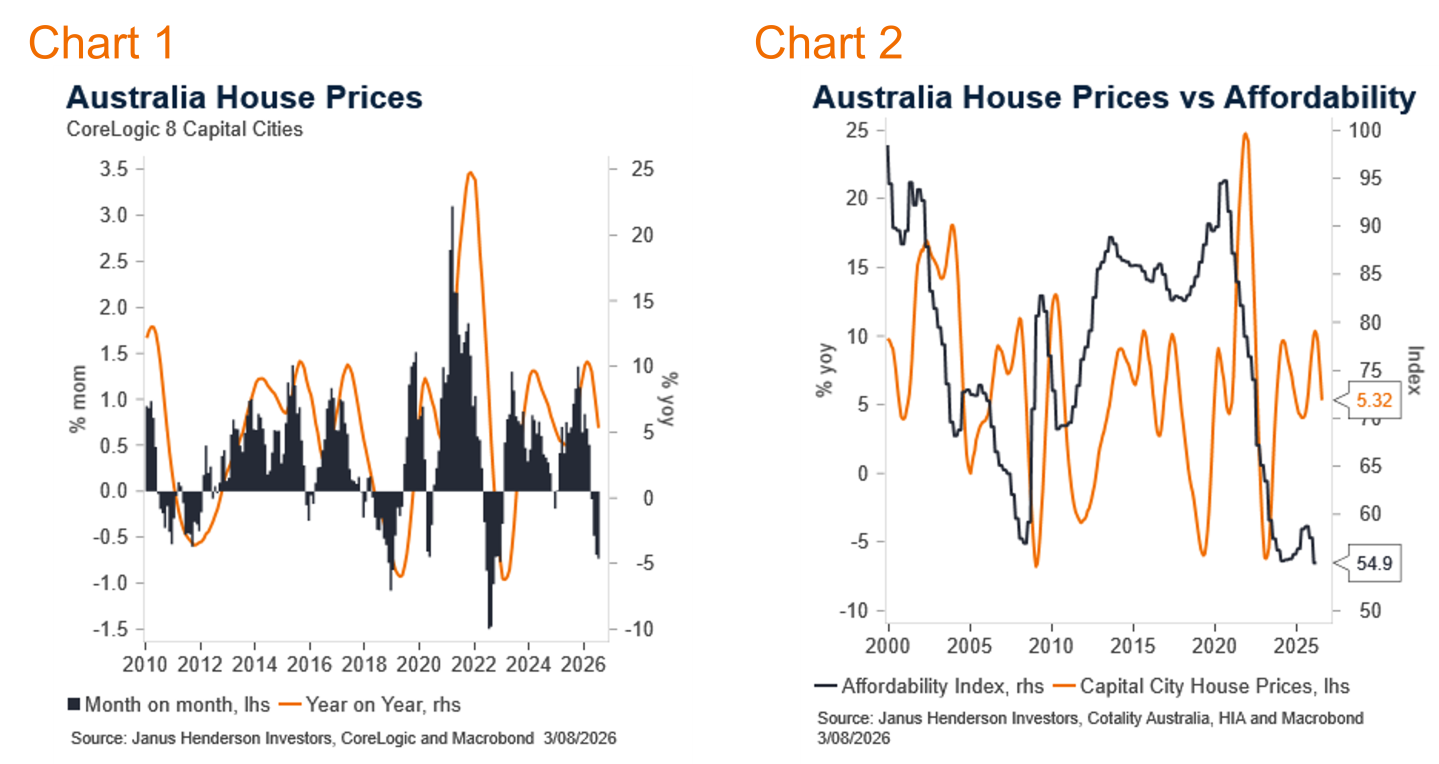
Australian economic data provided a mixed picture. Inflation remains above the RBA’s target range but was lower than consensus in June, while labour market conditions continue to show resilience. Recent business and consumer surveys suggest activity remains subdued but stable, with households continuing to face cost‑of‑living pressures. Housing prices are falling, which has follow-on impacts through the economy, and is now something the RBA are factoring in. Against this backdrop, markets reduced expectations for near‑term policy easing and continue to focus on the path of inflation over coming quarters.
Market outlook
The market outlook remains one of continued volatility, with opportunities presenting themselves amid large swings. We begin to focus on the pricing of the H2 2027 easing cycle, while still anticipating one more RBA hike through late 2026. While we hold no specific tilt at present, the low case is one where the RBA remain on hold and need to lower interest rates earlier than anticipated. The high case arises through persistent inflation, and a series of extra rate rises are required. We hold a modest long duration position and will take advantage of any market mis-pricing.
Monthly focus – Housing gaps
The Australian housing market is facing a variety of challenges. Given Australia’s household wealth is highly intertwined with the housing market, it’s worth assessing the pressures. While there are near-term headwinds, fundamental underpinning suggests markets should stabilise in time.
On a global scale, Australia’s high level of housing debt to income, at 178%, is often met with raised eyebrows and cautionary tales. The flip side, however, is that total Australian household assets to income are very high; a significant proportion of those are housing assets (631% housing asset to income). This makes house prices keenly monitored, as well as having a strong influence over the broad economy via household spending, government revenue, and the residential construction sector.
Drivers of house prices are multifaceted, with staggered timelines; something to keep in mind at the current, uncertain, juncture. Demand for housing is dependent on cyclical factors, such as affordability and ability to pay. Structural factors relate to population growth and household formation ratios. Housing supply is determined by construction input costs, regulation and the interaction with demand for new housing.
The current cyclical environment is rife with challenges for housing demand. Affordability is near record lows. House prices have risen strongly for a prolonged period in many capital cities, making the average housing stock expensive in comparison to incomes. Rising interest rates are raising debt servicing back towards 2024 highs. These challenges are set against moderating growth in real incomes, which further erodes affordability and demand. Offsetting this, remains very high levels of mortgage pre-payments, creating a payment buffer for existing housing owners, as well as a solid labour market. Given these dynamics, moderation in cyclical housing demand can be expected, and is consistent with current market softening.
There is greater concern post the multitude of tax changes in the 2026/27 Federal Government budget. Changes relating to negative gearing for existing housing, and capital gains tax, alter the return proposition for new investors in existing properties. Grandfathering of the policies places less pressure for change on existing holders of investment properties. New investors in existing housing are now less incentivised to purchase. The housing market is comprised of 66% owner occupiers, and 31% investors/renters, as similarly historically reflected in the housing credit split. Negatively geared, existing home investors are a smaller sub-set of investors. New demand by this investor base is likely to moderate, however, with investor demand in new-build housing likely to increase over time. Eventually offsetting a drop in investor demand will be a rise in owner occupiers responding to improved affordability and debt servicing conditions.
A natural medium-term underpinning of Australian house prices is a persistent supply shortage. Housing supply in Australia has not kept up with new household formation. Required new supply ebbs and flows depending on net migration, household formation ratios and demolitions, but for much of the past two decades, there has been an undersupply of new housing. This was at an extreme post the pandemic, while improving since, there remains a net under-supply.
The building pipeline for new housing has risen in 2026. Building approvals are higher through the year, albeit moderating in recent months. There has also been an increase in housing construction starts, while completions have dropped off. Together, approvals and starts represent a healthy pipeline, but this is expected to cyclically slow. Physical completions face a range of headwinds. The residential sector currently competes with Government infrastructure, as well as private non-residential construction associated with datacentres for inputs for building supplies as well as labour. Rising construction costs, through labour, inputs and finance likely cyclically moderates building starts. This may further exacerbate housing supply shortages. Over time, these pressures will ease and demand for new stock rises. The new tax changes support new builds by nudging demand away from existing housing and should provide underlying support for new housing over time.
Overall, with the shifting housing dynamics, we anticipate a period of house price declines through 2026, before fundamentals underpin the market in the medium term. Thereafter, a period of house price stability is expected.
Views as at 3 August 2026.
All opinions and estimates in this information are subject to change without notice and are the views of the author at the time of publication. Janus Henderson is not under any obligation to update this information to the extent that it is or becomes out of date or incorrect. The information herein shall not in any way constitute advice or an invitation to invest. It is solely for information purposes and subject to change without notice. This information does not purport to be a comprehensive statement or description of any markets or securities referred to within. Any references to individual securities do not constitute a securities recommendation. Past performance is not indicative of future performance. The value of an investment and the income from it can fall as well as rise and you may not get back the amount originally invested.
Whilst Janus Henderson believe that the information is correct at the date of publication, no warranty or representation is given to this effect and no responsibility can be accepted by Janus Henderson to any end users for any action taken on the basis of this information.