
Key takeaways:
- Economic Focus: Unemployment – how high, how fast?
- Global AI investment themes are being challenged.
- Australian inflation is proving more persistent, amid a weakening in housing and confidence.
- RBA: We expect the RBA to raise interest rates further and with a 25% weight to the high case.
Economic Focus: Unemployment – How high, how fast?
The Reserve Bank of Australia’s (RBA) inflation problem has all the focus at present, quite rightly, but there will come a time where the labour market side of the mandate becomes important. As the unemployment rate continues to trend upwards, that date gets closer.
The RBA’s mandate is to maintain full employment. While the unemployment rate doesn’t represent the entire health of the labour market, it is the indicator for which the RBA is often benchmarked.
The focus, recently, has been on the level of the unemployment rate, against the non-accelerating inflation rate of unemployment (NAIRU). Previously, the RBA has characterised the NAIRU as around 4.5%, but their model estimate has been edging higher.1 At the recent Senate estimates, they provided suggestions that it might be closer to 5%. This assumption means the economy is not slow enough, with an unemployment rate of 4.5-5%, to moderate inflation.
With current headline inflation running at 4.3% year-on-year (yoy), trimmed mean at 3.6%yoy and an unemployment rate trending at 4.6%, now considered below NAIRU, future inflationary pressures have escalated. This re-focusses the outlook on the hiking cycle and how much the RBA needs to do.
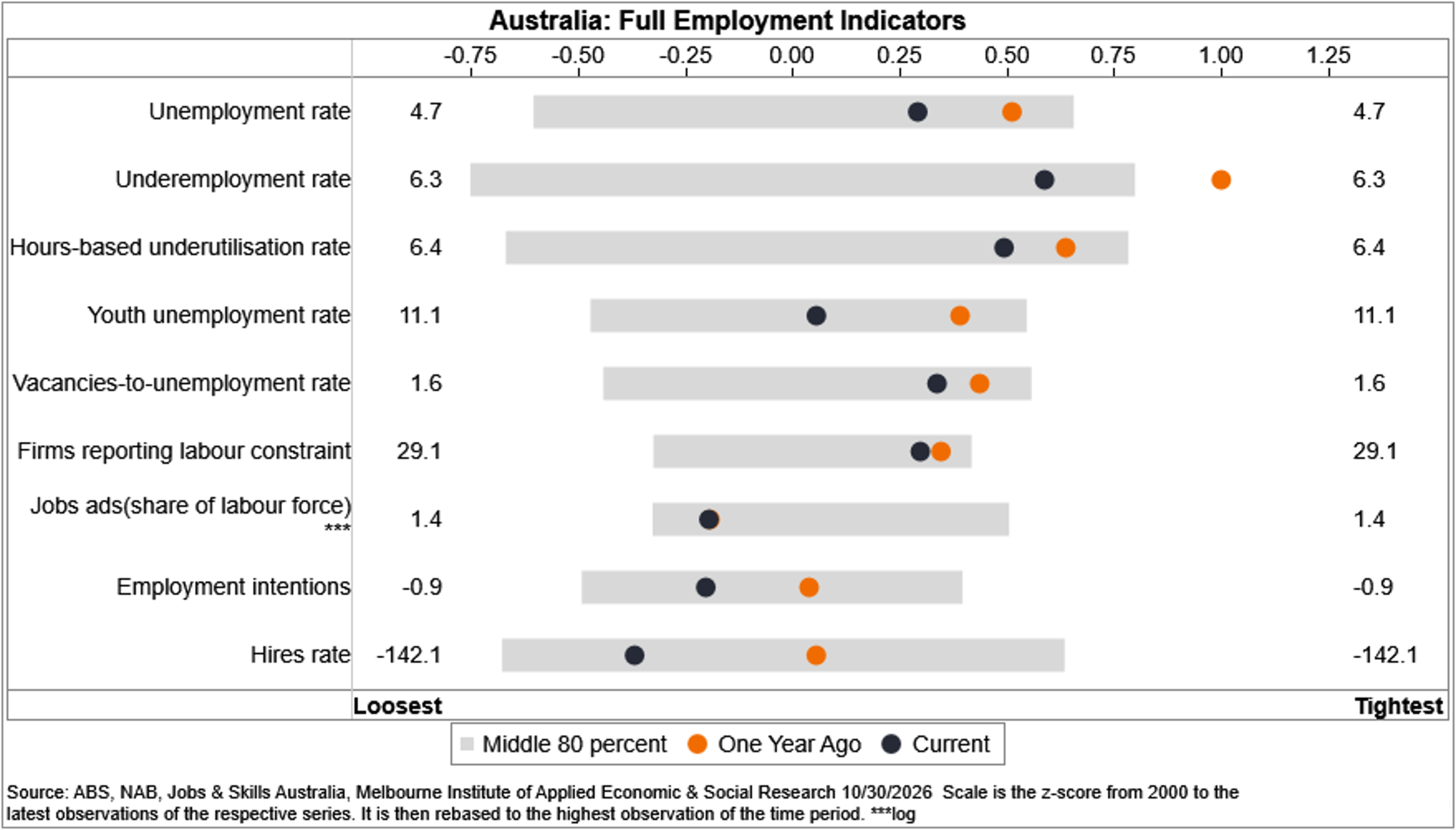
But the outright unemployment rate isn’t the whole story. The RBA itself, in their 2023 review, highlighted a range of employment indicators to explain what they mean by “full employment.” The RBA’s indicators cover both supply and demand for labour through vacancies, capacity utilisation, layoffs, quits and utilisation to name a few. This shows a more nuanced picture.
There remain pockets of strength in the labour market, apart from the below NAIRU unemployment rate. Capacity utilisation within in the Australian economy remains high albeit moderating from peaks. The underemployment rate, while rising, is also below historical levels. Utilisation of labour is high and there are plenty of vacancies. Firms continue to report that they are facing labour constraints.
Balancing this is the slow deterioration, from peaks, across a number of variables. Those noted above are moving lower, but there are a number of other factors which point to a weaker labour market ahead. After 100 basis points (bps) of policy tightening, that can be expected. Closely associated with a rise in the actual unemployment rate is the rise in household expectations of unemployment, and the Westpac survey shows expectations trending higher. The youth unemployment rate is now back to long term levels and softening, as are job ads as a share of the labour force, and business employment expectations have dropped to zero. Businesses are telling us they are no longer looking to hire.
As interest rates rise, the economy slows. Factoring in the relatively low labour intensity of a capital expenditure boom, unemployment rate rises, in a softer economy, tend to be non-linear. As the economy slows, the unemployment rate rises at an ever-faster rate. This is the premise behind the Sahm rule. An economy can show an unemployment rate still below NAIRU, thus inflationary, but evidence signs of an increasingly softer economy. The Sahm rule, as applied in the Australian context,2 contends that a rise in the three-month moving average unemployment rate of more than 0.75 percentage points from its lowest point in the last 12 months, indicates a high risk of an economy entering a recession.
This theory highlights that it is not just the level of the unemployment rate that matters, but also the speed of the rise. On this measure, the Australian unemployment rate has risen 0.45ppts since the lowest level in the last 12 months. This is close the US version that warns at 0.50ppts, but not yet a trigger in Australia. We will continue to monitor this because the risks at this stage of the monetary policy cycle and with more hiking to come, it is likely that the unemployment rate will rise from here.
This is one factor why we have the RBA lowering rates in the later stages of 2027; Australia will still experience policy cycles, despite what markets are currently pricing.
Market review
The RBA did not meet in October. Three-month bank bills reflected a post CPI rise in expectations of hiking, rising 13bps to 4.90%, while six-month bank bill rates rose 13bps to 5.25%. Australian three-year government bond yields fell 12bps to 4.81%, while 10-year yields fell 23bps to 5.12%.
Global forces are driving yields through October, as uncertainty around risks in the artificial intelligence (AI) investment thematic were challenged. Safe haven flows into sovereign bonds allowed for a partial re-tracing of the September highs in yields.
Locally, there was a strong focus on the RBA’s thoughts. Public speaking events where Deputy Governor Hauser outlined their inflation concerns were repeated up by other speakers, and then backed up by a robust third quarter CPI outcome. With headline inflation running at 4.3%yoy, and the trimmed mean at 3.6%yoy, there was enough evidence for the market to expect the RBA to pursue further hiking ahead. The unemployment rate rose to 4.7%, business and consumer confidence both fell, while the housing market continues to moderate.
The sustainability of the powerful global AI investment cycle was seriously called into question during the month. In Fixed Income markets, investors debated the resilience and relative attractiveness of credit versus risk free instruments in the face of a potentially higher for longer environment. The Australian iTraxx Index closed 5bps wider at 78bps, while the Australian fixed and floating rate credit indices returned +0.83% and +0.37% respectively.
Market outlook
We believe that while the RBA risks future hiking, we are more toward the end of the cycle than the beginning, unlike other central banks such as the US Federal Reserve. We raised the base case to a peak in the cash rate to 4.85%, and maintain a 25% chance of the high case, with a peak in the cash rate of 5.35%. There is a substantial amount priced in right across the Australian curve. The curve is also suggesting that the current tight monetary policy conditions will be held, almost permanently, across time. And while we see policy rates in a higher band than previously, we do see a period in the future where the RBA will be able to move back toward a less restrictive policy.
We have a small long position at present and will continue to add as more opportunities present themselves if yields rise further.
We expect volatility to remain structurally elevated as geopolitical and macro risks persist whilst left-tail risks continue to proliferate. To the latter, we would add disruption risks (and opportunities) related to the accelerating impact of AI on a significant part of the global economy. In recognition of the complex and bifurcated investment environment, our credit strategy remains skewed towards high-quality, investment grade issuers who benefit from resilient moats, solid earnings power and conservative balance sheets. Conversely, we are avoiding economically-sensitive, lower credit quality and leveraged corporate and consumer focused sectors where default stress remains elevated, or which are highly exposed to Artificial Intelligence disruption. Credit spreads and all-in yields particularly in low/no default-risk Australian Investment Grade credit remain reasonably attractive vs global credit. In our view, high quality Australian credit will remain resilient through a range of macro-economic environments. While we remain constructive and are well-invested across our client portfolios, we are becoming increasingly discerning on new portfolio additions and have actively re-built ample capacity to take advantage of likely periods of opportunity. Lastly, we have prudently elected to maintain material levels of inexpensive credit protection to protect against downside left-tail risks.
1RBA-AR-262721 “Forecasting assumptions, star variables and gaps August 2026 SMP” 7/10/2026.
2RDP 2024-04: Nowcasting Quarterly GDP Growth during the COVID-19 Crisis Using a Monthly Activity Indicator, July 2024.
Views as at 1 November 2026.
All opinions and estimates in this information are subject to change without notice and are the views of the author at the time of publication. Janus Henderson is not under any obligation to update this information to the extent that it is or becomes out of date or incorrect. The information herein shall not in any way constitute advice or an invitation to invest. It is solely for information purposes and subject to change without notice. This information does not purport to be a comprehensive statement or description of any markets or securities referred to within. Any references to individual securities do not constitute a securities recommendation. Past performance is not indicative of future performance. The value of an investment and the income from it can fall as well as rise and you may not get back the amount originally invested.
Whilst Janus Henderson believe that the information is correct at the date of publication, no warranty or representation is given to this effect and no responsibility can be accepted by Janus Henderson to any end users for any action taken on the basis of this information.