Key takeaways:
- China’s AI opportunity spans the full stack, from energy and semiconductors to infrastructure, models and applications.
- Cost and deployment may matter as much as technological leadership. China is emerging as a lower-cost, faster-scaling AI market with advantages in infrastructure and commercial adoption.
- The application layer may drive the greatest long-term value as AI adoption expands into robotics, autonomous driving, healthcare and enterprise workflows.
A broader framework to understand AI as a structural investment theme
For much of the past two years, discussions about artificial intelligence (AI) have centred on who has the most powerful model or the most advanced semiconductor. Markets have tended to see China as trailing the US, particularly following restrictions on access to leading-edge AI chips.
However, as AI evolves from research laboratories into the real economy, the key question is no longer simply who possesses the most capable model. Instead, investors should also consider who can generate the computing power, build the infrastructure, reduce the cost of intelligence and successfully deploy AI at scale.
This shift in thinking is prompting a reassessment of China’s AI ecosystem. While the US remains the clear leader at the technological frontier, China is developing a different set of competitive advantages centred on cost efficiency, manufacturing scale, speed of deployment, infrastructure buildout and practical applications.
In short, China is focused on how AI can drive industrial transformation at scale and turn constraints into opportunities.
Assessing AI opportunities via the five-layer framework
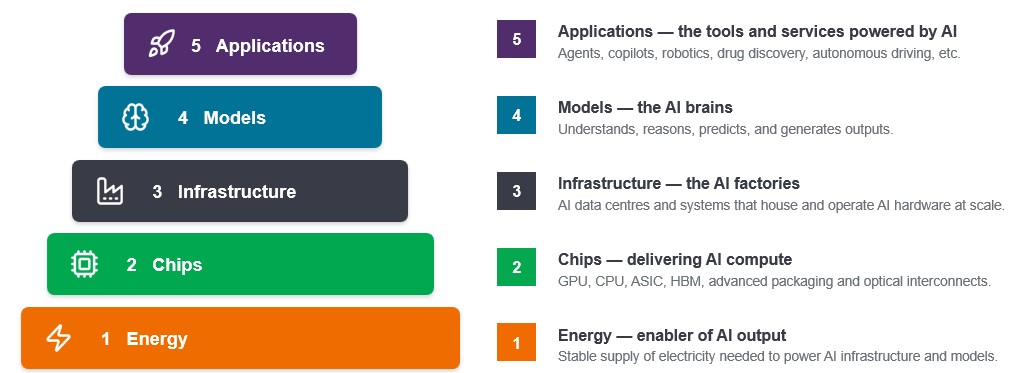
To evaluate the AI opportunity in China, we adopt NVIDIA CEO Jensen Huang’s five-layer AI framework: energy, chips, infrastructure, models and applications (figure 1). This framework helps answer two key questions:
- Where is value being created across the AI stack?
- Where can China benefit from structural advantages that could translate into attractive investment opportunities?
Figure 1: The five layers of the AI value chain
Source: Janus Henderson Investors. For illustrative purposes only.
AI is not a single product, company or technology. It is a multi-layer ecosystem.
At its foundation sits energy, the electricity required to power AI infrastructure and workloads. Next come chips, including GPUs, CPUs, memory and other components that convert electricity into computing power.
The third layer is infrastructure, comprising data centres and networking systems that enable large-scale AI deployment. The fourth layer consists of models, the algorithms that reason, predict and generate outputs. Finally, applications represent the products and services that businesses and consumers interact with daily.
Each layer has unique economics, bottlenecks and competitive dynamics. Understanding how China and the US compare across each layer provides a broader perspective on where future AI value may accrue.
1. Energy: The critical foundation of AI growth
Every AI workload ultimately depends on reliable and affordable electricity. The challenge is not simply generating more power. As AI adoption accelerates, the focus is shifting towards system flexibility, grid reliability, power distribution and energy storage. This becomes increasingly important as AI workloads transition from planned training exercises to real-time inference tasks, which are more variable and harder to forecast.
China possesses notable advantages here given it generates substantially more electricity than the US and typically benefits from lower industrial power prices. Combined with growing renewable energy capacity and continued investment in grid infrastructure, these factors provide a structural cost advantage for energy-intensive AI data centres.
2. Chips: Frontier leadership versus commercial adoption
Semiconductors remain central to AI development, but the industry extends beyond GPUs alone. The AI semiconductor ecosystem includes processors, memory, advanced packaging, interconnects and supporting software. Together, these components determine overall system performance and efficiency.
The US continues to lead in frontier AI chips, with NVIDIA maintaining a significant performance advantage. However, as AI usage shifts from training toward inference, the economics of deployment may become increasingly important.
For many AI applications, the objective is not necessarily to maximise raw performance. Instead, businesses often prioritise lower costs, higher utilisation rates and reduced cost per output. This dynamic may create opportunities for China’s domestic semiconductor ecosystem as local alternatives become commercially viable across a growing number of inference workloads.
3. Infrastructure: Building the AI factory
If semiconductors are the engines of AI, infrastructure represents the factories that put those engines to work. Today’s AI data centres combine servers, storage, networking, power management and cooling solutions to deliver large-scale computing capabilities. These facilities form the backbone of AI deployment.
While the US maintains a commanding lead in installed computing capacity, China’s infrastructure buildout is accelerating rapidly. Supported by extensive telecommunications networks, large-scale data centre development and abundant power resources, the country is becoming an increasingly important market for AI infrastructure investment.
4. Models: Cost efficiency is becoming a competitive advantage
AI models are the intelligence layer of the stack, but competition is increasingly shifting from performance alone towards cost-performance. US developers continue to lead in frontier model capabilities. However, Chinese developers such as DeepSeek, Zhipu, Qwen and Doubao have narrowed the gap significantly in many practical use cases.
More importantly, many Chinese open-source models offer substantially lower usage costs. For companies seeking commercial AI deployment, a model that is sufficiently capable, affordable and easy to scale may prove more attractive than one offering only marginally better performance at a significantly higher cost. We believe as AI adoption expands, this emphasis on cost efficiency could become an important competitive differentiator.
5. Applications: Where AI creates real-world value
Ultimately, applications are where AI translates into measurable economic value.
This layer spans diverse industries, including robotics, autonomous driving, healthcare, financial services and defence technologies. While adoption rates vary by industry, the common theme is that AI is increasingly moving beyond software tools and into real-world productivity enhancement.
The application layer is likely to be highly fragmented, creating winners across multiple sectors rather than concentrating value within a small number of model developers. For long-term investors, it may also represent the largest potential opportunity within the AI ecosystem.
What are the US and China’s AI competitive advantages?
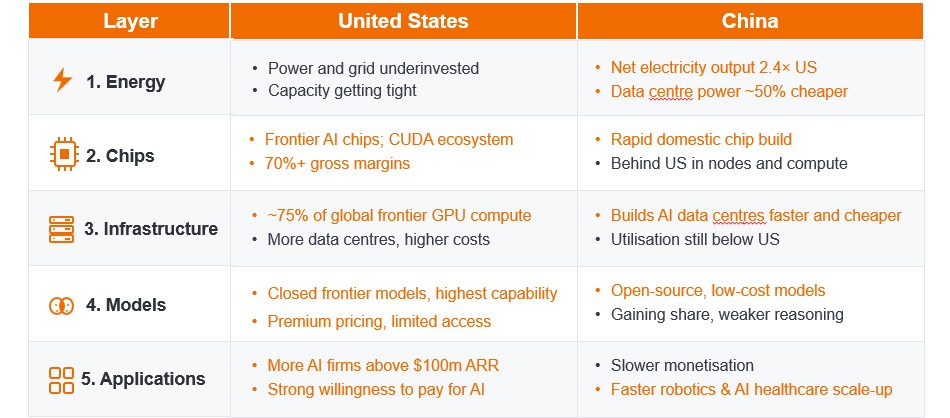
The US remains dominant in frontier AI technologies. It leads in advanced semiconductors, GPUs, the CUDA software ecosystem, frontier computing power and cutting-edge closed-source models. It also benefits from strong enterprise demand and customers willing to pay premium prices for AI services.
Meanwhile, China benefits from lower industrial power costs, significant electricity generation capacity, rapid infrastructure deployment and a proven ability to commercialise technology at scale. These advantages position China as an increasingly important player in the deployment and adoption phase of AI development.
Figure 2: How the US and China compare across the five AI layers
Source: Janus Henderson Investors as at July 2026. ARR= annual recurring revenue.
Conclusion
The US continues to lead at the technological frontier. However, China is developing meaningful advantages in energy, infrastructure deployment, cost efficiency and real-world adoption. As AI moves from experimentation to industrial-scale implementation, these strengths could become increasingly important drivers of value creation.
For investors, the most compelling opportunities may not be found within any single layer of the AI stack. Instead, they may emerge across the interconnected ecosystem that enables AI to scale from research breakthrough to real-world productivity engine.
In our next related article, we will discuss how the AI arms race and policy support is extending the AI investment runway for Chinese companies as well as key risks to monitor such as extreme valuations.
Note: References made to individual securities do not constitute a recommendation to buy, sell or hold any security, investment strategy or market sector, and should not be assumed to be profitable. Janus Henderson Investors, its affiliated advisor, or its employees, may have a position in the securities mentioned.
Agentic AI: AI systems that can autonomously plan, make decisions and perform tasks with limited human input.
CPU (Central Processing Unit: The primary functional component of a computer. The CPU is an assemblage of electronic circuitry that run a computer’s operating system and apps and manage a variety of other computer operations.Data centre: A facility that houses computing equipment, servers and networking infrastructure used to process and store data.
CUDA: Compute Unified Architecture (CUDA) is a platform for general-purpose processing on Nvidia’s GPUs. CUDA is specifically designed for Nvidia’s GPUs.
GPU (Graphics Processing Unit): A chip originally designed for graphics processing that is now widely used to train and run AI models due to its parallel computing capabilities.
Inference: The process of using a trained AI model to generate outputs, predictions or responses.
Infrastructure: The physical systems and facilities that support AI operations, including data centres, networking equipment and power systems.
Large Language Model (LLM): A type of AI model trained on vast amounts of text that can understand and generate human-like language.
Token: The basic unit of text processed by an AI model. AI providers often charge customers based on the number of tokens used.