Key takeaways:
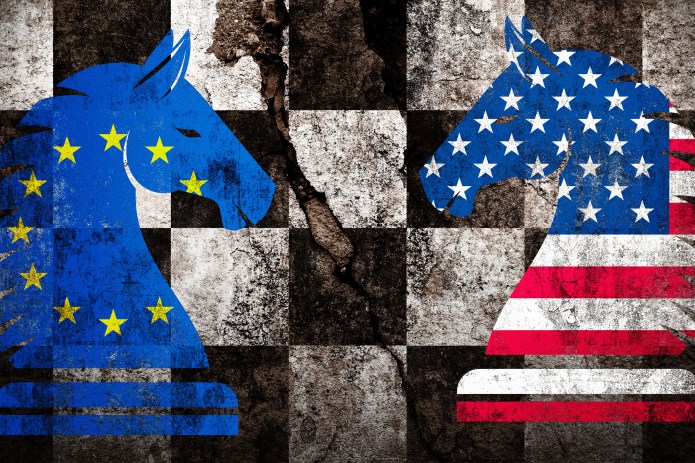
- Trump has threatened to hit eight European countries with new tariffs to pressure Denmark over Greenland, prompting concern among EU and UK governments.
- EU nations have shown unusual unity, with plans to prepare countermeasures, including counter-tariffs, trade‑deal suspension, and potential digital taxes.
- The impact of direct US tariffs on European companies appears small, but escalation risk remains high and there are concerns that markets are being too complacent.
US President Trump has threatened to impose an additional 10% tariff, effective from 1 February 2026, on eight European countries in an effort to pressure Denmark into giving up Greenland. Should there be no deal, the tariffs would ratchet up to 25% from June.
Among the most notable affected countries are EU member states Germany, France, and the Netherlands, and the UK. Trump has explicitly refused to rule out military force, despite that constituting a potential threat directed at other NATO members.
Signals from Washington – Bessent’s tough line
So far, EU member states have pledged unity in response and are readying countermeasures, while still attempting to de-escalate. There is some hope for dialogue during President Trump’s appearance in Davos. But US Treasury Secretary Bessent, well placed to understand the concerns of financial markets, has followed Trump’s lead, warning that EU retaliation would be “unwise”.
Bessent also pointed out that the trade deal negotiated in 2025 has not been finalised, and that the US believes emergency actions can be warranted. In somewhat dismissive language, he argued that Europe is too weak, and it should focus on Ukraine rather than Greenland.
The potential direct tariff impacts on Europe seem fairly limited, given relatively strong consensus forecasts for 2026 earnings growth (12% for the Stoxx Europe 600 and 13% for the EuroStoxx 50). The true risk arises from any escalation. US threats have culminated in a rare moment of unity among European countries and across the political spectrum, including populist parties in countries like Germany. There is a general feeling that Europe already swallowed hard and compromised as much as it possibly could when it agreed to last year’s trade deal.
What countermeasures could the EU deploy?
On the EU side, there are various options for how to respond. For example, the European Parliament could also opt to suspend ratification of the US/EU trade deal, originally due this week. It could introduce tariffs on c. €90bn of US imports – a measure that was prepared last year, but never executed.
It could activate the so‑called ‘anti‑coercion tool’, excluding any US company from EU public‑works tenders, which would include Microsoft software or Apple phones, and blocking Goldman Sachs or JPMorgan from public financings. Or it could introduce a digital‑services tax on services like WhatsApp, Google, Amazon or X. In such a scenario, we would expect the hit to European large‑cap earnings growth to be orders of magnitude larger, and likely met by further escalation from the US side before negotiations might prevail.
There is debate whether Europe might opt to weaponise its vast holdings of US financial assets, which includes (approximately) US$6tn in equities, US$2tn of government bonds, US$2tn of corporate bonds. We see that as an unlikely prospect. Most of these assets are held by private institutions, with their own fiduciary duties and business interests. Any decision to dump US Treasuries would likely be met by an extension to existing quantitative easing measures or a larger Treasury buyback programme.
Escalation risk – what happens next?
The political relationship between Europe and the US is fraught at present. In this context, the measured response from stock markets on Monday, 19 January, was surprising. Particularly given the reaction to ‘Liberation Day’, when Trump first announced his plan to introduce ‘reciprocal’ tariffs.
While the tariffs and their impact are better understood than they were nine months ago, we see an element of complacency in this initial response to the risk of escalation. The US Supreme Court could well rule that Trump’s trade tariffs are illegal, but in our view, there is no guarantee of business as usual. Our concern is that the initial lack of any strong financial‑market response might encourage both sides to escalate the situation to gain more leverage.
From an investment perspective, we expect signs of a sensible de-risking path to continue. Should markets begin to show distress, it could lead to acceleration in this process, which we believe would favour a counter‑rotation between winners and losers. As the geopolitical realignment theme continues apace, we believe careful stock selection remains paramount in such an uncertain environment.
—–
Glossary:
Trump’s Liberation Day: On 2 April 2025, Trump announced what he termed ‘Liberation Day’, when he announced a series of tariffs to be applied on the import of foreign goods, in an effort aimed at trying to address a perceived trade ‘imbalance’.