

Key takeaways:
- Asset-backed finance (ABF) is accelerating as private credit grows. In our experience, structuring loans against clearly defined collateral with shorter durations and stronger lender protections can provide resilience, yield, and enhanced downside protection.
- As examples of weak controls, TriColor and First Brands will likely push markets towards independent audits, granular data access, and stronger oversight. Managers with disciplined risk frameworks and tech-driven monitoring will likely differentiate themselves as private credit matures.
- Risks can be minimized through sole-lender control, delayed-draw structures, short asset durations, and proprietary systems for daily, asset-level monitoring. VPC believes strengthening collateral integrity will serve clients well in 2026.
Private credit has made headlines following the high-profile failures at Tricolor and First Brands. In our view, rather than creating a headwind for the asset class, these events highlight that private credit is maturing and that expectations for participation are rising. The resulting scrutiny appears to be driving greater emphasis on transparency, stronger processes, and what we believe are the structural advantages of asset backed finance (ABF) – a strategy central to VPC’s approach for nearly two decades.
How ABF differs from direct lending – and why it matters now
ABF provides capital against clearly defined sets of tangible or financial collateral – such as receivables, inventory, equipment, or real estate – supporting businesses that are deeply connected to the real economy. It differs meaningfully from traditional cashflow-based direct lending.
Well-structured ABF strategies ensure underwriting is focused on specific collateral assets, supported by granular, independently verifiable data to evaluate performance. Through proprietary API (application programming interface) integrations, it is possible to receive daily, weekly, or monthly asset-level data, giving real-time visibility into risk and enabling active management.
By contrast, and importantly for investors in 2026, cashflow-driven lending often relies heavily on projected EBITDA. In a downturn, EBITDA can deteriorate quickly, reducing lender protection. In our view, ABF’s shorter asset durations, more deliberate structuring, and greater lender control provide additional downside protection. In stressed environments, collateral can often be liquidated to support repayment. When combined with independently verifiable data and frequent reporting, ABF creates what we see as a transparent, defensible framework for managing risk.
The growth outlook for private credit in 2026
Private credit’s ascent began after the Global Financial Crisis, when regulatory constraints limited banks’ willingness to provide credit. Direct lending led the early phase of growth and helped establish private credit as a core allocation across institutional portfolios.
Figure 1: Private credit AUM has grown, initially driven by direct lending
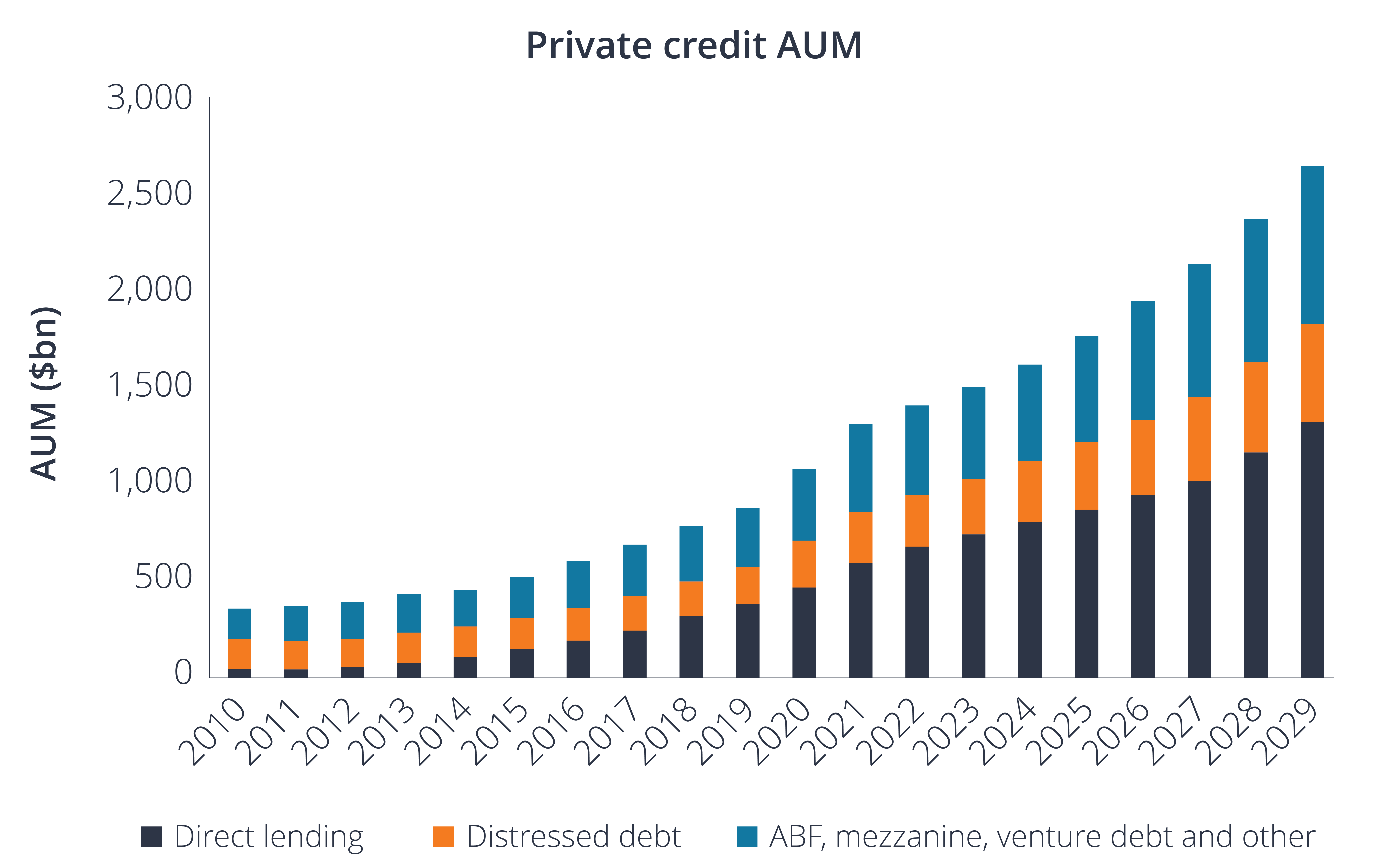
Source: Preqin 2025 Global Report: Private Debt. 2024 onwards are forecasts. There is no guaranteed that past trends will continue, or forecasts will be realised.
We believe the next stage of growth is now underway. As banks continue to retrench and fintech-enabled platforms scale, ABF is expanding meaningfully and, in our view, is positioned to continue growing through 2026.
Investors can choose from a wide range of risk-return profiles depending on deal structure, collateral type, and data transparency. We expect that demand for resilient income and downside protection – particularly in an uncertain environment – will further accelerate ABF’s trajectory.
Figure 2: Private ABF is growing rapidly
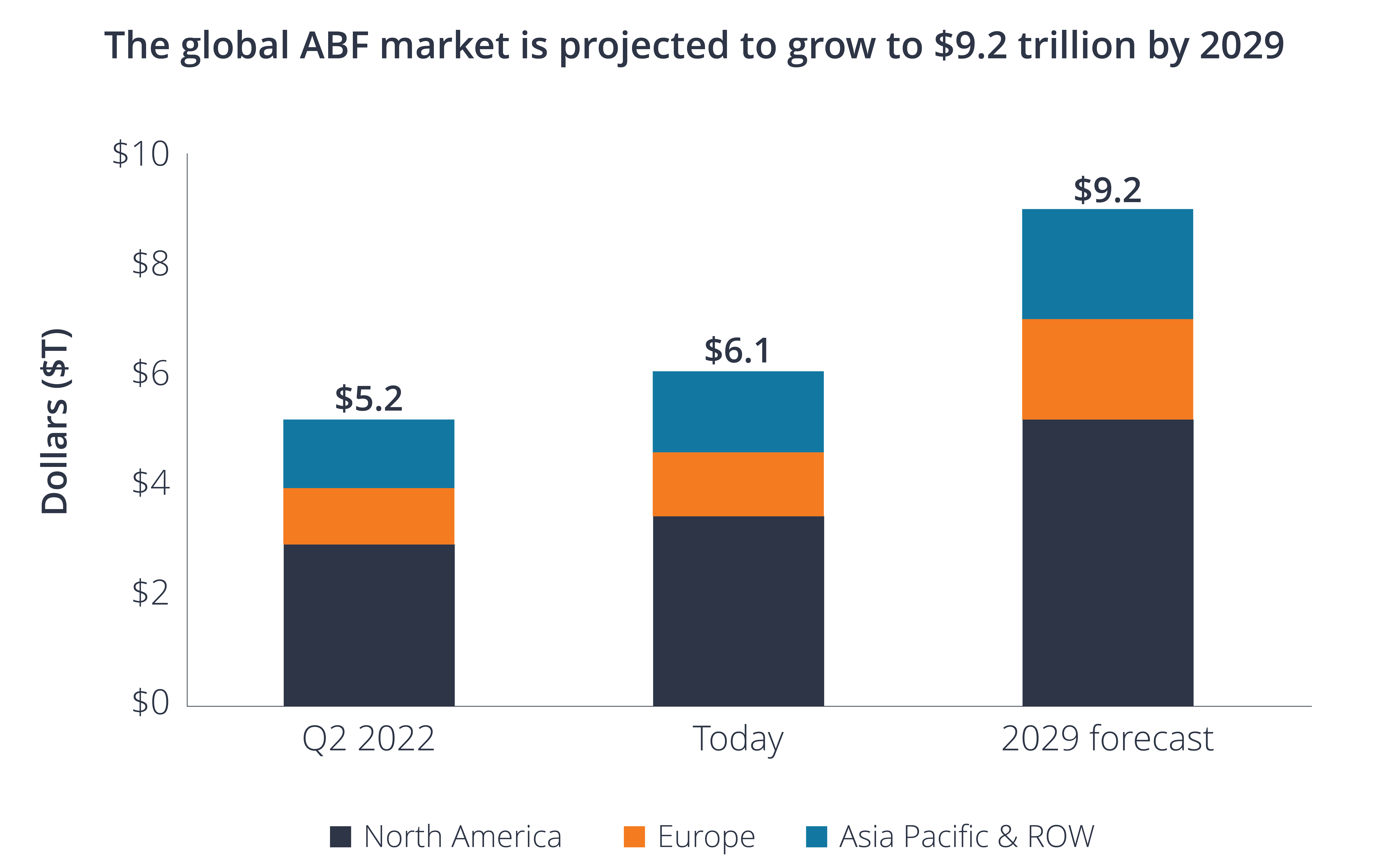
…. potentially greater than corporate credit (Figure 3)
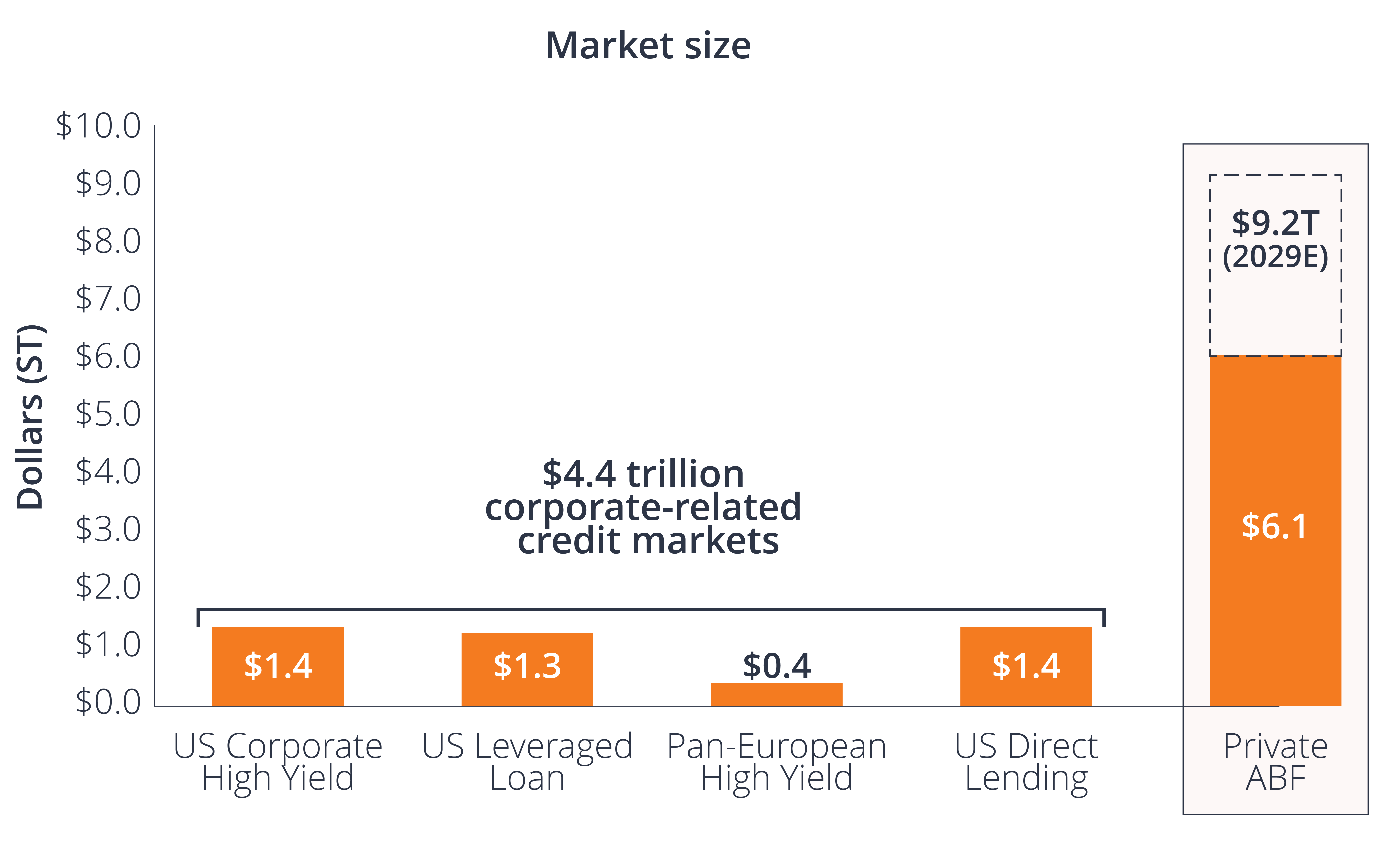
Source: KKR & Co. Inc. Asset-Based Finance Overview Investor Presentation, October 9, 2025. Integer Advisors and KKR Credit research estimates based on latest available data as of March 31, 2024, sourced from country-specific official / trade bodies as well as company reports. Represents the private financial assets originated and held by non-banks based globally, related to household (including mortgages) and business credit. Excludes loans securitized or sold to government agencies and assets acquired in the capital markets or through other secondary / syndicated channels. US Corporate High Yield: Bloomberg US Corporate High yield; US leveraged loan: Bloomberg US Leveraged Loan Index; Pan-European High Yield: Bloomberg Pan-European High Yield Index, as of December 31, 2024, KBRA DLD (US Direct Lending) as of January 31, 2025.
What happened at TriColor and First Brands – and what this means for investors
TriColor and First Brands underscored a fundamental reality: not all asset-backed credit is created equal. Both cases allegedly involved the double-pledging of collateral – TriColor with auto loans and First Brands with invoice-factoring facilities. In our view, these outcomes were not failures of the asset class itself, but failures of oversight and verification.
From our perspective, the biggest blind spot in ABF is not credit selection – it is data integrity and collateral verification. When lenders depend on borrower-controlled audits or opaque reporting, the risk of misinformation increases. These scandals have accelerated a “flight to transparency,” with investors placing greater value on operational rigor rather than yield alone.
We believe this scrutiny is ultimately beneficial. With real-time data, independent verification, and clear visibility into collateral, managers can intervene early when performance changes. Investors will increasingly distinguish between managers who actively oversee their collateral and those who rely on incomplete or dated reporting. We expect that distinction to influence capital allocation meaningfully in the years ahead.
Greater scrutiny and institutionalization in 2026 and beyond
We believe the market is entering a phase of heightened due diligence.
Lenders may increasingly require:
– Cross-collateral visibility
– More frequent independent audits
– Direct access to real-time reporting
These are practices VPC have long considered standard. At the same time, we are seeing investors ask more pointed questions about controls, systems, data lineage, and governance. The managers with demonstrably robust risk frameworks will be best positioned to capture the next wave of institutional capital.
Key questions to ask would include:
- Are you the sole lender?
Ideally the answer is yes, or in multi-lender transactions, the right to inspect collateral across the full financing arrangement is important. - How do you underwrite?
Delayed drawdown would require approval for every payment, triggering repeated underwriting, updated eligibility tests, and ongoing collateral verification. - How long are your loans?
We believe two to four years initially is optimal – far shorter than the six plus years common in direct lending strategies. This provides enhanced control, flexibility, and continual insight into collateral performance. - How do you track data?
A proprietary risk-management platform would ideally be used to pull asset-level data directly through APIs rather than relying on borrower-compiled reports. - Are independent audits performed?
These are important with the manager – not the borrower – needing to engage auditors and define the scope to ensure rigorous collateral validation.
We believe these disciplines can be instrumental in avoiding issues such as double-pledged or non-existent collateral.
Conclusion: ABF is coming of age
Despite recent noise, we believe the outlook for ABF in 2026 remains overwhelmingly positive. In our view, bank retrenchment, fintech innovation, and sustained demand for resilient income will continue to fuel growth. We do not expect the scandals of 2025 to derail the space; instead, we see them as catalysts that will accelerate the push toward transparency, precision, and institutional-grade execution.
At VPC, our philosophy is straightforward: apply rigorous structure, insist on verifiable data, and maintain true alignment with our partners. These are the principles we believe investors need to consider when seeking to protect capital and create durable value in 2026 and beyond.
IMPORTANT INFORMATION
Private credit refers to direct lending or debt financing outside of traditional banking, typically involving non-publicly traded companies, and comes with increased risk including limited liquidity, reliance on the borrower’s financial health, and less regulatory oversight compared to traditional bank lending.
KBRA DLD Direct Lending Index tracks the US direct lending market.
The Bloomberg US Corporate High Yield Bond Index measures the USD-denominated, high yield, fixed-rate corporate bond market.
The Bloomberg US Leveraged Loan Index measures the performance of USD denominated, high-yield, floating-rate, institutional leveraged loan market.
The Bloomberg Pan-European High Yield Index measures the market of non-investment grade, fixed-rate corporate bonds denominated in the following currencies.
Application Programming Interface (API): a set of functions and procedures allowing the creation of applications that access the features or data of an operating system, application, or other service.
Collateral: something pledged as security for repayment of a loan, to be forfeited in the event of a default.
Delayed drawdown: A delayed drawdown is a type of financing that allows a borrower to access a loan in stages over an extended period, rather than receiving the full amount at once.
Downside protection: Limiting or reducing losses in the case of a decline in the value of the underlying security.
Duration: Duration can measure how long it takes (in years) for an investor to be repaid a bond’s price by the bond’s total cash flows. Duration can also measure the sensitivity of a bond’s or fixed-income portfolio’s price to changes in interest rates. The longer a bond’s duration, the higher its sensitivity to changes in interest rates, and vice versa. ‘Going short duration’ refers to reducing the average duration of a portfolio, while ‘going long duration’ refers to extending a portfolio’s average duration.
Double-pledging: refers to the act of using the same asset as collateral for more than one loan or financial obligation, often without the knowledge or consent of the involved parties.
Earnings before interest, tax, depreciation, and amortization (EBITDA): EBITDA is a metric used to measure a company’s profitability net of expenses and associated costs, taxes, or debts.
Yield: The level of income on a security over a set period, typically expressed as a percentage rate. For equities, a common measure is the dividend yield, which divides recent dividend payments for each share by the share price. For a bond, this is calculated as the coupon payment divided by the current bond price.