Chart to Watch: Looking beyond U.S. market leadership
Portfolio Managers Christopher O'Malley and Julian McManus discuss the factors supporting markets outside the U.S. and where they continue to find attractive opportunities.
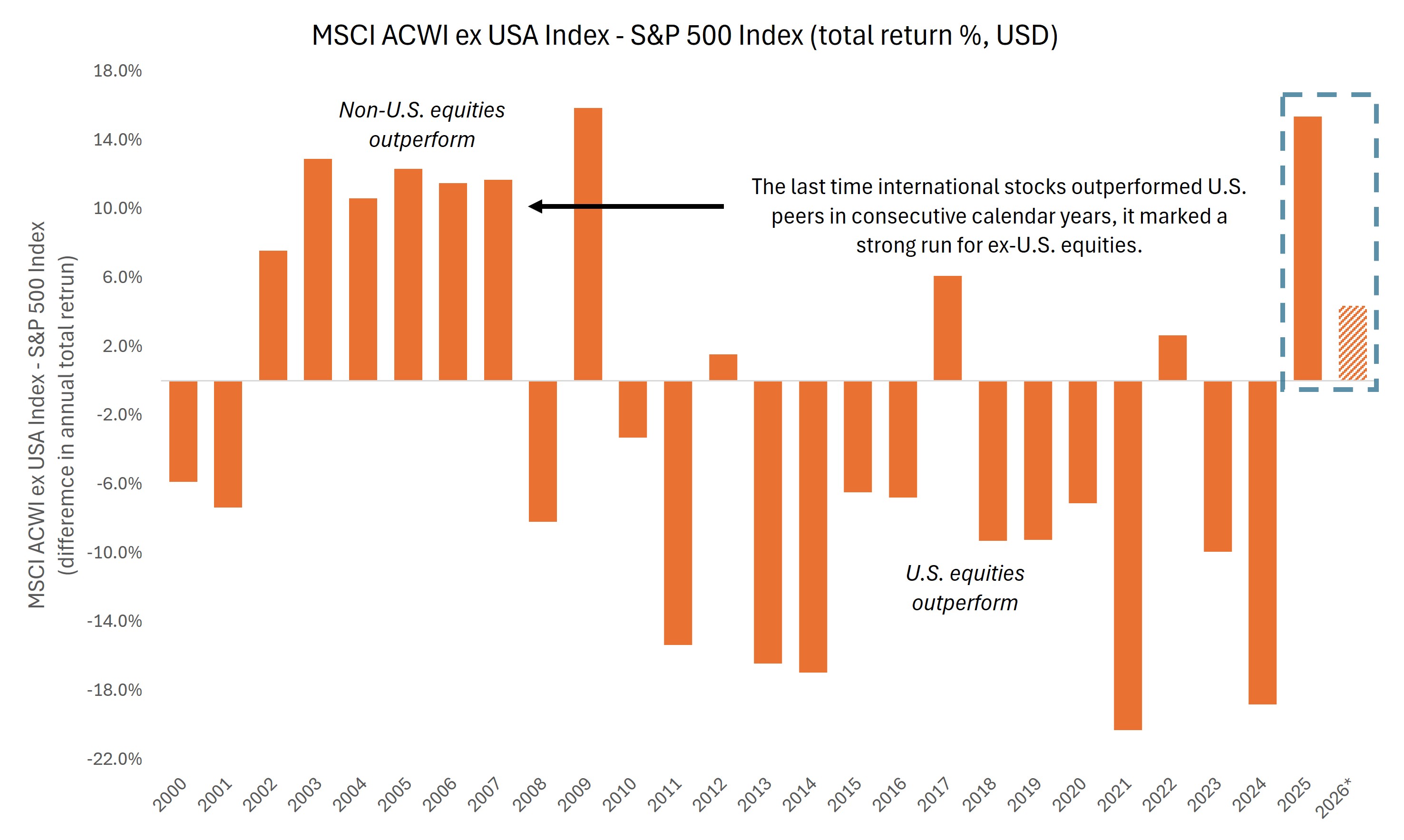
Source: Bloomberg. Chart shows the annual difference in total return (%) between non-U.S. equities, as represented by the MSCI ACWI ex USA Index, and U.S. equities, as represented by the S&P 500® Index. Positive values indicate years in which international equities outperformed U.S. equities. *Data for 2026 is year-to-date as of 31 July 2026. Past performance does not predict future results.
While a fluid macro environment may continue to drive bouts of volatility, we do not believe last year’s strong performance from ex-U.S. equities should be viewed as an aberration. In our view, a combination of secular trends and long-term structural shifts are shaping an attractive environment for active stock selection. European banks have generated their strongest profitability in more than a decade while still trading at a discount to many U.S. peers, and defense firms stand to benefit from a sustained ramp-up in military spending. We also see opportunities in leading technology suppliers at the heart of the AI buildout, select luxury consumer companies, and Japanese financials positioned to benefit from a supportive rate backdrop.
- After outperforming U.S. equities by the widest margin since 2009 last year, international stocks extended their lead through the first half of 2026. If the trend holds, it would mark the first consecutive years of ex-U.S. relative outperformance since before the Global Financial Crisis (GFC) in 2008-2009 – a period that saw a multi-year stretch in which non-U.S. equities outpaced their U.S. peers.
- While U.S. equities should continue to benefit from powerful secular trends, we believe many investors accustomed to U.S. leadership may be overlooking the potential of international equities as a source of differentiated returns. In addition to providing access to themes such as artificial intelligence (AI) and the related infrastructure buildout, overseas markets offer a broader mix of geographies, policy environments, and sector exposures, creating a diverse set of potential return drivers.
- We continue to find attractive opportunities in companies with durable competitive advantages, strong free cash flow growth, and valuations that do not fully reflect their long-term potential.
*Data for 2026 is year-to-date as of 31 July 2026. Past performance does not predict future results.
IMPORTANT INFORMATION
Actively managed investment portfolios are subject to the risk that the investment strategies and research process employed may fail to produce the intended results. Accordingly, a portfolio may underperform its benchmark index or other investment products with similar investment objectives.
Aerospace and defense industries can be significantly affected by changes in the economy, fuel prices, labor relations, and government regulation and spending.
Artificial intelligence (“AI”) focused companies, including those that develop or utilize AI technologies, may face rapid product obsolescence, intense competition, and increased regulatory scrutiny. These companies often rely heavily on intellectual property, invest significantly in research and development, and depend on maintaining and growing consumer demand. Their securities may be more volatile than those of companies offering more established technologies and may be affected by risks tied to the use of AI in business operations, including legal liability or reputational harm.
Diversification neither assures a profit nor eliminates the risk of experiencing investment losses.
Equity securities are subject to risks including market risk. Returns will fluctuate in response to issuer, political and economic developments.
Financials industries can be significantly affected by extensive government regulation, subject to relatively rapid change due to increasingly blurred distinctions between service segments, and significantly affected by availability and cost of capital funds, changes in interest rates, the rate of corporate and consumer debt defaults, and price competition.
Foreign securities are subject to additional risks including currency fluctuations, political and economic uncertainty, increased volatility, lower liquidity and differing financial and information reporting standards, all of which are magnified in emerging markets.
Technology industries can be significantly affected by obsolescence of existing technology, short product cycles, falling prices and profits, competition from new market entrants, and general economic conditions. A concentrated investment in a single industry could be more volatile than the performance of less concentrated investments and the market as a whole.
Free cash flow (FCF) yield is a financial ratio that measures how much cash flow a company has in case of its liquidation or other obligations by comparing the free cash flow per share with the market price per share and indicates the level of cash flow the company will earn against its share market value.
MSCI ACWI ex USA Index reflects the equity market performance of global developed and emerging markets, excluding the U.S.
S&P 500® Index reflects U.S. large-cap equity performance and represents broad U.S. equity market performance.
Volatility measures risk using the dispersion of returns for a given investment.
These are the views of the author at the time of publication and may differ from the views of other individuals/teams at Janus Henderson Investors. References made to individual securities do not constitute a recommendation to buy, sell or hold any security, investment strategy or market sector, and should not be assumed to be profitable. Janus Henderson Investors, its affiliated advisor, or its employees, may have a position in the securities mentioned.
Past performance does not predict future returns. The value of an investment and the income from it can fall as well as rise and you may not get back the amount originally invested.
The information in this article does not qualify as an investment recommendation.
There is no guarantee that past trends will continue, or forecasts will be realised.
Marketing Communication.
Important information
Please read the following important information regarding funds related to this article.
- Shares can lose value rapidly, and typically involve higher risks than bonds or money market instruments. The value of your investment may fall as a result.
- Emerging markets expose investors to higher volatility and greater risk of loss than developed markets; they are susceptible to adverse political and economic events, and may be less well regulated with less robust custody and settlement procedures.
- Derivatives may be used with the aim of reducing risk or managing the portfolio more efficiently. However, this introduces other risks, in particular, that a derivative counterparty may not meet its contractual obligations.
- If the Fund holds assets in currencies other than the base currency of the Fund, or you invest in a share/unit class of a different currency to the Fund (unless hedged, i.e. seeks to mitigate exchange rate movements between the share/unit class currency and the base currency of the Fund), the value of your investment may be impacted by changes in exchange rates.
- When the Fund, or a share/unit class, seeks to mitigate exchange rate movements of a currency relative to the base currency (hedge), the hedging strategy itself may positively or negatively impact the value of the Fund due to differences in short-term interest rates between the currencies.
- Securities could become hard to value or to sell at a desired time and price, especially in extreme market conditions when asset prices may be falling, increasing the risk of investment losses.
- Losses could be incurred if a counterparty became unwilling or unable to meet its obligations, or as a result of failure or delay in operational processes or the failure of a third party provider.