
Key takeaways:
- Equities rallied in the second quarter, delivering their strongest quarterly performance since 2020 as investors found reassurance in resilient economic growth, strong corporate earnings, and easing geopolitical tensions that contributed to a pullback in crude oil prices.
- A second wave of enthusiasm around the buildout of artificial intelligence (AI) computing capacity fueled technology sector gains, while rapid advances in AI capabilities continued to reshape the competitive landscape across industries.
- As market leadership continues to shift, we believe maintaining a long-term view remains important, with opportunities continuing to favor companies aligned with durable secular themes such as AI adoption, increasing power demand, and healthcare innovation.
The stock market rallied in the second quarter, recovering from the sharp pullback in March, with global equities delivering their strongest performance since 2020. Investors found reassurance in strong corporate earnings performance and resilient economic growth. Easing geopolitical uncertainty and the resulting pullback in oil prices further supported investor risk appetite as the quarter progressed. A second wave of exuberance around the buildout of AI computing capacity also took hold during the quarter. At the same time, fears around AI-driven disruption remained prevalent across market segments, from Software-as-a-Service to financial services.
Against this backdrop, our investment team remains focused on discovering opportunities to both capitalize on and avoid technological disruption. Looking ahead, we will continue to monitor shifting market crosswinds and their impact on our companies.
Q2 2026 global equity performance (total return)
The technology sector surged amid renewed enthusiasm around the AI buildout, while industrials and financials also posted strong gains. Energy was the notable laggard as oil prices retreated.
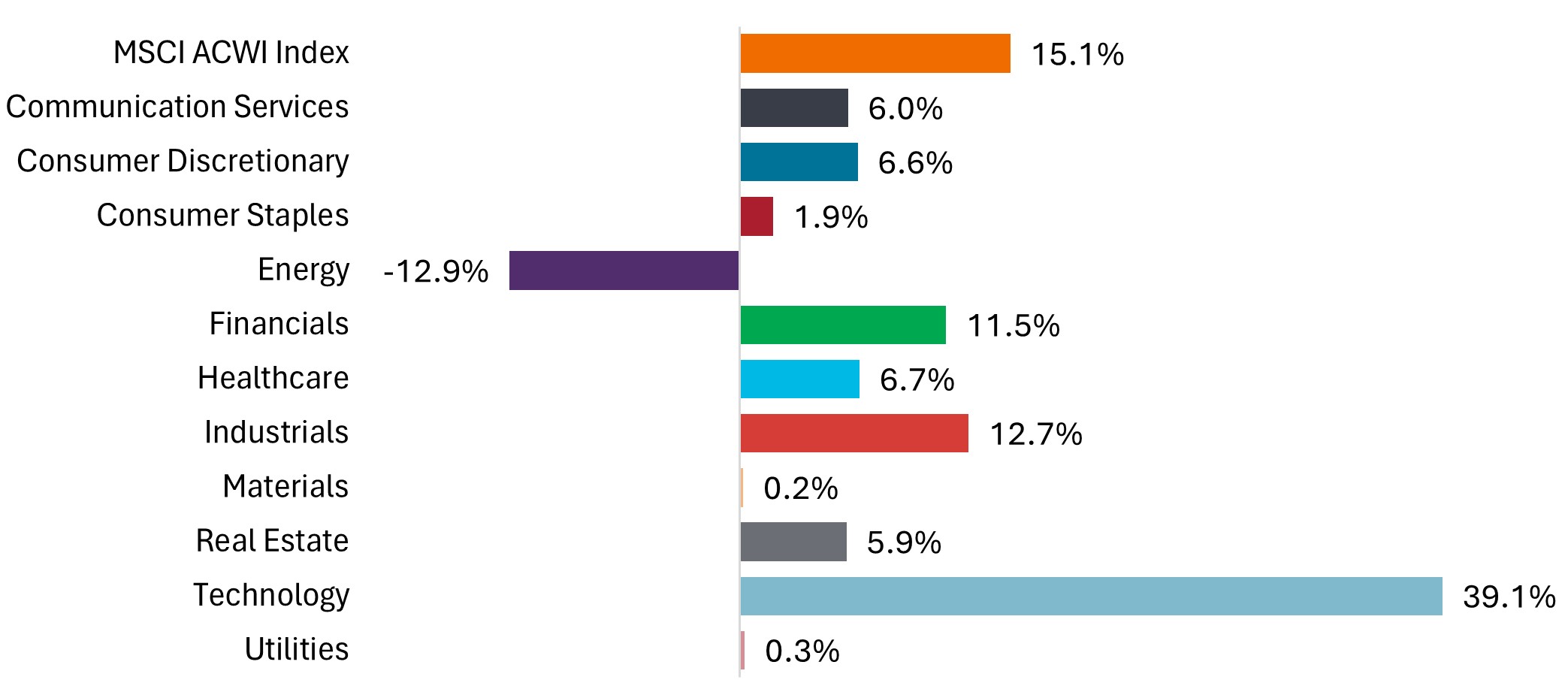
Source: Bloomberg, data from 31 March 2026 to 30 June 2026. Returns are for the MSCI All Country World Index (ACWI) and its 11 sectors. The MSCI ACWI Index captures large- and mid-cap representation across 23 developed markets and 24 emerging markets countries. Past performance is no guarantee of future results.
Communication Services
AI is reshaping the communications services landscape
What happened: Communication Services stocks underperformed broader equities as company-specific factors pressured several stocks in the sector. Shares of Netflix declined as investors became more cautious about the potential costs of customer engagement initiatives. Additionally, worries over subscriber-growth churn and wireless pricing pressured shares of T-Mobile. On a positive note, shares of Google parent Alphabet rose as investors shook off worries about potential disruption to the company’s Search business and focused instead on its expanding AI opportunities.
Looking ahead: We are bullish on the long-term outlook for Communication Services companies, and especially those seeking innovative ways to incorporate AI to enhance their competitive advantages and earnings potential. We believe the potential around AI will ultimately prove far more pervasive and value-creative than most investors now anticipate.
Consumer
Expanded growth opportunities for consumer-facing companies
What happened: While consumer stocks broadly rose during the quarter, the sector underperformed the broader market. This was partly due to valuation compression, as uncertainty around the Iran conflict and oil price volatility weighed on investor sentiment. In our view, this caution was excessive. Consumer spending remained resilient even with higher gasoline prices. Most U.S. households remain on strong financial footing by historical standards, despite some pockets of weakness. Of course, we recognize that the ability to spend does not always translate into a willingness, and we will continue to closely monitor consumer confidence and spending trends.
Looking ahead: We expect resilient consumer spending to support earnings growth prospects for consumer-facing companies, particularly if a reopening of the Strait of Hormuz leads to lower energy prices. Consumers could also benefit from potential stimulus measures ahead of the U.S. midterm elections. We favor a balanced mix of cyclical and defensive businesses and are seeking opportunities in companies we believe are well positioned to benefit from long-term secular trends, including digitization and growing AI adoption.
Energy & Utilities
Secular themes remain supportive
What happened: Volatility in energy stocks was a dominant theme in the first half of 2026. Energy stocks generally outperformed in the first quarter as fears of potential war-related production disruptions in the Middle East pushed the price of crude oil above $100 per barrel. The picture shifted in the second quarter as geopolitical tensions eased, along with fears of a prolonged supply disruption. Oil prices retreated from earlier highs, and energy stocks broadly underperformed the market. Despite commodity price volatility, we believe energy fundamentals remain positive, especially as traditional energy companies continue to generate substantial free cash flow while returning money to shareholders.
In the utilities sector, accelerating power demand was another driving theme in the second quarter, reflecting the surging energy needs of AI and data centers. Growing investor recognition of these power requirements fueled increased investment in utilities and in the broader power infrastructure supply chain, including companies tied to new generation capacity, transmission infrastructure, and grid upgrades.
Looking ahead: In our view, energy stocks appear reasonably valued relative to company cash generation, and we believe they could offer additional upside if commodity prices remain firm and capital return programs continue. However, we see potential downward risk for energy prices if global economic growth slows or Middle East supply normalizes more quickly than expected. For this reason, we favor a defensive approach focused on energy companies with high-quality, long-duration assets that we believe are underappreciated by the market.
From a utilities perspective, we believe the power demand story is becoming increasingly structural rather than cyclical. Demand continues to rise as data centers and AI workloads expand, while broader electricity consumption is reaccelerating after decades of relatively flat growth. At the same time, the industry faces significant constraints on how quickly new generation capacity can be added. These dynamics strengthen the investment case for companies across the power ecosystem.
Financials
Capitalizing on cyclical and secular growth opportunities
What happened: Financials stocks advanced in the second quarter, supported by solid earnings growth, robust capital markets activity, and reduced geopolitical and economic uncertainty. Financial firms reported stable consumer spending trends and mostly benign consumer and corporate credit metrics, which also helped to reassure investors. Investments in AI technology have been another driver of economic and capital markets activity, and the market’s view of AI risks and opportunities has continued to evolve.
Looking ahead: The global financial services sector offers many opportunities to put our deep fundamental research to work. We remain excited about secular growth trends such as increased capital markets activity and rising global wealth. Increased adoption of AI presents both opportunities and risks for financial business models, and we are actively engaged in research and dialogue to identify potential winners and avoid potential losers. We are also constructive on the outlook for select European banks, which may benefit from an improving regulatory backdrop and potential industry consolidation. Interest rates remain well above zero in most major markets, which may provide an earnings tailwind for financial services companies.
Healthcare
Innovation remains a driving force in the healthcare sector
What happened: Healthcare stocks advanced in the second quarter, with the bulk of the gains in June as investors sought diversification away from technology and AI-related stocks. Gains were broad-based, as several positive developments supported pharmaceuticals and biotechnology stocks. Despite the absence of permanent leadership at the U.S. Food and Drug Administration (FDA), regulatory activity remained active, with approvals granted across a range of therapeutic areas. The FDA also issued updated guidance aimed at accelerating drug development and approval timelines. This may lead to greater flexibility for certain late-stage programs and help streamline early-stage development. Mergers and acquisitions remained robust as large pharmaceutical companies continued to deploy capital in high-growth therapeutic areas. Cash-rich drug manufacturers are increasingly turning to acquisitions to strengthen product pipelines and offset future patent expirations.
Looking ahead: Healthcare stocks continue to trade at meaningful valuation discounts relative to both historical averages and the broader S&P 500® Index, providing a favorable backdrop for active stock selection, in our view. We remain encouraged by developments across the healthcare landscape and believe the sector offers an attractive opportunity for patient investors. We expect a steady pace of clinical data releases and regulatory milestones over the coming quarters, with significant opportunities in oncology, cardiovascular, neurological, and rare diseases.
We remain committed to identifying companies with differentiated products, strong clinical data, and durable competitive advantages. Additionally, we see potential across early commercial-stage companies with breakthrough products, as well as lower-risk, late-stage development companies that face less clinical uncertainty.
Industrials
Opportunity for industrial companies despite near-term uncertainties
What happened: Industrials stocks delivered solid performance in the second quarter, broadly keeping pace with the overall market. The sector benefited from improving business confidence, as well as easing fears of a prolonged Middle East conflict and oil price shock. Energy prices retreated from their early-quarter highs, helping to reduce uncertainty for many industrial businesses. By quarter end, investor focus shifted from geopolitical risks and commodity prices toward the potential impact of a higher interest rate environment on economic activity and industrial demand.
Looking ahead: We remain encouraged by the resilience of the industrial sector. The Institute for Supply Management (ISM) Purchasing Managers Index (PMI) stayed above the critical 50 level that signals expansion, extending the improvement that began earlier in the year. This improvement has supported expectations for a gradual industrial recovery. While near-term uncertainty remains, we are optimistic that easing geopolitical tensions and renewed energy market stability could provide a more supportive backdrop for industrial companies. At the same time, we recognize other sources of uncertainty, including interest rates, commodity prices, tariffs, freight demand, consumer and business confidence, U.S. midterm elections, and the upcoming USMCA joint review negotiations.
We continue to prioritize companies with exposure to strong secular themes, such as commercial aerospace and electrification, as well as AI-related power demand and data center investment. We are also on the lookout for well-managed companies that are making operational improvements or have unique catalysts that may drive stable profit growth. While valuations across some of these areas have become more demanding, we have continued to see long-term growth prospects, strong revenue opportunities, and the potential for meaningful margin expansion.
Technology
AI has the potential to revolutionize industries and the broader economy
What happened: Information technology stocks were among the market’s strongest performers in the second quarter. Strong corporate earnings reports across the AI ecosystem reinforced confidence that the AI infrastructure investment cycle remains intact. We have continued to see robust demand but also persistent shortages of critical components, including advanced processors, memory chips, accelerators, and optical networking equipment. We believe demand for AI-enabling technologies will continue to outpace supply as AI adoption expands across industries. Growing investor recognition of these structural supply constraints was an important driver of recent share price performance, particularly for semiconductor capital equipment companies. In contrast, software stocks generally lagged as investors assessed the potential for AI-driven disruption.
Looking ahead: We believe AI represents a generational growth opportunity that will unfold over the coming decade. Companies remain committed to investing in AI infrastructure and capabilities, and we see little reason for spending to slow. Supply constraints are also a key theme. Demand for AI applications and components is growing rapidly, while supply expansion requires significant time and capital. In our view, these bottlenecks are likely to persist for several years, creating favorable conditions for providers of critical technologies, components, and equipment.
We are also monitoring the ongoing AI-related capital expenditure cycle. While the market has rewarded many infrastructure beneficiaries, it has been less favorable toward some of the companies making these investments. We believe much of this spending is justified and should generate attractive returns over time.
For our part, we remain focused on identifying long-term AI beneficiaries while avoiding businesses that may face elevated disruption risk. We continue to find opportunities among suppliers of critical components and materials. Regarding software investments, we favor a selective approach focused on companies that are using AI to accelerate their businesses or expand their margins.
IMPORTANT INFORMATION
Artificial intelligence (“AI”) focused companies, including those that develop or utilize AI technologies, may face rapid product obsolescence, intense competition, and increased regulatory scrutiny. These companies often rely heavily on intellectual property, invest significantly in research and development, and depend on maintaining and growing consumer demand. Their securities may be more volatile than those of companies offering more established technologies and may be affected by risks tied to the use of AI in business operations, including legal liability or reputational harm.
Consumer discretionary industries can be significantly affected by the performance of the overall economy, interest rates, competition, consumer confidence and spending, and changes in demographics and consumer tastes.
Consumer staples industries can be significantly affected by demographics and product trends, competitive pricing, food fads, marketing campaigns, environmental factors, and government regulation, the performance of the overall economy, interest rates, and consumer confidence.
Energy industries can be significantly affected by fluctuations in energy prices and supply and demand of fuels, conservation, the success of exploration projects, and tax and other government regulations.
Financials industries can be significantly affected by extensive government regulation, subject to relatively rapid change due to increasingly blurred distinctions between service segments, and significantly affected by availability and cost of capital funds, changes in interest rates, the rate of corporate and consumer debt defaults, and price competition.
Health care industries are subject to government regulation and reimbursement rates, as well as government approval of products and services, which could have a significant effect on price and availability, and can be significantly affected by rapid obsolescence and patent expirations.
Technology industries can be significantly affected by obsolescence of existing technology, short product cycles, falling prices and profits, competition from new market entrants, and general economic conditions. A concentrated investment in a single industry could be more volatile than the performance of less concentrated investments and the market as a whole.
Monetary Policy refers to the policies of a central bank, aimed at influencing the level of inflation and growth in an economy. It includes controlling interest rates and the supply of money.
Purchasing Managers’ Index (PMI) is an index of the prevailing direction of economic trends in the manufacturing and service sectors, based on a survey of private sector companies.
S&P 500® Index reflects U.S. large-cap equity performance and represents broad U.S. equity market performance.
Volatility measures risk using the dispersion of returns for a given investment.
These are the views of the author at the time of publication and may differ from the views of other individuals/teams at Janus Henderson Investors. References made to individual securities do not constitute a recommendation to buy, sell or hold any security, investment strategy or market sector, and should not be assumed to be profitable. Janus Henderson Investors, its affiliated advisor, or its employees, may have a position in the securities mentioned.
Past performance does not predict future returns. The value of an investment and the income from it can fall as well as rise and you may not get back the amount originally invested.
The information in this article does not qualify as an investment recommendation.
There is no guarantee that past trends will continue, or forecasts will be realised.
Marketing Communication.