
Key takeaways:
- Tight spreads are not a new phenomenon and there is justification for why they are compressed, but the tightness does necessitate a more thorough search for value, even among less loved sectors.
- Private placements and the new issue market can provide routes to achieving better spreads than may be available in the secondary or public market.
- Fundamental research and access to private deals can offer a potential advantage to professional investors with institutional access.
The tightness in credit spreads (the difference in yield between a corporate bond and a government bond of similar maturity) is not a new phenomenon. We spoke about this a couple of years ago and nothing much has changed other than spreads getting tighter still. What it does mean is that investors need to work harder at uncovering value.
Figure 1: The big squeeze – tight credit spreads (basis points)
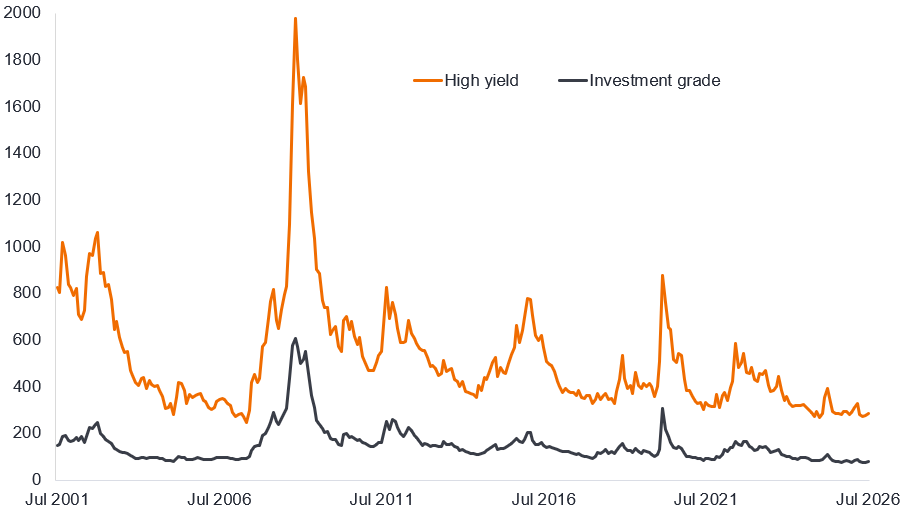
Source: Bloomberg, US High = ICE BofA US High Yield, Investment grade = ICE BofA US Corporate, Option-adjusted spread over government, 31 July 2021 to 31 July 2026. One basis point equals 1/100 of a percentage point. 1 bp = 0.01%, 100 bps = 1%. Spreads may vary over time and are not guaranteed.
As before, we see some justification for the tightness – earnings in general are extremely strong (up 50% year-on-year in Q2 for the S&P 500)1; many companies’ balance sheets are not over-stretched; and the market is doing a decent job in identifying companies with excessive debt levels. The rise in government bond yields (on near-term inflation concerns and elevated levels of government borrowing) additionally means some of the tightening can be accounted for by the simple mathematics of overall corporate yields not climbing as much as the sovereign yield, thus narrowing the spread.
Tech technicals
While spread in many areas of the high yield and investment grade market have tightened or barely changed over the last three months, an area of relative weakness has been spreads on bonds issued by hyperscalers.2 These have widened on the volume of debt issuance coming to the market to help fund the buildout of artificial intelligence (AI) infrastructure. While there are several reasons why we believe it is right to be cautious towards AI-related debt, particularly within US investment grade where much of the new supply is arising, that does not mean avoiding the sector completely. In fact, when spreads are tight it is worth casting the net wide for value opportunities.
One of the advantages of being institutional-size investors is we get access to deals that are out of reach of ordinary investors. A case in point is Sopaipilla Investor LLC (“Sopaipilla”), which recently raised just over US$12 billion through a senior secured note due in 2048, issued in a private placement at 278.5 basis points spread above the yield on the 10-year US Treasury.
The debt issued is to help fund an AI data centre in Texas, which will have Meta (the tech hyperscaler and Facebook owner) as its initial tenant. In other words, the cash flows come from an investment grade hyperscaler. Yet the spread is comparable to a high yield bond issuer despite S&P Global Ratings assigning an A+ preliminary rating to the Sopaipilla notes. Investors would have to venture into B-rated high yield territory or mezzanine BBB-rated collateralised loan obligations to find similar spreads.
Figure 2: Seeking relative value
Spreads across different rated US indices (basis points)
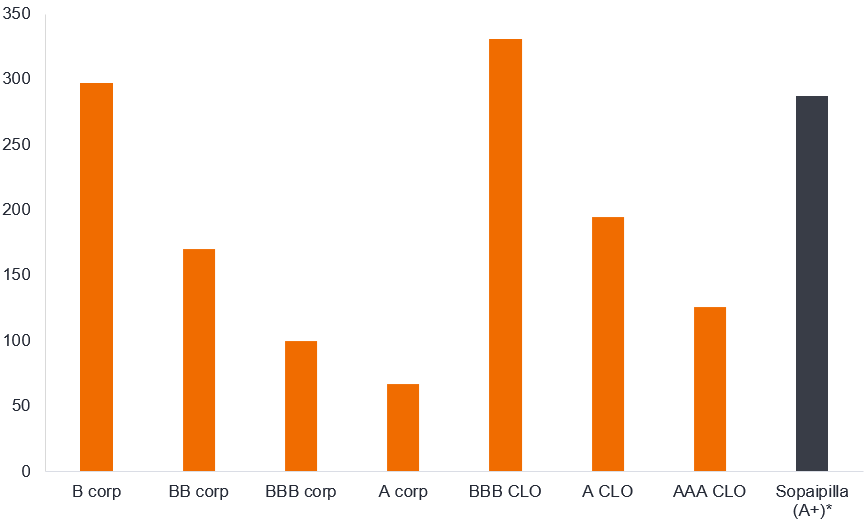
Source: Bloomberg, ICE BofA US Indices for corporates, J.P. Morgan US collateralised loan obligations indices for CLO, Sopaipilla 7.534% 11/30/2048. Spreads at 27 July 2026. Spreads may vary over time and are not guaranteed. *Rating in brackets is preliminary and not guaranteed. References made to individual securities do not constitute a recommendation to buy, sell or hold any security, investment strategy or market sector, and should not be assumed to be profitable. Janus Henderson Investors, its affiliated advisor, or its employees, may have a position in the securities mentioned.
As a longer-dated note, the spread was always likely to be higher on the Sopaipilla bond, but we believe that part of the higher spread came from broader AI softness in the market and trepidation around what might be perceived as off-balance sheet financing of data centres by the hyperscalers.
Nvidia’s surprise debt capital raise in mid-June, Amazon’s untimely capital raise in early July (earnings blackout and close to US Independence week), followed by spread widening of SpaceX’s debut bonds, set a poor tone for markets. This was not helped by projections of rising capital expenditure (capex) across the hyperscalers meaning sentiment in the market towards tech issuers in late July was less receptive than it might otherwise have been. Due diligence on the bond, however, gave us some degree of comfort around lender protection and convinced us that negative near-term sentiment might allow participation in a bond with a potentially generous spread.
We participated in the Sopaipilla private placement, which came at a spread of 287.5 basis points (bps). Within a few days of issue, the spread had tightened around 20 bps allowing us to sell the bond with an uplift in the bond’s price (bond prices rise when yields fall).
Ultimately, this demonstrates three points:
- First, the new issue or private placement market remains a valuable source of relative value. When markets are less familiar with a borrower this can lead to inefficient pricing.
- Second, even in a sector that suggests caution from a technical perspective, that does not mean it should be avoided completely as there are likely to be selective opportunities.
- Third, it may be possible to use short-term technical weakness to a fixed income investor’s advantage, much like an equity investor might take advantage of a market correction.
Of course, this only works if investors are prepared to do the fundamental research and be confident that the credit is worth investing in. Having institutional access to private deals is also an advantage as we can participate ahead of the broader market. Given the explosive growth projected in capex spending for the AI buildout we expect more of these opportunities to arise.
1Source: Factset, Q2 2026 earnings based on 88% of S&P500 companies having reported results, 7 August 2026.
2Source: Bloomberg, spreads on ICE BofA US High Yield Index, ICE BofA US Corporate Index, and hyperscalers, 13 May 2026 to 12 August 2026. Hyperscalers here include Meta, Amazon, Google, and Oracle, plus SpaceX from 25 June 2026. Past performance does not predict future returns.
Collateralized Loan Obligations (CLOs) are debt securities issued in different tranches, with varying degrees of risk, and backed by an underlying portfolio consisting primarily of below investment grade corporate loans. The return of principal is not guaranteed, and prices may decline if payments are not made timely or credit strength weakens. CLOs are subject to liquidity risk, interest rate risk, credit risk, call risk and the risk of default of the underlying assets.
Fixed income securities are subject to interest rate, inflation, credit and default risk. The bond market is volatile. As interest rates rise, bond prices usually fall, and vice versa. The return of principal is not guaranteed, and prices may decline if an issuer fails to make timely payments or its credit strength weakens.
High-yield or “junk” bonds involve a greater risk of default and price volatility and can experience sudden and sharp price swings.
ICE BofA US High Yield Index tracks the performance of US dollar denominated below investment grade corporate debt publicly issued in the US domestic market.
ICE BofA US Corporate Index tracks the performance of US dollar denominated investment grade corporate debt publicly issued in the US domestic market.
ICE BofA BBB US Corporate Index is a subset of ICE BofA US Corporate Index including all securities rated BBB+ through BBB- inclusive.
ICE BofA BB US High Yield Index is a subset of UCE BofA US High Yield Index including all securities rated BB+ through BB- inclusive.
ICE BofA Single-B US High Yield Index is a subset of ICE BofA US High Yield Index including all securities rated B+ through B- inclusive.
J.P. Morgan Collateralized Loan Obligation Index (CLOIE) is the first rule-based benchmark designed to track the USD-denominated, broadly syndicated, arbitrage US CLO market.
J.P. Morgan Collateralised Loan Obligation BBB Index is a specialised sub-index of the J.P.Morgan Collateralised Loan Obligation Index (CLOIE). It tracks the performance of BBB-rated tranches.
J.P. Morgan Collateralised Loan Obligation A Index is a is a specialised sub-index of the J.P. Morgan Collateralised Loan Obligation Index (CLOIE). It tracks the performance of A rated tranches.
J.P. Morgan Collateralised Loan Obligation Index AAA Index tracks the performance of U.S. dollar denominated AAA rated floating rate CLO tranches backed by broadly syndicated corporate loans.
Balance sheet: A financial statement that summarises a company’s assets, liabilities, and shareholders’ equity at a particular point in time. Each segment gives investors an idea as to what the company owns and owes, as well as the amount invested by shareholders. It is called a balance sheet because of the accounting equation: assets = liabilities + shareholders’ equity.
Off-balance sheet financing: An accounting practice where a company keeps certain assets or liabilities off its balance sheet, examples include joint ventures or setting up separate vehicles to hold assets and debt. While this can help lower reported debt and protect credit ratings, it can also disguise financial risks.
Basis point: One basis point equals 1/100 of a percentage point. 1 bp = 0.01%, 100 bps = 1%.
Capex: Money a business spends on major, long-term assets such as property and equipment (tangible assets) or technology, software, trademarks, patents etc (intangible assets) to facilitate new projects or investments that support business growth and expansion.
Collateralised Loan Obligation: A securitised portfolio of corporate leveraged loans rated below investment grade (a rating on a bond where the borrower is perceived as having a relatively low risk of defaulting on repayment). The underlying loan pool is financed through the issuance of bonds that are structured into tranches with differing risk profiles, where interest and principal payments are prioritised according to each tranche’s position in the capital structure.
Corporate bond: A bond issued by a company. Bonds offer a return to investors in the form of periodic payments and the eventual return of the original money invested at issue on the maturity date.
Credit rating: A score given by a credit rating agency such as S&P Global Ratings, Moody’s and Fitch on the creditworthiness of a borrower. For example, S&P ranks investment grade bonds from the highest AAA down to BBB and high yields bonds from BB through B down to CCC in terms of declining quality and greater risk, i.e. CCC rated borrowers carry a greater risk of default.
Credit risk: The risk that a borrower will default on its contractual obligations to investors, by failing to make the required debt payments. Anything that improves conditions for a company can help to lower credit risk.
Coupon: A regular interest payment that is paid on a bond, described as a percentage of the face value of an investment. For example, if a bond has a face value of $100 and a 5% annual coupon, the bond will pay $5 a year in interest.
Data centre: A data centre is a physical facility or building that houses a large group of networked computer servers, data storage drives, and networking hardware
Default: The failure of a debtor (such as a bond issuer) to pay interest or to return an original amount loaned when due.
Due diligence: In bond investing, this is the process of researching an issuer’s financial health, credit rating, and legal terms to check risks before making a decision on investing.
Duration: Duration can measure how long it takes (in years) for an investor to be repaid a bond’s price by the bond’s total cash flows. Duration can also measure the sensitivity of a bond’s or fixed-income portfolio’s price to changes in interest rates. The longer a bond’s duration, the higher its sensitivity to changes in interest rates, and vice versa.
Fundamentals: In the context of corporate debt, “fundamentals” refer to the essential financial health indicators and characteristics of a company that suggest its ability to meet debt obligations.
High yield: A bond that has a lower credit rating than an investment grade bond. Sometimes known as a sub-investment grade bond. These bonds carry a higher risk of the issuer defaulting on their payments, so they are typically issued with a higher coupon to compensate for the additional risk.
Hyperscaler: Technology providers that provide IT architectures that scale dynamically to handle exponential increases in workload and data. Apart from capacity, they offer enterprise-grade cloud services, flexible hardware resources, and robust software environments that support a broad range of AI applications.
Inflation: The rate at which prices of goods and services are rising in the economy.
Investment grade: A bond typically issued by governments or companies perceived to have a relatively low risk of defaulting on their payments. The higher quality of these bonds is reflected in their higher credit ratings.
Issuance: The act of making bonds available to investors by the borrowing (issuing) company, typically through a sale of bonds to the public or financial institutions.
Maturity: The maturity date of a bond is the date when the principal investment (and any final coupon) is paid to investors. Shorter-dated bonds generally mature within five years, medium-term bonds within five to 10 years, and longer-dated bonds after 10+ years.
Private placement: A means of raising funds through the sale of securities directly to a select number of individuals or private investors rather than as part of a public offering.
Relative value: Comparing the price of an asset to the market value of similar assets to help determine if the asset is worth investing in.
Secondary market: Newly-issued bonds are traded on the primary market, with issuers selling their bonds directly to investors to raise capital (borrow). The purchase or sale of any existing bond occurs in the secondary market, between investors.
Senior secured note: A type of corporate bond or loan that takes payment precedence over other debts if the company runs into difficulties. It is senior because it gets paid before other debts and secured because it is backed by specific assets.
Spread/credit spread: The difference in yield between a corporate bond and that of a government bond of equivalent maturity.
Technical environment: The overall demand (appetite from investors) and supply (issuance of bonds and debt securities from borrowers) environment.
Yield: The level of income on a security, typically expressed as a percentage rate. For a bond, at its most simple, this is calculated as the annual coupon payment divided by the current bond price.
These are the views of the author at the time of publication and may differ from the views of other individuals/teams at Janus Henderson Investors. References made to individual securities do not constitute a recommendation to buy, sell or hold any security, investment strategy or market sector, and should not be assumed to be profitable. Janus Henderson Investors, its affiliated advisor, or its employees, may have a position in the securities mentioned.
Past performance does not predict future returns. The value of an investment and the income from it can fall as well as rise and you may not get back the amount originally invested.
The information in this article does not qualify as an investment recommendation.
There is no guarantee that past trends will continue, or forecasts will be realised.
Marketing Communication.