Chart to Watch: Have CLOs justified their credit ratings?
Global Head of Securitised Products John P Kerschner and Portfolio Managers Denis Struc and John Baumgardner discuss how collateralized loan obligations (CLOs) have consistently shown better credit strength than their corporate counterparts.
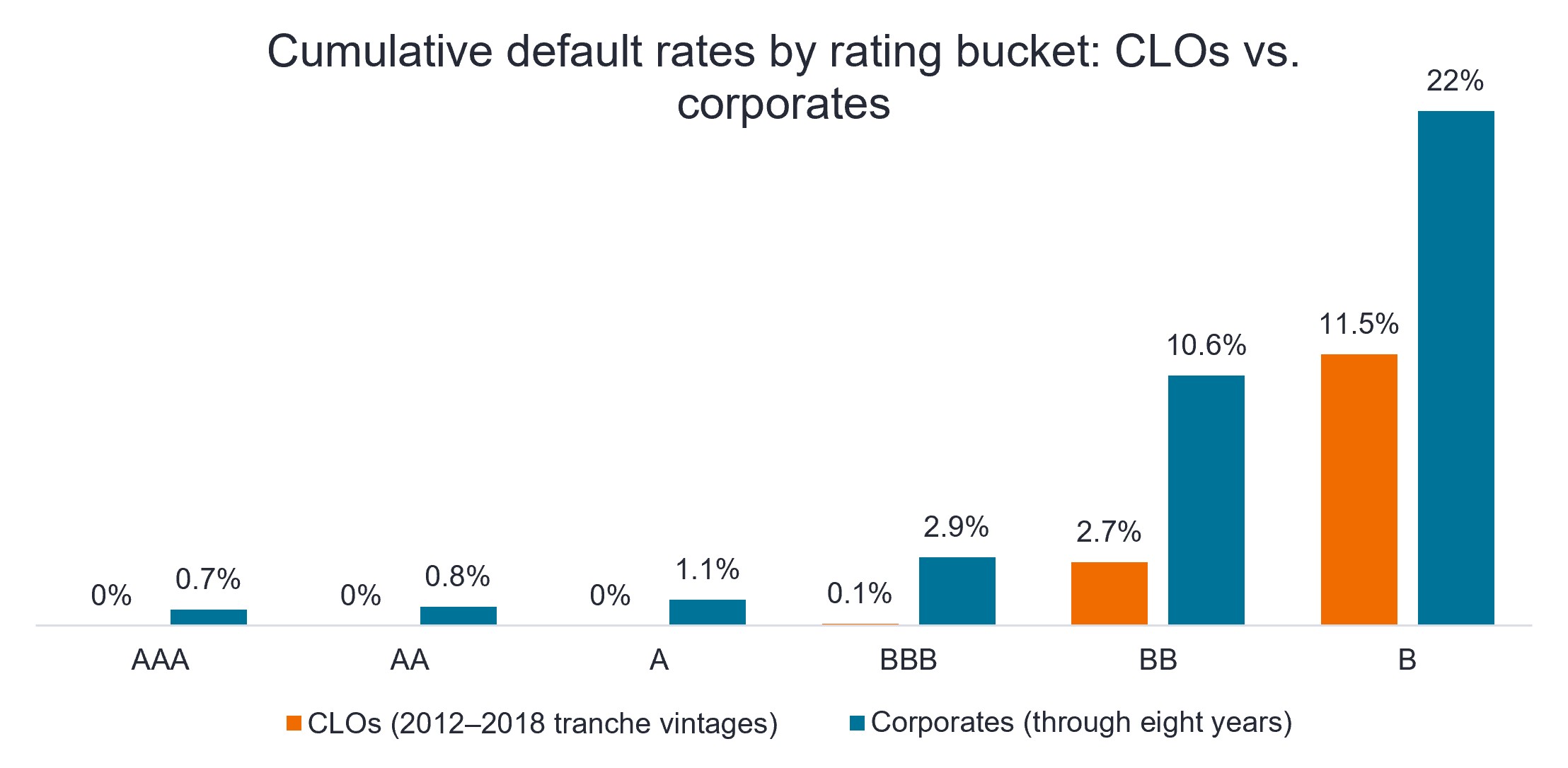
Source: Intex, Markit, S&P, Moody’s, Nomura, as of 31 May 2026. Defaults include those downgraded to D by S&P, those classified as impaired by Moody's (excluding certain tranches that paid in kind and were subsequently cured), and any tranches with less than full original principal repaid upon deal redemption. Past performance does not predict future results.
Even though skepticism remains around the credit ratings on CLOs following the Global Financial Crisis (GFC), CLOs were not at the center of the crisis. Faulty sub-prime mortgages that were packaged into collateralized debt obligations (CDOs) – an entirely different investment – was the main culprit. Investment-grade (IG) CLOs held up well through the GFC, with zero defaults in 2008 and 2009 and just a 0.12% default rate in BBB CLOs in 2010. Post GFC, IG CLOs have continued to show superior credit strength to corporate bonds and have been further bolstered by stricter lending requirements and greater credit enhancement within CLO structures.
- Despite investor skepticism regarding the trustworthiness of the ratings on securitized products, historical default rates on CLOs are significantly lower than on similar-rated corporate bonds, with zero defaults in AAA through A tranches and a 0.1% BBB default rate on CLO deals originated between 2012 and 2018.*
- Floating-rate bond exposure remains an essential component of a diversified fixed income allocation, with CLOs being our preferred investment vehicle due to their strong credit ratings, structural protections, and historical resilience.
- Exposure to investment-grade tranches of CLOs – where structural protections are at their highest – remains our favored approach. Investors in BB and B CLO tranches may face more direct risks, as a negative turn in credit markets could drive tranche rating downgrades and spread repricing further down the capital stack.
IMPORTANT INFORMATION
Collateralized Loan Obligations (CLOs) are debt securities issued in different tranches, with varying degrees of risk, and backed by an underlying portfolio consisting primarily of below investment grade corporate loans. The return of principal is not guaranteed, and prices may decline if payments are not made timely or credit strength weakens. CLOs are subject to liquidity risk, interest rate risk, credit risk, call risk and the risk of default of the underlying assets.
Securitized products, such as mortgage- and asset-backed securities, are more sensitive to interest rate changes, have extension and prepayment risk, and are subject to more credit, valuation and liquidity risk than other fixed-income securities.
Fixed income securities are subject to interest rate, inflation, credit and default risk. The bond market is volatile. As interest rates rise, bond prices usually fall, and vice versa. The return of principal is not guaranteed, and prices may decline if an issuer fails to make timely payments or its credit strength weakens.
*According to Nomura.
Credit quality ratings are measured on a scale that generally ranges from AAA (highest) to D (lowest).
Volatility measures risk using the dispersion of returns for a given investment.