
Key takeaways:
- The global economy has held up well, despite widening growth divergence, persistent geopolitical uncertainty and mounting fiscal pressure.
- Emerging markets (EMs) enter this period with stronger policy frameworks, deeper domestic investor bases and longer debt maturities – yet debt affordability and financing visibility increasingly matter more than debt ratios alone.
- For investors, this places importance on selectivity: reform announcements, International Monetary Fund (IMF) engagement and market access are useful, but only credible execution turns them into durable credit improvement.
Bangkok: rethinking the emerging–developed market divide
Bangkok is a city of contrasts. Skyscrapers and luxury malls sit alongside food stalls, while longtail boats use the Chao Phraya as a waterborne highway through the city. The city’s modern transport system and bustling street economy makes the distinction between emerging and developed feel rather blurred. That made it an appropriate setting for this year’s IMF and World Bank Annual Meetings since many of the divisions in the world economy no longer map cleanly onto the traditional EM and developed market (DM) distinction. Some emerging economies have built credible policy institutions and substantial shock absorbers. Meanwhile, fiscal sustainability, political fragmentation and infrastructure constraints are becoming more visible in parts of the developed world.

Thailand last hosted the Annual Meetings in 1991, when globalisation was the dominant theme. This time, discussions were shaped by four less comfortable uncertainties: geopolitical and geoeconomic fragmentation; rapid technological change, particularly artificial intelligence (AI); higher energy and living costs; and the return of more expensive money.
Thailand’s role as host also offered a reminder of how differently Asia features across emerging-market debt portfolios. The country is absent from the JP Morgan EMBI Global Diversified Index, while China accounts for just 3.3% of the index and India accounts for less than 1%, entirely through quasi-sovereign bonds.1 South Korea and Taiwan are excluded, as their high-income status puts them outside the index’s eligibility criteria, despite their prominence alongside China and India in EM equity indices.
A resilient but increasingly uneven world economy
Beyond the regional perspective, the meetings’ broader message was one of continued growth resilience. The IMF expects global growth of 3.1% in 2026, rising to 3.4% in 2027, although the headline conceals an increasingly uneven picture.2
The US economy continues to benefit from domestic demand and investment. China retains formidable industrial capacity but is still struggling to translate it into stronger household consumption. India remains one of the more durable growth stories, while economies positioned inside the semiconductor and broader technology value chain have received an additional tailwind from AI adoption. At the other end of the spectrum, conflict-affected economies and vulnerable fuel importers face weaker growth, higher inflation and much narrower policy room.
This divergence is reflected in the IMF’s diagnosis of global imbalances: the US needs to save more, China needs to consume more, and Europe needs to invest more. The fiscal message was similarly direct. Governments need credible medium-term consolidation plans, supported by better tax administration, more efficient spending and stronger fiscal frameworks. Energy prices should generally be allowed to reflect market conditions, while support should be directed temporarily towards vulnerable households rather than delivered through broad price suppression.
Emerging markets: stronger foundations, tighter financing

At the IMF conferences, we met with finance ministers, central bank governors, sovereign debt managers, multilateral institutions, private investors, economists and policy experts. Our meetings this time around broadly reinforced the view that EMs have become more resilient. Policy frameworks are stronger; currencies are generally more flexible; and central banks have shown greater willingness to tighten early. Many governments have lengthened debt maturities, reduced reliance on external borrowing by developing domestic investor bases and sought multilateral support before foreign exchange reserves came under acute pressure. These improvements have reduced the probability that every external shock develops into a balance-of-payments crisis.
But the easy phase of the recovery is largely behind us. Disinflation, restructuring-related cash-flow relief and renewed market access supported broad improvement across many sovereign credits. The next phase depends more heavily on fiscal delivery, reform continuity and the ability to refinance without consuming an ever-larger share of government revenue.
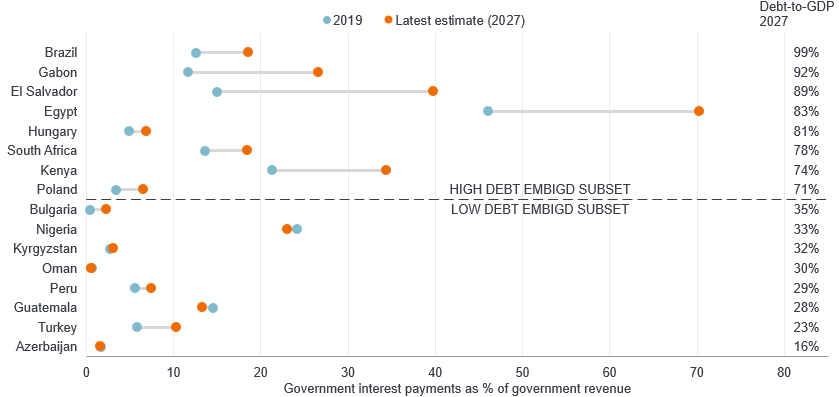
Debt-to-GDP therefore tells only part of the story. Two countries with similar debt ratios can have materially different credit profiles depending on their revenue base, average interest cost, maturity structure, domestic investor depth and access to external financing. Instead, we focus on interest payments as a share of government revenue to provide a clearer measure of near-term fiscal strain. Figure 1 shows in the top half a group of highly indebted EMBI benchmark countries while the bottom half shows some that are less indebted, highlighting the wide difference in interest costs within each group despite comparable debt burdens. Financing visibility – knowing who may buy the next bond, could fund the next budget gap or when the next IMF review may come – also matters just as much.
Figure 1: Debt burdens mask wide differences in interest costs
Source: Janus Henderson Investors, IMF World Economic Outlook, JP Morgan, as at 26 October 2026. Sub-sets of countries in the JP Morgan EMBI Global Diversified Index. There is no guarantee that past trends will continue, or forecasts will be realised.
Making sovereign debt workouts work better
After a run of sovereign-debt restructurings that tested everyone’s patience, the international framework for resolving sovereign debt distress is showing signs of improvement. The G20 Common Framework for Debt Treatments, broader creditor engagement and the Global Sovereign Debt Roundtable have helped build a better shared understanding of the process. Nevertheless, creditor coordination, debt-data transparency, comparability of treatment and sequencing remain material frictions. Non-bonded commercial creditors can be particularly difficult to organise, while information often reaches creditor groups sequentially. Investors should therefore be wary of valuation assumptions that rely on heroic restructuring timelines.
The revised Low-Income Country Debt Sustainability Framework gives more systematic attention to domestic debt and distinguishes more clearly between debt distress and debt unsustainability. That distinction matters: a country facing acute liquidity pressure does not necessarily require the same treatment as one whose debt burden is fundamentally unpayable. For investors, the result should be a more realistic – although not necessarily simpler – assessment of restructuring needs and recovery values.
Four country takeaways

Romania: the path exists, but execution remains political
- Romania’s 2026 fiscal execution has been better than feared, and alternative financing should help reduce reliance on expensive Eurobond issuance. The political crisis is now behind us, with a new government voted-in immediately after our meetings.
- The central question has shifted to the credibility and composition of the 2027 budget. Fiscal consolidation remains achievable, but political durability, revenue mobilisation and the prioritisation of EU-funded investment will determine whether the debt trajectory can stabilise.
- In our view, stronger fiscal execution and the resolution of the political crisis have raised the bar for a downgrade to high yield. We believe a credible 2027 budget could pave the way for rating outlooks to begin stabilising in the second half of next year.
Ukraine: financing visibility is the key credit anchor
- Our meetings highlighted the toughest moment in the war so far, with intensified attacks on energy and logistics infrastructure disrupting exports and adding to economic pressure. We believe Western support remains the central credit anchor (stabilising force on spreads), but downside risks have increased.
- Securing external financing is the immediate priority, with Europe expected to provide most of the outstanding support alongside multilateral and bilateral partners.
- Longer-term European funding arrangements and greater use of frozen Russian assets could improve visibility, though political and legal hurdles remain.
Montenegro: from EU accession negotiations to ratification
- Montenegro’s “28 by 28” campaign reflects impressive progress towards becoming the EU’s 28th member in 2028, with 21 of 33 negotiating chapters provisionally closed after October’s accession conference.
- Treaty drafting is already under way. Closing the remaining chapters, securing European Parliament consent and unanimous member-state approval would pave the way for signature, followed by ratification in Montenegro and every EU member state.
- The 2028 target remains dependent on completing reforms and these ratification processes.
Gabon: catalysts need credibility
- Gabon’s return to the bond market has not resolved its underlying fiscal concerns. While we were in Bangkok, it priced a US$580 million Eurobond due in 2034 at a yield of 12.8%3 – securing market access, but at a steep borrowing cost.
- The fiscal outlook is likely the biggest obstacle to an IMF programme: spending appears to follow whatever financing is available, rather than financing needs being determined by a credible spending plan.
- Progress on arrears is encouraging, but investors still need greater confidence in fiscal data, the debt perimeter and execution of the debt-audit follow-up.
- An IMF anchor could materially improve financing visibility; until then, the market is likely to demand proof rather than promises.
Selectivity is key when navigating emerging market debt
The different forces shaping these countries’ credit trajectories, together with the wide variation in debt-servicing costs among countries with comparable debt burdens, illustrate the breadth of the emerging-market hard-currency debt (EMD HC) universe. The common message from the IMF meetings was of EM resilience, particularly relative to DMs. For investors, the implication is neither blanket optimism nor broad pessimism. It is greater selectivity: distinguishing countries that could absorb shocks and finance themselves from those whose apparent resilience depends on favourable markets or policy promises that have yet to be delivered.
1 Source: JP Morgan, Bloomberg, as at 30 September 2026.
2 Source: IMF World Economic Outlook, October 2026.
3 Source: Bloomberg, 14 October 2026.
Sovereign debt securities are subject to the additional risk that, under some political, diplomatic, social or economic circumstances, some developing countries that issue lower quality debt securities may be unable or unwilling to make principal or interest payments as they come due.
Foreign securities are subject to additional risks including currency fluctuations, political and economic uncertainty, increased volatility, lower liquidity and differing financial and information reporting standards, all of which are magnified in emerging markets.
Actively managed portfolios may fail to produce the intended results. No investment strategy can ensure a profit or eliminate the risk of loss.
Emerging market investments have historically been subject to significant gains and/or losses. As such, returns may be subject to volatility.
The J.P. Morgan EMBI Global Diversified Index (EMBIGD) tracks liquid, US Dollar emerging market fixed and floating-rate debt instruments issued by sovereign and quasi-sovereign entities.
Fixed income securities are subject to interest rate, inflation, credit and default risk. The bond market is volatile. As interest rates rise, bond prices usually fall, and vice versa. The return of principal is not guaranteed, and prices may decline if an issuer fails to make timely payments or its credit strength weakens.
High-yield or “junk” bonds involve a greater risk of default and price volatility and can experience sudden and sharp price swings.
28 by 28: Montenegro’s campaign and stated ambition to become the 28th member of the European Union by 2028. The initiative promotes the country’s progress towards EU membership and its goal of completing the accession process.
Balance of payments: A record of all transactions between a country and the rest of the world over a given period, including trade, investment and financial flows.
Bond: A debt security issued by a company or government as a way of raising money. The investor buying the bond is effectively lending money to the issuer. Bonds usually provide periodic interest payments and return the original amount invested at maturity.
Borrowing: Where a company, individual or government temporarily takes on debt to fund spending or investment, usually in exchange for interest payments.
Cash flow: The net balance of cash moving in and out of a company. Positive cash flow means more cash is moving in than out, while negative cash flow means more is moving out than in.
G20 Common Framework for Debt Treatments: A G20 initiative designed to coordinate sovereign debt treatments for eligible countries among participating official creditors, with restructuring needs informed by IMF-World Bank debt sustainability analysis and an IMF-supported programme.
Credit: An agreement between a lender and a borrower. The term is often used to describe borrowing through bonds, loans or other fixed-interest investments.
Credit anchor: A policy, institution or source of financial support that helps underpin a borrower’s creditworthiness and maintain investor confidence.
Credit rating: An independent assessment of a borrower’s creditworthiness by a recognised agency such as Standard & Poor’s, Moody’s or Fitch.
Credit risk: The risk that a borrower will default on its contractual obligations to make required interest payments or repay a loan.
Debt maturities: The dates on which a borrower must repay the principal amount of its outstanding debts.
Debt perimeter: The range of public-sector entities and financial obligations included when measuring and reporting a country’s government debt.
Debt-to-GDP: A ratio comparing a country’s total government debt with the size of its economy, as measured by gross domestic product.
Default: The failure of a borrower, such as a bond issuer, to pay interest or return the original amount borrowed when due.
Disinflation: A fall in the rate of inflation.
Emerging market: The economy of a developing country that is becoming more integrated into the global economy, including through the development of its financial markets and regulatory institutions.
Equity: A security representing ownership, typically listed on a stock exchange. Equities are also known as shares or stocks.
Eurobond: A bond issued in a currency different from that of the country or market in which it is issued. In emerging markets, the term commonly refers to internationally issued government bonds denominated in a major currency such as the US dollar or euro.
External borrowing or financing: Funding obtained from lenders or investors outside a country, such as through international bonds, foreign bank loans or multilateral institutions.
Fiscal consolidation: Measures taken by a government to reduce its budget deficit and stabilise or lower public debt, typically by increasing revenue, reducing expenditure or both.
Fiscal execution: The implementation of a government’s approved budget, including its ability to collect planned revenue and control or deliver expenditure as intended.
Fiscal policy: Government policy relating to tax rates and spending levels. Fiscal policy is separate from monetary policy, which is typically set by a central bank.
Fixed income: Another term for bonds. These are debt securities issued by companies or governments to raise money.
Foreign-exchange reserves: Foreign-currency assets held by a country’s central bank that can be used to meet external payment obligations, support the domestic currency or respond to financial shocks.
Global Sovereign Debt Roundtable (GSDR): A forum co-chaired by the IMF, World Bank and G20 Presidency that brings together borrowing countries, official bilateral creditors and private creditors to build greater common understanding of sovereign debt and restructuring challenges and improve restructuring processes. It does not replace existing restructuring mechanisms such as the Common Framework.
Gross domestic product (GDP): The value of all finished goods and services produced by a country over a specific period. GDP is a broad measure of the size and health of a country’s economy.
High-yield bond: A bond with a lower credit rating than an investment-grade bond, also known as a sub-investment-grade or “junk” bond. These bonds usually carry a higher risk of default and therefore typically offer a higher interest rate to compensate investors for the additional risk.
Index: A statistical measure of a group or basket of securities or other financial instruments. Each index has its own calculation method and is usually expressed as a change from a base value.
Inflation: The rate at which the prices of goods and services are rising in an economy.
Interest rates: The amount charged for borrowing money, expressed as a percentage of the amount owed. Base interest rates are generally set by central banks and influence the rates lenders charge.
Investment grade: A bond issued by a government or company considered to have a relatively low risk of default, as reflected in the higher rating assigned by a credit-rating agency.
Liquidity: A measure of how easily an asset can be bought or sold in the market. Assets that can be traded in high volumes without causing a major price movement are described as liquid.
Low-Income Country Debt Sustainability Framework (LIC DSF): A framework used to assess whether a low-income country can meet its current and future debt obligations without requiring debt relief or accumulating unsustainable levels of debt.
Maturity: The date on which the principal amount invested in a bond, together with any final interest payment, is repaid to investors.
Non-bonded commercial creditors are private-sector lenders to a government whose claims are not held in the form of publicly traded sovereign bonds. The Global Sovereign Debt Roundtable specifically refers to bank loans and other non-bonded commercial debt
Portfolio: A grouping of financial assets such as equities, bonds, commodities, property or cash. A portfolio is also often called a fund.
Principal: In fixed-income investing, the original amount lent to a bond issuer. The principal must be returned to the lender at maturity and is separate from regular interest payments.
Real GDP: The value of goods and services produced by a country, adjusted for inflation, providing a measure of changes in economic output over time.
Recovery values: The amounts investors expect to recover from a debt investment following a default or restructuring, usually expressed as a percentage of the debt’s original value.
Refinancing: The process of revising or replacing an existing borrowing agreement, including replacing debt with new borrowing before or when the existing debt matures.
Revenue mobilisation: Measures taken by a government to increase the revenue it collects, for example by broadening the tax base, improving tax administration or strengthening compliance.
Security: A broad term referring to shares, bonds or any other financial instrument.
Sovereign bonds: Bonds issued by governments to raise money to repay debt or finance spending. Sovereign debt can also refer to a country’s total government debt.
Volatility: The rate and extent at which the price of a portfolio, security or index moves up and down. Larger price movements indicate higher volatility and a higher level of investment risk.
Yield: The level of income provided by a security over a set period, typically expressed as a percentage. For a bond, in its simplest form, this is calculated by dividing the interest payment by the current bond price.
All opinions and estimates in this information are subject to change without notice and are the views of the author at the time of publication. Janus Henderson is not under any obligation to update this information to the extent that it is or becomes out of date or incorrect. The information herein shall not in any way constitute advice or an invitation to invest. It is solely for information purposes and subject to change without notice. This information does not purport to be a comprehensive statement or description of any markets or securities referred to within. Any references to individual securities do not constitute a securities recommendation. Past performance is not indicative of future performance. The value of an investment and the income from it can fall as well as rise and you may not get back the amount originally invested.
Whilst Janus Henderson believe that the information is correct at the date of publication, no warranty or representation is given to this effect and no responsibility can be accepted by Janus Henderson to any end users for any action taken on the basis of this information.