
Key takeaways:
- The rebound in securitised issuance has continued through 2026 following a strong 2025. Most notable has been the revival in CMBS, where issuance has climbed to its highest levels since the Global Financial Crisis. A broader mix of sponsors and collateral types, from logistics assets to data centres, is creating a more diverse opportunity set for investors.
- CLOs remain a significant contributor to issuance, with strong investor demand helping to absorb new supply and supporting the continued growth of the European CLO market. At the same time, we’re seeing greater dispersion across CLO managers.
- As issuance expands across CMBS and CLOs, capturing opportunities goes further than analysing each individual deal. Assessing opportunities across regions, sectors and structures alongside careful evaluation of collateral, sponsors and CLO managers, can help investors evaluate relative value and risk-adjusted return potential in an increasingly diverse market.
European securitised issuance at post-GFC highs
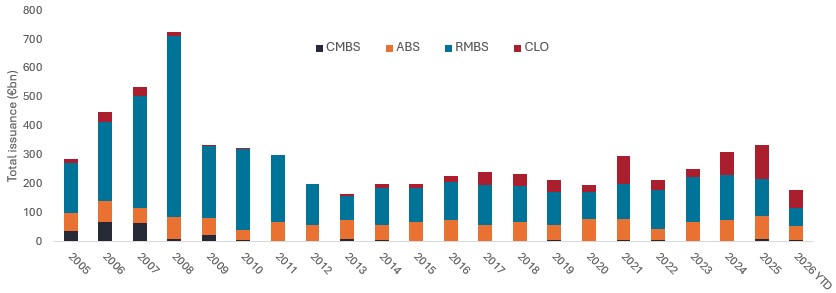
Securitised issuance has continued to surge in 2026, with supply coming to market at a record pace. Across asset-backed securities (ABS), residential mortgage-backed securities (RMBS) and collateralised loan obligations (CLOs), primary issuance is at post-global financial crisis (GFC) highs (Figure 1). For investors, that means more choice, greater flexibility and one of the most dynamic market backdrops in years.
Figure 1: European securitised issuance at post GFC highs
Source: JP Morgan, 17 July 2026.
At the same time, the market has become increasingly selective. While demand for securitised credit remains strong, healthy issuance, tighter spreads and macro uncertainty make security selection critical to delivering returns in excess of the market. In our view, this backdrop rewards active management, rigorous due diligence and the ability to discriminate effectively between sectors, structures and CLO managers.
Record issuance is creating opportunities
European securitised primary issuance has been running at around €14 billion per month for four consecutive months[1], a historically high level for Europe. Greater supply creates greater choice. It allows us to rotate portfolios, refresh exposures and access opportunities that may have been difficult to source when issuance was more constrained. In a market where spreads have tightened materially from their wides earlier in the year, primary issuance provides an important source of relative value.
Importantly, that supply has been absorbed remarkably well, with deals generally well covered. Over recent months, we have seen geopolitical volatility, inflation concerns and shifting interest rate expectations. Yet despite these uncertainties, investors have continued allocating capital to securitised markets. The ability of the market to digest elevated primary supply suggests that the underlying demand for high-quality, income-generating securitised assets remains robust.
The revival of CMBS is one of the most interesting developments
Perhaps the most striking issuance development this year has been the resurgence of the European commercial mortgage-backed securities (CMBS) market. CMBS issuance has returned to the highest levels seen since the GFC, with first-half issuance on the same pace as last year’s record numbers.
What is particularly encouraging is the diversity of the collateral coming to market and sponsors, where the sector has been dominated by one sponsor for some time. Much of the recent issuance has been backed by logistics assets, reflecting the continued evolution of global supply chains and the growth of e-commerce. We are seeing a combination of ‘Big Box’ logistics, last-mile logistics assets and multi-let industrial estates coming through, creating a variety of industrial asset types to invest in. Then there is a proliferation in datacentre deals, gaining traction with the AI build-out.
The revival in issuance is therefore creating a broader opportunity set across CMBS. One of the attractions of the sector is that it can offer attractively priced bonds and relatively thick mezzanine tranches, allowing investors to gain meaningful exposure where they have conviction in the underlying credit. At the same time, CMBS often behaves differently from other securitised sectors; traditional curve-based relative value opportunities are generally not as pronounced compared to the more frequently traded markets such as CLO. In our view, this makes bottom-up analysis even more important to finding and evaluating opportunities. As supply continues to recover, we see growing opportunities in carefully selected transactions backed by high-quality sponsors and compelling asset profiles.
Strong CLO demand continues to absorb supply
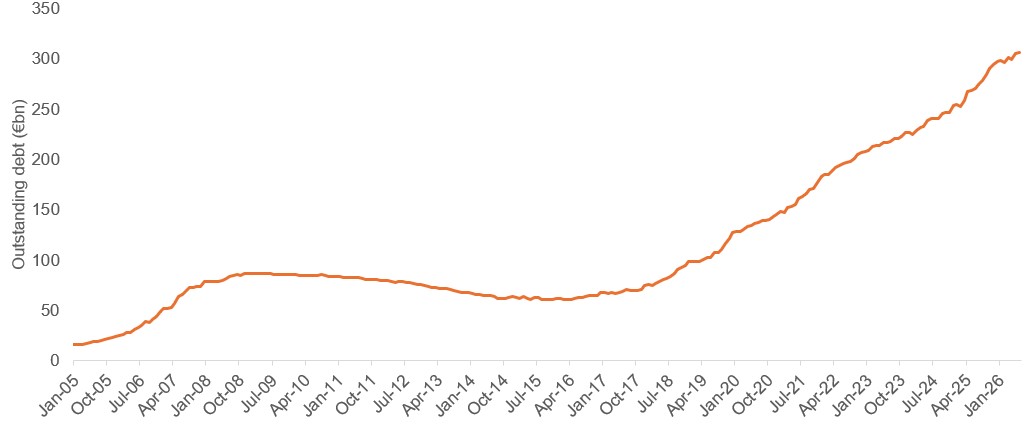
The resurgence in CMBS issuance is not occurring in isolation. Across securitised markets more broadly, activity has been strong, with CLOs remaining one of the largest contributors to overall issuance and supporting growth of the European CLO market (Figure 2). Trading activity in CLOs has also been elevated, reflecting both healthy new issuance and active portfolio repositioning by investors. Earlier in the year, for example, trading volumes increased as investors reassessed technology and software exposures within loan portfolios, while recent months have seen continued activity as investors rotated into new primary opportunities.
Figure 2: The growth of the European CLO market
Source: Bank of America Global Research, 30 June 2026.
Demand for CLO exposure has remained strong despite elevated issuance volumes, which has helped support spread tightening across the market. Following the spread widening in February and March, European CLO spreads steadily retraced through the second quarter, with AAA spreads effectively returning to where they began the year[2].
Even so, we do not believe the relative value opportunity has disappeared. While CLO spreads have tightened, they still offer a spread pick up relative to similarly rated corporate bond markets. As a result, investors continue to receive attractive compensation for risk, particularly when viewed alongside the diversification, income and resilience that CLOs have offered through multiple market cycles.
Why the ‘specialist premium’ persists
A common question is why CLOs continue to offer a meaningful spread premium if the underlying corporate fundamentals are robust.
Our view is that a specialist premium remains embedded within the asset class. CLOs require deeper analysis than many traditional fixed income investments. Investors need to understand the structure, the underlying collateral and, perhaps most importantly, the CLO manager responsible for constructing and managing the portfolio.
Regulatory requirements reinforce this dynamic. Proper due diligence requires detailed analysis of collateral pools, deal structures, manager behaviour and portfolio construction. These barriers to entry help explain why CLO spreads continue to offer attractive compensation relative to other fixed income.
Dispersion is increasing and manager selection matters more than ever
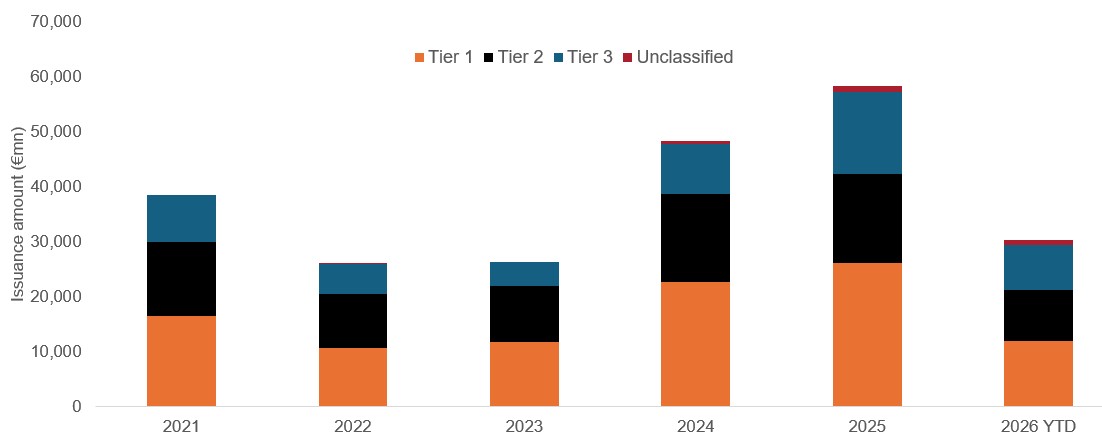
As issuance has expanded and market conditions have evolved, increasing dispersion has emerged across the CLO manager universe. One reason could be a rising proportion of overall issuance is from lower tier 3 managers, namely around 25% this year to date and last year (Figure 3). In our experience, understanding how a manager underwrites risk, constructs portfolios and responds to changing market conditions is becoming increasingly important to determining long-term performance. CLO managers actively trade loans, rotating credit exposure and seek to optimise portfolio quality throughout the life of a transaction. Their skill, experience and investment philosophy directly influence outcomes.
Figure 3: CLO issuance by tier of manager
Source: JP Morgan, as at 7 July 2026.
For that reason, we continue to favour higher-quality managers with proven underwriting disciplines, strong credit resources and a demonstrated ability to manage through multiple market environments. We place significant emphasis on understanding not only the collateral they own today, but also how they are likely to react when conditions become more challenging.
Innovation may reshape the market over time
Looking further ahead, innovation has the potential to change how investors access securitised assets, such as through a maturing of tokenisation and digital ownership structures. The securitisation ecosystem currently involves multiple intermediaries, including managers, arrangers, dealers, rating agencies and legal service providers among others. Over time, technology may create opportunities to simplify parts of that process, increase transparency further and potentially improve liquidity.
While these developments remain some way from becoming mainstream, they highlight an important point: securitisation continues to evolve. The market today is significantly different from the one that existed a decade ago, and innovation is likely to remain a feature of the asset class.
More supply, more opportunities, but greater selectivity needed
Ultimately, while higher issuance is creating a broader opportunity set across CMBS, CLOs, ABS and RMBS, it is also increasing the importance of selectivity. Differences in collateral quality, transaction structures and CLO manager capabilities mean headline spreads alone tell only part of the story.
In our view, the ‘specialist premium’ available in securitised markets continues to be driven by the need for detailed credit analysis, rigorous due diligence and a deep understanding of the underlying collateral and, in CLOs, the managers. The ability to assess opportunities across regions, sectors and structures can provide valuable context when evaluating relative value and portfolio construction in an increasingly diverse market. This is what our global securitised platforms helps to facilitate. In a market supported by resilient demand, structural safeguards and attractive income, we believe disciplined security selection and careful underwriting can help define better outcomes for investors.
Footnotes
[1] Source: JP Morgan, as at 30 June 2026. Includes RMBS, ABS and CMBS.
[2] Source: J.P. Morgan CLOIE Index, J.P. Morgan ABS Spreads, Citi Velocity, 7 July 2026.
All opinions and estimates in this information are subject to change without notice and are the views of the author at the time of publication. Janus Henderson is not under any obligation to update this information to the extent that it is or becomes out of date or incorrect. The information herein shall not in any way constitute advice or an invitation to invest. It is solely for information purposes and subject to change without notice. This information does not purport to be a comprehensive statement or description of any markets or securities referred to within. Any references to individual securities do not constitute a securities recommendation. Past performance is not indicative of future performance. The value of an investment and the income from it can fall as well as rise and you may not get back the amount originally invested.
Whilst Janus Henderson believe that the information is correct at the date of publication, no warranty or representation is given to this effect and no responsibility can be accepted by Janus Henderson to any end users for any action taken on the basis of this information.