With US Treasury yields at 5%, we explore whether ‘crowding out’ is a phenomenon evident in fixed income.
Our latest thinking on the themes shaping today’s investment landscape. Explore timely updates, quarterly features and in-depth analysis straight from our experts.
With US Treasury yields at 5%, we explore whether ‘crowding out’ is a phenomenon evident in fixed income.

The securitised sector offers access to different consumer-driven and ‘real economy’ risks, diversifying from corporate credit. Here we unravel the sector's distinguishing features.

Private markets have been viewed as a source of diversification and income, but recent performance is prompting a closer look at liquidity, structure, and inflation sensitivity.

Overlooked equity-linked note pricing parameters highlight the importance of active management in managing ELN portfolios.
With credit spreads at historic tights and rates moving higher, investors should focus on resilient yield, as there is limited room for price appreciation.
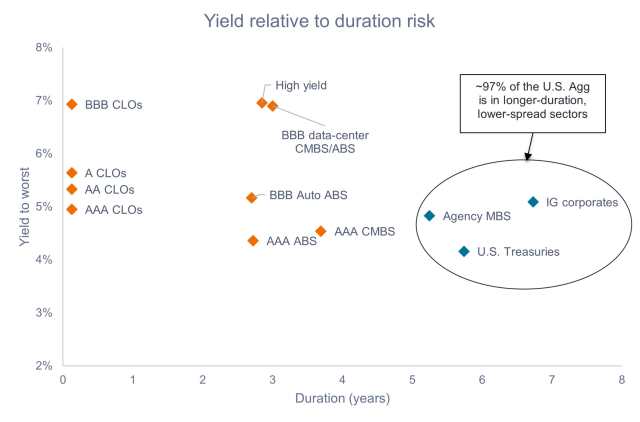
In contrast to many securitized credit sectors, the U.S. Agg captures very little credit spread income relative to its duration.
A more diversified, outcome‑oriented approach to fixed income designed to improve risk‑adjusted results over time.
Allocating to Collateralised Loan Obligations (CLOs) opens up access to diversification and defensive income. How do CLOs work and what can history tell us about the asset class?

AI is driving dispersion in software. We analyse where CLO managers’ views are broadly aligned, where they diverge, and why active CLO manager selection remains key as bifurcation in the loans market continues.

BBB CLOs combine income, structural resilience and diversification benefits, offering an alternative way to reshape credit exposure for a late‑cycle environment of tight credit spreads.

Investors concerned about high concentration in US stocks should look elsewhere to achieve better portfolio diversification.